How to Launch ABM in B2B: Principles, Formats, Metrics

TL;DR
ABM (account‑based marketing) is a B2B strategy where a company works not with a flow of leads but with a selected list of target accounts, personalizing communications for specific organizations and their decision makers. Below: the essence of the approach, differences from inbound and ABX, three ABM formats, a step‑by‑step launch algorithm, metrics to use instead of MQL/CPL, and realistic timelines and budgets for the Russian market.
The essence of account‑based marketing and a breakdown of the term
In complex B2B sales, targeted work wins: instead of a mass flow, a company aims at a selected set of organizations and their decision makers, tailoring marketing and sales to them. This approach is known as account‑based marketing (ABM).
Let’s break down the term:
- Account — the whole company, not an individual contact. In ABM the planning unit is the account and its whole influence group.
- Based — “based on.” The whole strategy is built around a preselected list of target companies.
- Marketing — marketing closely linked with sales: teams act as a single unit.
The idea is simple: in complex B2B a decision is made by a group (DMU, decision making unit), deals are large and cycles are long. It’s more rational to concentrate efforts on 30–100 “own” companies than to spread the budget across thousands of random leads.
How ABM differs from lead generation and inbound
Classic inbound and lead generation are set up as a top‑down funnel: attract a wide audience, warm them with content, qualify MQLs and hand them to sales. Basic metrics are CPL and number of MQLs.
ABM flips the logic. First we determine who exactly we want to work with, and only then build personalized communications for those companies and roles within them. It’s an “inverted funnel”: a narrow entry of selected accounts and deep work inside.
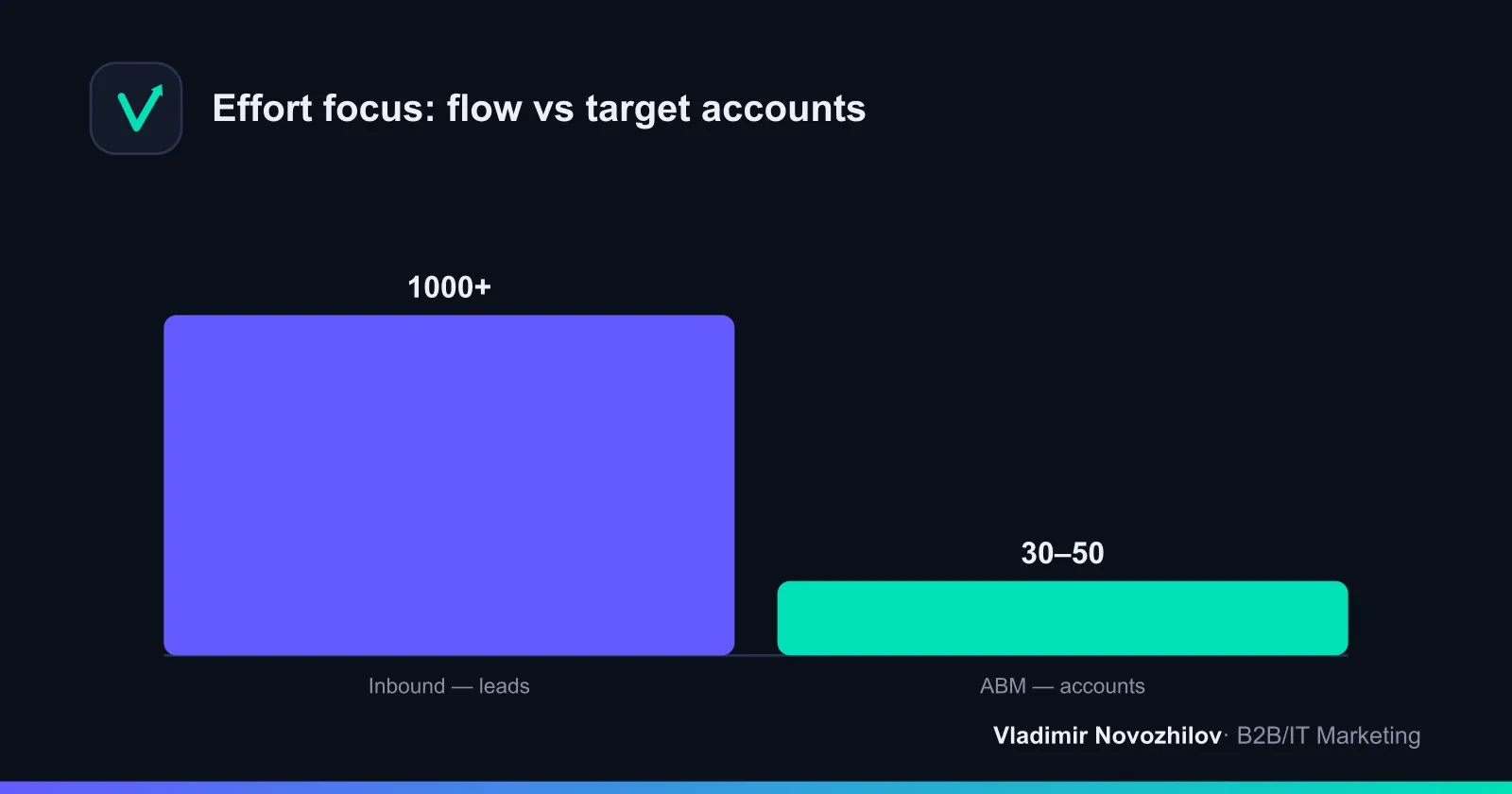
Key differences:
- Unit of work. Inbound — a lead (person). ABM — an account (company and its DMU).
- Direction. Inbound pulls in inbound demand. ABM actively shapes demand and uses outbound touches.
- Success metric. Inbound — volume and cost of leads. ABM — engagement and revenue in target accounts.
- Role of sales. In inbound sales receive leads at the funnel exit. In ABM there is sales–marketing alignment: marketing and account managers work on the same accounts and share KPIs.
ABM and inbound do not compete. In practice inbound grows demand and data, while ABM concentrates resources on the most valuable companies.
ABM and ABX: what’s the difference and when to move on
ABX (account‑based experience) is a logical evolution of ABM. If ABM is responsible for acquisition and closing deals in target accounts, ABX extends personalization across the entire lifecycle: onboarding, support, upsell and retention.
| Parameter | Inbound | ABM | ABX |
|---|---|---|---|
| Focus | Lead flow | Target accounts | Account experience across the lifecycle |
| Unit | Lead | Company | Company + customer success |
| Horizon | Up to MQL | Up to deal | Acquisition → retention |
| Teams | Marketing | Marketing + sales | Marketing + sales + CS |
| Metric | CPL, MQL | Engagement, pipeline, win‑rate | LTV, retention, NRR |
Move to ABX when ABM already delivers results and the key value is in retaining and growing existing customers, not only in new deals.
Three ABM formats: one‑to‑one, one‑to‑few, one‑to‑many
The format choice depends on personalization depth and available resources.
- One‑to‑one (strategic ABM). Individual work with a single large account: personalized content, company‑specific landing pages, custom proposals. Usually 5–20 Tier 1 accounts. Expensive, but with the highest deal size.
- One‑to‑few (ABM lite). Work with clusters of similar companies (by industry or pain), 20–50 Tier 2 accounts. Content is personalized at the segment level.
- One‑to‑many (programmatic ABM). Scale to hundreds of Tier 3 accounts using technology: dynamic segments, firmographic personalization. Closer to targeted marketing, but the focus remains on companies.
A mature program combines all three levels: top accounts get one‑to‑one, mid accounts one‑to‑few, the rest one‑to‑many.
Step‑by‑step plan to launch ABM in B2B
Here is an end‑to‑end implementation plan suitable for both large and mid‑sized B2B companies:
- Form the ICP and select target accounts by tiers.
- Collect data and map stakeholders (DMU) in each account.
- Prepare personalized content and offers by tier and role.
- Align marketing and sales, establish a joint process and tech stack.
- Launch multichannel touches (email, social, ads, direct contacts).
- Track engagement and pipeline metrics, adjust the account list.
- Scale working elements and gradually move to ABX.
Below are three critical steps in more detail.
Step 1. Forming the ICP and selecting target accounts (Tier 1/2/3)
ICP (Ideal Customer Profile) — a description of companies that get the most value from your product. It’s built from firmographics (industry, revenue, headcount, region), technographics (stack) and behavior. A practical method: take 10–20 best deals by LTV, close speed and retention and find common traits.
Then distribute accounts into tiers. A simple working frame for selection:
- Tier 1 — strategic. High potential contract value, exact ICP fit, an entry point exists and a clear pain. Work one‑to‑one.
- Tier 2 — prioritized. Match ICP but lower ticket or weaker contact. Work one‑to‑few by clusters.
- Tier 3 — potential. Formally fit ICP but little data. Work one‑to‑many and monitor interest signals.
It’s reasonable to start with 20–50 accounts so the pilot is manageable.
Step 2. Mapping stakeholders (DMU) and personalizing content
In a large deal the decision is made by the DMU (decision making unit) — a group of 5–10 people: an economic buyer, a technical expert, an end user, a finance person and potential blockers. For each account it’s important to know who is in this group and what motivates them.
Each role needs a different content emphasis:
- Economic buyer — ROI, payback, impact on business metrics.
- Technical expert — integrations, security, compatibility with the stack.
- End user — usability, time savings, removing routine work.
Personalization ranges from named landing pages and company‑specific analyses (Tier 1) to industry case studies and curated packs (Tier 2–3).
Step 3. Integrating marketing and sales, tech stack (CRM, analytics)
ABM doesn’t work if marketing and sales act separately. Sales–marketing alignment means a shared account list, shared KPIs (pipeline, revenue), regular syncs and unified criteria for what constitutes a “hot” account.
Minimum stack to start in Russia without western platforms like Demandbase or 6sense:
- CRM (Битрикс24, amoCRM and local analogs) — the core where accounts and deals live.
- Email and mailing — for personalized touches by role.
- Ad accounts (Yandex) — follow‑up campaigns by company lists and retargeting.
- Analytics and dashboards — metrics by account, not by lead.
- Data enrichment — manual research plus public sources and parsing.
You can start with CRM + content + advertising — that’s ABM‑lite without large investments.
ABM metrics: what to measure instead of MQL and CPL
In ABM classic CPL and MQL counts tell little about progress — the goal is not lead quantity but penetration into specific companies. Measure:
- Account engagement rate — depth of engagement of company contacts (opens, visits, meetings).
- Share of target accounts in the pipeline — how many from the list reached active deals.
- Pipeline velocity — speed of deals moving through stages.
- ACV (Average Contract Value) — average annual contract; in ABM it should increase.
- Win‑rate on target accounts — portion of won deals.
- Revenue impact — how much revenue came specifically from target accounts.
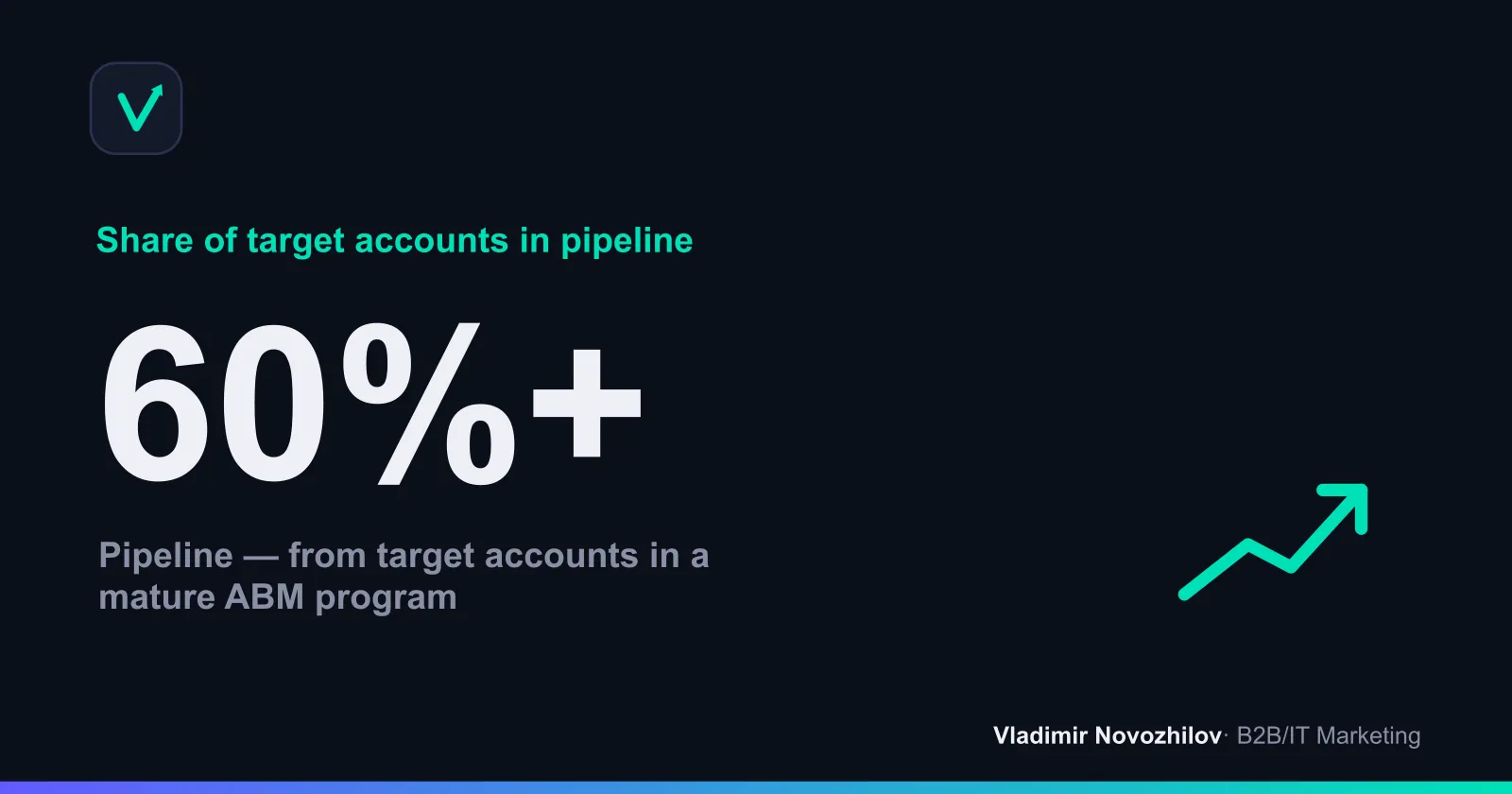
Timelines and budget: how much time and money launching ABM takes
The main thing is to be realistic about the horizon. B2B deal cycles run from 6 months to 1.5 years, so expect the first ABM‑sourced deals no earlier than about six months.
Benchmarks:
- ABM‑lite (one‑to‑many/few): launch in 1.5–3 months with a team of “marketer + 1–2 salespeople.” Budget mainly covers CRM, content and ads.
- Dedicated ABM (one‑to‑one): 3–6 months for preparation, a dedicated team, custom content for each account. Budget is multiple times higher due to deep personalization.
A sensible path is to start with an ABM‑lite pilot on 20–50 accounts, prove effectiveness with numbers, and only then invest in one‑to‑one.
Cases and figures from Russian practice
On the Russian market there are measurable results. In one published case ABM produced up to 67% confirmed leads from target accounts and closed deals worth tens of millions of rubles — achieved by working with a limited list of companies rather than mass lead flow. This confirms the main principle: fewer accounts, deeper work and a higher average ticket.
Practitioners also emphasize the realistic side: results aren’t instant, deal cycles are long, and success critically depends on account selection quality and marketing–sales alignment.
ABM limitations: when the approach is not suitable
ABM is not universal. It’s not justified when:
- The product is cheap and mass‑market. With a low ticket personalization won’t pay off — inbound is more effective.
- Short deal cycle with a single decision maker. No point in complex DMU mapping if one person decides in a week.
- No resources to align sales and marketing. Without alignment ABM collapses.
- Poor market data. Without a precise ICP you’ll personalize for the wrong targets.
There’s also a critical view: some experts call ABM repackaging of key account work. There is truth in that — but systematization, metrics and a tech stack turn modern ABM into a manageable process rather than one‑off efforts.
FAQ on account‑based marketing
Answers to frequent questions — from differences with lead generation to tool choices and launching without big budgets. In short: start with a clear ICP, a narrow account list and marketing–sales alignment; measure engagement and revenue by account, not CPL; give the program at least six months to produce the first deals.
FAQ
- Чем ABM отличается от классической лидогенерации и inbound?
- Lead generation and inbound build a wide funnel and evaluate CPL/MQL. In ABM you first select a list of target companies and personalize touches for roles within them. Metrics are account engagement, share of target accounts in the pipeline, deal velocity, win‑rate and revenue.
- С чего начать внедрение ABM, если ресурсов немного?
- Form an ICP, choose 20–50 accounts, align marketing and sales, prepare basic personalized content for roles and launch a series of multichannel touches. CRM, email, advertising and simple account analytics are sufficient to start.
- Как определить ICP, если исторических данных мало?
- Take 10–20 best deals (by LTV, speed and retention) and identify common traits: industry, size, region, tech stack, demand triggers. If there is no sample, do manual research on the best current customers and lost deals and validate hypotheses in a pilot.
- Какие инструменты использовать в России вместо западных ABM‑платформ?
- Basic stack: CRM (Битрикс24, amoCRM and analogs), email, ad accounts (Yandex) for list‑based follow‑up campaigns, simple account analytics and manual data enrichment (public sources, research). That's enough to start.
- Какие метрики считать в первые месяцы, когда до выручки ещё далеко?
- Track account engagement (visits, opens, replies, meetings), share of target accounts in the pipeline, deal velocity and quality of contacts in the DMU. Financials will follow as the funnel accumulates.
- Сколько контактов из аккаунта прорабатывать и кто за это отвечает?
- In a large deal the DMU has 5–10 roles. Marketing's job is to reach relevant roles and launch personalized touches; sales' job is to develop dialogue, qualify needs and move the deal. They work as a single unit with joint plans and KPIs.