How to Set Up B2B Lead Gen in Telegram: Bots, Chats, and Ads

TL;DR
Telegram already functions as a full B2B channel: leads arrive via bots, industry chats, channels and Ads. This guide gives a step‑by‑step launch plan, CPL and conversion benchmarks by source, scripts, CRM integration with amoCRM/Bitrix24, metrics to track, and a real case showing results.
Telegram has long been a place to discuss purchases and look for contractors: industry chats regularly contain requests like “need a supplier/contractor,” and inquiries arrive straight in DMs. This article presents a working scheme: where and how to collect leads via bots, chats, channels and Telegram Ads, how to calculate CPL and how to pass requests to CRM without manual routine.
How lead generation in Telegram is structured and why it works for B2B
In Telegram, leads are collected via messenger tools: chat bots, industry chats, niche channels and official Telegram Ads. Unlike web forms on a site, the contact lands immediately in a dialog — easier to qualify and faster to schedule a meeting.
Why the approach is especially effective in B2B:
- Intentional demand. In niche chats people write “looking for a contractor,” “need a supplier” — these are warm requests, not cold traffic.
- Short path to conversation. From request to dialog takes minutes, not days as with a website form and callbacks.
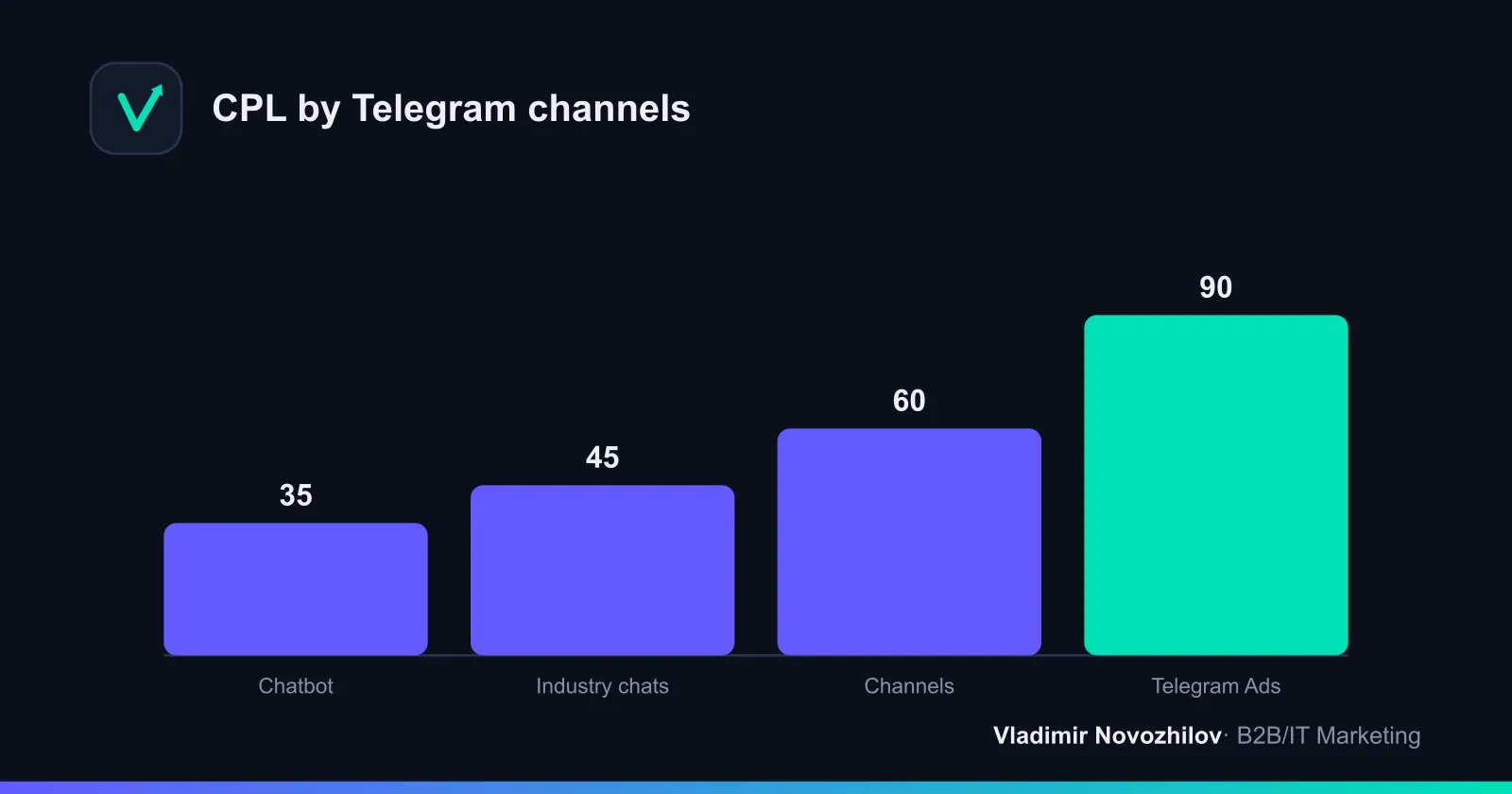
- Economics. CPL in Telegram is often lower than search/context, with comparable or better conversion.
- Less competition. Many companies haven’t mastered the channel yet — it’s not overheated.
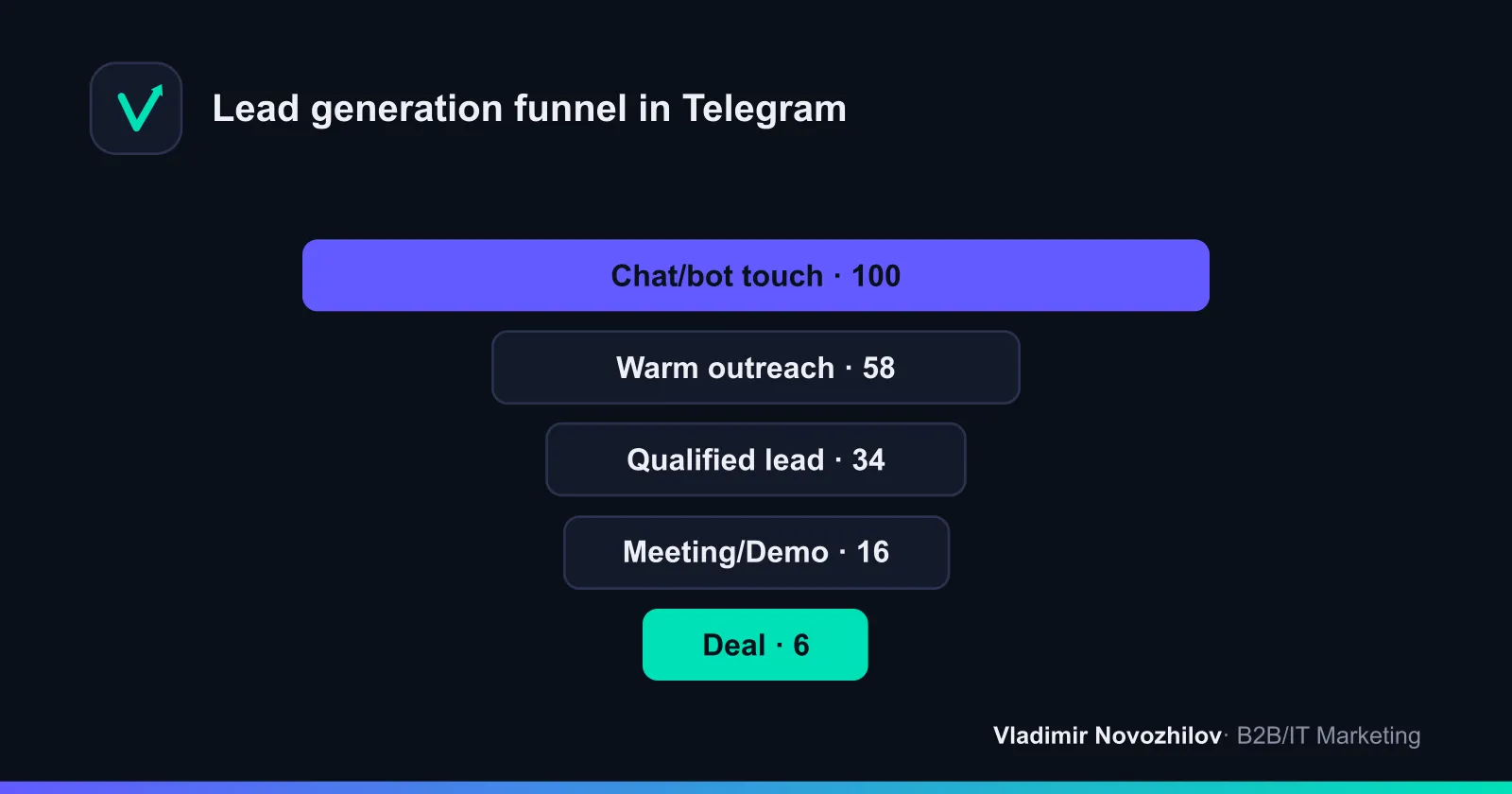
Four sources of B2B leads in Telegram: bots, chats, channels and Ads
Rely on four sources and link them together:
- Chat bot for lead generation. Accepts traffic from ads and content, delivers a lead magnet, asks qualifying questions and hands the request to a manager.
- Industry chats. Manual outreach and monitoring requests — the warmest source in B2B.
- Channels. Content warming: expert posts, cases, pinned lead magnet and a link to the bot.
- Telegram Ads. Advertising in channels and via the official platform: scalable, but more expensive than other sources.
How to find and select target chats in Telegram for your B2B niche
Start from hypotheses: where your target audience sits. Use catalogs and TGStat search, conference chats and business club groups, regional entrepreneur communities.
Evaluate each chat by criteria:
- concentration of your target audience (who posts, which companies and roles);
- active moderation without spam flow;
- real requests like “looking for contractor/supplier”;
- activity during business hours, not only evening chat.
Practice shows: 5–10 quality chats provide more value than 50 random ones. Behave as an expert — help substantively, and move to private sales only after delivering value.
Step‑by‑step launch: from bot to lead handoff to CRM
Launch checklist for Telegram B2B lead generation:
- Define ICP and an offer tailored to it.
- Prepare a lead magnet — material that solves the target’s pain.
- Build a chat bot via Telegram Bot API with a short flow: greeting → magnet → 3–4 qualifying questions → handoff to manager.
- Select and evaluate 5–10 industry chats.
- Prepare outreach and chat response scripts.
- Configure Telegram integration with CRM (amoCRM or Bitrix24).
- Launch Telegram Ads and seeding in channels driving to the bot.
- Set up analytics: UTM tags, source tags, CPL dashboard.
- Implement lead qualification in the bot using BANT criteria.
- Review channel combinations weekly and turn off unprofitable ones.
Channel comparison: bots, chats, Ads and “classic” channels
| Channel | Indicative CPL | Conversion to qual. lead | Time to launch | Scalability |
|---|---|---|---|---|
| Chat bot for lead generation | 200–900 ₽ | 40–55% | 3–7 days | Medium |
| Industry telegram chats | 300–1500 ₽ | 45–60% | 1–3 days | Low (manual labor) |
| Channels (content + pin) | 500–2000 ₽ | 30–45% | 2–6 weeks | Medium |
| Telegram Ads for B2B | 1000–4000 ₽ | 25–40% | 5–10 days | High |
| Search/context (for comparison) | 1500–6000 ₽ | 20–35% | 1–2 weeks | High |
Scripts and message templates for collecting B2B contacts
Ready phrasings (not for info‑business or freelancing):
- Reply to a request in chat: “Hello! For your task [X] we can help — we’ve done similar for [niche]. I’ll send a short rundown in DM, ok?”
- First DM: “Good afternoon, [Name]. I saw your question in [chat name]. To propose a solution — could you clarify approximate volume/timelines/budget?”
- Bot qualifying question: “To match a solution, please tell us: 1) the task, 2) deadlines, 3) whether a budget exists, 4) who makes the decision?”
- Follow‑up after lead magnet: “Did you have a chance to review the material? If relevant — I can offer a 20‑minute call to show how to apply this for you.”
Lead magnets for B2B audiences: what actually works
A lead magnet must save the decision‑maker’s time and demonstrate expertise:
- checklist or template (calculation, brief spec, estimate);
- mini audit or checklist review;
- industry benchmark with numbers;
- case with ROI calculation;
- calculator/spreadsheet for self‑assessment.
Avoid “discounts” and empty “free consultations” — in B2B these reduce trust.
Telegram integration with amoCRM/Bitrix24: automating the funnel
Integration removes manual transfers and lost leads. Steps:
- Create a bot via Telegram Bot API and get the token.
- Connect Telegram in amoCRM or Bitrix24 as a channel (built‑in connector or widget).
- Configure auto‑creation of a deal on the first message and route it to the correct pipeline.
- Map fields: name, company, task, budget, decision‑maker.
- Add source tags (chat/bot/Ads) — for CPL analytics by channel.
- Set up auto‑tasks for the manager and notifications on new leads.
This builds automation securely: via the official API, without parsing and blocking risks.
Metrics and lead cost: how to calculate CPL and ROI in Telegram
Key metrics — CPL (cost per lead), CAC, stage‑by‑stage conversion and ROI.
CPL formula: CPL = channel spend / number of leads.
Monthly example calculation:
| Metric | Value |
|---|---|
| Budget (Ads + labor) | 120 000 ₽ |
| Leads | 150 |
| CPL | 800 ₽ |
| Qualified leads (40%) | 60 |
| Deals (10% of qual.) | 6 |
| Average ticket | 180 000 ₽ |
| Revenue | 1 080 000 ₽ |
| ROI | ~800% |
ROI is calculated as (revenue − costs) / costs × 100%. Even with a higher CPL, the channel pays off due to large ticket sizes.
B2B company case: real numbers
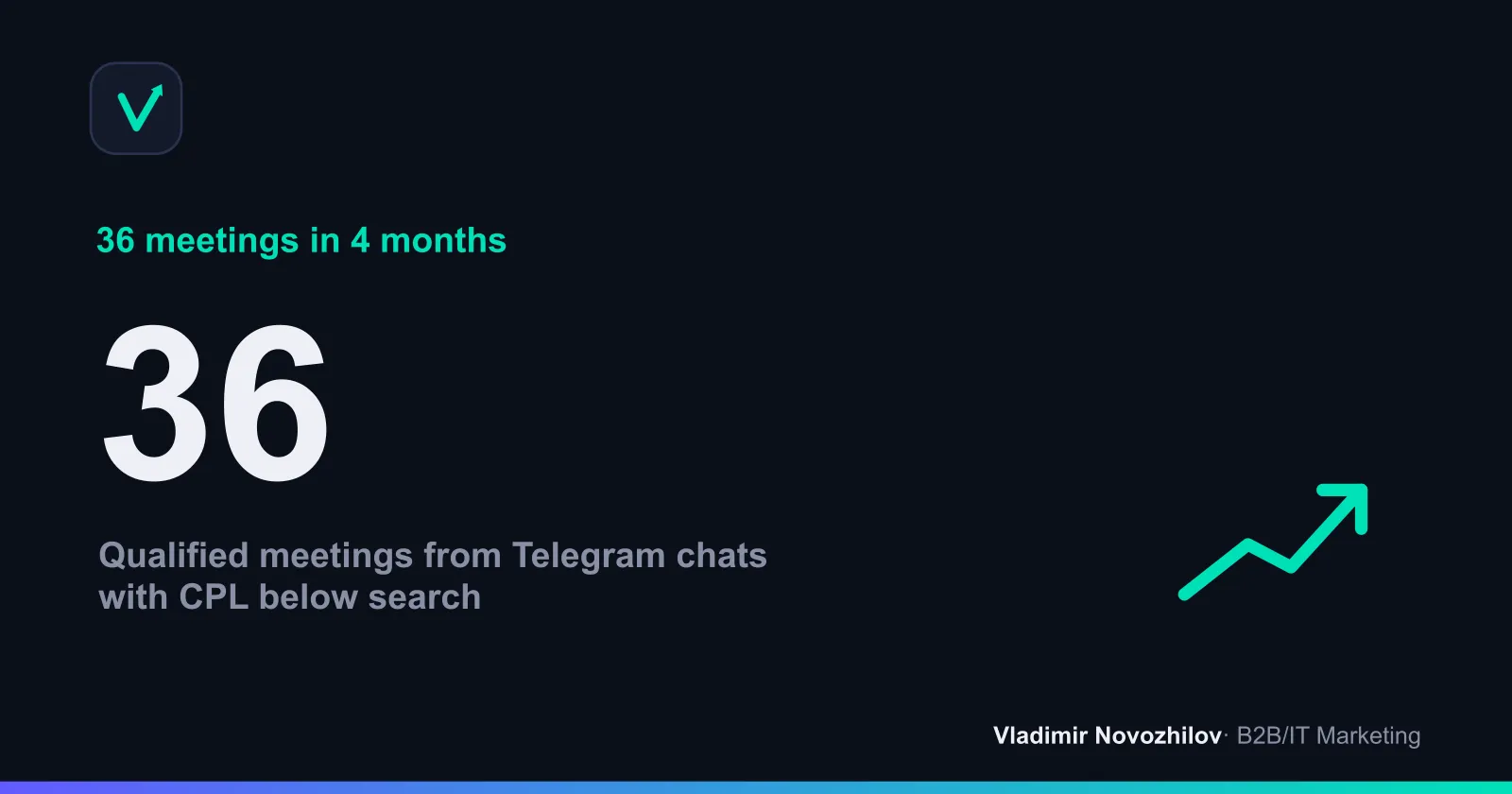
A Russian AI service obtained 36 qualified meetings in 4 months via industry chats and outreach. Scheme: monitoring 8 niche chats, expert replies, moving to DMs using a script, bot qualification and logging in CRM. CPL was lower than search ads, and some meetings converted into pilots. Conclusion: scale comes from systematic work, not one‑off mailings.
Common mistakes in B2B lead generation in Telegram
- Spam and mass messaging instead of expert presence.
- Selling bluntly in the chat without adding value.
- No qualification — managers drown in non‑target requests.
- Missing source tags — impossible to calculate CPL by channel.
- Manual transfer of contacts instead of Telegram‑CRM integration.
- Relying on one source instead of a bot + chats + Ads bundle.
Legal risks and Telegram rules when working with chats
Parsing chats and mass cold messaging from personal accounts violate Telegram rules and lead to blocks. Collecting personal data without consent creates PII compliance risks. A safe model:
- collect contacts via a lead magnet and chat bot with a consent checkbox;
- automate only via the official Telegram Bot API;
- operate in chats manually and respect community rules;
- store conversations and consents in the CRM.
This way you get reliable bot qualification and reduce the risk of blocks and claims.
FAQ
- Where to start if the company doesn’t have a Telegram bot yet?
- Define your ICP and offer, prepare a useful lead magnet, design a short bot flow (magnet → 3–4 questions → handoff to manager) and connect CRM right away so requests aren’t lost.
- When to expect the first inquiries and which sources bring them fastest?
- Industry chats often produce inquiries on day one with proper outreach. Ads start delivering in 5–10 days; bots get traffic immediately after seeding and ads launch.
- How to calculate CPL per source without getting confused?
- Use UTM tags and source tags (chat/bot/Ads), enable auto‑creation of deals in CRM and build a dashboard for CPL, conversions and ROI.
- What volume of manual outreach in chats is realistically manageable?
- Focus on 5–10 high‑quality chats, act as an expert, answer concisely and move the conversation to DMs. Scale with scripts, a lead magnet and a bot.
- How to qualify leads so you don’t waste time on weak requests?
- Implement BANT directly in the bot, map fields to CRM and set auto‑tasks for the manager. That way only relevant leads enter the pipeline.
- How to avoid blocks and personal data issues?
- Collect contacts via the bot with a consent checkbox, use the official Bot API, follow community rules and store chats and consents in the CRM.