Competitor Audience Analysis: Methods, Steps, and Examples


TL;DR
Competitor audience analysis means studying the clients, buyers, and customers of rival companies to refine your own audience profile, uncover underserved segments, and sharpen positioning. This article covers a step-by-step algorithm, data sources, methods (JTBD, customer development, review analysis), ready-made table templates, and a breakdown of common mistakes.
Most competitive analysis guides dig deep into rivals’ products, prices, and advertising, but rarely touch on the thing that matters most — their customers. Yet it’s people who bring in the money. Competitor audience analysis answers the question of who they serve, what they get paid for, and — more importantly — who they overlook. Below is a step-by-step algorithm, data sources, methods, ready-made table templates, and a breakdown of common mistakes to help you refine your own audience profile, find open segments, and sharpen your positioning.
What competitor audience analysis is and how it differs from analyzing your own audience
Competitor audience analysis is a systematic study of other companies’ clients, buyers, and consumers to understand their segments, pain points, objections, channels, and purchase motives. Unlike classic competitive analysis (product, price, promotion), the focus here isn’t the rival company but its people.
The difference from analyzing your own audience is fundamental:
- Analyzing your own audience relies on internal data — CRM, sales history, calls, interviews with current customers. It answers: “Who is already with us, and why?”
- Analyzing competitors’ audience relies on external sources — reviews, social media, forums, advertising. It answers: “Who do others serve, which segments do they cover, and which do they ignore?”
The real power lies in combining the two. Your own analysis shows the current core; competitor audience analysis shows growth potential. At the intersection, hypotheses are born: a segment that complains about a competitor’s service could become yours if you solve exactly that pain point.
Key terms in plain language
- Competitor audience segmentation — dividing their customers into groups based on shared traits: tasks, behavior, industry, price sensitivity.
- Competitor target audience profile — a generalized description of a typical customer: who they are, what task they’re solving, what holds them back.
- JTBD (Jobs To Be Done) — a model that looks not at demographics but at the “job” a person “hires” a product to do.
- Customer development (custdev) — in-depth interviews that reveal real purchase motives and barriers.
- Competitor audience map — a visual summary of segments, their pain points, and channels on a single screen.
Why analyze competitors’ customers and buyers
Analyzing customers and competitors isn’t curiosity — it’s a way to make decisions based on data rather than guesswork. Here’s what it gives a business:
- Finds underserved segments. Analyzing consumers and competitors often reveals groups the market serves poorly or not at all. That’s your entry point.
- Sharpens positioning. When you see what customers praise and criticize about rivals, positioning based on competitor audience insights is built on real pain points instead of generic phrases like “quality and reliability.”
- Improves the product. Studying competitors’ customers reveals which features, terms, or service levels are missing.
- Lowers acquisition costs. Understanding where rivals’ audience lives and what messages resonate with them helps you pick channels and offers more precisely.
- Prepares you for negotiations and sales. Knowing other buyers’ objections turns into ready-made responses for your sales team.
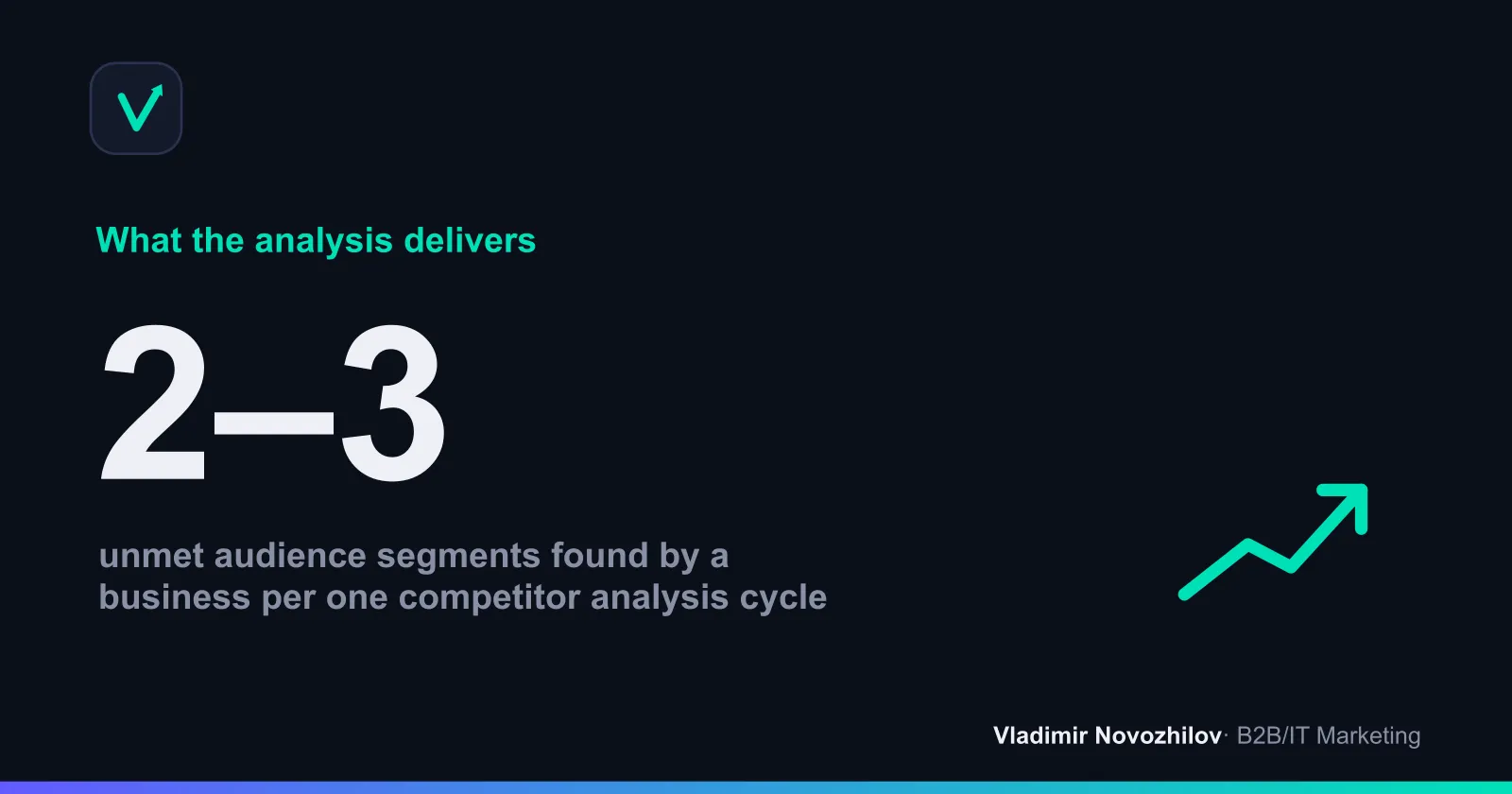
In my experience, one thoughtful cycle of competitor audience analysis usually yields 2–3 actionable hypotheses about new segments — enough to adjust your offer for the quarter ahead.
Which competitors matter for audience analysis: direct, indirect, substitute
Before studying people, define whose people you’re studying. Three types of competitors matter for audience analysis:
- Direct competitors — offer the same product to the same audience. Their customers most closely resemble yours, making them the core of your sample.
- Indirect competitors — solve the same problem differently. For an online English school, an indirect competitor might be a tutor or a mobile app. Their audience reveals alternative scenarios.
- Substitute competitors — meet the need in a fundamentally different way (the customer abandons the category altogether). Studying them helps you understand the customer’s deeper “job” through the JTBD lens.
For a reliable profile, take 3–5 direct competitors and 2–3 indirect/substitute ones. Fewer than three risks mistaking a special case for a rule; more than seven means the data starts repeating while effort grows.
Step-by-step algorithm: how to conduct competitor audience analysis
Below is a five-step workflow. It applies equally to B2B, IT, and services — only the sources and wording change.
Step 1. Identify competitors and their products
Compile a list of 5–8 companies across the three types above. For each, record:
- what product or service they sell and at what price point;
- what promise appears on their homepage (this is a hypothesis about their audience);
- what plans/packages exist — these reveal which customer groups the company targets.
At this stage you already have a rough hypothesis: who the competitor sells to and how they position themselves. Next, you need to validate it against real customer data.
Step 2. Collect data on competitors’ customers (reviews, social media, forums, support chats)
This is the core of the whole exercise. You don’t need access to someone else’s CRM — customers leave their own digital footprint. Key sources:
- Reviews on marketplaces, maps, review sites, and product pages. Analyzing competitor reviews is the richest source of pain points and objections.
- Social media and comments — what people ask, complain about, and praise under posts and ads.
- Forums and Q&A platforms — detailed discussions where people candidly describe their experience.
- Support chats and FAQs — frequent questions reveal common difficulties.
- Videos and streams — reviews and unboxings with live reactions.
- Ads and landing pages — which pain points competitors emphasize and which segments they target.
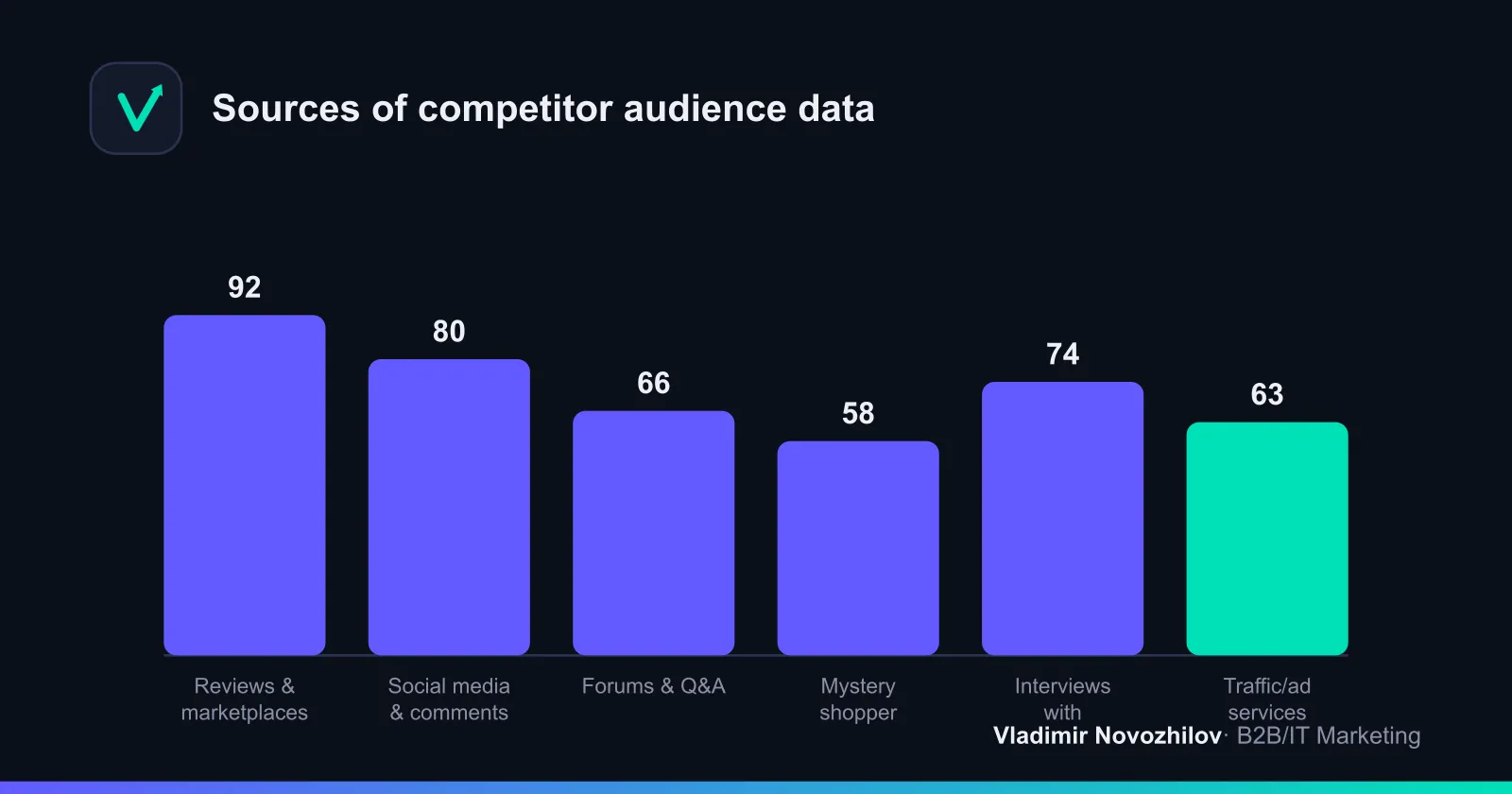
A practical tip: export reviews into a spreadsheet and tag each quote right away — “pain point,” “objection,” “purchase trigger,” “segment.” After 100–150 reviews, recurring patterns emerge, and that’s the foundation of a competitor audience profile.
Checklist for collecting data on competitors’ customers
- Collected ≥ 30 reviews for each direct competitor
- Reviewed comments under 5–10 ad posts
- Studied 2–3 forum discussions on the topic
- Noted frequent questions from FAQs and support
- Conducted a “mystery shopper” check on at least one competitor
- Found 3–5 customers who switched from a competitor to you
- Compiled all quotes into a single tagged spreadsheet
Step 3. Build segments and audience profiles for competitors
Once the data is collected, move on to structuring it. Competitor audience segmentation groups their customers by traits that influence purchasing:
- by task (JTBD) — what job the person hires the product to do;
- by customer type — beginner/expert, small business/large, individual/company;
- by price sensitivity — bargain hunters, balance seekers, or premium buyers;
- by channel — where they came from and where they make decisions.
For each segment, build a mini-profile: who they are, what task they’re solving, what pain points and objections they have, what triggered the purchase, and what caused disappointment. It’s useful to split a competitor’s audience into three groups, as is common in niche breakdowns: ideal customers (delighted), average customers (neutral), and “non-customers” (who left or complain). The last group is your most valuable resource.
Step 4. Compare competitors’ audience with your own
Now map their segments against yours. Comparative audience analysis reveals three zones:
- Overlap — segments you’re already competing for. Here, differentiation on pain points matters most.
- Their strength — segments where a competitor clearly leads. Decide whether to compete or focus elsewhere.
- White spots — segments competitors overlook or serve poorly. This is your priority.
White spots most often drive growth: you enter where demand exists but supply is thin.
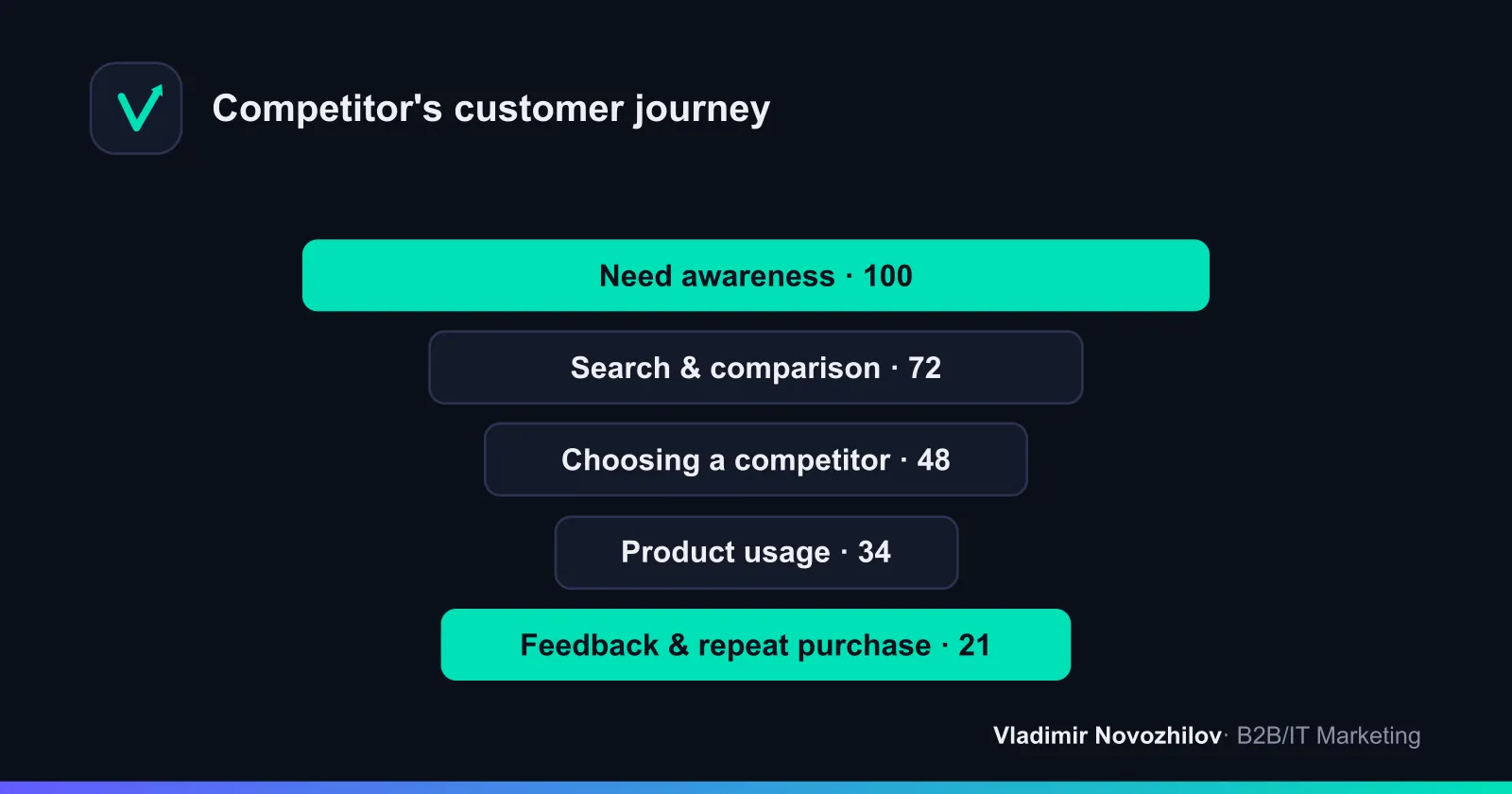
Step 5. Formulate hypotheses and refine positioning
The final step is turning data into action. For each promising segment, formulate a hypothesis using this template:
For segment [who] with pain point [what], we will offer [offer], because competitors [what they fail to provide].
Then adjust your positioning based on competitor audience insights: website messaging, offers, sales arguments. Tie each hypothesis to a metric — landing page conversion, cost per lead, share of deals in the new segment — so you can tell in 4–8 weeks whether it worked.
Methods of analysis: JTBD, custdev, SWOT for audiences, comparison tables
Different audience analysis methods solve different problems. Here’s a comparison of when to use each.
| Method | What it delivers | When to use it | Complexity |
|---|---|---|---|
| Competitor review analysis | Pain points, objections, triggers across a large sample | Always — the starting point | Low |
| JTBD (Jobs To Be Done) | Deep motivation and “hiring” scenarios for a product | When demographics don’t explain the choice | Medium |
| Customer development (interviews) | Live wording, hidden barriers | Testing segment hypotheses | Medium |
| SWOT for audiences | Strengths/weaknesses as seen by customers | Before repositioning | Low |
| Empathy map | What the customer thinks, sees, hears, feels | For designing offers and creatives | Low |
| Segment benchmarking | Comparing segment coverage across players | Finding white spots | Medium |
JTBD: focus on the task, not demographics
Instead of “a 35-year-old man from a big city,” the JTBD model asks: “What job does this person want done, and why did they choose this particular product?” In other companies’ customer reviews, JTBD insights show up in phrases like “I needed it to…” or “I bought it because…” This shifts analysis of competitors’ buyers from statistics to genuine understanding of motives.
Custdev with someone else’s customers
The most underrated technique is interviewing people who used a competitor’s product. It’s easiest to talk to those who switched to you — they remember exactly what didn’t work.
Questions for a custdev interview with a competitor’s customer:
- How did you solve this problem before, and why did you choose that provider?
- What ultimately didn’t work? At what point did you consider switching?
- What did you miss the most?
- What kept you there despite the shortcomings?
- If you could bring back one element of that service, which would it be?
- How did you search for an alternative, and what criteria did you compare?
Ten such conversations yield more than a hundred lines of traffic analytics.
SWOT for audiences and empathy maps
SWOT analysis here applies not to the company but to how customers perceive it: strengths (what they praise), weaknesses (what they criticize), opportunities (unmet requests), threats (growing dissatisfaction). An empathy map complements this by breaking down the customer experience along the axes of “thinks / sees / hears / feels / pains / gains.”
Tools and services for analyzing competitor reviews and audiences
Competitor analysis tools fall into groups by task. You can cover the basic level entirely for free; paid services speed up and deepen the work.
| Task | Free approaches | Paid/advanced tools |
|---|---|---|
| Collecting reviews | Manual review of marketplaces, maps, review sites | Review aggregators and parsers, mention monitoring |
| Social media and comments | Manual browsing of groups and posts | Social monitoring and community analytics services |
| Traffic and sources | Public statistics, counters | Traffic and site visibility estimation tools |
| Ads and keywords | Manual review of ads | Ad campaign and semantic analysis tools |
| Systematization | Spreadsheets with tagging | CRM systems and analytics dashboards |
A tool doesn’t replace thinking. A service can gather 500 reviews, but drawing conclusions about segments and positioning is still a human job. Start with free sources and add paid ones only once you hit the limits of manual work volume.
Ready-to-use competitor audience comparison table template
Bring everything together into one competitor audience map. Below is a comparison table template you can recreate in any editor. Fill in the rows for each competitor.
| Parameter | Competitor A | Competitor B | Competitor C |
|---|---|---|---|
| Main segment | Small business | Mid-size business | Independent specialists |
| Key task (JTBD) | Launch quickly | Scale up | Save money |
| Main customer pain point | Long setup | Expensive support | No training |
| Common objections | ”Too complicated" | "Too expensive" | "Results unclear” |
| What they’re praised for | Ease of use | Functionality | Price |
| What they’re criticized for | Support | Price | Limited features |
| Acquisition channels | Paid search, social media | Partners, SEO | Word of mouth, social media |
| Price segment | Mid-range | High-end | Budget |
| White spot for us | Training and onboarding | Flexible pricing | Advanced functionality |
The last row is the most valuable. That’s exactly where hypotheses for your growth take shape — where a competitor is weak but demand exists.
Examples and case studies: how companies find their niche through competitor customer analysis
Case 1. B2B automation service: a segment found in complaints
A company selling an accounting system for small businesses studied 200+ reviews about two direct competitors. One pain point kept coming up: “powerful, but you spend a week figuring it out on your own.” Major players were targeting mid-size businesses and didn’t see onboarding as a problem.
The team bet on that white spot — a same-day launch with personal onboarding support. They rewrote their positioning from a vague “convenient accounting system” to a concrete “start working the same day you sign up, no training required.” Within a quarter, the share of deals in the segment of beginners without an in-house IT specialist grew noticeably, and cost per lead dropped because the offer precisely addressed a pain point competitors were ignoring.
Case 2. Services: custdev with switched customers
A services agency conducted eight interviews with customers who had left competitors. It turned out people weren’t irritated by price but by lack of transparency — they didn’t understand what they were paying for or what was happening on the project. Meanwhile, every competitor was selling “results” and “experience,” but none were selling process transparency.
The agency made transparency the center of its positioning: clear stages, weekly reports, fixed deadlines. This argument, uncovered through studying competitors’ customers, became the main message on the website and in sales, and noticeably boosted lead-to-contract conversion.
Both cases share one thing in common: growth didn’t come from a new product but from a precise understanding of a pain point market peers had overlooked.
Common mistakes in competitor audience analysis
- Copying instead of analyzing. The goal is to understand the audience and differentiate, not replicate someone else’s offer. A copy always loses to the original.
- Looking only at direct competitors. Indirect and substitute competitors reveal alternative scenarios and deeper underlying tasks.
- Ignoring negative feedback. Complaints and “non-customers” are exactly what points to market white spots.
- Stopping at demographics. Gender and age don’t explain choices — you need tasks, pain points, and triggers.
- Collecting data without drawing conclusions. A spreadsheet without hypotheses and metrics is wasted time.
- Analyzing only once. Markets change; without ongoing monitoring, a profile quickly goes stale.
- Confusing your audience with someone else’s. Don’t automatically transplant other companies’ segments onto your own — validate hypotheses against your own data.
How to combine analysis of your own and competitors’ audiences
The biggest payoff comes not from choosing between analyzing your own audience or someone else’s, but from combining both. A practical sequence:
- Describe your current audience based on sales data and interviews.
- Conduct competitor audience analysis using the algorithm above.
- Overlay the two maps and identify the discrepancies.
- In areas of discrepancy, formulate hypotheses: new segments, new pain points, new arguments.
- Test one hypothesis per sprint and keep whatever delivers results.
This cycle turns competitor and target audience analysis from a one-off presentation into an ongoing source of decisions for product, marketing, and sales.
In brief: the essentials of competitor audience analysis
Competitor audience analysis isn’t espionage — it’s a discipline of working with data about other companies’ customers. Identify three types of competitors, gather reviews and live interviews, break the audience down into segments with pain points and triggers, compare it to your own audience, and find the white spots. From there: hypotheses, precise positioning, and metrics. You can start for free today: export 30 reviews about your closest competitor into a spreadsheet and tag the pain points — the first insights will show up by this evening.
FAQ
- How does competitor audience analysis differ from analyzing your own audience?
- Analyzing your own audience relies on internal data: CRM, sales history, customer interviews. Competitor audience analysis relies on external sources — reviews, social media, forums, advertising — and answers a different question: who do market peers serve, which segments do they cover, and which do they ignore? The first clarifies who is already with you; the second shows where you can grow and where to find an untapped niche.
- Where can I get data on competitors' customers if I don't have access to their CRM?
- You don't need CRM access. Customers leave their own digital footprint: reviews on marketplaces and maps, comments on social media, discussions on niche forums, questions in support chats, and firsthand stories on YouTube. Traffic and ad analytics tools, mystery shopping, and interviews with people who switched from a competitor to you also help.
- How many competitors should I analyze to get a reliable audience profile?
- placeholder
- Which services help analyze reviews and comments from competitors' customers?
- For collecting reviews, use marketplace and map aggregators, social media comment parsers, and brand mention monitoring services. For traffic and ad keyword analysis, use web analytics and visibility assessment tools. Part of the work still has to be done manually: exporting reviews into a spreadsheet and tagging pain points, objections, and purchase triggers.
- Can I analyze a competitor's audience for free?
- Yes. A basic competitive audience analysis can be done without paid subscriptions: reviews on marketplaces and maps, open social media groups, forums, comments under videos, free tiers of analytics services, and your own interviews with switched customers. Paid tools speed up data collection and add depth on advertising and traffic, but they're not required to get started.
- How often should competitor audience analysis be updated?
- A full review every 6–12 months, or whenever the market shifts noticeably — a new player launches, prices change, a competitor faces a wave of negative feedback. Monitoring reviews and ads should run continuously in the background so you catch new segments and pain points before everyone else.