Analyzing the Competitive Environment: A Step-by-Step Guide


TL;DR
Competitive environment analysis is a systematic assessment of a market, its players, and the forces shaping niche profitability. This article covers how it differs from competitor analysis, the process stages, key methods (Porter's Five Forces, SWOT, PEST), data sources, a ready-to-use template, and common mistakes.
Competitive environment analysis is a systematic assessment of the market and all the forces that affect your profitability: direct and indirect competitors, suppliers, buyers, substitute products, and potential new entrants. Unlike a simple competitor analysis, here you look not only at rivals but at the overall structure of the market. Below is a step-by-step methodology with stages, methods (Porter’s Five Forces, SWOT, PEST), tools, a ready-made template, and common mistakes — all applicable to your own company or product.
What competitive environment analysis is and how it differs from competitor analysis
Terminology confusion gets in the way of clear results, so let’s separate three concepts right away.
- Market analysis — assessing the size, dynamics, segments, and trends of a niche. It answers the question “how much money is here and where is demand heading.”
- Competitor analysis — a detailed study of specific companies: product, pricing, channels, strengths and weaknesses. It answers the question “who are my rivals and how do they operate.”
- Competitive environment analysis — the broadest concept. It’s an assessment of the entire competitive landscape and the structural forces of the market, including suppliers, buyers, entry barriers, and substitutes.
In practice, market analysis and competitor analysis almost always go hand in hand: first you define the market, then you study the players, and on top of that you layer an analysis of the competitive environment. It’s this last layer that produces strategic conclusions: whether it’s even worth entering the niche and where your place is (the logic of rivals’ moves is explored in more depth in competitor strategy analysis).
Why a company needs competitive environment analysis
Competitive analysis isn’t an academic exercise — it’s a working tool for decision-making. It helps you:
- Assess market attractiveness before investing and understand the real intensity of competition.
- Find open niches and rivals’ weak spots where you can differentiate.
- Shape positioning and value proposition so you avoid head-on competition.
- Justify pricing — understand where you sit in the price range and why.
- Forecast threats — new entrants, substitutes, price wars.
This matters especially in B2B and services: deals take longer, clients compare offers in detail, and the winner is whoever understands the battlefield better.
Level of competition: how to determine it and what it affects
Level of competition is the intensity of the fight for customers within a market. To assess it, look at five indicators:
- the number of active players and the rate at which newcomers appear;
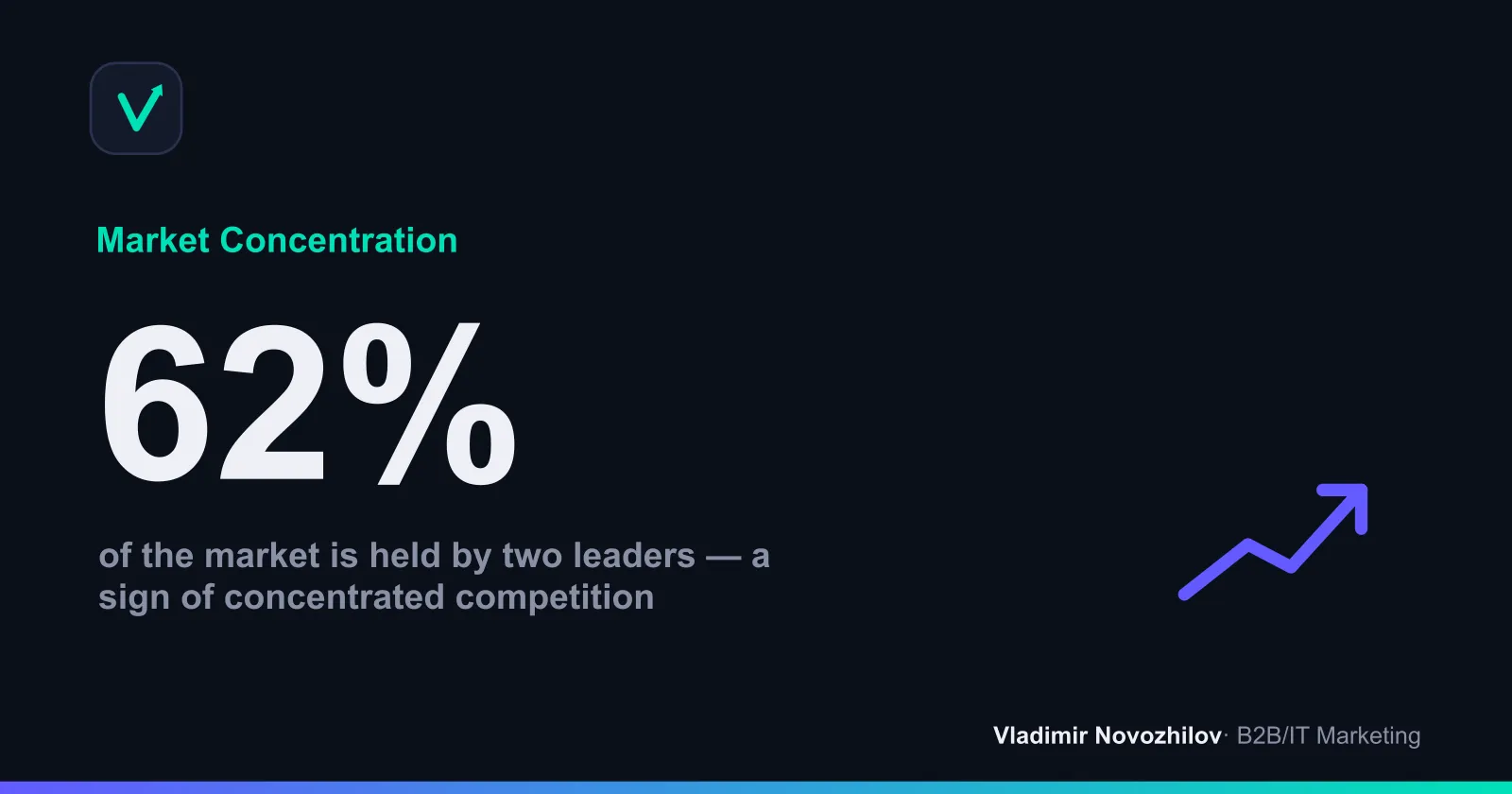
- market concentration (what share the top 2–3 leaders hold);
- the frequency of promotions, discounts, and price wars;
- the intensity of advertising and the fight for traffic;
- the height of barriers to entry.
The higher the concentration and barriers, the closer the market is to an oligopoly — entry is costly, but leaders are protected. Many small players with low barriers mean a fragmented market with intense price competition. Your margin and customer acquisition cost depend directly on the level of competition.
Competitive landscape: direct, indirect, and potential competitors
One of the biggest mistakes is treating only companies that sell “the same thing” as competitors. The competitive landscape is broader:
- Direct competitors — offer the same product to the same audience. A classic example: two web development studios in the same city.
- Indirect competitors — solve the same customer problem in a different way. For a PPC agency, an indirect competitor is an SEO contractor or an in-house marketer.
- Potential competitors — not in the market yet but capable of entering: adjacent companies, large players with resources, startups.
Keep a separate eye on substitute products — alternatives that change the way the problem is solved altogether. Ignoring indirect and potential competitors is risky: they’re often the ones who unexpectedly grab market share.
Stages of analyzing a company’s competitive environment
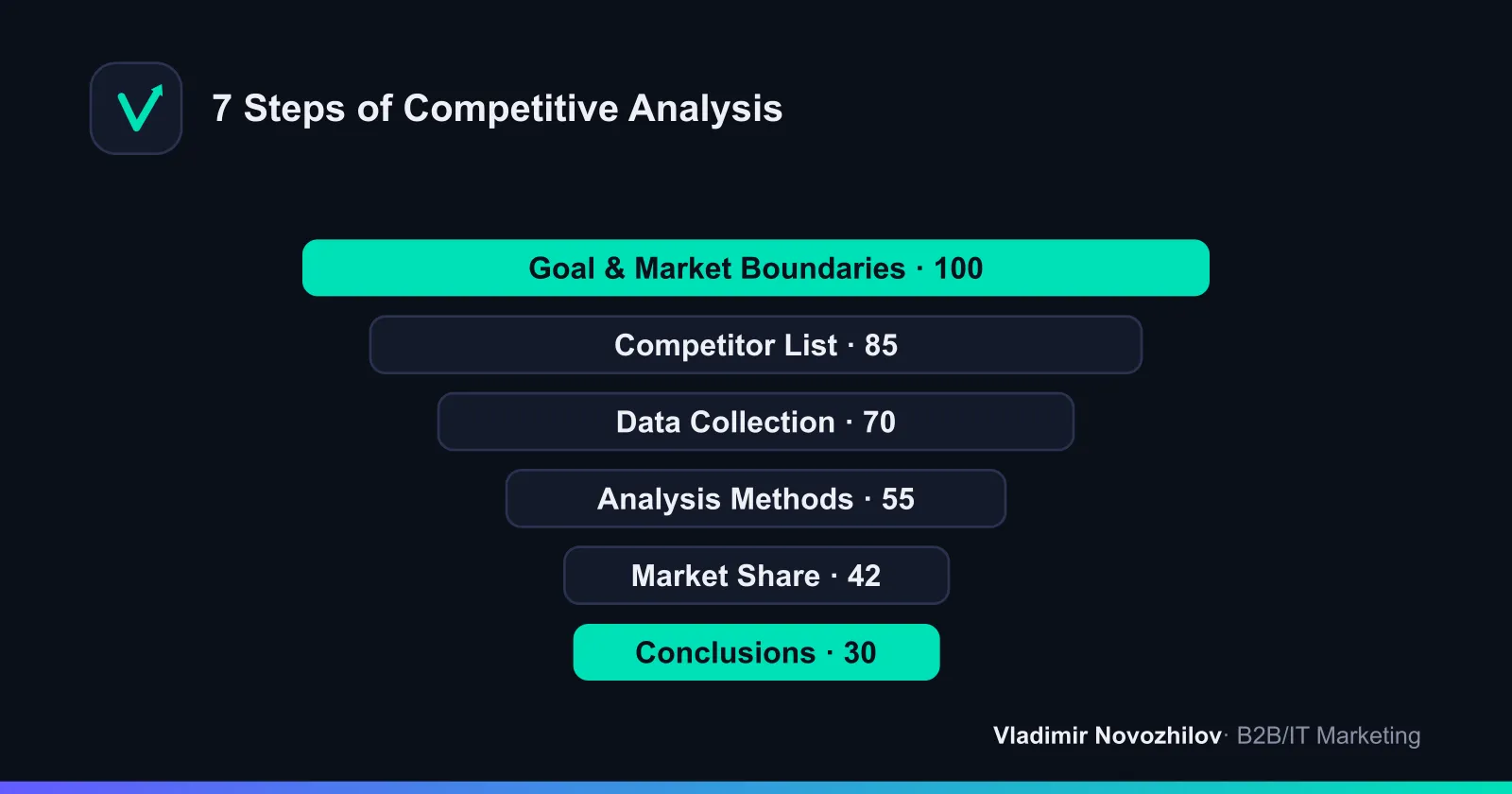
Let’s break the process into clear steps — essentially a checklist for “how to conduct a competitive environment analysis.”
- Define the goal and market boundaries. What decision are you making: entering a niche, launching a product, revisiting pricing? Set the geography, segment, and time period.
- Build a list of competitors. Direct, indirect, potential. 5–10 companies is optimal for an in-depth review.
- Collect data. Use a consistent set of parameters so results are comparable.
- Apply analysis methods. Porter’s Five Forces for market structure, SWOT for comparing strengths, PEST for external factors.
- Assess market shares and positioning. Build a competitor map.
- Draw conclusions. Where are the open niches, and what are your advantages and vulnerabilities?
- Build an action plan. Concrete steps for product, pricing, and promotion.
Gathering competitor data: sources and tools
The quality of the analysis depends on the data. Collect it using a single template so you can later compare apples to apples.
Open sources:
- competitors’ websites, price lists, proposals, and landing pages;
- customer reviews on marketplaces, maps, and review sites;
- social media and content — what they publish and how often;
- job postings (revealing priorities, technologies, and hiring pace);
- public filings, tenders, patents, media coverage.
Tools and services for competitive market analysis:
- SEO and traffic trackers to assess visibility and keywords;
- ad and content monitoring services;
- keyword research and demand estimation tools (e.g., Wordstat);
- CRMs and spreadsheets for organizing data.
Field methods of competitive intelligence: mystery shopping, surveys of competitors’ customers, conversations with suppliers and partners. These often reveal insights unavailable from open data.
Market and competitor analysis methods: Porter’s Five Forces, SWOT, PEST
Three methods cover different tasks and work well together.
Porter’s Five Forces model
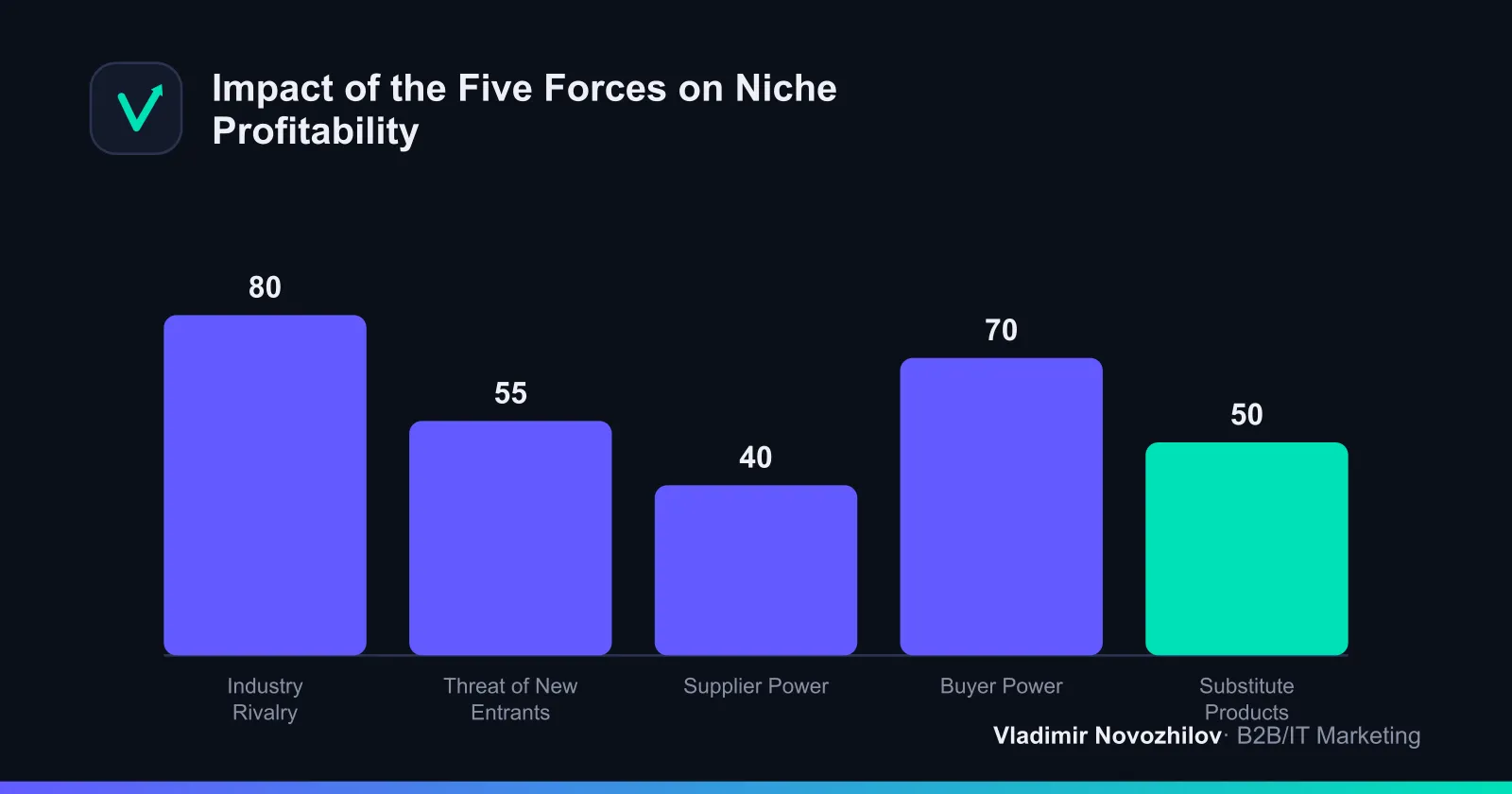
The Porter’s Five Forces model assesses the structural attractiveness of a market by evaluating pressure from five forces: rivalry among existing players, the threat of new entrants, the bargaining power of suppliers, the bargaining power of buyers, and the threat of substitute products. The stronger the pressure, the lower the potential profitability. Use it as a set of guiding questions: How easy is it to enter? Who sets the prices — you or the customer? Are there cheap alternatives?
SWOT analysis of competitors
SWOT analysis organizes strengths (Strengths) and weaknesses (Weaknesses), along with opportunities (Opportunities) and threats (Threats). Build a SWOT not just for yourself but for key competitors as well — that’s how contrasts and differentiation points become visible.
PEST analysis
PEST analysis covers external factors: political, economic, social, and technological. It’s not about specific rivals but about the environment everyone operates in: regulation, exchange rates, shifting customer behavior, and new technologies.
Comparing the methods
| Method | What it assesses | When to apply | Complexity | Result |
|---|---|---|---|---|
| Porter’s Five Forces | Market structure and attractiveness | Before entering a niche, assessing profitability | Medium | Map of market forces and threats |
| SWOT analysis | Strengths/weaknesses of players | Comparing with competitors, positioning | Low | Differentiation points and vulnerabilities |
| PEST analysis | External macro factors | Strategy, long-term planning | Medium | Trends and external risks |
In practice, the combination works like this: PEST sets the context, Porter’s model reveals market structure, and SWOT defines your position within it.
Assessing market share and competitor positioning
Market share is the portion of a niche’s total sales that belongs to a company. If exact figures aren’t available, estimate using indirect indicators: number of reviews, social media reach, website traffic, headcount, and geographic presence.
A simple reference formula: market share = company revenue ÷ total market volume × 100%. When revenue is unavailable, build a range-based estimate with explicit assumptions — that’s more honest than false precision.
For positioning, build a competitor map — a two-dimensional matrix along two axes that matter to the customer (e.g., “price” and “level of service”). Place players on the map, and you’ll spot empty zones where competition is lower. These are candidates for your niche.
Analyzing competitive markets: practical examples and case studies
Example 1. B2B services (a web studio). A mid-sized studio considered other similar studios its competitors. Analyzing the competitive landscape revealed that the real threat came from outsourced freelance teams on gig platforms and no-code builders (substitute products). Conclusion: competing on price was pointless; the studio needed to differentiate through expertise in complex integrations. After repositioning, average deal size grew and the share of price-driven leads dropped.
Example 2. A local service business. The company ran a SWOT analysis on its three closest competitors and found a shared weakness — slow response to inquiries and poor reviews about turnaround time. By making response speed its key advantage and backing it with a guarantee, the business claimed an open spot on the competitor map — the “fast + reliable” zone — and increased lead conversion.
Both cases illustrate the main point: the value of analysis isn’t the table itself but the concrete decision it leads to.
Template and checklist for competitive environment analysis
Below is a table structure you can easily recreate in Excel or Google Sheets. Rows represent competitors, columns represent parameters.
| Parameter | Your company | Competitor A | Competitor B | Competitor C |
|---|---|---|---|---|
| Type (direct/indirect) | — | Direct | Indirect | Potential |
| Target audience | ||||
| Value proposition | ||||
| Price segment | ||||
| Promotion channels | ||||
| Strengths | ||||
| Weaknesses | ||||
| Estimated market share | ||||
| Reviews (rating) |
Checklist: “Competitive Environment Analysis in 7 Steps”:
- Goal and market boundaries defined
- List of 5–10 competitors of all types compiled
- Data collected using a consistent set of parameters
- Analysis conducted using Porter’s model, SWOT, and PEST
- Market shares assessed and competitor map built
- Open niches and differentiation points identified
- Action plan drawn up with owners and deadlines
Tools and services for competitive market analysis
A minimal no-budget starter kit: a template spreadsheet, manual data collection from websites and review sites, free versions of SEO tools, and search query statistics. As your needs grow, add paid traffic and ad trackers, price and mention monitoring services, and competitive intelligence tools. The main rule: the tool is secondary, the method is primary — without a clear goal and parameters, even an expensive service just produces noise.
Common mistakes in competitive environment analysis
- Treating only direct rivals as competitors. Indirect competitors and substitutes are often more dangerous.
- Collecting data without a consistent structure. That makes comparison impossible.
- Copying competitors. The goal of analysis is to differentiate, not replicate.
- Doing the analysis as a formality. Without conclusions and an action plan, the report is useless.
- Treating analysis as a one-off exercise. Markets change, so ongoing monitoring is required.
- Chasing false precision. Range-based estimates with clear assumptions are more useful than being stuck without data.
Conclusions: how to use the results of competitive environment analysis
Competitive environment analysis isn’t a report for its own sake — it’s a foundation for decisions. Going through all the stages gives you three things: an understanding of the level of competition and market attractiveness, a map of open niches, and clear differentiation points. Next, translate these findings into action — adjust your positioning, value proposition, pricing, and channels. Run a full analysis once a year, and keep key competitors under regular monitoring. That way, the competitive environment turns from a source of threats into a map of your opportunities.
FAQ
- How does competitive environment analysis differ from competitor analysis?
- Competitor analysis studies specific companies: their products, prices, channels, and strengths. Competitive environment analysis is broader: it assesses the entire market — the level of competition, entry barriers, suppliers, buyers, substitute products, and external factors. Simply put, competitor analysis answers 'who are my rivals,' while environment analysis answers 'how attractive and risky is this market overall.'
- How often should you conduct a competitive environment analysis?
- A full competitive environment analysis is usually enough once a year or when making strategic decisions: entering a new market, launching a product, or repositioning. Monitoring key competitors (prices, promotions, new releases, content) should be done monthly or quarterly. In fast-moving markets — IT, for example — increase the monitoring frequency.
- Which methods work for small businesses with no budget?
- Start with a SWOT analysis and a simplified competitor map — both are free and deliver quick results. Collect data manually: competitors' websites and price lists, reviews on marketplaces and maps, social media, free versions of SEO tools, and keyword-research tools like Wordstat. Use Porter's model as a checklist of questions to make sure you don't overlook suppliers, substitutes, and entry barriers.
- How do you determine the level of competition in a niche?
- Assess the number of active players, their market concentration (how much share the leaders control), the rate at which newcomers appear, the intensity of advertising and price wars, and the height of entry barriers. If a few companies control most of the market and entry is costly, competition is concentrated. Many small players with low barriers signal a fragmented, high-intensity market.
- What if there's little or no available data on competitors?
- Combine indirect sources: customer and employee reviews, job postings (which reveal priorities and technologies), tenders, patents, public filings, and media mentions. Run mystery shopping and survey competitors' customers. Range-based estimates with clearly stated assumptions are better than no conclusions at all.