Analyzing Competitive Advantages: Methods and Checklist


TL;DR
Analyzing competitive advantages means assessing where your company outperforms rivals in the eyes of customers and the market. This article covers types of advantages, Porter's, Lambin's, and SWOT models, a step-by-step algorithm, evaluation metrics, and common mistakes — plus a ready-to-use checklist and template.
A customer almost never chooses blindly: in B2B and services, before signing a deal, they compare several vendors and ask one question — “why you, and not them.” The answer to that question is the outcome of the work known as competitive advantage analysis. It’s a systematic assessment of where your company and product are objectively stronger than the market in the customer’s eyes. Below is a practical guide: types of advantages, Porter’s, Lambin’s, and SWOT models, a step-by-step algorithm, evaluation metrics, examples, and a ready checklist.
What a competitive advantage is and why you should analyze it
A competitive advantage is a characteristic of a company or product that creates more value for the customer than rivals’ offerings — and is hard to copy. It’s always measured relative to the market: an advantage exists only in comparison.
Why regular analysis of a company’s competitive advantage matters:
- to craft an honest unique selling proposition instead of generic “quality and individual approach” claims;
- to justify pricing and reduce discount pressure;
- to choose segments where you’re objectively stronger;
- to notice in time when an advantage is eroding.
It’s important to distinguish product competitiveness (comparing a specific product) from company competitiveness (comparing firms as systems). A product can be copied in weeks; a system takes years to replicate — so long-term bets should be made at the firm level.
Types of competitive advantages: internal and external
The classic distinction, drawn from the work of J.-J. Lambin, separates internal and external competitive advantages.
- Internal advantages are based on cost and productivity: cheap production, efficient logistics, automation, economies of scale. They let you sell at lower prices while keeping the same margin.
- External advantages are based on distinctive product qualities that customers value: unique features, service, speed, brand. They let you charge above the market price.
Internal advantages create cost leadership, external advantages create product differentiation — the two basic strategies in Porter’s framework.
Natural, artificial, and sustainable competitive advantages
Another way to slice advantages is by their nature:
| Type | What it is | Example |
|---|---|---|
| Natural | Objective facts about the company | Lower price, delivery time, 15 years in business, certified engineering staff |
| Artificial | Trust boosters created by marketing | Results guarantee, case studies, dedicated account manager, lead magnet |
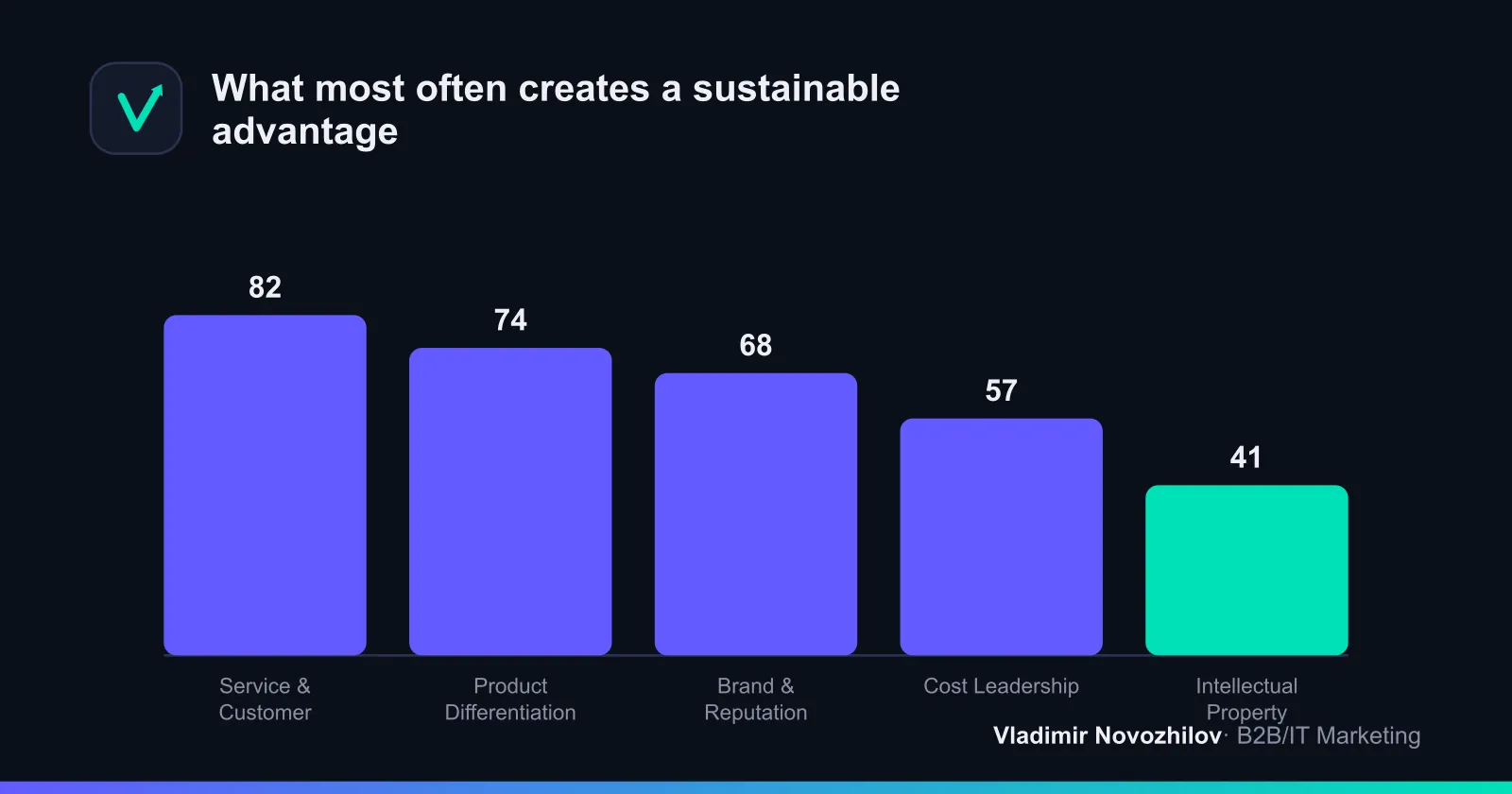
| Sustainable | Advantages that are hard to copy | Patent, strong brand, unique technology, exclusive resource |
A sustainable competitive advantage is one that persists for years and can’t be quickly replicated by competitors. It’s the one that drives long-term profit. Natural advantages are copied easily, artificial ones almost always — but a patent, reputation, or network effect provide real protection.
Porter’s Five Forces model for analyzing the competitive environment
Porter’s Five Forces (Michael Porter, 1979) assess not the company itself but the attractiveness of the industry and the pressure on profit. The five forces are:
- Rivalry among existing competitors — the intensity of competition.
- Threat of new entrants — how high the barriers to entry are.
- Bargaining power of suppliers — whether they can dictate terms.
- Bargaining power of buyers — whether customers can push prices down.
- Threat of substitute products — whether alternative solutions exist for the customer’s problem.
The stronger the pressure, the lower the potential margin. Analyzing competitive advantage factors through Porter’s lens helps identify where to build defenses — for example, raising entry barriers through expertise or reducing dependence on a single supplier.
Jean-Jacques Lambin’s model: market power and productivity
Jean-Jacques Lambin proposed measuring a company’s position along two axes:
- Market power — how much more a customer is willing to pay compared to the price of the leading competitor (external advantage, differentiation);
- Productivity — how much lower your costs are than the competitor’s (internal advantage).
Lambin also described market types — pure competition, monopolistic competition, oligopoly, monopoly — and a matrix of competitor reaction elasticity: how rivals will respond to a price cut or advertising push. If Porter answers the question “how attractive is the industry,” Lambin answers “exactly where does my firm stand, and what sustains that position.”
Comparing analysis models: Porter, Lambin, SWOT
No single model replaces the others. Their power lies in combining them.
| Criterion | Porter’s Five Forces | Lambin’s model | SWOT analysis |
|---|---|---|---|
| Object | Industry | Firm’s position | Company and environment |
| Key question | Where is the pressure on profit | What sustains our position | Strengths/weaknesses and risks |
| Key axes | 5 forces of pressure | Market power and productivity | S-W-O-T |
| When to use | Market assessment, industry entry | Choosing between price and differentiation | Quick inventory, starting point |
| Complexity | Medium | High | Low |
A practical sequence: start with a SWOT analysis of competitors and your own company for a general picture, add Porter for market context, and Lambin to choose between price and differentiation.
Step-by-step algorithm for analyzing a company’s competitive advantage
Here’s a working algorithm that covers the full cycle — from data to an action plan.
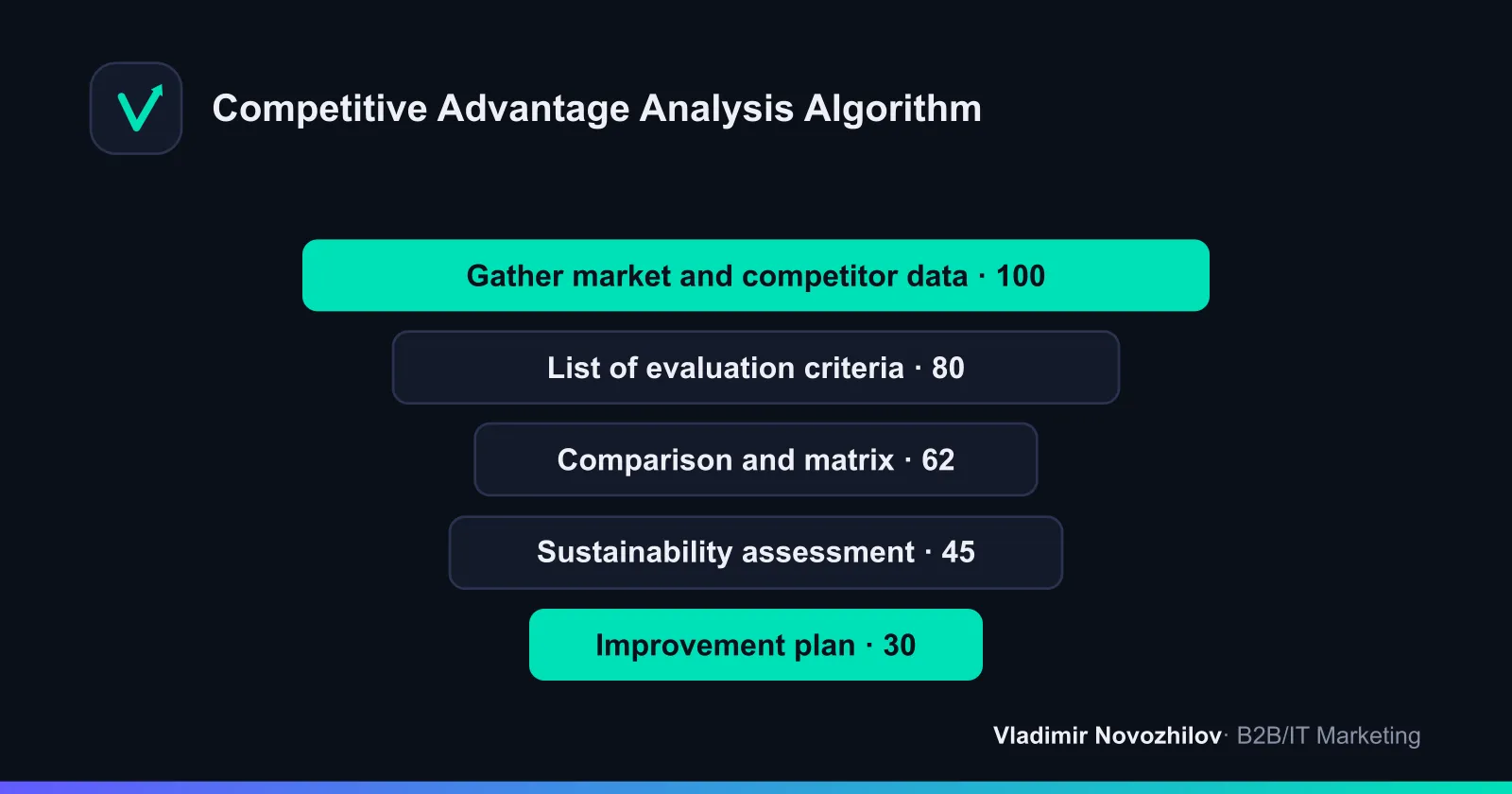
- Collect data. Look at 5–7 direct competitors: websites, price lists, USPs, reviews, social media, sales proposals (you can request these as a mystery shopper).
- Build a list of evaluation parameters. 8–12 factors that matter to the customer: price, lead times, warranty, product range, service, expertise, geography, reputation.
- Build a comparison matrix. Score yourself and competitors on each parameter (for example, on a 5-point scale) and weight by importance to the customer.
- Assess durability. For each advantage, ask: can this be copied within a quarter? If so, it’s not a sustainable advantage — it’s just market hygiene.
- Build an improvement plan. Strengthen what the customer values and what’s hard to copy; fix critical gaps.
This approach also answers the question of how to identify competitive advantages: they sit at the intersection of “matters to the customer” and “we do it better than competitors.”
How to assess competitive advantages: methods and metrics
Assessing competitive advantages combines qualitative and quantitative methods:
- Observation of competitors and the market;
- Employee surveys — salespeople know customers’ real objections;
- Competitor analysis using a parameter matrix;
- Studying customer values through interviews and reviews.
A simple weighted formula for assessing a firm’s competitiveness:
Index = Σ (score on parameter × importance weight)
Example calculation for three parameters (scale 1–5, weights as fractions):
| Parameter | Weight | Us | Competitor A |
|---|---|---|---|
| Service speed | 0.4 | 5 (2.0) | 3 (1.2) |
| Price | 0.35 | 3 (1.05) | 4 (1.4) |
| Expertise | 0.25 | 5 (1.25) | 3 (0.75) |
| Index | 1.0 | 4.30 | 3.35 |
This kind of matrix clearly shows where you win (service, expertise) and where you lag (price), and where to direct resources.
How to phrase and communicate competitive advantages to customers
Rules for describing advantages so they work in sales:
- Specifics instead of vague claims. Not “fast delivery,” but “we deliver within 24 hours or refund your money.”
- The language of customer benefits, not company features: “you’ll save 3 days on approvals.”
- Proof — numbers, case studies, guarantees.
- Differentiation: the phrasing should set you apart, not repeat what everyone says.
Description template:
| Block | What to fill in |
|---|---|
| Customer’s problem | What’s hurting the buyer |
| Our solution | What exactly we do |
| Difference from competitors | What others don’t have |
| Proof | A number, case study, guarantee |
| Benefit | What the customer gets |
Common mistakes in competitive advantage analysis
- Comparing yourself to the market “in your head,” without data or a matrix.
- Confusing hygiene factors (things everyone has) with an actual advantage.
- Describing advantages in company-speak instead of customer benefits.
- Ignoring durability: a copyable advantage offers no real protection.
- Running the analysis once and never updating it.
- Relying solely on management opinion instead of asking customers.
Examples of competitive advantages across industries
- Logistics company (B2B). Sustainable advantage — a proprietary IT tracking system letting customers see cargo in real time. Expensive to copy, boosts retention.
- IT integrator (services). Differentiation through narrow specialization: implementations exclusively for healthcare. Niche expertise becomes an entry barrier for generalists.
- Promotional equipment manufacturer. Cost leadership through localized assembly — prices 15% lower than imported equivalents at comparable quality.
- Real estate agency. Artificial advantage — a legal purity guarantee on transactions backed by financial liability, which strengthens trust in a competitive market.
How to strengthen your business’s competitive advantages
To strengthen your business’s competitive advantages, work on three fronts: cut costs without sacrificing value, deepen product differentiation, and build assets that are hard to copy — brand, intellectual property, customer base, unique competencies. Invest in the factors customers flagged as important during interviews, and turn one-off advantages into systematic processes.
Checklist for self-directed competitive advantage analysis
- Identified 5–7 direct competitors
- Collected price lists, USPs, and reviews for each
- Conducted 5–10 customer interviews
- Surveyed your own salespeople about objections
- Compiled a list of 8–12 evaluation parameters
- Weighted parameters by importance to the customer
- Built a comparison matrix with scores
- Calculated a competitiveness index
- Checked the durability of each advantage
- Phrased advantages in the language of benefits
- Built an improvement plan with priorities
- Set a date for the next review
Work through this checklist, and you’ll end up not with a set of slogans but with a substantiated picture: where you’re objectively stronger than the market, what’s worth reinforcing, and how to communicate it to customers.
FAQ
- What's the difference between a company's competitive advantage and a product's competitive advantage?
- A product advantage is a specific attribute of a good or service (price, speed, feature, quality) that a customer compares when choosing. A company's advantage is broader: reputation, team expertise, service, logistics, partner network, intellectual property. A product can be copied faster than a company's entire system, so durable advantages usually sit at the firm level, not the individual product.
- How often should you analyze competitive advantages?
- A full competitive advantage analysis is worth doing every 6–12 months, plus before a product launch, entry into a new segment, or repositioning. Monitoring competitors' prices, promotions, and USPs is useful monthly — the market moves faster than an annual planning cycle.
- Which model is better — Porter's or Lambin's?
- They solve different problems. Porter's Five Forces assess industry attractiveness and pressure on profit. Lambin's model measures a specific company's position through market power (external advantage) and productivity (internal advantage). In practice they're combined: Porter provides market context, Lambin and SWOT define your firm's position.
- Can a company have both a price advantage and a quality advantage at the same time?
- Yes, but it's a rare and hard-to-sustain position. Usually a company picks one core strategy — cost leadership or differentiation. Combining both is possible through technology, scale effects, or a unique business model, but it requires strong operational control, or the advantage erodes.
- How can you assess competitive advantages without a big research budget?
- Desk research is usually enough: gather websites and price lists from 5–7 competitors, study customer reviews, run 5–10 in-depth interviews with buyers, survey your own sales team, and build a comparison table across 8–12 parameters. This delivers up to 80% of the useful insights without hiring a marketing agency.