Analyzing Competitor Strategy: Methods and Steps

TL;DR
Competitor strategy analysis examines what drives rivals' growth: their goals, positioning, channels, pricing, and product logic. Unlike standard competitor analysis, it answers not just 'what are they doing' but 'why and where are they heading.' This article covers a step-by-step method, frameworks (SWOT, PESTEL, Porter's Five Forces, JTBD, positioning map), tools, and a ready-to-use table template.
In short: what is competitor strategy analysis
Competitor strategy analysis is a breakdown of what drives your rivals’ results: their goals, positioning, target segments, promotion channels, pricing policy, and product logic. Unlike standard competitor analysis, which captures “what’s happening now,” strategic competitor analysis answers the questions “why are they acting this way” and “where are they heading.” This lets you anticipate market players’ moves and build your own competitive strategy instead of chasing someone else’s decisions.
Below is a step-by-step method, frameworks (SWOT, PESTEL, Porter’s Five Forces, JTBD, positioning map), tools, and a ready-to-use table template you can apply yourself in B2B, IT, and services.
What competitor strategy analysis is and why business needs it
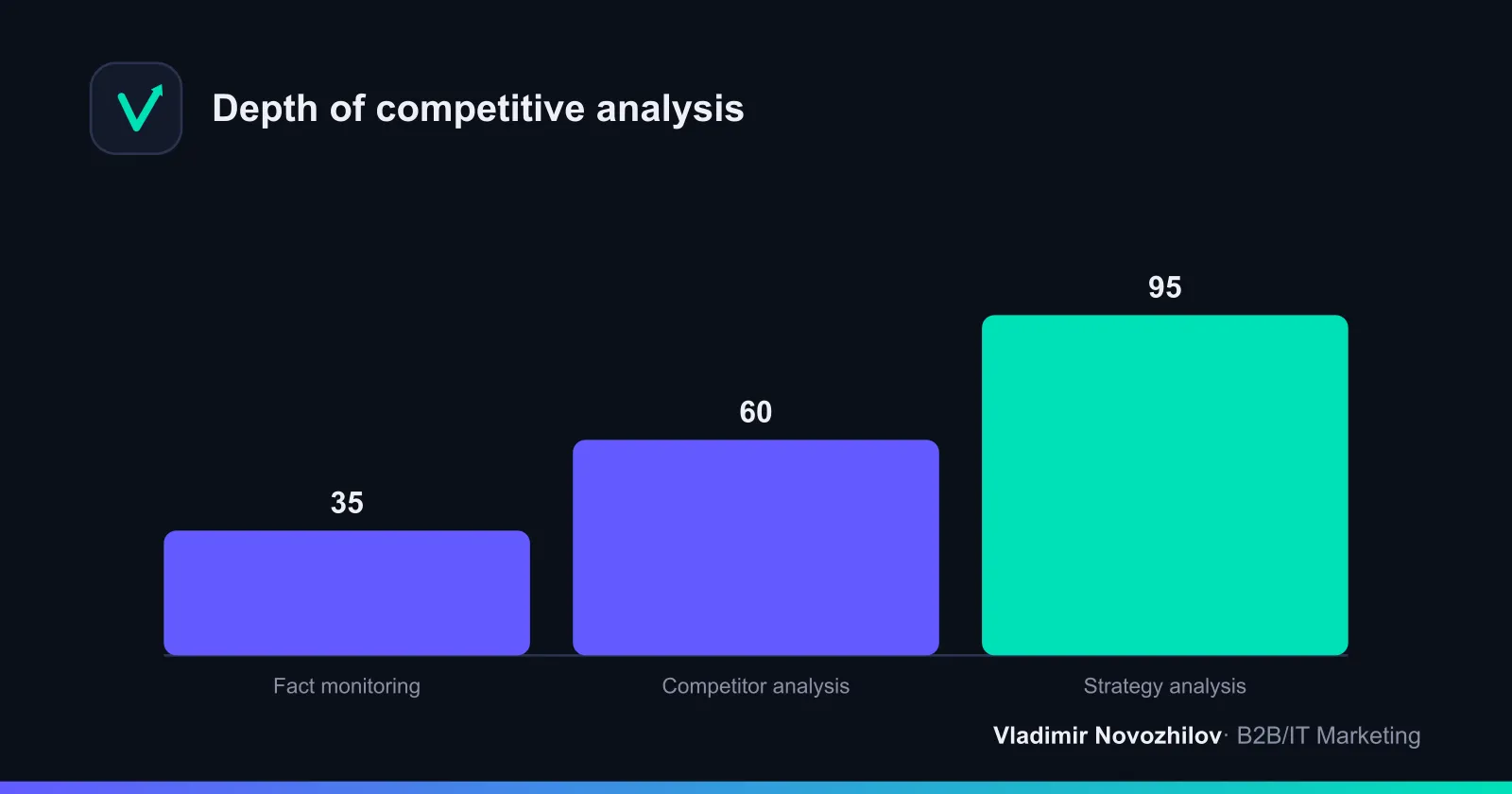
Competitor analysis in marketing comes in different depths. You can simply track prices and new releases — that’s monitoring. You can systematically describe strengths and weaknesses — that’s classic competitor analysis. Or you can reconstruct a rival’s logic: which segment it’s betting on, how it differentiates, where it gets customers, and what moves it will make tomorrow. The latter is competitor strategy analysis.
Why business needs this:
- Find an open niche. Understand where rivals are strong and where they leave gaps, and claim the unoccupied position.
- Sharpen positioning and USP. Formulate advantages no one else has, instead of repeating others’ promises.
- Avoid overpaying for growth. See which promotion channels actually work for market players, and stop burning budget on ineffective ones.
- Anticipate moves. Spot signals (new job postings, pricing plans, partnerships) and prepare in advance.
Direct, indirect, and substitute competitors
Before analyzing strategy, you need to correctly define the field of rivals. Skipping this step is a common source of wrong conclusions.
- Direct competitors — companies with the same product for the same audience. For example, two web development studios serving small businesses in the same region.
- Indirect competitors — solve the same customer problem in a different way. For that same studio, these would be website builders or freelancers.
- Substitute competitors — what the customer spends the budget on instead of your category. For example, a company decides to hire an in-house marketer instead of ordering a website.
For an objective picture, take 3–5 direct competitors for in-depth analysis and add a few indirect and substitute ones for context on the competitive environment.
How competitor strategy analysis differs from regular competitor analysis
This is the key distinction most often missed. Regular analysis describes the state of things; strategic analysis reveals intent and direction.
| Criterion | Regular competitor analysis | Competitor strategy analysis |
|---|---|---|
| Main question | What are they doing? | Why and where are they heading? |
| Horizon | Present | Present + forecast |
| What’s studied | Prices, products, website, ads | Goals, segments, positioning, economics, channels |
| Result | List of facts and differences | Growth logic and counter-action plan |
| Key question for you | How do I look no worse? | How do I win using my own position? |
A simple example: seeing that a competitor cut prices is regular analysis. Understanding that they’re doing it to capture the lower segment and later upsell expensive services — that’s competitor strategy analysis.
When to conduct strategic competitor analysis
A full analysis of strategic competitors makes sense:
- before launching a new product or service;
- when entering a new market or region;
- before rebranding or repositioning;
- when revising pricing policy;
- on a regular schedule — every 6–12 months.
In between, keep light monitoring of signals: pricing changes, new ad campaigns, job postings (which reveal where a company is investing), and executive interviews and public appearances.
Preparing for competitor strategy analysis: goals, competitor selection, criteria
Preparation determines the quality of results. Go through three steps.
- Define the goal. Not “study competitors in general,” but something specific: “understand what lets the market leader retain large clients” or “find an undervalued segment.”
- Select competitors. 3–5 direct plus 2–3 indirect. List them with websites and brief profiles.
- Set comparison criteria. A single set of parameters to evaluate everyone by: segment, USP, pricing, channels, product, strengths/weaknesses, direction. Uniform criteria make conclusions comparable.
Methods for analyzing competitor strategy: SWOT, PESTEL, Porter’s Five Forces, positioning map, JTBD
No competitive review is built on a single method. Combine several — each covers a different layer.
- SWOT analysis of competitors — strengths, weaknesses, opportunities, and threats. A basic tool that shows where a rival is vulnerable.
- PESTEL analysis — the influence of the external environment (political, economic, social, technological, environmental, legal). Helps understand which external factors are driving the market and players’ strategies.
- Porter’s Five Forces — analyzing the competitive environment through supplier and buyer power, threat of new entrants, substitutes, and internal rivalry. Shows market attractiveness and points of pressure.
- Positioning map — a visual diagram plotting all players along two axes (for example, “price” and “level of expertise”). Instantly reveals open zones.
- Jobs to Be Done (JTBD) — the “job” a customer hires the product to do. Reveals which underlying need a competitor is betting on.
Competitor benchmarking and competitive intelligence aren’t separate methods but cross-cutting practices: gathering benchmark figures and systematically collecting data from open sources.
How to conduct competitor marketing strategy analysis step by step
Analyzing competitors’ marketing strategy can conveniently be broken into seven steps.
- Set a goal and select competitors (see the preparation section).
- Gather data. Websites, pricing, case studies, reviews, social media, ads, job postings, public appearances.
- Break down positioning. Who each rival is promising what to, in what tone, and with what arguments.
- Study channels and content. Where traffic comes from, which content marketing formats work.
- Break down pricing and product. Pricing logic, upsells, product lineup.
- Apply frameworks. SWOT, positioning map, and if needed, Porter and PESTEL.
- Draw conclusions and a plan. Where the rival is vulnerable and how to use it in your own competitive strategy.
Analyzing competitors’ promotion channels, advertising, and content marketing
This section is often overlooked, but it’s exactly where you see what’s driving a rival’s growth. Assess:
- Traffic sources — the share of SEO, paid search, social media, partnerships, direct visits.
- Competitor content marketing — which topics and formats are published, how often, and what gets traction.
- Advertising — creatives, offers, landing pages, geo and targeting segments.
- Reputation management — reviews, case studies, how negative feedback is handled.
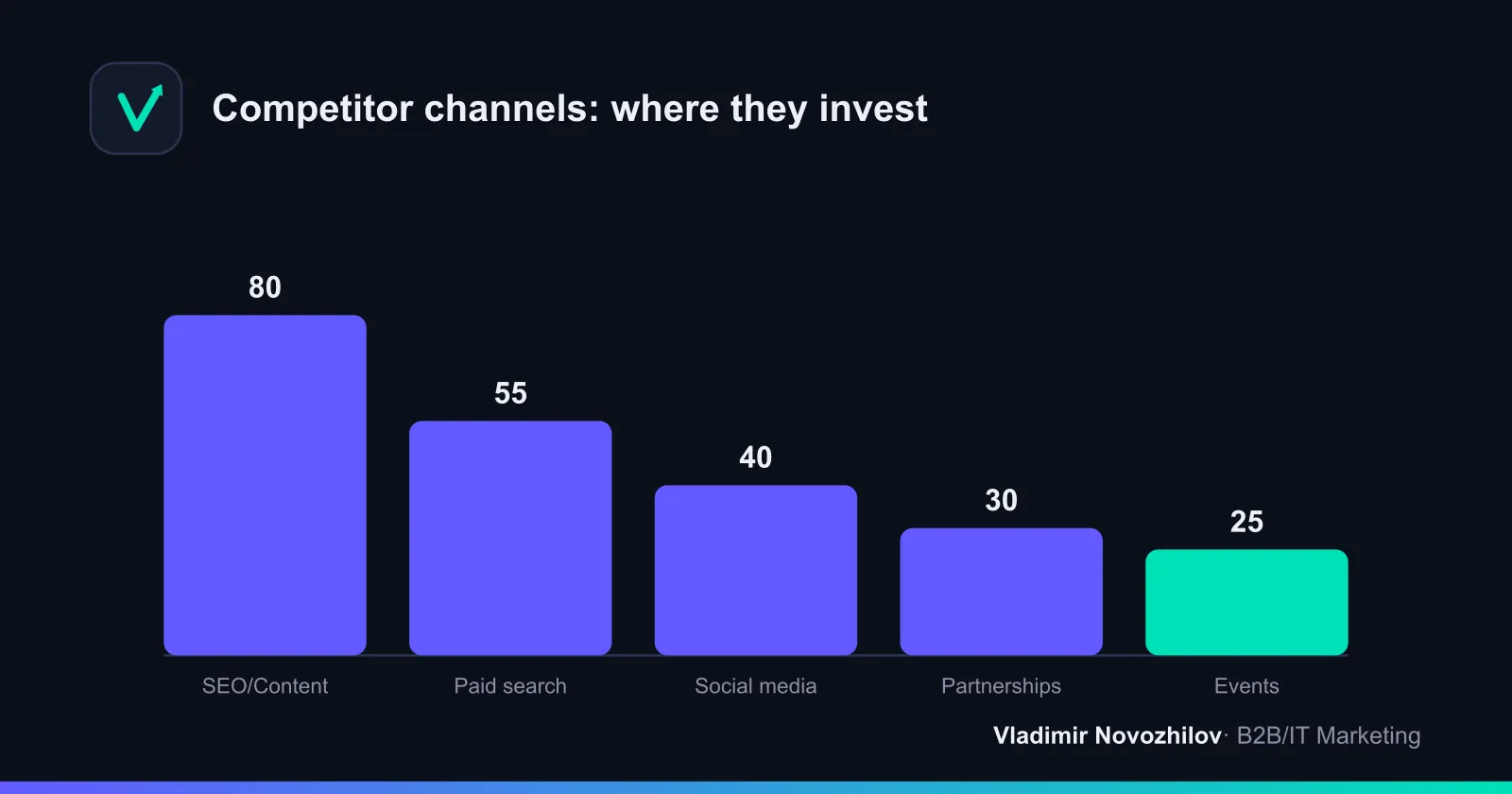
If a competitor is clearly investing in SEO and expert content while barely running paid ads, its strategy is built on long-term organic trust. That’s a clue: head-on competition in paid search will be cheaper, but you’ll have to fight for organic reach for years.
Analyzing competitors’ pricing policy and product lineup
Analyzing competitors’ pricing policy reveals not just the numbers but the monetization model. Pay attention to:
- the structure of pricing plans and what’s included in each;
- “anchor” and premium offers;
- discounts, bundles, and upsells;
- which segment each pricing tier serves.
Examine the product lineup in terms of logic: where the entry point is, where the upsell is, and where the “magnet” product is — the one that attracts a customer so the main product can later be sold to them.
Tools for analyzing strategic competitors (services + checklist)
Competitor analysis tools fall into automated services and manual methods.
| Task | Services | What they show |
|---|---|---|
| Traffic and sources | Similarweb, Keys.so | Traffic volume and structure |
| SEO and content | Ahrefs, Serpstat, Topvisor | Keywords, pages, backlinks |
| Advertising | ad transparency tools, Serpstat | Active ads and offers |
| Social media | Popsters, LiveDune | Formats and engagement |
| Reputation | Brand Analytics, YouScan | Mentions and sentiment |
Manual collection checklist (no tools needed):
- review the website, pricing, and case studies;
- read 20–30 reviews across different platforms;
- check job postings — they reveal company priorities;
- study social media and newsletters;
- find interviews and public appearances by executives.
How to present results: a table of competitors’ strengths and weaknesses
The best way to summarize findings is a single template table. Rows are competitors, columns are criteria. Below is an example you can copy and fill in for your own market.
| Criterion | Competitor A | Competitor B | Us |
|---|---|---|---|
| Segment | Enterprise | Small business | Mid-market |
| Positioning / USP | Reliability and experience | Low price | Speed + expertise |
| Pricing policy | Premium | Undercutting | Mid-plus |
| Main channels | Partnerships | Paid search | SEO + content |
| Strengths | Brand, large clients | Price, reach | Flexibility, expertise |
| Weaknesses | Slow, expensive | Low quality | Brand awareness |
| Growth direction | Moving upmarket | Scaling reach | Capturing a premium niche in small/mid-market |
In the row below the table, always record your own takeaway: where the rival is vulnerable and how you’ll use it.
Common mistakes in competitor strategy analysis
- Collecting facts without conclusions. A table without a final decision is wasted time.
- Copying instead of differentiating. The goal of analysis is to find a difference, not repeat someone else’s USP.
- Ignoring indirect and substitute competitors. Often they’re the ones stealing your customers.
- One-off analysis. Strategies change; an analysis that’s never updated goes stale fast.
- Different criteria for different rivals. That makes comparison meaningless.
- Trusting only automated tools. Numbers show “what,” not “why” — the logic comes from manual analysis.
Conclusion
Competitor strategy analysis differs from a standard breakdown in that it exposes rivals’ logic and direction, not just their current actions. Gather 3–5 direct competitors, set uniform criteria, apply a combination of methods (SWOT, positioning map, and if needed Porter’s Five Forces and PESTEL), separately break down channels, content, and pricing — and bring it all together in a table with conclusions. That’s how competitor analysis turns from a report into the foundation of your own growth strategy.
FAQ
- How is competitor strategy analysis different from general competitor analysis?
- Standard competitor analysis records facts: prices, product range, channels, website. Competitor strategy analysis answers the 'why and where' question: what drives a rival's growth, which segment it targets, how it positions itself, and what moves it will make next. The first describes the current state; the second reveals the underlying logic and direction of development, which lets you anticipate moves and build a counter-strategy.
- How often should you conduct competitor strategy analysis?
- A full strategic competitor analysis is worth doing 1–2 times a year, plus before launching a product, entering a new market, rebranding, or revising prices. Monitoring key signals (new pricing plans, ad campaigns, job postings, website updates) should be ongoing — monthly or quarterly.
- How many competitors should you analyze for an objective picture?
- Ideally 3–5 direct competitors for in-depth analysis, plus another 3–5 indirect and substitute competitors for context. Fewer than three gives a distorted picture, while more than 8–10 spreads resources too thin and lowers the quality of conclusions. It's better to deeply analyze five than superficially cover twenty.
- What tools should you use to analyze strategic competitors?
- For traffic and advertising — Similarweb, Serpstat, Keys.so; for SEO and content — Ahrefs, Topvisor; for social media — Popsters, LiveDune; for mention monitoring — Brand Analytics, YouScan. Plus manual methods: reviewing websites, pricing, testimonials, job postings, and executive interviews — these often reveal strategy more precisely than paid tools.
- How do you present competitor strategy analysis results as a table?
- Build a table where rows are competitors and columns are comparison criteria: segment and positioning, USP, pricing policy, main channels, strengths and weaknesses, growth vector. In a final row, record your own takeaways: where a rival is vulnerable and how to exploit it. This format makes conclusions clear and easy to defend to your team.