In-Depth Interviews: How to Conduct Them, Types, and Questions


TL;DR
An in-depth interview is a qualitative research method where an interviewer talks one-on-one with a customer about their experience, tasks, and problems. This article covers the types of in-depth interviews, a step-by-step preparation and execution process, sample task-based questions, a checklist, and a custdev guide template.
An in-depth interview is a qualitative research method in which an interviewer talks one-on-one with a customer in detail about their experience, tasks, motivations, and problems. Unlike a survey, what matters here isn’t dry percentages but the reasons behind behavior: why a person acts one way and not another, what’s really driving their decisions. That’s why in-depth customer interviews have become a core tool for marketers, product teams, and founders in B2B, IT, and services.
In this article, we’ll cover why the method matters, how it differs from surveys and focus groups, the types of in-depth interviews, how to prepare for and conduct a conversation, and how to analyze the results. At the end, you’ll find a checklist, a guide template, and sample questions you can copy and adapt for your own product.
What an in-depth interview is and why you need one
The in-depth interview belongs to the family of qualitative research methods. Its goal isn’t to measure — it’s to understand. You work with a small sample, but you get depth: context, emotions, hidden barriers, and insights that a mass survey simply can’t surface.
Businesses use customer interviews to:
- test a problem hypothesis before investing money in development;
- understand their target audience: how people actually make decisions, where they look for information, what they’re afraid of;
- refine positioning and messaging in the customer’s own language;
- uncover the reasons behind churn and sales objections;
- gather material for a CJM (Customer Journey Map), personas, and JTBD statements.
In the Customer Development (custdev) methodology, the in-depth interview is the primary data source. A custdev interview helps a founder avoid falling in love with their own idea and instead test it against real people. Hence the related terms you’ll see in searches: customer interview, custdev interview, problem interview.
In-depth interview vs. survey, focus group, and standard interview
To pick the right tool, it helps to understand the differences. A survey answers the question “how many”; an in-depth interview answers the question “why.”
| Method | What it delivers | Format | When to use it | |---|---|---| | Survey (questionnaire) | Quantitative data, percentages | Many respondents, closed questions | When the hypothesis is already clear and you need to measure scale | | Focus group | Group dynamics, reactions | 6–10 people at once | Testing concepts, ads, packaging | | Standard interview | Facts, opinions on an agenda | Formal Q&A | Expert surveys, media | | In-depth interview | Motivations, pain points, context | One-on-one, open questions | Validating problems, finding insights, custdev |
The key distinguishing feature of an in-depth interview is a flexible script. The interviewer follows the respondent’s lead, asks clarifying questions, and digs into details that weren’t in the plan. A focus group doesn’t work for this: in a group setting, people adjust to each other and stay quiet about personal matters.
Types of in-depth interviews: problem, solution, expert
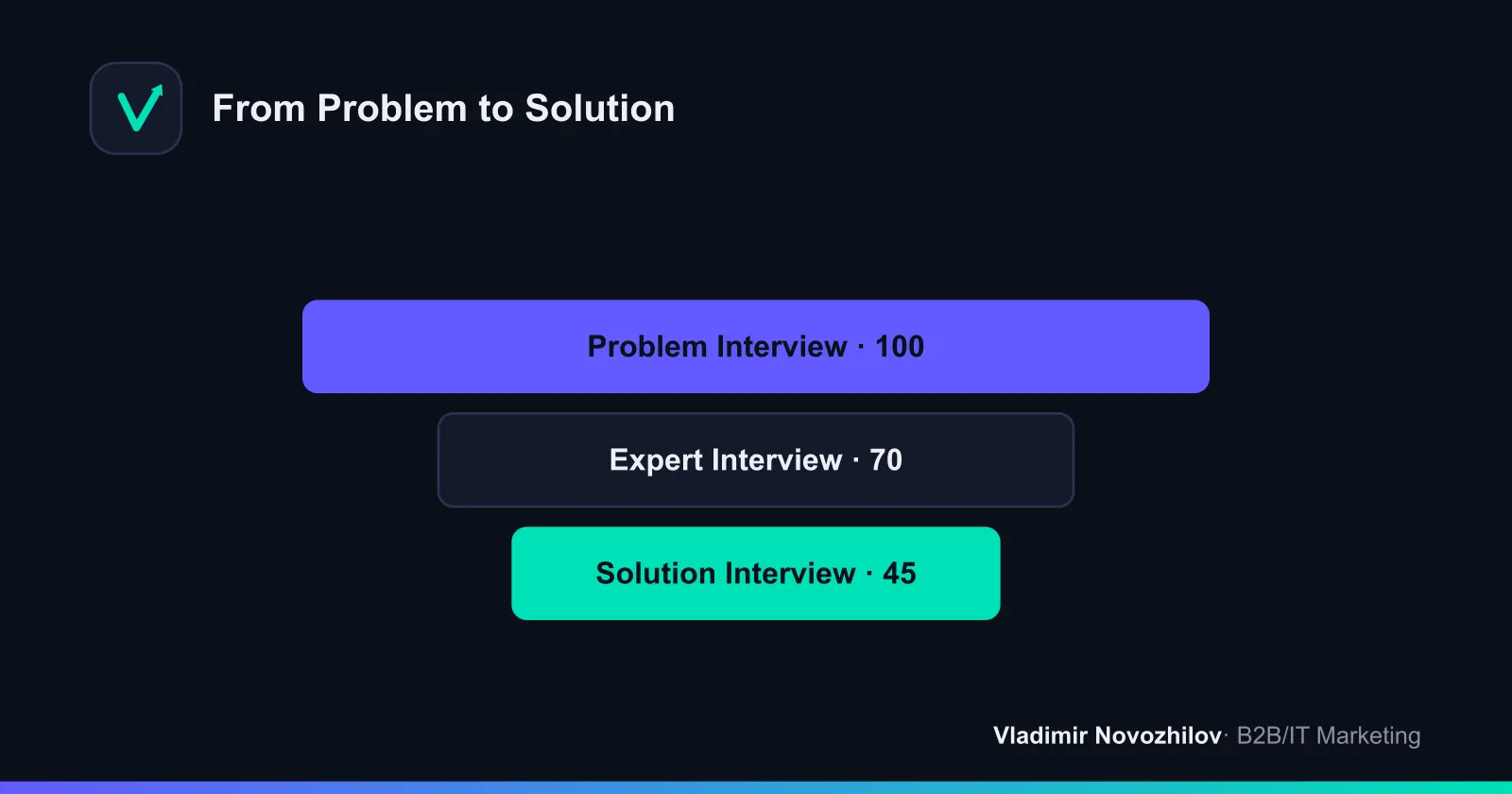
Types of in-depth interviews differ by objective. In custdev, three main types are distinguished, and they form a logical sequence.
Problem interview
The goal is to find out whether a problem exists and how painful it is. You do NOT talk about your product. You ask about the person’s actual past experience: how they solve the task now, what frustrates them, how much time and money it costs them. The problem interview is the foundation — if there’s no pain, there’s no point moving forward.
Solution interview
This is conducted once you have a prototype, MVP, or concept. You show the solution and observe the reaction: is the value clear, is the person willing to pay, what’s confusing. A solution interview doesn’t test the idea itself — it tests how well your specific solution addresses an already-validated problem.
Expert interview
The respondent is a specialist in the industry or holds rare expertise. This type of interview helps you quickly get up to speed on an unfamiliar market, understand terminology, and spot pitfalls. An expert interview complements a problem interview well but doesn’t replace talking to real users.
UX research includes its own subtypes: contextual interviews (observing users at work), critical incident interviews, and ethnographic interviews. These are also forms of in-depth interviews, just focused on behavior and the usage environment.
When and for which tasks each type fits
| Interview type | Main goal | Stage | Key question | |---|---|---| | Problem | Validate a pain point | Idea, pre-product | “How do you solve this now?” | | Solution | Test a solution | Prototype, MVP | “What’s unclear here?” | | Expert | Understand the market | Any | “What do newcomers overlook?” | | UX / contextual | Study behavior | Live product | “Show me how you do this” |
In practice, teams combine methods. For example, they might start with a few expert interviews to understand the market, then run a series of problem interviews, and after launching an MVP, move to solution interviews. This way, qualitative research accompanies the product through every stage.
How to prepare for an in-depth interview: goals, target audience, guide
Interview quality is roughly 70% determined by preparation. Let’s break down how to conduct an in-depth interview properly, starting with the fundamentals.
- Formulate a hypothesis and a goal. What exactly do you want to learn? “Understand how small businesses choose an accounting vendor” is a goal. “Gather insights” is not.
- Define your interview target audience. Describe selection criteria: role, experience, behavior. A poor-fit respondent can pull the research off track.
- Find and invite respondents. Channels: existing customers, CRM, social media, professional communities, friends of friends. Be upfront that this is research, not a sales pitch.
- Write an interview guide — a script with question blocks and transition logic. The guide isn’t read verbatim; it’s a scaffold.
- Prepare your equipment. A voice recorder or video call recording (with consent), a notebook for notes, a quiet location.
How many questions and respondents you need for customer interviews
An optimal guide has 10–15 open-ended questions, grouped into 3–5 thematic blocks. No more than that — every good question generates several follow-up questions right there in the conversation.
For the number of respondents, the saturation point rule applies: keep interviewing until new respondents start repeating what you’ve already heard. That’s typically 8–15 people per segment.
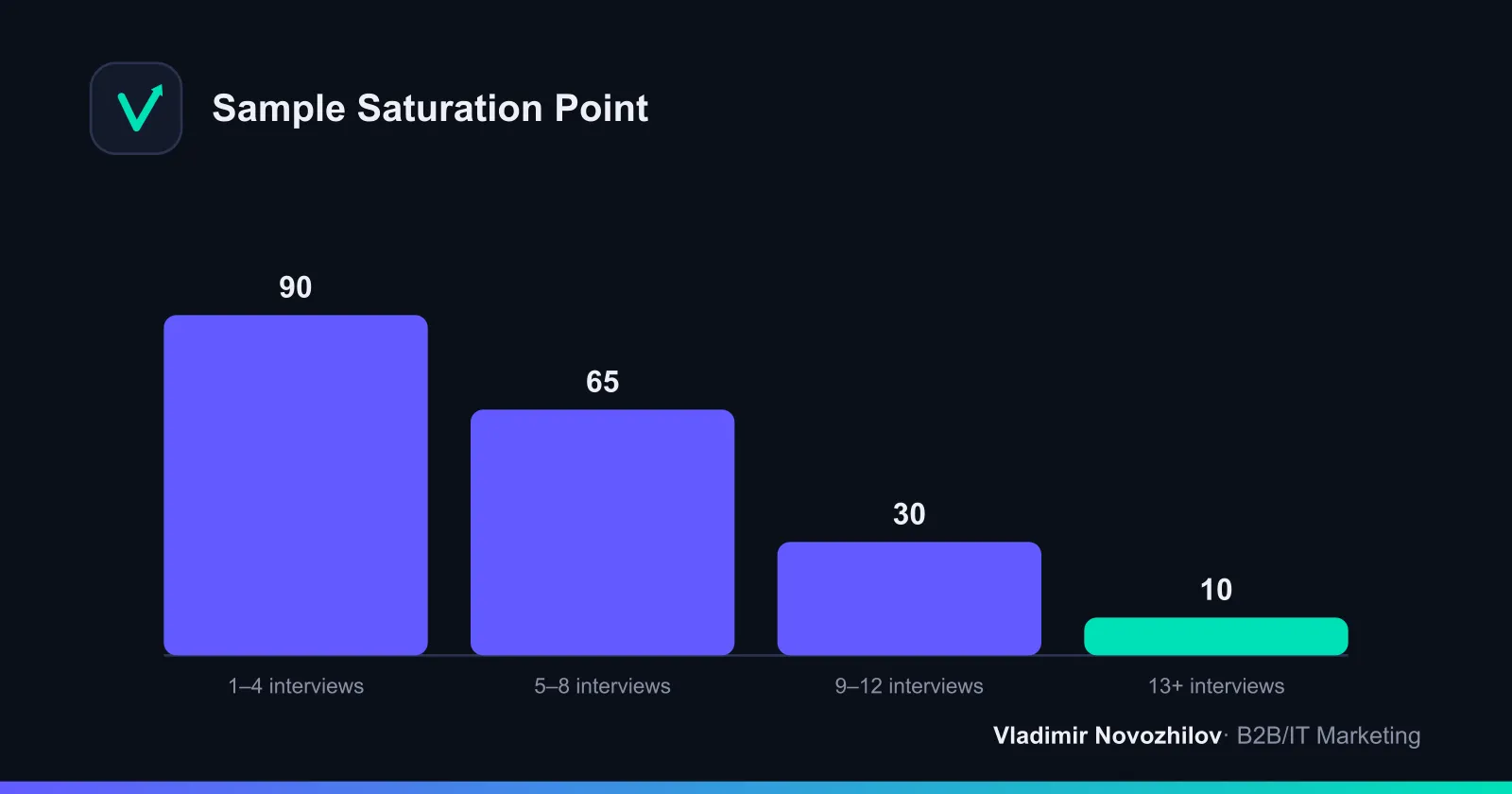
If your audience is heterogeneous, break it into segments and run 8–12 interviews per segment. A single conversation should last 40–60 minutes.
Sample customer interview questions (by task)
Here are sample in-depth interview questions grouped by objective. These are ready-made phrasings — adapt them to your own context.
Introduction and context:
- Tell me about what you do and what a typical workday looks like for you?
- Who on your team is responsible for this task?
Problem interview (pain points and experience):
- How do you handle this task right now? Walk me through the steps.
- When was the last time you ran into this? What happened?
- What’s the most frustrating part of this process?
- How much time and money does it take?
- Have you tried solving it a different way? Why didn’t that work?
Solution interview (reaction to the product):
- What’s unclear to you here at first glance?
- What task do you think this solves?
- What would stop you from using this?
These are the basic customer interview questions that cover most scenarios. What matters more than the list itself is the ability to dig deeper: after every answer, ask “why?” and “tell me more.”
Right and wrong phrasings
| What NOT to say (leading/hypothetical) | What to say instead (about past experience) |
|---|---|
| “Don’t you feel like you’re missing automation?" | "Tell me how you handle this right now" |
| "Would you buy a service like this?" | "When was the last time you paid for something similar?" |
| "Wouldn’t it be convenient to get reports in one click?" | "What do you do when you need a report?" |
| "Do you like our product?" | "What did you try first, and why?” |
How to conduct customer interviews: rules for running the conversation
The main rule for how to conduct customer interviews: listen more, talk less.
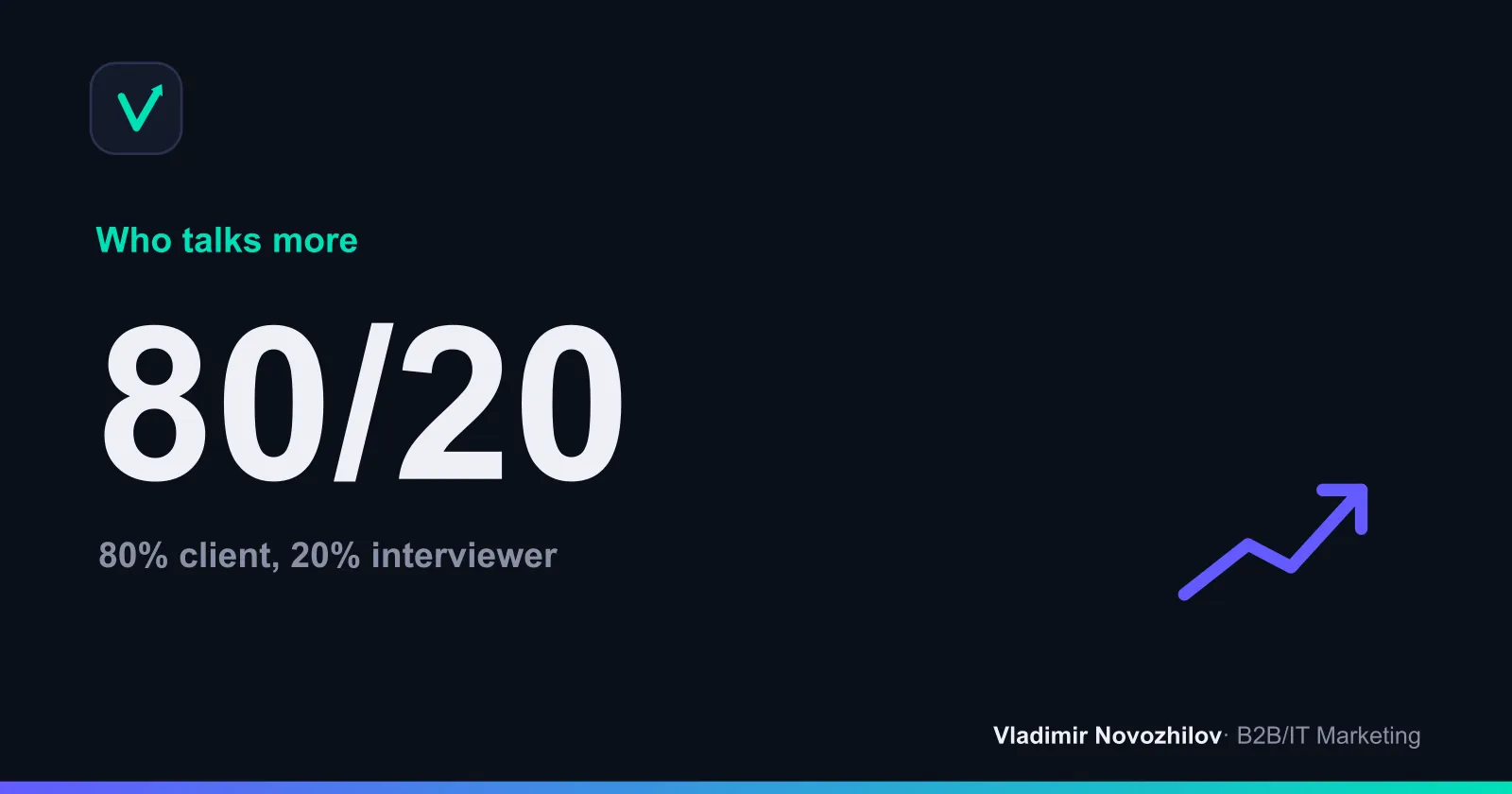
- Stick to an 80/20 ratio. The customer talks 80% of the time, you talk 20%.
- Ask open-ended questions. No yes/no questions — only “how,” “why,” and “tell me about.”
- Don’t defend the product. Criticism is data, not something to argue about.
- Use pauses. Silence prompts the other person to add more detail.
- Dig deeper. The “five whys” technique helps you get to the real cause.
- Record quotes verbatim. The customer’s exact wording is more valuable than your paraphrase.
“The best interviewer is more like a curious child than a salesperson. The moment you start trying to convince the other person, the interview turns into a pitch, and the data loses its value” — a common principle among product researchers and UX specialists.
Common interview mistakes and how to avoid them
- Selling instead of researching. You’re there to learn, not to persuade.
- Leading questions. They hint at the “right” answer and taint your sample.
- Questions about the future. “Would you use this?” — people are bad at predicting their own behavior. Ask about the past instead.
- Wrong target audience. Talking to the wrong person produces answers that sound good but aren’t useful.
- No recording. Memory distorts facts within an hour.
- The interviewer talking too much. Breaking the 80/20 ratio.
How to analyze in-depth interview results
Analyzing interview results is the stage most often botched. There are recordings, but no conclusions. Work through it systematically.
- Transcribe. Turn recordings into text right after the conversation.
- Pull out quotes and facts. Note pain points, tasks, barriers, emotions.
- Code the data. Tag fragments (e.g., “reporting problem,” “distrust of vendors”).
- Group patterns. Look for recurring themes across different people — these are your insights.
- Map to hypotheses. Each hypothesis gets a verdict: confirmed, rejected, or needs more data.
- Draw conclusions and decisions. What will you change in the product, positioning, or funnel.
Results are easiest to package into user personas, JTBD statements, and a CJM. That way, qualitative data turns into concrete product and marketing decisions.
Checklist for preparing and conducting an in-depth interview
Here’s an in-depth interview checklist as a progress table — check off items as you complete them.
| Stage | Item | Done |
|---|---|---|
| Preparation | Hypothesis and goal are defined | ☐ |
| Preparation | Target audience criteria are described | ☐ |
| Preparation | 8–12 respondents recruited per segment | ☐ |
| Preparation | A 10–15 question guide is written | ☐ |
| Preparation | Recording equipment is tested | ☐ |
| Execution | Consent to record obtained | ☐ |
| Execution | 80/20 ratio maintained | ☐ |
| Execution | Questions focus on the past, not the future | ☐ |
| Execution | Clarifying “why” questions asked | ☐ |
| Analysis | Recordings transcribed | ☐ |
| Analysis | Quotes and patterns identified | ☐ |
| Analysis | Verdict reached for each hypothesis | ☐ |
Custdev interview guide template
Here’s a ready-made guide template you can copy and fill in for your own product.
- Introduction (2 min). Introduce yourself, explain the purpose, ask for permission to record, ease the tension.
- Warm-up and context (5–7 min). Who the respondent is, their role, how their workflow is structured.
- Main block — pain points and experience (20–25 min). How they handle the task now, what gets in the way, how much it costs them, what they’ve already tried.
- Deeper dive (10 min). “Five whys,” walking through a specific recent case.
- Solution block (if needed, 5–10 min). For solution interviews only: reaction to the prototype.
- Wrap-up (3 min). “What did I forget to ask?”, ask for referrals to other respondents, say thank you.
Case studies: in-depth interviews in business
IT company and churn. A project management service was losing customers in their second month. A series of 12 problem interviews revealed that people weren’t leaving because of missing features — they didn’t understand where to start. The fix was an onboarding flow, not new features. Churn dropped.
Services agency and positioning. A consulting firm conducted customer interviews with 10 clients and heard that they were valued for “peace of mind and predictability,” not “expertise,” as the website claimed. The landing page copy was rewritten in the customers’ own language, and lead conversion increased.
B2B startup and MVP. Before development, the founder ran 15 problem interviews and discovered the original problem hypothesis was wrong — the real pain point was in an adjacent process. Pivoting at the idea stage saved months of development work.
These examples illustrate the key point: in-depth customer interviews pay off not through the number of questions asked, but through the quality of the decisions you make based on what you hear.
Frequently asked questions
Below are short answers to common questions about customer interviews. Fuller explanations are in the FAQ section.
FAQ
- How many respondents are needed for an in-depth customer interview?
- For a single segment, 8–15 interviews is usually enough. A practical rule: stop when new respondents stop bringing new information — when 3–4 in a row repeat what you've already heard. This is called the saturation point. If there are multiple segments, plan for 8–12 interviews per segment.
- What's the difference between a problem interview and a solution interview?
- A problem interview explores the customer's real experience and pain points without mentioning your product — you're checking whether the problem actually exists. A solution interview comes later: you show a prototype or concept and observe the reaction, willingness to pay, and clarity of value. Start with the problem interview, then move to the solution interview.
- How long does one in-depth interview take?
- The optimal length is 40–60 minutes. Under 30 minutes isn't enough to uncover context, and over 75 minutes tires both participants, which lowers answer quality. Set aside another 15–20 minutes after the conversation to write up notes while the details are still fresh.
- Can an in-depth interview be conducted online?
- Yes, a video call works well, especially for B2B and geographically distributed audiences. It's important to turn on video to catch nonverbal reactions, record with the participant's consent, and minimize technical glitches. For contextual and ethnographic interviews, an in-person format is still more informative.
- What questions should you avoid in a custdev interview?
- Avoid leading questions ("Wouldn't you agree you're missing feature X?"), hypothetical questions ("Would you buy this if...?"), and questions asking people to evaluate the future. People are poor at predicting their own behavior. Ask about past experience and concrete facts: what they did, when, how much they spent, what got in the way.