How Content Drives Leads: A Practical Guide

TL;DR
Content can generate leads for months and years — and the cost per lead decreases over time. This article explains how to allocate formats across TOFU/MOFU/BOFU, calculate CPL and conversion, connect content to CRM, which lead magnets work best, and includes numeric case studies, a checklist and a content-plan template.
Advertising brings inquiries while you pay for impressions. Content works differently: one strong article or webinar can generate leads for months or years, and the cost of each subsequent contact falls. That’s why content lead generation is a core channel for B2B, IT and complex services where decisions take time and rely on trust.
This piece explains how it works in practice: how content differs from other channels, which formats work at each funnel stage, how to calculate CPL and conversion, and how to build the system from scratch. Inside — tables, a checklist, a content-plan template and numeric case studies.
How content turns readers into leads and how it differs from other channels
By lead generation through content we mean attracting potential clients (leads) with useful materials: articles, videos, webinars, case studies, lead magnets. The reader gets value for free and in return leaves a contact or inquiry. This is a form of inbound: the client comes to you, not you interrupting their day with a cold call.
To speak the same language, let’s fix the terms:
- Lead — a contact of a person or company that showed interest: left an email, downloaded a material, registered for a webinar.
- Inbound marketing (incoming lead generation) — attracting an audience through usefulness and search rather than direct pressure.
- Content marketing for customer acquisition — systematic work with materials that guides a person from first acquaintance to deal.
- Lead magnet — a valuable material (checklist, template, calculation) given in exchange for a contact.
- Sales funnel — the customer’s path through stages: awareness → interest → decision.
The main difference between content and paid advertising or cold outbound is the nature of the asset. Advertising is renting attention: stop paying — the flow dries up. Content is owned: a published article continues to bring leads from search for free. Below — a comparison of channels by key parameters.
| Channel | Type | Speed of first leads | Cost per lead over time | Lead quality |
|---|---|---|---|---|
| Content (inbound) | Inbound | Slow (1–6 mo) | Low, decreases over time | High, warm |
| Search ads | Paid | Fast (days) | Consistently high | Medium |
| Targeted/social ads | Paid | Fast | Medium | Medium |
| Cold calls / emails | Outbound | Fast | High (labor) | Low, cold |
| Referral programs | Inbound | Medium | Low | Very high |
The conclusion is simple: content is not a replacement for ads, it’s the foundation. Ads provide fast but expensive flow; content gives a slow start and inexpensive cumulative results. Strong teams use both: paid traffic accelerates content, and content lowers overall acquisition cost.
Why content works for B2B leads: facts and trends
A B2B/IT buyer completes a significant part of their decision journey on their own — reading, comparing, studying cases — and reaches the seller almost decided. Industry estimates say a buyer completes up to 60–70% of the journey before the first contact with sales. If you aren’t present in their research — you’re out of the game.
Trends that strengthen content lead generation:
- Trust matters more than reach. For complex services, buyers choose those who have already proven expertise through materials. A case with numbers convinces better than any ad offer.
- Search remains the entry point. SEO content catches people at the moment they put their problem into words — meaning they’re ready for a conversation.
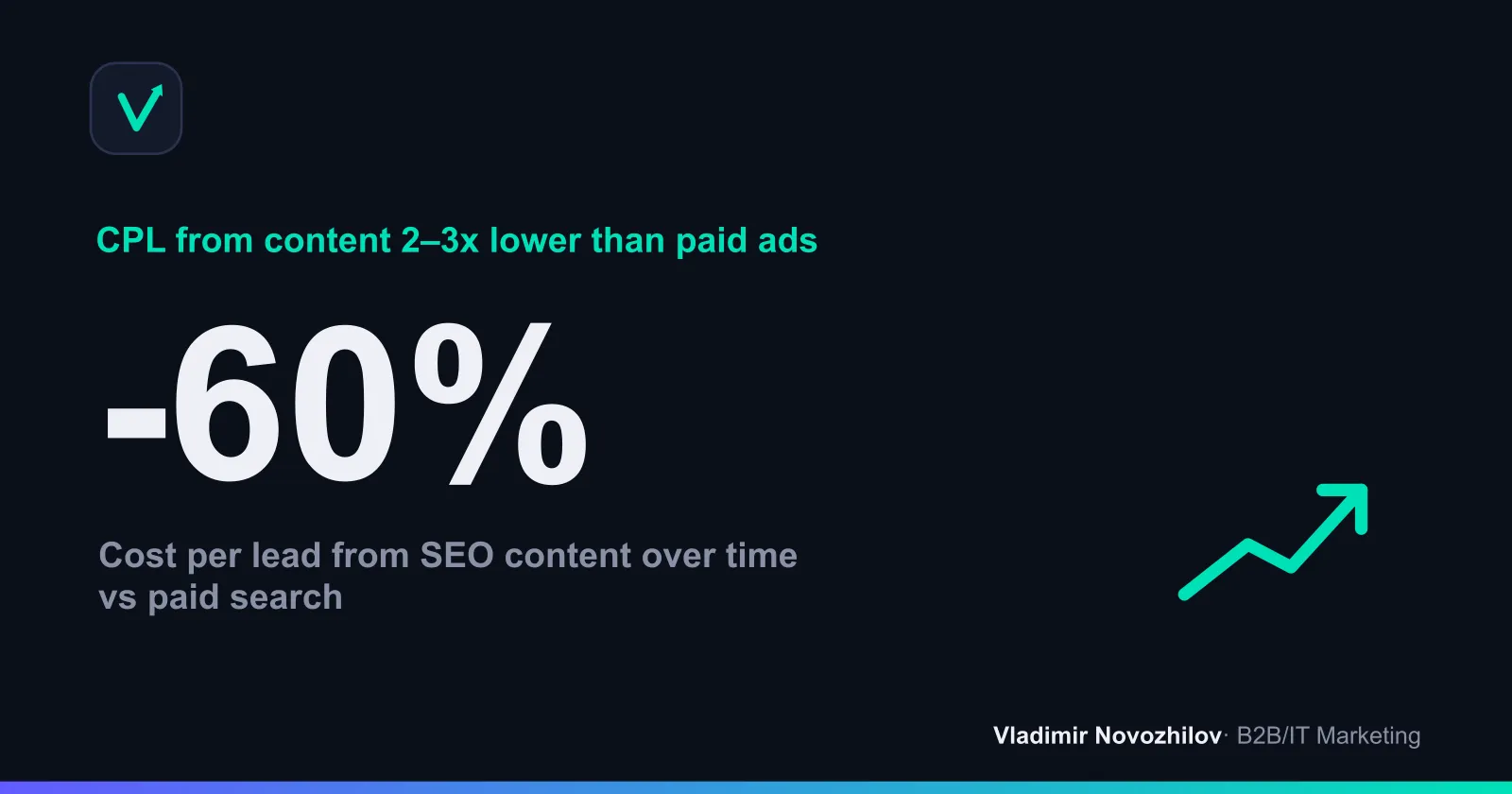
- Content leads are cheaper over time. Inbound leads cost noticeably less than outbound, and the gap grows.
- Content scales without linear budget growth. One article serves thousands of readers simultaneously.
Important: inquiries don’t appear “just because content exists.” Leads come where the whole system is built — from traffic acquisition to contact capture and handoff to sales. We’ll break this down by funnel stages.
Content funnel: which formats work at TOFU, MOFU, BOFU
For content to generate inquiries, it’s distributed across the funnel. The classic model splits the journey into three stages — TOFU/MOFU/BOFU.
- TOFU (Top of Funnel) — awareness. The person only recognizes the problem. Broad-reach content works here: overview SEO articles, short videos, posts. The goal is traffic and topic introduction, not selling.
- MOFU (Middle of Funnel) — interest and evaluation. The person compares approaches and solutions. Webinars, in-depth guides, comparisons, lead magnets fit here. The goal is to collect a contact and start warming.
- BOFU (Bottom of Funnel) — decision. The person chooses a vendor or product. Case studies, calculations, demos, testimonials work here. The goal is to turn the contact into an inquiry.
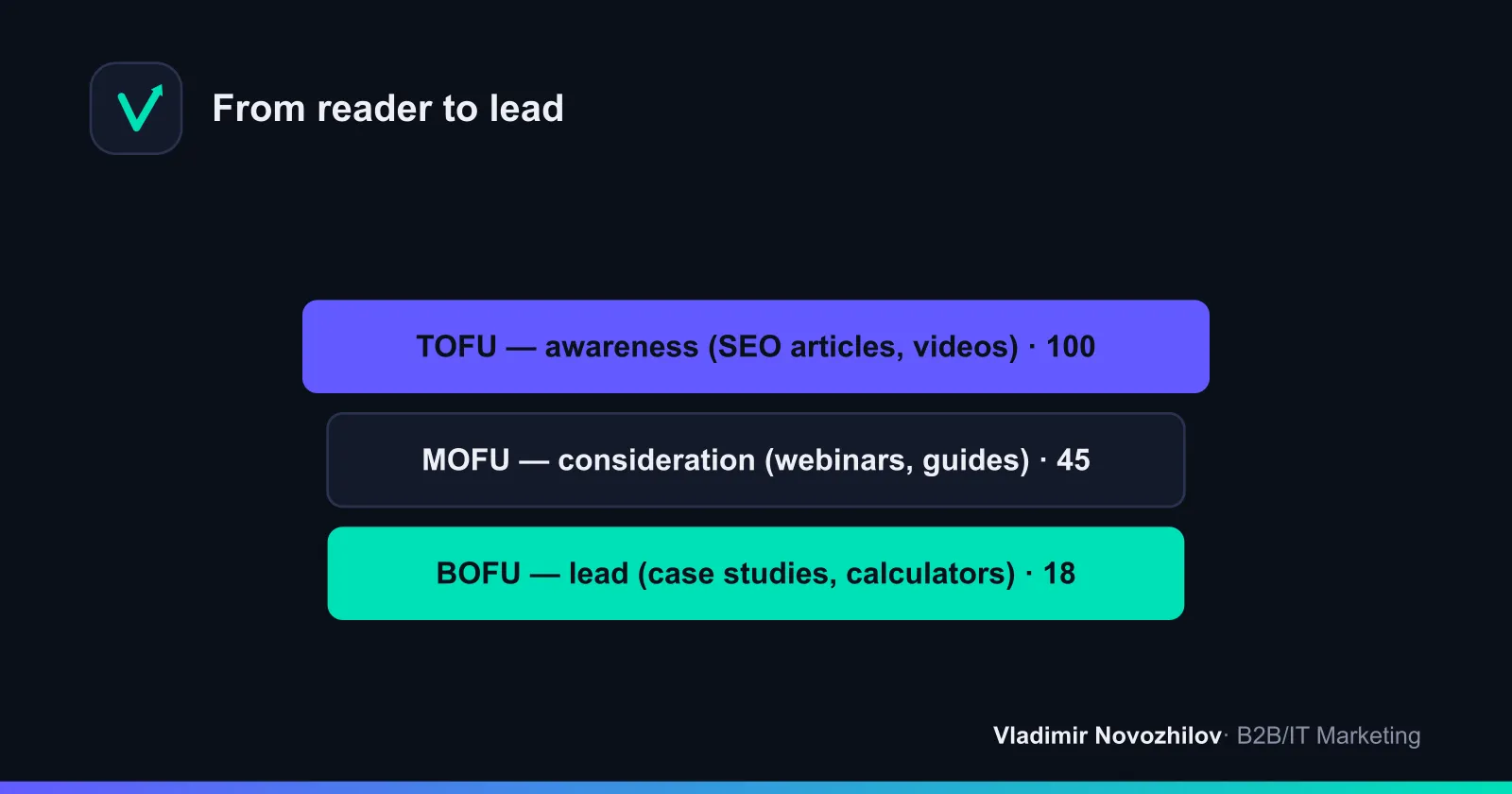
A common mistake is publishing only TOFU content (overview “what is…” articles) and wondering why there are no inquiries. There’s traffic but no conversions to leads because there are no bridges deeper into the funnel. Conversely, trying to sell with BOFU materials to a cold audience is pointless — there’s nothing to convince yet. The stage linkage is the content lead-gen strategy.
Template content plan by funnel stages
| Stage | Goal | Content formats | Lead capture point | Success metric |
|---|---|---|---|---|
| TOFU | Reach, traffic | SEO articles, overview videos, posts | Subscription, soft CTA | Traffic, read-throughs |
| MOFU | Interest, contact | Webinars, guides, checklists, quiz | Lead magnet, registration | Number of leads, form CTR |
| BOFU | Inquiry, sale | Case studies, calculators, demos, testimonials | Inquiry, RFQ | Conversion to MQL/SQL |
This template is a framework. Under it you pick concrete topics: at TOFU — questions the audience Googles; at MOFU — how to practically solve the task; at BOFU — why choose your approach.
Formats that generate leads: blog, video, webinars, cases, lead magnets, podcasts
Let’s unpack formats individually — what works, how and at which stage. Below is a comparative table for lead conversion, production cost and role in the funnel.
| Format | Stage | Conversion to lead | Production cost | When to apply |
|---|---|---|---|---|
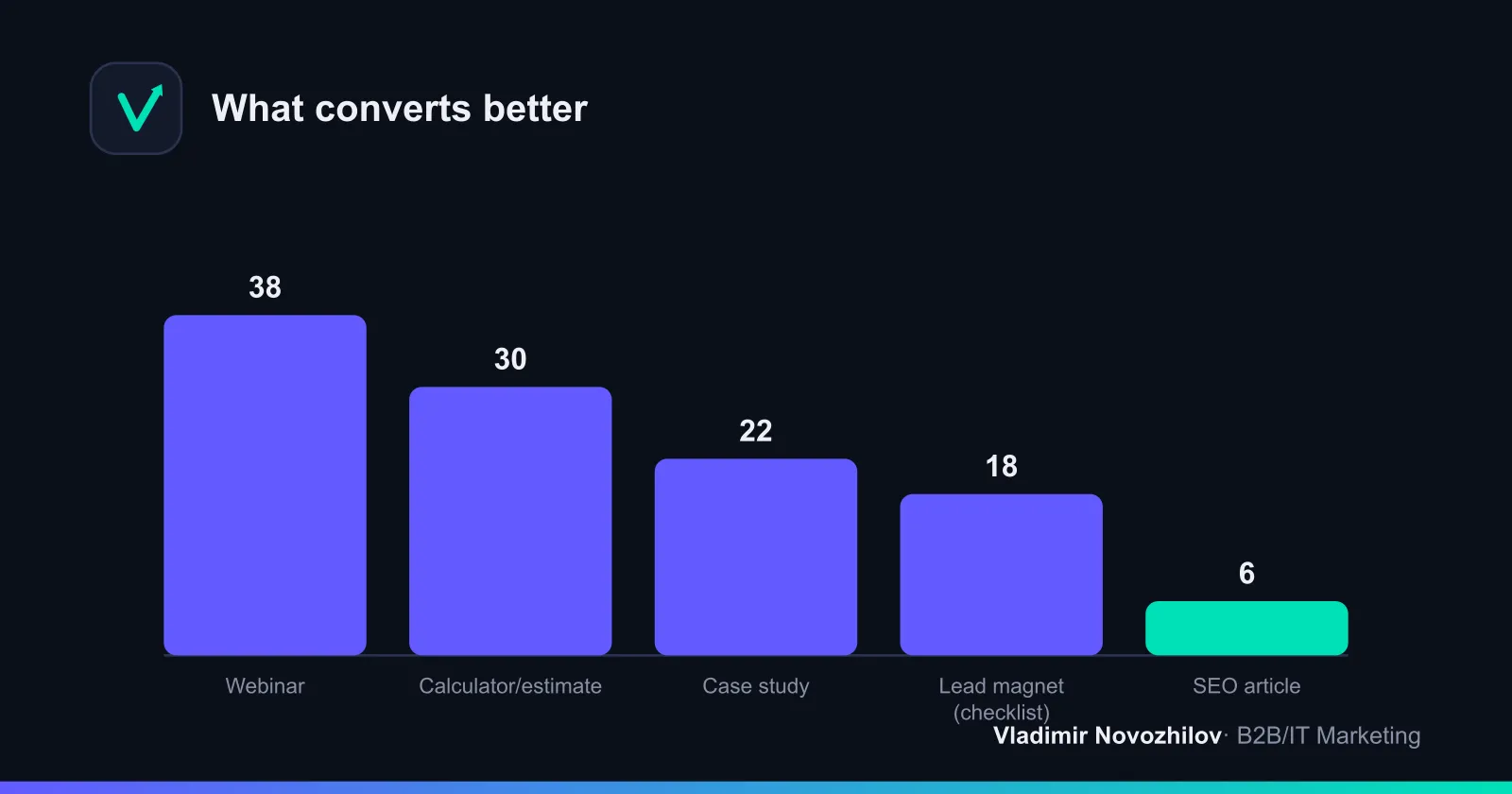
| SEO blog article | TOFU/MOFU | Low (3–7%) | Medium | Capture search demand |
| Video / YouTube | TOFU | Low–medium | High | Reach and trust |
| Webinar | MOFU | High (25–40%) | Medium | Warm up and collect warm leads |
| Case study | BOFU | High (15–25%) | Low | Convince before purchase |
| Lead magnet (checklist, template) | MOFU | Medium (15–20%) | Low | Capture contact |
| Calculator / quiz | MOFU/BOFU | High (25–35%) | High | Personalize the offer |
| Podcast | TOFU | Low | Medium | Long-term trust, reach |
| Email newsletter | MOFU/BOFU | Medium–high | Low | Nurture and re-engage |
Brief notes on key formats:
- Blog and SEO articles — the foundation of inbound lead generation. They provide steady free traffic, but convert poorly on their own — they need lead magnets and clear CTAs.
- Video builds trust faster and works well for reach, but production is costlier and direct conversion is lower.
- Webinars are among the most effective B2B formats: a person spends an hour with you, so they’re warm. Registration equals a ready lead.
- Case studies remove final doubts at the bottom: a case with figures answers “will this work for me?”
- Lead magnets are the workhorse for contact capture. More on them below.
- Podcasts play the long game: weak direct conversion but a strong cumulative trust effect.
Lead magnets: packaging value in exchange for a contact
A lead magnet is a practical material that solves a narrow reader task and is delivered in exchange for a contact. A good magnet saves time or money now, not “sometime.”
What works in B2B and services:
- checklists and templates (e.g., “Website audit checklist before an ad launch”);
- calculations and calculators (estimate, savings, ROI);
- mini-guides and role-specific breakdowns;
- webinar recordings and closed research;
- document templates, briefs, scripts.
Packaging rules:
- One task — one magnet. Not “everything about marketing” but “one-month content-plan template.”
- Quick value. Result visible in 10–15 minutes of use.
- Match the stage. On MOFU — a practical tool; on BOFU — a calculation for a specific situation.
- Minimum form fields. The fewer questions, the higher the conversion. Email is enough at the start.
- An honest exchange. Don’t promise more than you deliver: a contact without trust won’t turn into an inquiry.
You don’t need a lead magnet for every piece. Place them where you need to convert an anonymous reader into a known contact — and then lead them through touchpoints.
SEO content as the main source of inbound leads
SEO content are articles answering real audience queries and bringing free targeted search traffic. Unlike ads, the flow doesn’t stop when the budget ends.
How it brings leads:
- You find queries your audience is typing at different funnel stages.
- You write materials that cover those queries better than competitors.
- You embed conversion points: lead magnet, form, webinar invite.
- A search reader becomes a contact, then an inquiry.
The key is intent. TOFU queries (“what is…”) give reach but few inquiries. Commercial and problem queries (“how to choose…”, “comparison…”, “cost…”) are closer to money and convert better. A strong strategy covers the whole ladder — from informational to transactional queries.
Important: SEO unfolds over 3–6 months. It’s not a sprint but an investment. After that a post works as an asset, bringing leads for years with almost no new spend.
Email content and newsletters to nudge and re-generate leads
Getting a contact is half the job. Then email kicks in: sequences that warm the person up to an inquiry and bring back those who aren’t ready.
How it works in practice:
- Welcome sequence. After downloading a lead magnet, the person receives a series: value, a case, an invite to a webinar or consultation.
- Warming with cases. Regular emails with breakdowns remove objections and keep attention.
- Reactivation. Some contacts “sleep” — you bring them back with useful mailings and new reasons.
- Interest-based segmentation. Different segments get different content; this multiplies conversion to leads.
The chain “SEO article → lead magnet → email sequence” is one of the most profitable in inbound lead gen. On average a contact needs 5–7 touches, and the chance of an inquiry rises with each email.
Connecting content to CRM and the sales funnel
To avoid losing leads from content, link content marketing with CRM and sales. Otherwise you won’t know which material brings revenue and which brings only traffic.
A minimal integration scheme:
- All conversion points send leads to CRM with source (UTM, material name).
- Lead scoring is set up — points for actions: downloaded a magnet (+5), attended a webinar (+20), opened a case (+10). This separates warm from cold.
- MQL and SQL criteria are defined. MQL — a lead with sufficient interest; SQL — ready for sales, handed to sales team.
- Content-marketing automation. Mailings, scoring, segmentation and reminders are set once and then run by themselves — saving dozens of hours.
Interactive formats help too — chatbots and quizzes: a bot collects initial qualification in dialogue, a quiz segments needs and immediately gives a personalized offer. That’s also content — just interactive.
How to measure effectiveness: CPL, conversion, MQL/SQL
Without numbers content becomes creation for creation’s sake. Here are metrics that show whether it works for inquiries:
- Traffic and read-through rates — evaluate TOFU content.
- Conversion of content into leads — share of readers who left a contact. Calculated as leads divided by material visitors.
- CPL (Cost per Lead) — cost of a single lead.
- MQL and SQL — how many leads reached qualification and sales stages.
- CAC and profitability — final cost of a customer from content.
CPL formula and example calculation
CPL = Затраты на контент ÷ Количество полученных лидов
Example. You invested 120 000 ₽ in a cycle of articles and their promotion for a quarter. The materials brought 200 leads.
- CPL = 120 000 ₽ ÷ 200 = 600 ₽ per lead.
Compare with search ads in the same niche where a lead costs 1 800 ₽. Content is more expensive at the start (it takes time), but already in the first quarter it gives CPL three times lower — and it will keep falling because articles keep working without new investments. Therefore conversion of content to leads and CPL are the main metrics to track monthly.
Cases: how many leads different content brings (with numbers)
A few generalized practical examples from B2B and services — how different formats produce leads.
Case 1. Webinar in IT services. A company ran a series of 4 niche webinars. Registration via a landing page with a single form. Average attendance — 120 people, registration-to-warm-lead conversion — about 35%. Result: ~170 qualified leads in a quarter with CPL around 700 ₽ — twice cheaper than their search ads.
Case 2. SEO blog + lead magnet in consulting. 15 articles targeting problem queries plus a downloadable template under each. After 5 months the blog reached 8,000 visits per month, conversion to lead — 4.5%. That’s ~360 leads monthly with almost no additional costs — the asset continues to work.
Case 3. Case studies on an agency site. A section with 12 detailed cases (problem → solution → numbers) placed at the end of commercial articles. Readers who reached the case converted into an inquiry in 18% of cases — the hottest bottom-funnel content. The “cases + commercial articles” combo increased inquiries by 40% with no new traffic.
Overall conclusion: inquiries are produced not by a single “magic” format but by a system where TOFU traffic is warmed by MOFU content and closed with BOFU materials.
Checklist: how to build a lead-generation system through content
Step-by-step checklist to launch content lead generation from scratch:
- Describe the audience and their pains. Who makes the decision, what they Google, what objections prevent buying.
- Collect keywords and topics for each funnel stage — from informational to commercial queries.
- Create a content plan following the TOFU/MOFU/BOFU template (table above).
- Create 1–2 lead magnets for MOFU — a checklist, template or calculation.
- Set up capture points: forms, landing pages, registrations, chatbot or quiz.
- Connect CRM and UTM tags to see the source of each lead.
- Launch an email sequence for warming and nudging contacts.
- Set up lead scoring and MQL/SQL criteria for handoff to sales.
- Measure metrics: traffic, conversion to lead, CPL, share of MQL/SQL.
- Optimize: scale profitable formats, switch off empty ones.
Follow the steps in order — and in a quarter you’ll have not scattered content but a working lead-generation machine.
Common mistakes and how to avoid them
Even good content won’t bring inquiries if typical mistakes are made.
- Only TOFU content. Lots of overview articles, zero conversion materials. You have traffic, no inquiries. Solution — build MOFU and BOFU.
- No capture points. The reader finishes and leaves because there was nowhere to go. Add lead magnets and clear CTAs.
- Weak lead magnet. “Download our presentation” is useless. Give a practical tool.
- No analytics. Without CRM and UTM you don’t know which content works and cut budget blindly.
- Expecting instant results. SEO unfolds over months; abandoning after 4 weeks wastes the investment.
- Leads not passed to sales. Collected contacts aren’t processed — conversion to deals collapses. Set up MQL → SQL handoff.
- Selling instead of helping. Content that only advertises isn’t read. Give value first, offer later.
Avoid these errors and you turn content from a cost item into a predictable source of inquiries — a channel that becomes more profitable over time.
Content lead generation is not a one-off campaign but a system: the right formats at each funnel stage, honest lead magnets, CRM linkage and discipline in measuring CPL and conversion. Start small — a content plan and one lead magnet — and build the system based on the numbers.
FAQ
- When should I expect the first leads from content?
- Typically the first leads arrive within 1–6 months. Webinars and lead magnets activate fastest; SEO articles take longer (they unfold over 3–6 months). After that leads come steadily and CPL declines.
- Which formats should I use at TOFU, MOFU and BOFU?
- TOFU: overview SEO articles, videos, posts — they drive traffic. MOFU: webinars, guides, checklists, calculators — they capture contacts and warm them up. BOFU: case studies, demos, testimonials and calculations — they convert into inquiries.
- What should a lead magnet include so people download it and leave a contact?
- Solve one practical task in 10–15 minutes: a checklist, template, calculation or webinar recording. Keep form fields minimal, promise honest value and match the funnel stage — this increases conversion.
- How do I connect content to CRM so I don't lose leads?
- Send all conversions to CRM with UTM and the material name, set up lead scoring and MQL/SQL criteria, automate mailings and reminders. That way you see which content brings revenue, not just traffic.
- How to calculate CPL for content and why does it fall over time?
- CPL = content costs ÷ number of leads. Content is an asset: materials keep working without extra spending, so as the number of leads (denominator) grows, CPL decreases.
- Should I stop paid ads if content already brings leads?
- No. Channels complement each other: paid traffic accelerates content performance and speeds up testing, while content reduces average acquisition cost and improves lead quality.