How to Find and Strengthen Competitive Advantages


TL;DR
We analyze what makes your company objectively stronger than competitors in the customer's eyes. Types of advantages, Porter, Lamben and SWOT, a step-by-step algorithm, metrics, common mistakes, examples and a checklist for independent work.
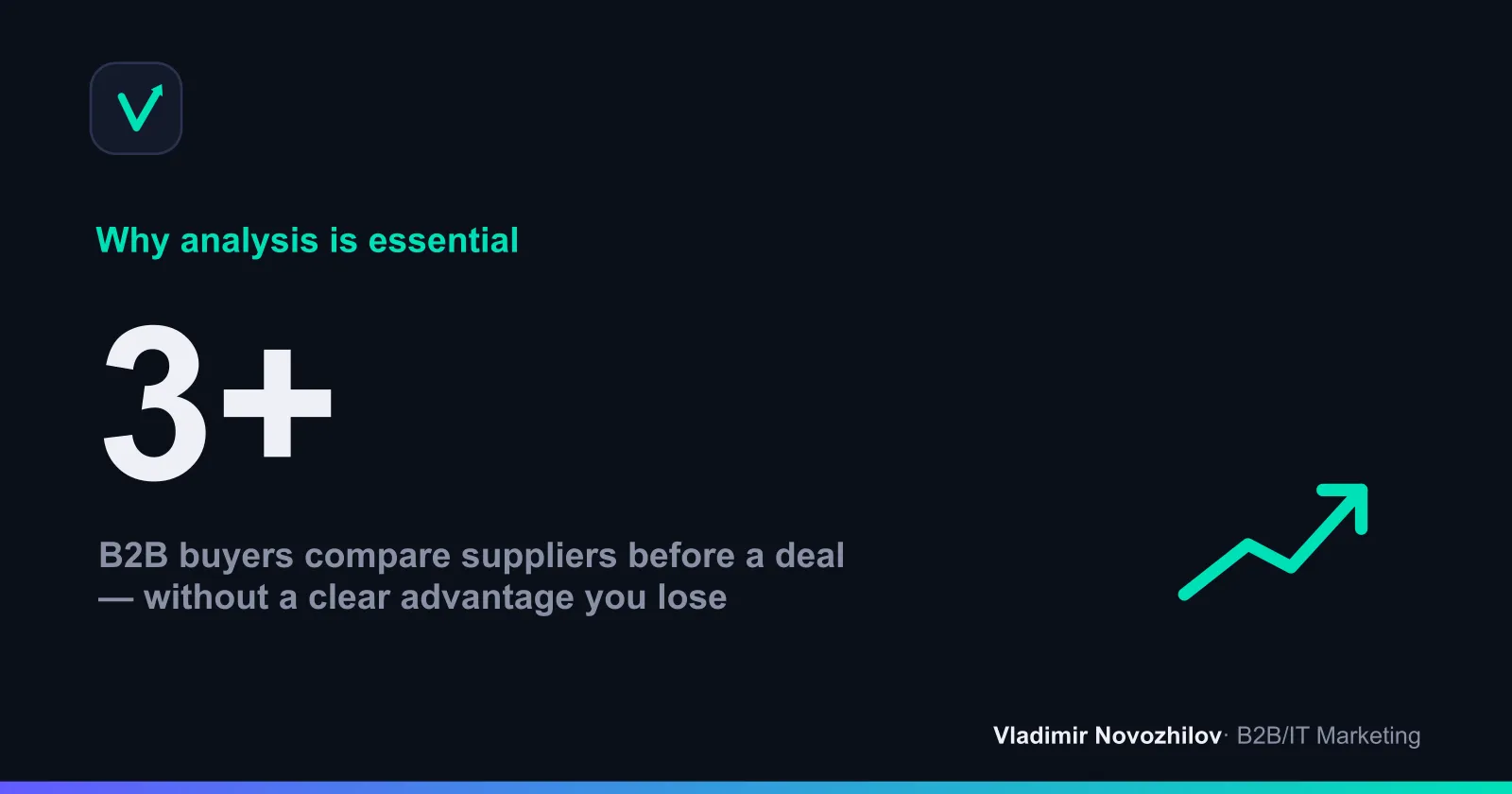
Clients in B2B and services rarely make decisions at random: before a deal they compare several suppliers and directly ask, “why you, not them.” A convincing answer is the result of systematic work on competitive advantages: what exactly in your company and product is more valuable to the buyer and why it’s hard to replicate. Below is a practical guide: types of advantages, Porter, Lamben and SWOT models, a step-by-step algorithm, metrics, examples and a ready checklist.
What exactly counts as a competitive advantage and why review it regularly
Competitive advantage — a characteristic of a company or product that creates greater value for the customer than competitors do, and is difficult to copy. It is always relative: it exists only in comparison with the market.
Why periodically analyze your company’s competitive advantages:
- to formulate an honest USP instead of generic phrases about “quality and individual approach”;
- to justify price and reduce discount pressure;
- to choose segments where you are objectively stronger;
- to notice in time that an advantage is eroding.
It’s important to distinguish product competitiveness (comparison of a specific product) from firm competitiveness (comparison of companies as systems). A product is copied in weeks, a system — in years, so the long-term bet is at the firm level.
Types of competitive advantages: internal and external
A classic approach from the work of J.-J. Lamben divides advantages into internal and external.
- Internal rely on costs and productivity: cheap production, efficient logistics, automation, economies of scale. They allow you to sell cheaper while maintaining the same margin.
- External are built on distinctive qualities valuable to the customer: unique features, service, speed, brand. They justify keeping price above the market.
Internal advantages lead to cost leadership, external ones — to product differentiation. These are the two basic Porter strategies.
Natural, artificial and sustainable competitive advantages
Another perspective is by the origin of the advantage:
| Type | What it is | Example |
|---|---|---|
| Natural | Objective facts about the company | Lower price, delivery time, 15 years in the market, a staff of certified engineers |
| Artificial | Marketing-created trust enhancers | Outcome guarantee, case studies, personal manager, lead magnet |
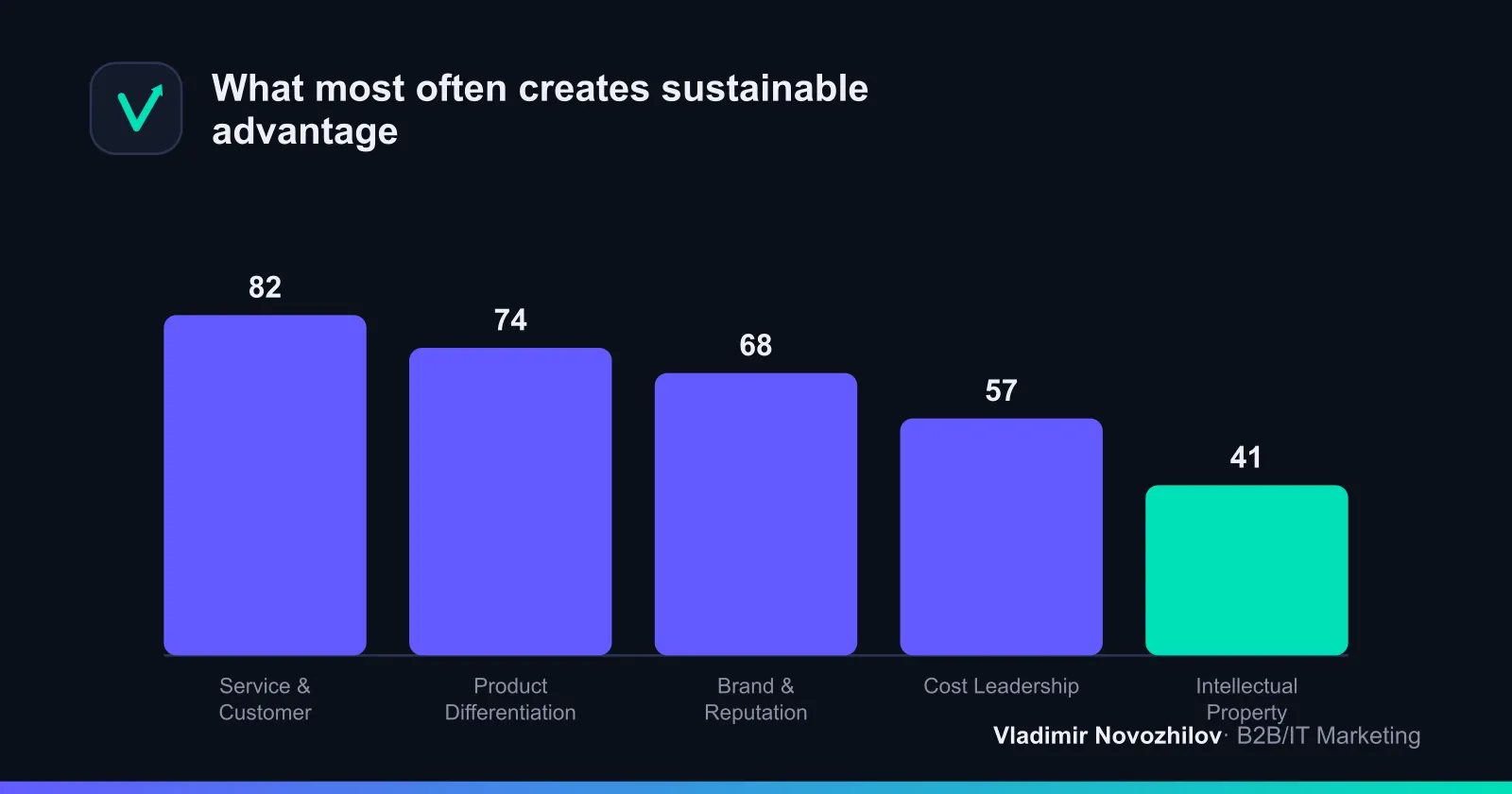
| Sustainable | Advantages that are hard to copy | Patent, strong brand, unique technology, exclusive resource |
Sustainable competitive advantage — one that persists for years and is not quickly reproduced by competitors. It determines long-term profit. Natural advantages are easily copied, artificial ones almost always are, while a patent, reputation or network effect provide protection.
Porter’s Five Forces model for assessing the competitive environment
Porter’s Five Forces (Michael Porter, 1979) helps evaluate not a specific firm but the attractiveness of an industry and pressure on profit. The five forces:
- Rivalry among existing competitors — intensity of competition.
- Threat of new entrants — how high entry barriers are.
- Bargaining power of suppliers — can they dictate terms.
- Bargaining power of buyers — can customers push the price down.
- Threat of substitutes — are there alternative ways to solve the customer’s problem.
The stronger the pressure, the lower the potential margin. Such an analysis suggests where to build defenses: increase entry barriers via expertise, reduce dependence on a single supplier, strengthen value to reduce price negotiation impact.
Jean-Jacques Lamben model: market power and productivity
Jean-Jacques Lamben proposes to measure a company’s position on two axes:
- Market power — the customer’s willingness to pay above the main competitor’s price (an external advantage, differentiation);
- Productivity — how much lower your costs are compared to a competitor (an internal advantage).
Lamben also describes market types — perfect competition, monopolistic competition, oligopoly, monopoly — and a matrix of competitors’ elasticity of response: how rivals react to a price cut or advertising attack. If Porter answers “how attractive is the industry”, Lamben answers “where exactly is my firm and why it holds its position”.
Comparing analysis models: Porter, Lamben, SWOT
No single model replaces the others. Maximum benefit comes from combining them.
| Criterion | Porter’s Five Forces | Lamben model | SWOT analysis |
|---|---|---|---|
| Object | Industry | Firm position | Company and environment |
| Main question | Where is the pressure on profit | What keeps our position | Strengths/weaknesses and risks |
| Key axes | 5 forces of pressure | Market power and productivity | S-W-O-T |
| When to apply | Market assessment, industry entry | Choosing price/differentiation strategy | Quick inventory, start-up |
| Complexity | Medium | High | Low |
A practical order: start with a SWOT of competitors and your company for an overall picture, add Porter for market context and Lamben to choose between price and differentiation.
Step-by-step algorithm to analyze a company’s competitive advantage
Here is a working algorithm that covers the whole cycle — from data to plan.
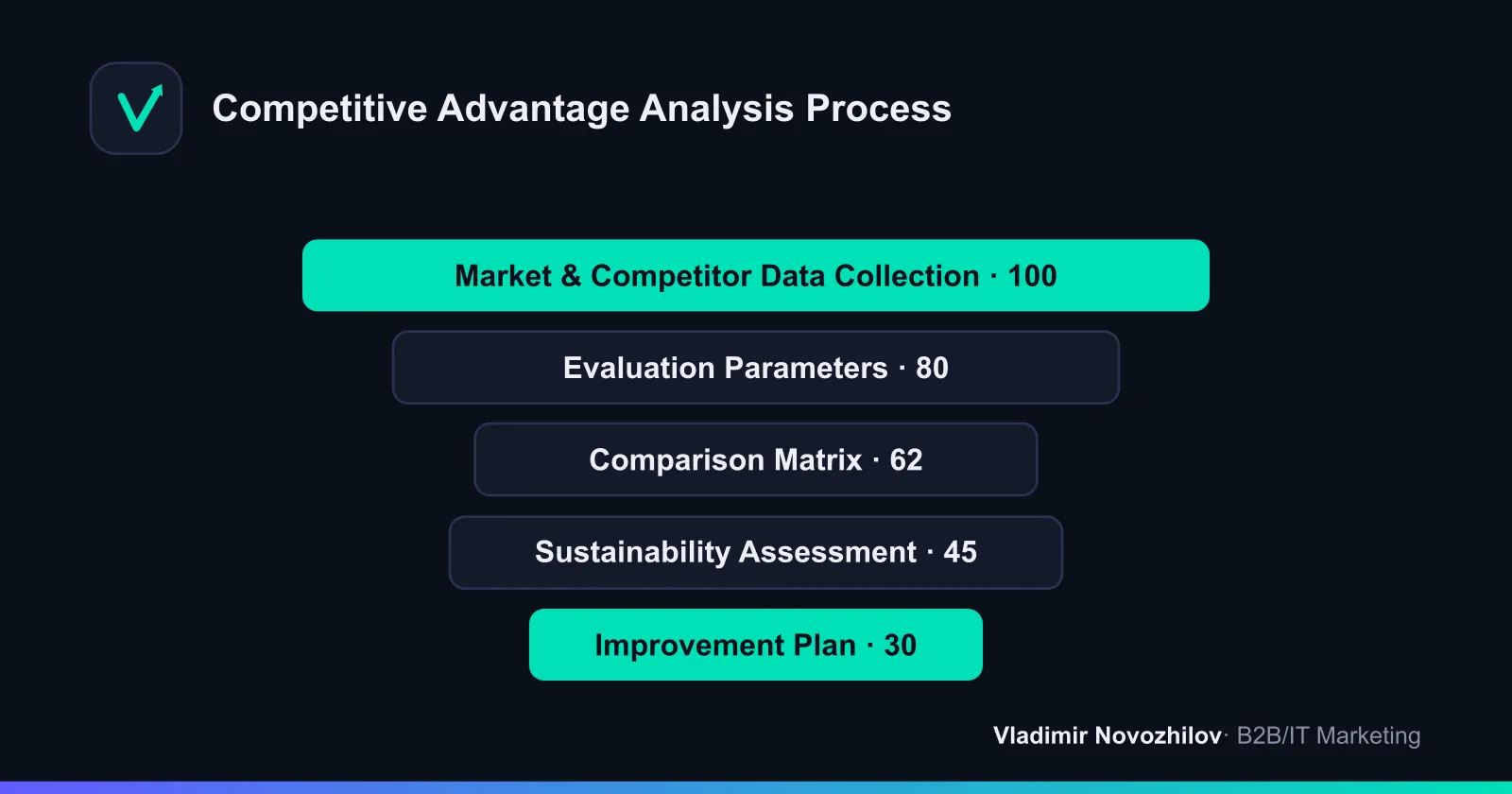
- Collect data. 5–7 direct competitors: websites, price lists, USPs, reviews, social media, commercial offers (you can request them as a mystery shopper).
- Create a list of evaluation parameters. 8–12 factors important to the customer: price, lead times, warranty, assortment, service, expertise, geography, reputation.
- Build a comparison matrix. Rate yourself and competitors on each parameter (for example, on a 1–5 scale) and weight by importance to the customer.
- Evaluate sustainability. For each advantage ask: can this be copied within a quarter? If yes — it’s not a sustainable advantage, but market hygiene.
- Create an improvement plan. Strengthen what customers value and what is hard to copy; close critical gaps.
This is how to answer how to uncover competitive advantages: find the intersection of “important to the customer” and “we do it better than competitors” — and verify sustainability.
How to evaluate competitive advantages: methods and metrics
Evaluating competitive advantages combines qualitative and quantitative approaches:
- Observation of competitors and the market;
- Surveys of employees — salespeople know real customer objections;
- Competitor analysis via a parameters matrix;
- Studying customer values through interviews and reviews.
A simple weighted competitiveness index formula:
Index = Σ (score by parameter × weight of importance)
Example calculation for three parameters (scale 1–5, weights as fractions):
| Parameter | Weight | Us | Competitor A |
|---|---|---|---|
| Service speed | 0.4 | 5 (2.0) | 3 (1.2) |
| Price | 0.35 | 3 (1.05) | 4 (1.4) |
| Expertise | 0.25 | 5 (1.25) | 3 (0.75) |
| Index | 1.0 | 4.30 | 3.35 |
Such a matrix clearly shows where you win (service, expertise) and where you lag (price) — and where to direct resources.
How to formulate and present competitive advantages to customers
For an advantage to work in sales, follow four rules:
- Specifics instead of claims. Not “fast delivery” but “delivery within 24 hours or your money back.”
- Customer-benefit language, not company features: “save 3 days on approvals.”
- Proof — numbers, case studies, guarantees.
- Differentiation: the wording should set you apart, not repeat everyone else.
Description template:
| Block | What to fill in |
|---|---|
| Customer problem | What pains the buyer has |
| Our solution | What we specifically do |
| Difference from competitors | What others don’t have |
| Proof | Number, case, guarantee |
| Benefit | What the customer will get |
Typical mistakes when analyzing competitive advantages
- Comparing yourself to the market “in your head,” without data and a matrix.
- Confusing hygiene (what everyone has) with an advantage.
- Describing advantages in company language rather than customer benefits.
- Ignoring sustainability: a copyable advantage gives no protection.
- Doing the analysis once and never updating it.
- Relying only on management opinion without asking customers.
Examples of competitive advantages across industries
- Logistics company (B2B). Sustainable advantage — an in-house tracking IT system: the client sees the cargo in real time. Expensive to copy, increases retention.
- IT integrator (services). Differentiation via narrow specialization: only implementations for healthcare. Niche expertise becomes an entry barrier for generalists.
- Manufacturer of industrial equipment. Cost leadership through localized assembly — price 15% lower than imported analogs with comparable quality.
- Real estate agency. Artificial advantage — a guarantee of legal transaction cleanliness with financial liability, boosting trust in a competitive market.
How to increase a business’s competitive advantages
To strengthen competitive advantages, move in three directions: reduce costs without losing value, deepen product differentiation and build assets that are hard to copy — brand, IP, customer base, unique competencies. Invest in factors customers named as important in interviews, and turn one-off findings into systemic processes.
Checklist for independent analysis of competitive advantages
- 5–7 direct competitors identified
- Price lists, USPs and reviews collected for each
- 5–10 customer interviews conducted
- Salespeople surveyed about objections
- A list of 8–12 evaluation parameters compiled
- Parameters weighted by importance to the customer
- Comparison matrix with scores built
- Competitiveness index calculated
- Sustainability of each advantage checked
- Advantages formulated in benefit language
- Improvement plan with priorities created
- Date for next review scheduled
Go through this checklist — and you’ll have not a set of slogans, but a substantiated picture: where you are objectively stronger than the market, what to strengthen and how to communicate it to the customer.
FAQ
- How often should I review the analysis of competitive advantages?
- At least once a quarter — more often with active competition and volatile demand. Always after significant product changes, price shifts, or the appearance of a strong competitor.
- How do I distinguish a real advantage from market "hygiene"?
- Ask two questions: is this important to the customer when choosing, and do we do it better than competitors? If the answer is yes to both and it‘s hard to copy within a quarter — it’s an advantage; otherwise it’s hygiene.
- What if competitors make similar promises in their communications?
- Move from slogans to proof: numbers, SLA, case studies, guarantees. Rephrase the benefit in the customer's language and emphasize differences in mechanism, speed, risk or outcome.
- How to determine weights of parameters in the evaluation matrix?
- Collect 5–10 customer interviews, test hypotheses in sales and adjust weights by frequency of mentions and impact on the decision. Verify with the sales team.
- Can I skip interviews and estimate weights intuitively?
- No. Without the customer's voice the picture will be distorted. Minimum required — short interviews and review analysis. Salespeople's input complements but does not replace direct feedback.