Will AI Replace Marketers: What Gets Automated and What Stays


TL;DR
AI will not 'fire' marketers but will eliminate up to half of routine work — from content drafts to creative generation and initial keyword research. Strategy, positioning, legal responsibility and stakeholder communication remain human tasks. This article provides a 3/6/12‑month implementation roadmap, an ROI calculator, measurable case studies and a tools matrix for RF/CIS and global markets.
Short answer — will AI replace marketers?
No. Artificial intelligence already confidently takes on repetitive fragments of work — from content drafts and creative variants to meeting summaries and initial keyword research. But marketing is not only content production. Decisions on positioning, strategy, budget, collaboration with sales and legal responsibility still lie with people. In the coming years, winners will be teams that learn to combine AI correctly with business experience and context.
What’s important to internalize:
- AI automates tasks, not professions. The marketer’s role shifts toward orchestrating tools and analytics.
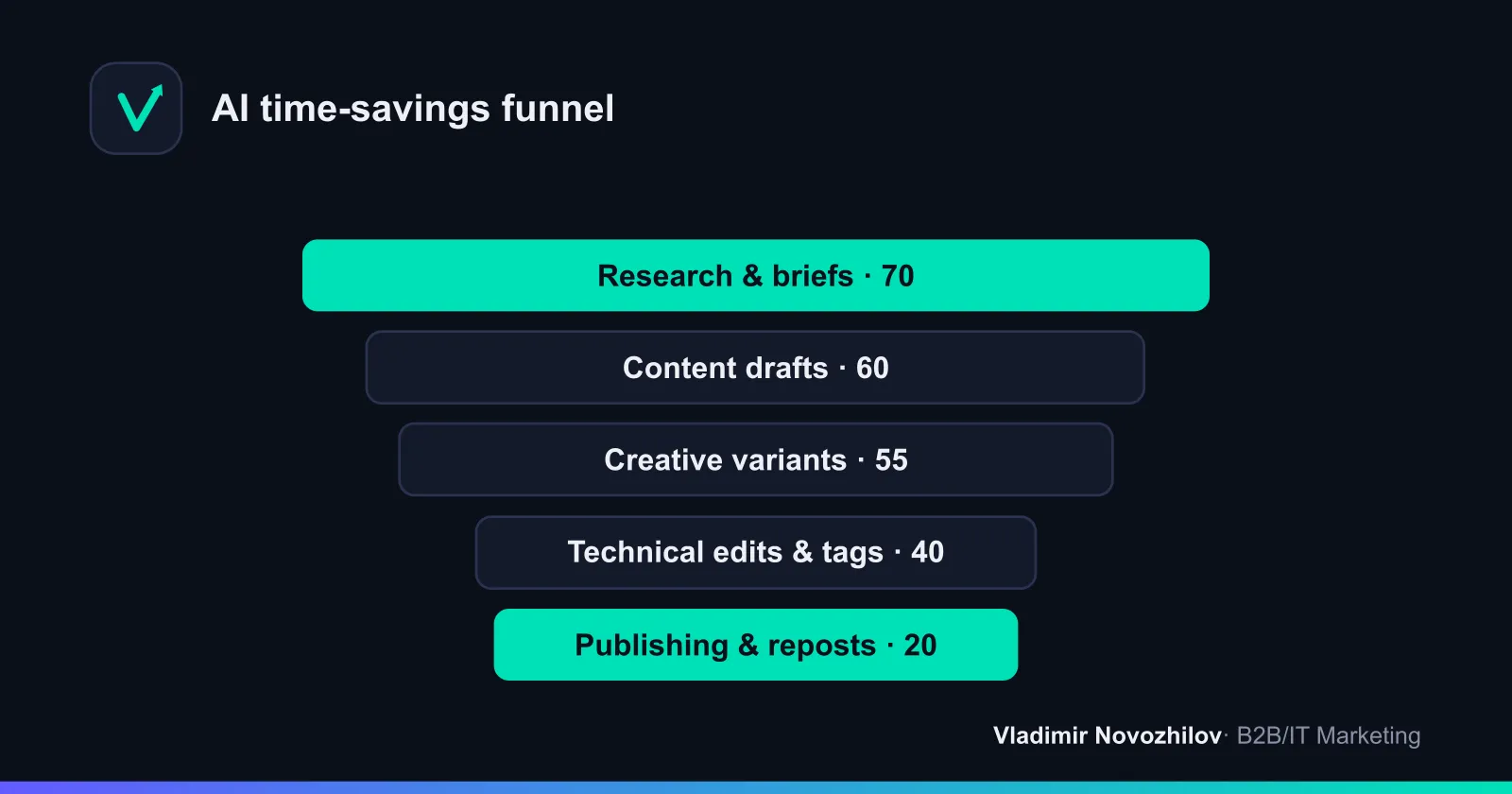
- Savings start with routine (20–50% of time on typical operations), while value depends on decision quality — which AI alone does not guarantee.
- Marketing in the AI era remains about strategy, meaning, trust and responsibility.
What AI already automates in marketing (task list with examples)
The idea is simple: give machines predictable, templated stages, and give people hypothesis choice, sense‑checking and accountability for results. Below is a practical snapshot by channels, tools and limitations.
Content and copywriting — which parts get automated
- Drafts of articles, posts, landing pages: GPT (OpenAI), YandexGPT, GigaChat, Jasper, Copy.ai, Writesonic.
- Rewrites and channel localization: long text → e‑mail digest → 5 posts → 3 short video scripts.
- Tone and style per brand guide: AI follows glossaries and examples if given good samples.
- Proofreading, structuring, publication checklists.
- Limitations: editors always verify facts and insights; access to confidential data follows security policy.
Practice: a simple workflow “brief → plan → draft → human edit → publish” removes 30–60% of mechanical work without quality loss. Choose tools by availability: for RF/CIS — YandexGPT, GigaChat; globally — GPT (OpenAI), Jasper/Copy.ai/Writesonic.
Advertising and creatives — what generators can do
- Variants of headlines/descriptions and USPs for A/B tests: GPT/YandexGPT/GigaChat.
- Banners and landing sections generated from a text brief: AdCreative.ai.
- Automatic UTM creation, grouping hypotheses, rapid creative iterations.
- Limitations: strategy, branding, approvals with sales and legal are human responsibilities. AI should not set its own KPIs.
SEO and keyword research — where AI speeds things up
- Draft keyword clusters and tags: GPT/YandexGPT + exports from Ahrefs.
- Article briefs, H2/H3 titles, snippets: Surfer SEO + GPT.
- Indexing audits and CTR‑snippet recommendations: Google Search Console combined with generated recommendations.
- Limitations: final clusters and prioritization are set by the SEO specialist; content is verified by an editor and domain expert.
What AI cannot do (strategy, negotiations, responsibility)
- Formulate strategy and positioning that account for P&L, competition and brand culture.
- Bear legal responsibility for promises made in communications.
- Conduct complex negotiations and build trust with clients and partners.
- Make ethical decisions (for example, where to draw the line on personalization).
- Invent a fundamentally new big idea from market and product context without a high‑quality brief and team critique.
By industry benchmarks and professional surveys (including the American Marketing Association), AI increases speed and breadth of tests, but responsibility for meaning and direction remains human.
Practical roadmap for implementing AI in a marketing department (3 stages)
The optimal trajectory is three waves: pilot (up to 3 months), scaling (by month 6) and operational integration (by month 12).
- 0–3 months: Pilot and quick wins
- Tasks: 3–5 repeatable processes with clear metrics (drafts, creatives, call summaries, keyword work).
- Roles: process owner (marketer), editor‑verifier, technician/configurator (no‑code/scripts).
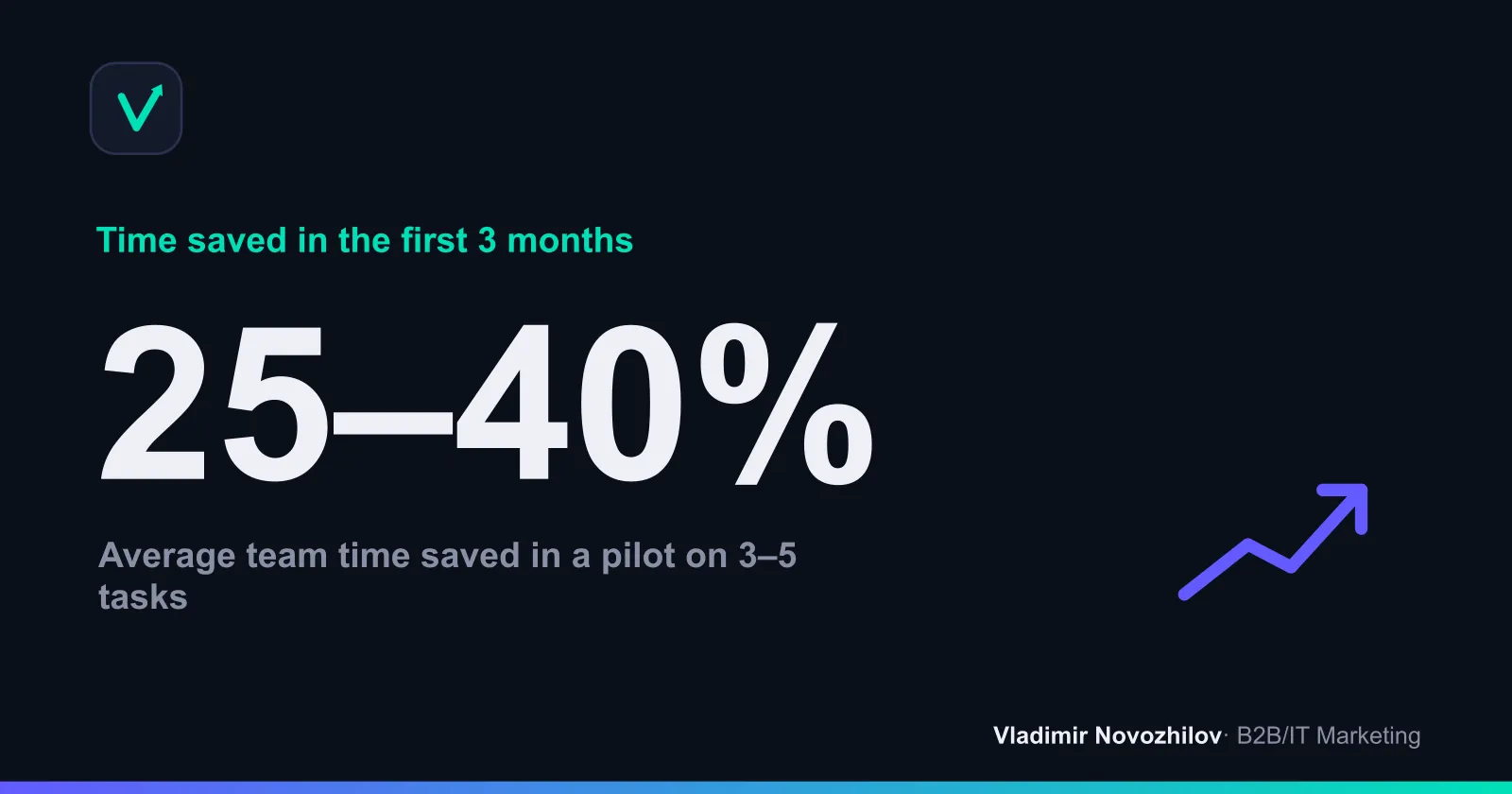
- KPI: time savings ≥25%, stable quality (edits ≤20% of content), campaign TTM −30%.
- Risks: data leaks — use private spaces, sanitize PII.
- 3–6 months: Scaling and standardization
- Tasks: prompt regs, brief templates, creative library, CRM integrations (HubSpot), reports.
- KPI: 60–70% of tasks in libraries; content SLA ≤48 hours; A/B iterations 2–4× faster.
- Control: monthly quality and fact‑checking audits; roles for a knowledge owner and compliance lead.
- 6–12 months: Operational integration and training
- Tasks: advanced prompt chains, KPI lift analytics, BI integration, data quality control.
- KPI: stable time savings ≥30–40%, conversion/CTR growth from more frequent tests; CPL/CPA reduction by 10–20% at same budget utilization.
- Training: internal workshops, case reviews, a skills matrix.
Process audit and economic impact checklist
Select processes with a high share of routine work and clear metrics.
- Has a repeatable input/output template (brief, format, deadline)
- Error is not legally critical (facts/data are checked by a person)
- Historical data exists for before/after (time, CTR, CPL)
- Decision does not require political approvals
- Personal data can be anonymized
- Task is performed by ≥2 people (scalable effect)
- There is a process owner and a quality editor
- Reference examples can be collected (few‑shot)
- Tool onboarding time ≤ 1 week
- Subscription payback ≤ 3 months
Selecting tools and integration (comparison table)
A short orientation by function, cost and data requirements. Prices are order‑of‑magnitude for planning (RF/CIS in rubles, global — in $). Check current terms in vendor accounts and contracts.
| Category | Tool | What it does | Price/month | Speed | Data/region |
|---|---|---|---|---|---|
| Text model | GPT (OpenAI) | Drafts, ideas, analysis | $20–60 per user/plan | High | Global; comply with GDPR/AI Act |
| Text model | YandexGPT | Texts and prompts in Russian | 1–3 тыс. ₽ per user/limits | High | RF/CIS; 152‑FZ on personal data |
| Text model | GigaChat | Russian/English, office tasks | 1–3 тыс. ₽ per user/limits | High | RF/CIS; 152‑FZ |
| Copywriting | Jasper, Copy.ai, Writesonic | Marketing texts, templates | $20–99 | High | Global; avoid PII |
| Creatives | AdCreative.ai | Banners, ad variants | $29–99 | High | Global |
| SEO research | Ahrefs | Keywords, links, audits | $99–399 | Medium | Global |
| SEO editing | Surfer SEO | Briefs, content optimization | $19–89 | Medium | Global |
| Transcripts | Fireflies.ai | Meeting recordings/summaries | $10–19 | Medium | Global; notify participants |
| Web analytics | Google Search Console | Indexing, clicks, CTR | Free | Medium | Global |
| CRM/e‑mail | HubSpot (with AI features) | e‑mail, funnels, recommendations | $20–90+ | Medium | Region depends on account |
Notes:
- For RF/CIS it’s safer to start with YandexGPT/GigaChat and local deployments, especially when working with personal data.
- For global teams consider GDPR/AI Act: minimize PII, anonymize data and sign DPAs with vendors.
Cases and measurable results (2–3 examples with metrics)
Below are characteristic examples from B2B and services. Metrics and horizons are typical for 8–12 week pilots.
- B2B integrator (IT infrastructure solutions)
- What was done: prompt library for e‑mail nurture and articles, drafts in GPT/YandexGPT, domain expert editing.
- Result: time to publish one article fell from 12 h to 4 h (−67%); e‑mail relevance increased (replies to sequences +19%); campaign TTM −35%. CPL for content leads −14% at same budget.
- Mid‑size e‑commerce (multi‑category)
- What was done: AdCreative.ai for banner packs and headlines; GPT for 20 USP variants; rapid A/B cycles.
- Result: CTR from cold traffic +28% (median across 60 creatives); CPA −15%; campaign prep time reduced from 2 days to 6 hours.
- Local clinic network (services, appointments)
- What was done: keyword clustering in Ahrefs, briefs and snippets via Surfer SEO + GPT; medical editor review; vital markup.
- Result: organic traffic +35% in 3 months in pilot region; snippet CTR +1.2 pp; cost per search lead −22%. Time per article dropped from 10 h to 5 h.
Important: metric growth doesn’t happen “by itself” — it stems from faster iterations and denser hypothesis testing. Final quality is always validated by humans.
Calculator/example ROI computation (time savings, subscription cost, payback)
Formula (3‑month pilot):
ROI = (Hours_Saved × Hourly_Rate × Period − Tool_Costs − Implementation_Costs) / (Tool_Costs + Implementation_Costs)
Where Hours_Saved = (Hours_before − Hours_after) × Number_of_tasks_per_month × Months.
Example calculation:
- Team spends 120 h/month on content and creatives. After implementation — 80 h/month (saves 40 h/month).
- Hourly rate (all‑in) — 1 200 ₽.
- Period — 3 months. Savings: 40 × 1 200 × 3 = 144 000 ₽.
- Subscriptions: 20 000 ₽/month × 3 = 60 000 ₽. Implementation: 40 000 ₽.
- ROI = (144 000 − 60 000 − 40 000) / (60 000 + 40 000) = 44 000 / 100 000 = 44% over 3 months.
Sensitivity scenarios:
| Scenario | Time saving | Money saved in 3 months | Subscriptions+implementation | ROI |
|---|---|---|---|---|
| Pessimistic | 25% | 90 000 ₽ | 100 000 ₽ | −10% |
| Base | 33% | 120 000 ₽ | 100 000 ₽ | 20% |
| Optimistic | 45% | 162 000 ₽ | 100 000 ₽ | 62% |
Conclusion: payback depends on pilot discipline, task selection and team hourly cost. Start with the “fat” processes and don’t skimp on editing — it insures reputational risks.
Prompt templates and examples for marketer tasks
Use few‑shot (2–3 exemplars) and decompose tasks into steps. Below — 12 ready prompts.
-
Brief → article plan
”You are a B2B editor. Based on this brief, create an article plan: goals, reader persona, 6–8 H2/H3, theses and CTA. Consider product/market: …” -
Draft article from plan
”Produce a draft based on the plan (below). Tone — business, concise. Insert 2 paragraphs with cases. State risks and how to mitigate them. Plan: …” -
Multimodal repurposing
”Compress the article into an e‑mail digest (120–160 words) and 5 posts for LinkedIn/VK/Telegram. For each post — headline, 3 theses, CTA.” -
Headlines and subheads
”Generate 20 headline and H2 variants for service X landing. Criteria: clarity, benefit, avoid jargon. Metrics: CTR/reading rate.” -
A/B creatives for ads
”Create 10 sets: headline (≤30), description (≤90), 3 USPs, 2 callout variants. Segments: … Brand constraints: …” -
Brief for designer
”Create a text brief for banners: sizes, scenes, visual metaphors, safe zone, variants. For campaign: …” -
Keyword clusters (draft)
“Split the key queries (below) into 5–7 clusters with intent and priority. For each — 3 article topics and H1 drafts.” -
Snippets and meta descriptions
”Generate title/description (title ≤60, description ≤160), unique for 20 URLs. Add CTA and unique selling point.” -
Meeting summary (from transcript)
“Produce a summary: goal, decisions, risks, 5 actions with owners and deadlines. Separately — open questions list.” -
Lead emails
”Write 3 nurture emails for segment X. Structure: pain → benefit → case → CTA. Tone — expert, non‑aggressive.” -
Content calendar
”Create a 4‑week calendar on topics: … Channels: site, newsletter, social. Detail: date, topic, format, goal, KPI.” -
Fact‑checking
”Line‑by‑line check facts in the text. Mark doubtful places, what data is needed for confirmation, propose clarifying questions.”
How to reformat marketer roles and skills (skills, training, job‑descr)
Default skills for a marketer in the AI era:
- Prompt engineering: task decomposition, few/fine‑tuning‑like approaches, preserving contexts.
- Data literacy: spreadsheets/SQL base, segmentation, attribution understanding.
- Automation: no‑code (task runs, integrations), basic scripting.
- Tools: GPT/YandexGPT/GigaChat, Jasper/Copy.ai/Writesonic, AdCreative.ai, Ahrefs, Surfer SEO, Fireflies.ai, HubSpot, Google Search Console.
- Content editing and fact‑checking.
- Security and compliance: GDPR/AI Act/152‑FZ, PII anonymization.
Job Description template: “Marketer with AI skills (Middle+)”
- Areas of responsibility:
- Maintain prompt library and quality standards.
- Run and control A/B experiments (creatives, landing pages).
- Produce AI‑assisted content and perform editing.
- SEO briefs, snippets, work with Google Search Console.
- CRM integration (e.g., HubSpot): triggers and e‑mail sequences.
- Ensure compliance and data security together with legal/security.
- KPIs: time saved on routine, iteration frequency, CTR/CR, CPL/CPA, SLA and quality adherence.
6–8 week training plan:
- Weeks 1–2: prompt basics, prompt library, checklists.
- Weeks 3–4: SEO toolchains (Ahrefs/Surfer) and content; snippets; Google Search Console.
- Weeks 5–6: ads and creatives (AdCreative.ai), UTM practices, A/B analysis.
- Weeks 7–8: automation, security, DPA, personal data rules.
Legal and regional notes (GDPR, AI Act, 152‑FZ)
- RF/CIS: personal data is regulated by 152‑FZ. For training and prompts, use anonymization; store data in domestic clouds or vendor environments with signed processing agreements. YandexGPT and GigaChat are convenient for RF environments.
- EU: comply with GDPR and the new AI Act requirements. Minimize PII, sign DPAs with vendors, and log AI decisions in important processes.
- USA and global: consider contractual obligations with clients and restrictions on third‑party data transfers.
- General principles: “data minimization”, anonymize before generation, mark where human decision is mandatory (campaigns with legal risks, public promises, sensitive niches). Consult legal counsel for regulated industries.
Frequently asked questions (FAQ)
See the FAQ block at the top of the article; below are brief answers.
-
Will AI fully replace marketers by 2030?
No. Repetitive tasks will be replaced. Strategy, negotiations, responsibility and ethics remain human domains. -
Which roles are at highest risk?
Routine executors without domain expertise: mass copywriting, initial keyword work, simple reports. The path out is upgrading toward AI orchestration and analytics. -
What to master first?
YandexGPT/GigaChat or GPT (OpenAI) as a universal notebook, AdCreative.ai for creatives, Ahrefs/Surfer SEO for keyword work and briefs, Fireflies.ai for meetings, Google Search Console for SEO analytics, HubSpot AI features for communications. -
How to calculate ROI?
Record before/after for time and KPIs (CTR/CPL/TTM). Use the formula in the calculator section and test extreme scenarios. -
How will the profession change?
More orchestration of tools, analytics and accountability for quality. Market analysts (including Gartner and professional associations like AMA) note that combinations of “business thinking + prompt engineering + data” will be in demand.
FAQ
- Will AI fully replace marketers by 2030?
- A full replacement is unlikely: task segments will be automated (content drafts, creative generation, initial keyword research, meeting summaries). Strategy, positioning, legal responsibility and partner relations remain human. The marketer role will shift toward managing AI tools and product analytics.
- Which marketing roles are most at risk of automation?
- Functions based on repetitive patterns are most automatable: draft content, mass advertising, basic reports, initial keyword work and UTM routine, call summaries. Junior executors without domain expertise are most at risk unless they upskill in AI and analytics.
- Which AI tools should a regular marketer learn first?
- For RF/CIS: YandexGPT and GigaChat for text and prompts, local IDEs/spreadsheets; globally — GPT (OpenAI). For SEO — Ahrefs and Surfer SEO; for creatives — AdCreative.ai; for transcripts — Fireflies.ai; for funnels and e‑mail — HubSpot's AI features. Plus basic analytics in Google Search Console.
- How to measure ROI from implementing AI in marketing?
- Calculate hours saved × hourly rate × period minus subscription and implementation costs. Also account for KPI effects (CTR, CPL, launch speed). Run a 4–6‑week pilot on 3–5 tasks, record before/after and extrapolate to the department.
- How to retrain a marketer to work with AI — what skills are needed?
- Required skills: advanced prompting (chain‑of‑thought, few‑shot), data literacy (SQL/spreadsheets), automation (no‑code/scripts), tool knowledge (GPT/YandexGPT/AdCreative.ai/Ahrefs/Surfer/Fireflies.ai/HubSpot), data security and basic regulation (GDPR/AI Act/152‑FZ).