How to Implement Jobs To Be Done in Product and Marketing


TL;DR
Jobs To Be Done shows that people “hire” a product to get a specific job done and reach a result. This article covers JTBD history (from Christensen to ODI), an interview template, how to write job statements, differences from personas and CJM, real cases, and a practical implementation plan that raises conversion and cuts churn.
If you’ve ever wondered why a product with great features doesn’t sell while a simpler competitor grows, you were probably describing the customer instead of their job. The Jobs To Be Done (JTBD) approach changes the focus: instead of “who is our user” — “what job does the person want to complete and why do they choose us for it.” This article explains the core idea, the historical development (from Clayton Christensen to Outcome-Driven Innovation), an interview template, how to formulate job statements, differences from personas and CJM, real examples and a step-by-step plan to implement JTBD in product and marketing — to increase conversion and reduce churn.
Core idea: focus on the “job,” not the customer
Jobs To Be Done explains customer behavior through the task, not their attributes. The key idea: people don’t buy products for the products themselves — they “hire” them to make progress toward a desired outcome in a particular situation.
When someone faces a situation where the current state is unsatisfactory, they have a customer job — the work they want done. The product is just a tool, an “employee” they hire. If the tool succeeds, it gets rehired; if it fails, it gets “fired” and another option is tried. Hence the central metaphor — hiring a product.
A simple example: a person doesn’t buy a drill, they buy “a neat hole in the wall to hang a shelf and make the room cozier.” The drill is just one candidate for the job; you could use glue or hire a handyman. Understanding the real job means you compete not only with other drills, but with all ways to solve that task.
How JTBD differs from the classic approach
Traditional marketing starts with segmentation by demographics and behavior. The problem is a “35-year-old male manager” can hire the same product for different jobs, and two very different people can hire it for the same job. JTBD makes the unit of analysis the job, which is much more stable over time: the job “grab a quick bite while commuting” doesn’t change much across decades, while the ways to accomplish it evolve.
This gives three practical benefits:
- Stability. Jobs outlive technologies and segments, so a strategy based on them is more resilient.
- Accuracy. You discover the real reason for purchase and switching behavior, not attributed motives.
- Innovation. You see where current solutions fail — those are product growth opportunities.
Origins: from Christensen to Outcome-Driven Innovation
The approach has two lineages and two complementary branches.
Clayton Christensen, Harvard Business School professor and author of disruptive innovation theory, popularized the idea in the 2000s. His formulation: “People don’t want a quarter-inch drill — they want a quarter-inch hole.” Christensen provided the philosophical frame: a product is hired for a job that has functional, emotional and social dimensions. He’s also behind the famous milkshake marketing case, discussed below.
Tony Ulwick, founder of Strategyn, turned JTBD into a measurable engineering process — Outcome-Driven Innovation (ODI). Ulwick argues every job has a set of desired outcomes — measurable results like “minimize the time required to…” or “reduce the likelihood that…”. Each outcome is scored by importance and satisfaction, and opportunities arise where outcomes are important but unsatisfied.
These two JTBD schools are useful to distinguish:
- Jobs-as-progress (switching/forces school). Focus on the purchase story, emotions and forces pushing someone to switch. Closer to marketing and positioning.
- Jobs-as-activities (Ulwick’s ODI). Breaks the job into steps and measurable outcomes. Closer to product development and prioritization.
In practice the combination works best: the switching approach explains why people come, ODI shows what to improve in the product.
How it works: hiring a product for the job
To apply the approach, understand the mechanics of decision-making. When someone considers “hiring” a new solution, four forces of progress act on them:
- Push. Pain and inconvenience of the current situation: the old solution frustrates, the job remains undone.
- Pull. Attraction of the new solution: the promise of a better outcome.
- Anxiety. Fear of the new: “what if it fails,” “will data be lost?”
- Habit. Inertia toward the current solution: “it’s fine as is,” reluctance to change.
A purchase happens when Push + Pull outweigh Anxiety + Habit. This is critical for marketing: many teams amplify only Pull (feature lists) and forget to reduce anxiety and inertia. Anxiety often kills deals in B2B and IT, where changing suppliers or systems feels risky.
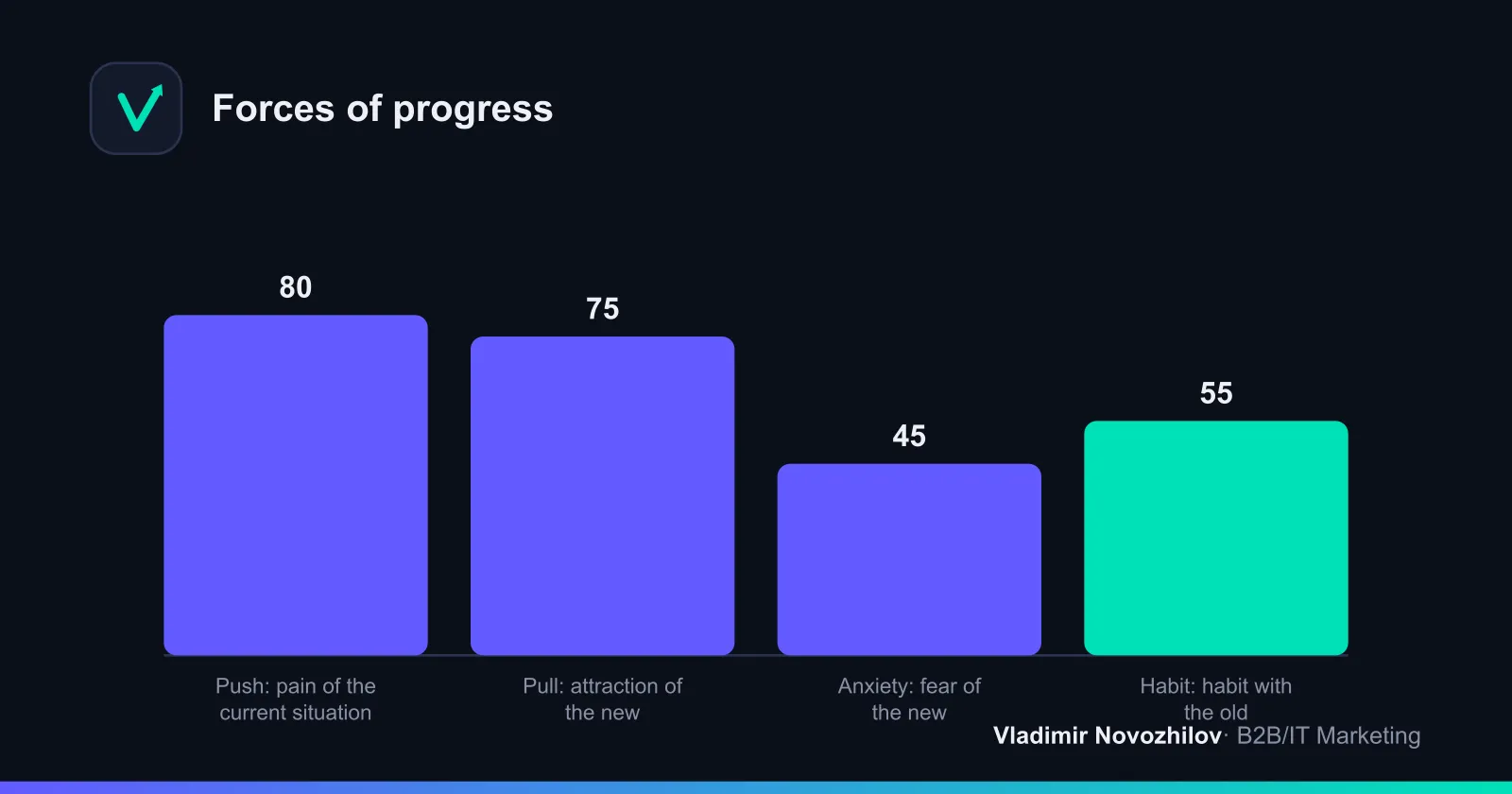
The diagram is not theory for theory’s sake, but a working tool. When analyzing any purchase decision, write down all four forces in the customer’s own words. Then in communication amplify Push and Pull and systematically alleviate Anxiety (case studies, guarantees, free migrations, pilots) and Habit (a simple first step, turnkey migration).
Types of jobs: functional, emotional, social
Any job is multi-layered. The same purchase often fulfills several types of tasks; good practice considers all three.
| Type of job | What it covers | Customer’s question | B2B/IT example |
|---|---|---|---|
| Functional job | The practical task, objective result | “What do I need to get done?” | Produce a report in 10 minutes instead of two hours |
| Emotional job | Internal state, self-perception | “How do I want to feel?” | Not worry about data loss or missed deadlines |
| Social job | How others perceive the buyer | “How do I want to look?” | Appear competent to the team and management |
A common rookie mistake is seeing only the functional job. In services and B2B, decisions are often driven by emotional and social layers: a manager picks a “safe” vendor to avoid blame. If you address only the function, you’ll lose to competitors who reduce fear and boost the buyer’s status.
How JTBD fits with personas, CJM and empathy map
JTBD doesn’t replace other tools — it answers a different question. Personas answer “who,” customer journey maps (CJM) answer “how the journey runs,” empathy maps show “what the customer feels,” and JTBD answers “why and for what.” Below is a short comparison table.
| Criterion | JTBD | User Personas | Customer Journey Map | Empathy Map |
|---|---|---|---|---|
| Key question | What job is the customer doing and why do they hire the product | Who is our typical user | How does the customer progress toward the goal | What the customer thinks, feels, sees, hears |
| Unit of analysis | Job and desired outcome | Person profile (demographics, behavior) | Stages and touchpoints | Emotional state |
| Stability over time | High — jobs change slowly | Low — segments age quickly | Medium | Medium |
| What it gives the product | Reasons for purchase, growth points, priorities | Tone of communication, empathy for audience | Bottlenecks and experience gaps | Understanding barriers and motives |
| Risk when used in isolation | Abstract without interview data | Stereotypes instead of real motives | Nice map without behavioral causes | Guesses without facts |
| Best combined with | ODI, switching interviews | JTBD and CJM | JTBD and metrics | JTBD and interviews |
Practical takeaway: start with JTBD — it provides a foundation of real motives. Then overlay a customer journey map to see the stages, and use personas as a team-friendly packaging to maintain empathy. That way each tool plays its role instead of duplicating others.
Crafting the job statement: structure and examples
A Job Statement is a concise articulation of the customer’s job without mentioning your product. It describes the situation, motivation and desired outcome so that any solution — including non-obvious competitors — fits under it.
Classic switching-school structure:
When [situation/trigger], I want [motivation/action], so I can [desired outcome].
Good examples:
- “When I commute alone to work, I want something to occupy me and stave off hunger so the long trip feels shorter” (the milkshake case).
- “When I need to report to management on a project, I want to quickly assemble a clear summary so I look in control and don’t waste my evening.”
- “When a new employee joins the team, I want to give them access to knowledge quickly so they reach productivity in a week instead of a month.”
In the Outcome-Driven Innovation school, statements tend to be verb + object: “listen to music on the go,” “track order status.” Desired outcomes are recorded as metrics: “minimize time to find the right track,” “reduce probability of missing an important notification.”
Job statement checklist
Before calling a job statement ready, verify it against these criteria:
- No product mentions. No brand, features, or technologies — only the job.
- Includes a situation (trigger). It’s clear when and in what context the job appears.
- Includes a desired outcome. It states what the customer wants to achieve, not the action to take.
- Stability. It won’t become obsolete if technology changes.
- Measurability. The outcome can be tied to a metric (time, money, risk, effort).
- Customer language. It reads like the customer said it, not your internal jargon.
- One job = one statement. Don’t cram several tasks into one sentence.
If a statement meets all seven points, it’s a working formulation you can rely on for product and communication.
JTBD interviews: how to run them and what to ask
A JTBD interview is an in-depth conversation that reconstructs the real purchase story: from the first moment the person thought about a solution to the deal and first use. The goal is not “what do you like,” but the timeline and forces of progress that led to hiring the product.
The golden rule: work with real recent purchases, not hypotheticals. People are poor at predicting future behavior but can recall specific events if guided through the timeline.
How to structure the interview
- Find the point of first thought. When did you first realize you needed such a solution? What was happening in your work/life?
- Reconstruct triggers. What pushed you to start looking? Was it a single event or a build-up?
- Explore alternatives. What did you consider? What else did you compare, including doing nothing or manual methods?
- Catch the moment of decision. What was decisive? What almost stopped you?
- Identify anxieties and habits. What were you afraid of when switching? What kept you from changing earlier?
- Go to first use. Did expectations match reality? What was the “moment of value?”
Ready-to-use interview question list
Use this template and adapt it to your product. It’s a base guide.
| Stage | Question |
|---|---|
| Trigger | “Remember the moment you first thought you needed such a solution. What was happening then?” |
| Trigger | “What exactly stopped working in how you solved this task before?” |
| Search | “What options did you consider? What else came to mind besides buying?” |
| Search | “Where did you look for information, who did you consult?” |
| Anxieties | “What worried you before deciding? What were your fears?” |
| Inertia | “What prevented you from leaving things as they were?” |
| Decision | “What was the last straw that made you decide?” |
| Expectations | “What did you imagine the ideal outcome would be?” |
| Use | “When did you first feel the solution worked?” |
| Outcome | “If this product disappeared tomorrow, what would you do?” |
Aim to run 8–12 interviews per job — usually after the tenth conversation patterns repeat and new insights diminish.
Common interview mistakes
These are rarely written down but recur across projects:
- Asking about the future and hypotheticals (“Would you buy if…”) instead of the real story. Hypotheticals often lie.
- Leading questions (“Speed matters to you, right?”) that echo your assumptions.
- Focusing on the product instead of the job — missing actual competitors.
- Ignoring emotional and social layers, limiting the focus to function.
- Interviewing only satisfied customers, losing insights from those who left or didn’t buy (where churn reasons hide).
- Not digging into the trigger — the most valuable insight, because the trigger shows when to activate marketing.
Step-by-step implementation in product and marketing
Theory is useless without rollout. Here’s a practical seven-step algorithm teams can follow.
- Define the market by job. Formulate the key customer job (not a segment), e.g., “maintain order in team tasks,” not “CRM for small business.”
- Collect interview data. Run 8–12 interviews with recent buyers and, importantly, with churned or non-buying prospects.
- Break the job into steps and outcomes. Describe job steps and list desired outcomes as metrics (time, effort, risk, cost).
- Write job statements. Create a set of statements using the checklist above — this becomes the core for product and positioning.
- Find opportunity gaps. Score each desired outcome by importance and satisfaction. “Important but unsatisfied” = priority for the product.
- Repackage marketing around the job. Rewrite key messages from “we do X” to “you achieve Y in situation Z,” amplify Push/Pull and remove Anxiety/Habit.
- Measure and iterate. Track conversion, activation, churn. Return to interviews when metrics or the market shift.
In B2B and services step 6 is especially important: often the product is good, but communication speaks in features not jobs. A simple message rewrite to reflect the real job increases landing conversion and lead quality without changing the product.
Practical examples: real cases
The best way to grasp the approach is through real examples.
The milkshake case (McDonald’s)
Classic. The chain wanted to increase milkshake sales and optimized recipes by demographics. Christensen’s team asked differently: what job do people hire the milkshake for? They found a substantial share of sales was in the early morning: drivers bought a milkshake to occupy themselves on long, boring commutes and avoid hunger until lunch. Competitors weren’t other milkshakes but bananas (they finish too quickly and dirty hands), bagels (too dry) and coffee (spills).
This insight flipped strategy: they needed a thicker milkshake (so it lasted longer through the straw) and faster service in the morning. Classic segmentation would never have revealed this. It’s the archetypal example of how product hiring explains real behavior.
B2B/IT case: fighting churn
A common scenario in subscription IT: teams reduce churn with discounts and new features, but users keep leaving. Switching interviews with churned customers revealed the real job: people had hired the service not for its feature set but to close their monthly reports calmly, without stress. Once the product stopped saving them nerves (the UI became complex, onboarding thresholds rose), it no longer executed the job — and users “fired” it.
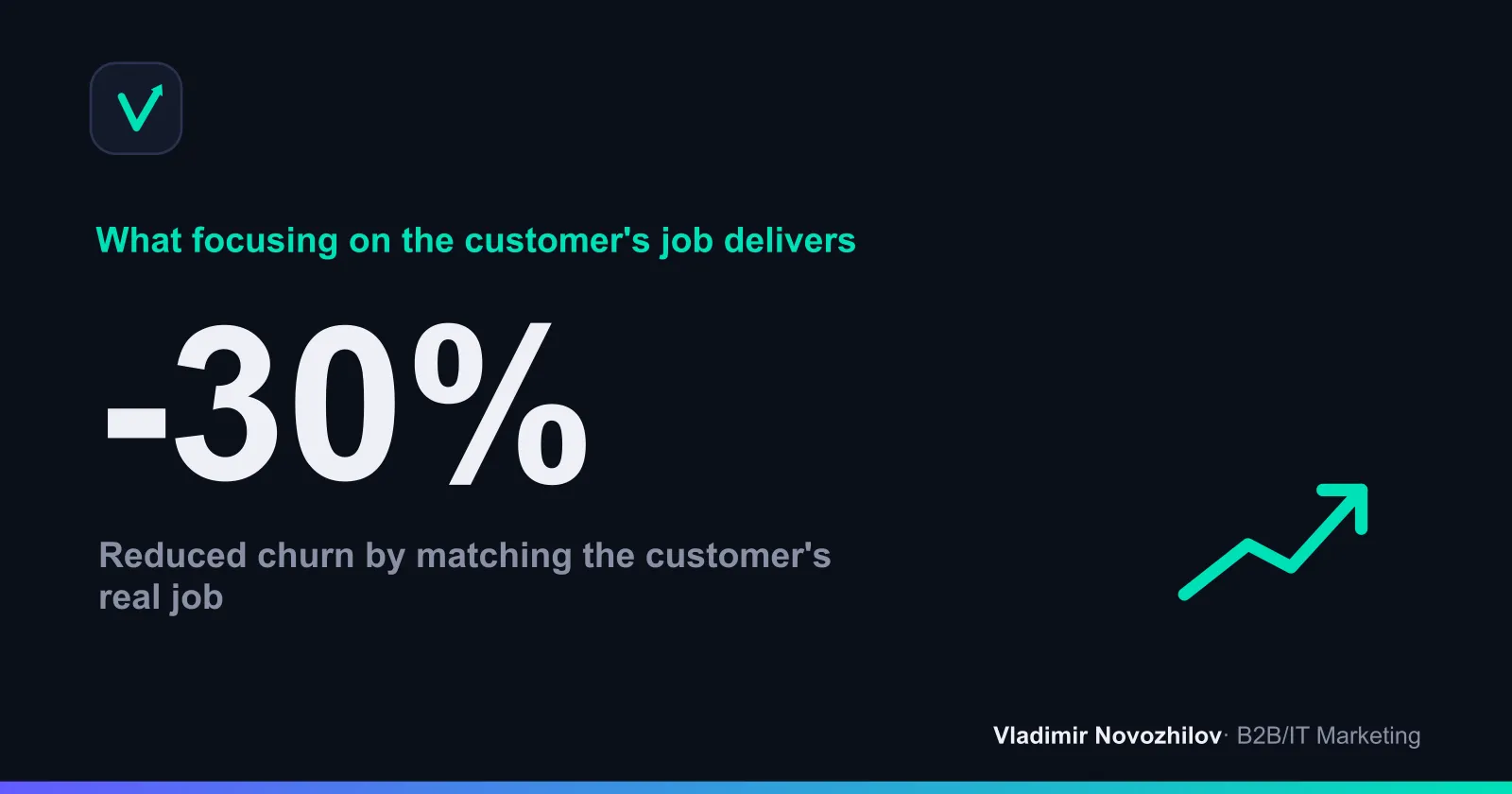
The fix wasn’t more features but a return to the original job: simplify onboarding, provide ready-made report templates, and remove early-stage anxiety. Focusing on the real job typically cuts churn significantly — on the order of a third — because you repair the cause, not the symptom.
Marketing case: repositioning
A team marketed their service as an “task management tool” in a crowded category. JTBD interviews showed managers hired it for a social job — “see the project picture and appear in control to management.” By shifting the key message from features to that result (“always know what’s happening in the project and be ready for any question from leadership”), conversion on the landing page rose and lead quality improved. The product didn’t change — the job the marketing addressed did. That’s JTBD in marketing.
How the approach reduces churn and raises conversion
Linking the method to business metrics. JTBD impacts the funnel at three points:
- Acquisition and conversion. When messaging targets the customer’s real job and situation, relevance rises: the visitor recognizes themselves. This is most visible on landing pages and the first screen — lead conversion increases and leads are warmer.
- Activation. Knowing the “moment of value” (when the job is first completed) lets you design onboarding so customers reach it faster. That’s a key lever for early retention.
- Retention and churn. Churn signals that “the product stopped doing the job” or “a better executor appeared.” Switching interviews with churned users reveal exact reasons, so you fix them directly instead of scattering discounts.
A practical rule: check any growth initiative against the question “what job does this help perform better?” If there’s no answer, you’re likely improving something customers don’t care about.
Templates and working tools
To keep JTBD practical, collect a minimal set of artifacts. Here’s a guide for what the team should maintain.
| Artifact | Contains | Where used |
|---|---|---|
| Interview guide | List of stage questions (see table above) | Research, custdev |
| Job statements map | Set of “When… I want… so I can…” statements | Product, positioning |
| Forces of progress map | Push / Pull / Anxiety / Habit for key decisions | Marketing, sales |
| Desired outcomes table | Outcomes + importance + satisfaction | Backlog prioritization (ODI) |
| Jobs-by-type map | Functional / emotional / social | Messaging, value proposition |
Important: tools are secondary. You can keep everything in a simple spreadsheet — value comes from quality interviews and honest prioritization, not a pretty template. Don’t replace customer conversations with form-filling.
Strengths and limitations of the approach
An honest look without evangelism.
Strengths:
- Focus on real reasons for purchase and switching, not demographics.
- Stability: jobs outlast technologies and segments.
- A common language for product, marketing and sales.
- Direct path to priorities (via desired outcomes) and positioning.
- Explains churn and reveals growth points.
Limitations:
- Requires high-quality interviews — with poor data the approach is useless.
- Abstractness: without discipline job statements turn into generic phrases.
- Two schools (switching and ODI) confuse newcomers; choose the right tool for the task.
- Doesn’t replace quantitative research and metrics — it complements them.
- Easy to fall into “cargo cult”: drawing diagrams instead of changing product and messaging.
Conclusion: JTBD is a powerful lens, not a silver bullet. It works best combined with analytics, CJM and continuous customer contact.
Quick start: apply this week
Summarizing into a short plan:
- Pick one product and hypothesize the core customer job.
- Run 5–8 interviews with recent buyers and one or two churned users.
- Reconstruct the timeline and forces of progress, find triggers.
- Produce 3–5 job statements using the checklist.
- Rewrite the landing page first screen to focus on the job and outcome.
- Measure conversion and churn, then repeat the cycle.
This is enough to see the first effects and feel the theory turn into decisions. Later add a desired outcomes map and ODI-driven prioritization when you want a systematic product management approach.
FAQ about the approach
What does JTBD mean? JTBD stands for Jobs To Be Done — the jobs a customer needs to complete. It explains purchases via the customer’s task and the hiring metaphor.
Where to start implementation? With interviews. No template replaces 8–12 quality conversations with real buyers. Everything else builds on that data.
How many interviews are enough to see the picture? Typically after 8–12 interviews focused on one job, answers start to repeat. That’s a good sign the core insights are collected.
How does JTBD differ from personas and CJM? JTBD answers “why and for what” (job and motives). Personas are “who,” CJM is “how the journey runs.” The best outcome comes from the sequence: jobs first, then journey, then team-facing persona packaging.
Are JTBD and custdev the same? No. Custdev is the wider process of testing customer hypotheses. JTBD is a specific lens inside it, focused on jobs and motives rather than people.
Do we need to relearn everything for JTBD? No. The approach mainly requires changing the question. Stop describing who your customer is and start discovering which job they want to complete and why they hire your product. That shift is where conversion growth, churn reduction and clearer positioning begin.
FAQ
- What does the acronym JTBD mean and what is the approach about?
- JTBD stands for Jobs To Be Done — the jobs a customer needs to complete. It explains purchases through the customer’s task and the metaphor of “hiring” a product, not through demographics.
- Where to practically start implementing JTBD?
- Start with interviews. Run 8–12 conversations with recent buyers and with churned users. Reconstruct timelines, forces of progress, and triggers. Use those insights to form job statements and change communications.
- How many interviews are needed to see repeating patterns?
- Usually after 8–12 interviews focused on one job, answers begin to repeat. That signals basic patterns are collected and you can move to formulation and prioritization.
- How does JTBD differ from personas and CJM in practice?
- JTBD answers “why and for what” (the job and motives). Personas answer “who,” CJM shows “how the journey proceeds.” The best result comes from combining them: start with jobs and motives, then map the journey and package it for the team.
- Are JTBD and custdev the same or different?
- They’re different levels. Custdev is the broader process of validating customer hypotheses. JTBD is a specific lens inside it, focused on the job and reasons for hiring/firing a product.
- Do we need to radically retrain to work with JTBD?
- No. It’s enough to change the focus: describe less “who the customer is” and instead analyze which job they want to complete and why they choose you. That shift drives conversion growth and lower churn.