Promoting Business in Neural Networks: GEO Guide with Checklists

TL;DR
A practical walkthrough of promoting a business and brand in neural networks: how to appear in neural answers and AI Overviews, what GEO and AEO mean, which markup and files are needed, how to submit your site for indexing and how to measure results. Includes checklists, Schema.org and llms.txt templates, a 90-day plan and KPI examples.
Why business and brand need GEO right now
Neural search is already taking some clicks from classic results: users ask a question and get a ready answer. If your company isn’t included in that answer, you lose attention before the click. Promoting a business in neural networks is a systematic effort to have models name your brand, cite your materials and pull correct company data. This article offers a practical GEO plan: audit, answer‑ready content, technical base (Schema.org, llms.txt, robots.txt), indexing and SOV measurement.
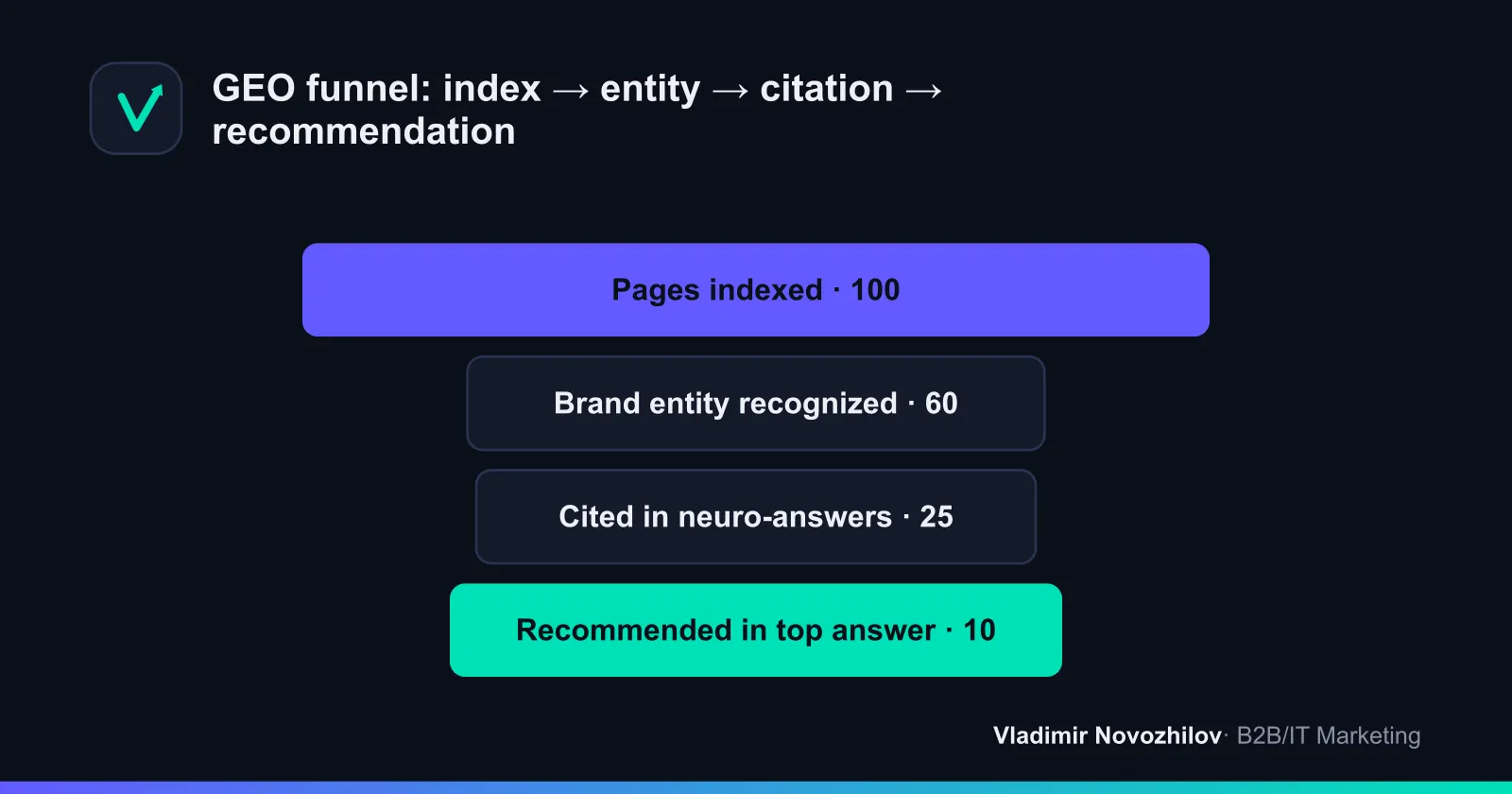
Brief on the approach: make the brand a recognizable entity, design content for user tasks, give models structured data and convenient sources, ensure technical access for bots and measure results as share of mentions and lead effect.
What promotion in neural networks (GEO) is and how it differs from classic SEO
A working definition: GEO (Generative Engine Optimization) — optimizing brand and content for generative answers (AI Overviews and neural answers in chat systems). Here the goal is not a position in a list, but inclusion in an answer and a model recommendation.
Classic SEO works with page ranking, query semantics and behavioral signals. GEO builds on that and adds:
- working with entities and brand context (where and how you are described);
- structuring knowledge so it’s easy to extract and cite;
- AEO/AI‑SEO format “question — short answer” for quick snippets;
- controlling technical access and explicit rules for AI crawlers.
Important: GEO does not replace SEO. Without an indexable, understandable site and external mentions, neural networks simply won’t find something to “attach” your brand to.
AEO vs GEO: when you need a quick answer and when you need a knowledge source
- AEO (Answer Engine Optimization, AI‑SEO): create a page block “question — direct answer”, ensure FAQ structure, microdata, consistent NAP for local listings. The goal is for a model to take a short fragment or fact from you.
- GEO: build a recognizable brand entity, strengthen E‑E‑A‑T, develop thematic hubs and checklists, publish data and comparisons. The goal is for a model to cite and recommend your material as a primary source.
Comparison for planning:
| Criterion | AEO | GEO |
|---|---|---|
| Goal | Quick answer fragment | Citation and recommendation |
| Format | FAQ, how‑to, price blocks | Guides, comparisons, tables, research |
| Markup | FAQPage, HowTo, LocalBusiness | Article/TechArticle, Product, Organization |
| Metric | CTR of hints, snippet quality | SOV in neural answers, citation quality |
| Horizon | 2–6 weeks | 6–12 weeks and beyond |
How modern generative answers work (retrieval vs parametric memory)
Models combine two modes:
- Parametric memory — “knowledge” from training. Good for general facts, worse for fresh company facts and prices.
- Retrieval/RAG — fetching sources on the fly. Requires access to indexes (Bing/Yandex/internal inputs), trust signals and clear data structure.
Implications for GEO:
- Make pages “answer‑ready”: a clear answer paragraph at the top, tables, steps, prices and conditions.
- Give machines structure: Schema.org in JSON‑LD, headings, lists, anchor formulations.
- Ensure accessibility: sitemap, correct robots.txt, llms.txt with rules for LLM bots.
Audit: how to understand what neural networks “know” about your business (step‑by‑step checklist)
The audit goal is to capture the current “file” of your brand in ChatGPT/Search, Perplexity, YandexGPT and Gemini and find the gap between real data and what models “see”.
Step 1. Brand passport
- Ask each system: who are you, what do you do, where are your offices, how to contact, what makes you different.
- Record: is the name correct, NAP (name/address/phone), sector, key products/services, unique traits.
Step 2. Category and region
- Questions: “best companies for [category] in [city/region]”, “compare [your service] among top providers”, “how much does [service] cost in [region]”.
- Record: are you listed, what sources are cited, which parameters are compared (price, terms, experience, certifications).
Step 3. User tasks
- “How to choose…”, “what to consider…”, “common mistakes…”, “calculator/checklist…”. See if the model pulls your materials.
Step 4. Sources and indexes
- Which domains does the model cite: industry directories, media, niche blogs, Yandex.Business/2GIS/Google Business cards.
- Which pages of your site appear: note titles, dates and content types.
Step 5. E‑E‑A‑T evaluation
- Author expertise, real experience (cases, methodologies), domain authority (mentions, citations), trust (policies, legal details, reviews).
Final audit artifacts
- Table “question → mention/no → wording → sources”.
- List of “quick wins”: fix NAP, add FAQ, structure price, make 2–3 cases answer‑ready.
Answer‑ready content: page template that gets cited
Structure of a single “combat” page:
- Title reflecting the user’s task (not just keywords).
- 2–3 sentences of concise answer (specifics and numbers). This is the paragraph the model will pick for snippets.
- Comparison table or checklist with steps.
- FAQ block of 4–8 questions.
- Prices/terms shown explicitly, date of last update.
- JSON‑LD markup (Article/FAQPage/Product/LocalBusiness — depending on page type).
- Examples/cases: before/after, figures, selection criteria.
Page readiness checklist
- Clear “direct answer” within the first 300 characters.
- Top subheading contains the key term in natural phrasing.
- Inserted table with selection parameters and units.
- Added FAQ with questions phrased as users would ask.
- Prices/ranges and currency specified, update date provided.
- Article/FAQPage set in JSON‑LD.
- Microcopy: short sentences, numbered steps, active verbs.
Technical base: Schema.org, llms.txt, robots.txt — ready examples
Below are copy‑paste templates. Replace with your data, remove extra fields. Intentionally no external URLs.
Article template (JSON‑LD)
{
  "@context": "https://schema.org",
  "@type": "Article",
  "headline": "How to choose an implementation partner for BI in industry",
  "datePublished": "2026-09-15",
  "dateModified": "2026-10-01",
  "author": { "@type": "Person", "name": "Ivan Ivanov" },
  "publisher": { "@type": "Organization", "name": "Example Company" },
  "articleSection": ["B2B", "Industry", "Analytics"],
  "inLanguage": "ru"
}
FAQPage template (JSON‑LD)
{
  "@context": "https://schema.org",
  "@type": "FAQPage",
  "mainEntity": [
    {
      "@type": "Question",
      "name": "How long does implementation take?",
      "acceptedAnswer": {
        "@type": "Answer",
        "text": "Pilot 2–4 weeks, production launch 8–12 weeks."
      }
    },
    {
      "@type": "Question",
      "name": "What access is required?",
      "acceptedAnswer": {
        "@type": "Answer",
        "text": "Access to data, a test environment and developer accounts."
      }
    }
  ]
}
LocalBusiness template (JSON‑LD)
{
  "@context": "https://schema.org",
  "@type": "LocalBusiness",
  "name": "IT Systems Integration — Region",
  "address": {
    "@type": "PostalAddress",
    "streetAddress": "Prимер St., 10",
    "addressLocality": "Moscow",
    "postalCode": "101000",
    "addressCountry": "RU"
  },
  "telephone": "+7-495-000-00-00",
  "openingHours": "Mo-Fr 10:00-19:00",
  "areaServed": ["Moscow", "MO"]
}
Product template (JSON‑LD) for a service package
{
  "@context": "https://schema.org",
  "@type": "Product",
  "name": "AI Promotion Audit 360°",
  "description": "GEO/AEO audit, technical base and content, 2 weeks, report and work plan.",
  "brand": {"@type":"Brand","name":"Example Company"},
  "offers": {
    "@type": "Offer",
    "priceCurrency": "RUB",
    "price": "120000",
    "availability": "https://schema.org/InStock"
  }
}
Example llms.txt (in the site root)
# Rules for LLM and neural search bots
User-agent: GPTBot
Allow: /

User-agent: ChatGPT-User
Allow: /

User-agent: ClaudeBot
Allow: /

User-agent: Claude-Web
Allow: /

User-agent: PerplexityBot
Allow: /

User-agent: Google-Extended
Disallow: /private/

User-agent: YandexGPT
Allow: /

# You can close duplicates or test sections
User-agent: *
Disallow: /tmp/
Recommended lines in robots.txt
# Indexing and search engine crawlers
User-agent: Bingbot
Allow: /

User-agent: YandexBot
Allow: /

# LLM bots (synchronize with llms.txt)
User-agent: GPTBot
Allow: /

User-agent: ClaudeBot
Allow: /

User-agent: PerplexityBot
Allow: /

User-agent: Google-Extended
Disallow: /private/

# Technical sitemaps
Sitemap: /sitemap.xml
Advice on hreflang and regionalization
- For multilingual materials use with localized pages.
- Indicate local currency and units of measure on each regional page.
- For addresses use official street/area names, opening hours and E.164 phone format.
Local business and neural networks: data synchronization (Yandex.Business, 2GIS, Google Business)
For local scenarios NAP consistency is critical. Mismatches in name, address or phone “break” the brand entity.
NAP synchronization checklist
- Name: one consistent form without extra appendices (LLC/Inc — only if necessary).
- Address: exact coordinates, matching district/city, correct postal code.
- Phone: one main format +7‑…; additional numbers in the card.
- Opening hours: actual hours with special days noted.
- Category and services: strictly according to the platform catalog.
- Photos/showcase: up‑to‑date, no watermarks.
- Responses to reviews: brief, fact‑based; add an FAQ in the card.
Regionalization on the site
- Create separate pages for key regions with local case studies and prices.
- Add LocalBusiness JSON‑LD to each regional page.
- Specify delivery/onsite visit methods and timelines for the region.
Submitting the site to engine indexes (Bing/Brave/Yandex) — step by step
The goal is to speed up inclusion of pages in indexes that feed ChatGPT/Search, Perplexity and YandexGPT.
General
- Ensure sitemap.xml is accessible and updated automatically.
- Put new URLs into the sitemap in batches of 200–500.
- Ensure important pages return 200, have no robots blocks and no canonical conflicts.
Bing (for ChatGPT/Search)
- Verify site ownership in webmaster tools.
- Submit the sitemap.
- Use the URL submission API for bulk intake. Example request (pseudo format):
POST BING_ENDPOINT
Headers: 'Content-Type: application/json', 'Host: api', 'Key: <BING_API_KEY>'
Body: { "siteUrl": "<YOUR_DOMAIN>", "urlList": ["/page-1", "/page-2", "/page-3"] }
Brave/Claude
- For Brave Search submit the sitemap and ensure pages are accessible. Check brand visibility with the same questions as for Bing.
- For Claude (ClaudeBot/Claude‑Web) allow crawling in robots.txt and llms.txt; focus on being a cited source in answers.
Yandex (for YandexGPT)
- Verify the domain in webmaster tools.
- Submit the sitemap, check the “Pages in search” statuses.
- For new materials use “Re‑crawl page” on priority URLs.
- Monitor “Indexing issues” and fix duplicates/redirects.
Batch URL submission (script template)
# Pseudo‑template: bulk URL submission to index
import json
from time import sleep

API_ENDPOINT = "BING_ENDPOINT"
API_KEY = "<BING_API_KEY>"
SITE = "<YOUR_DOMAIN>"
URLS = ["/guide/geo", "/cases/ai-overviews", "/pricing"]

payload = {"siteUrl": SITE, "urlList": URLS}
headers = {"Content-Type": "application/json", "Key": API_KEY}

# send(payload, headers, API_ENDPOINT)  # implement call for your system
sleep(1)
How to measure results: SOV, share of mentions, GEO traffic — formulas and tools
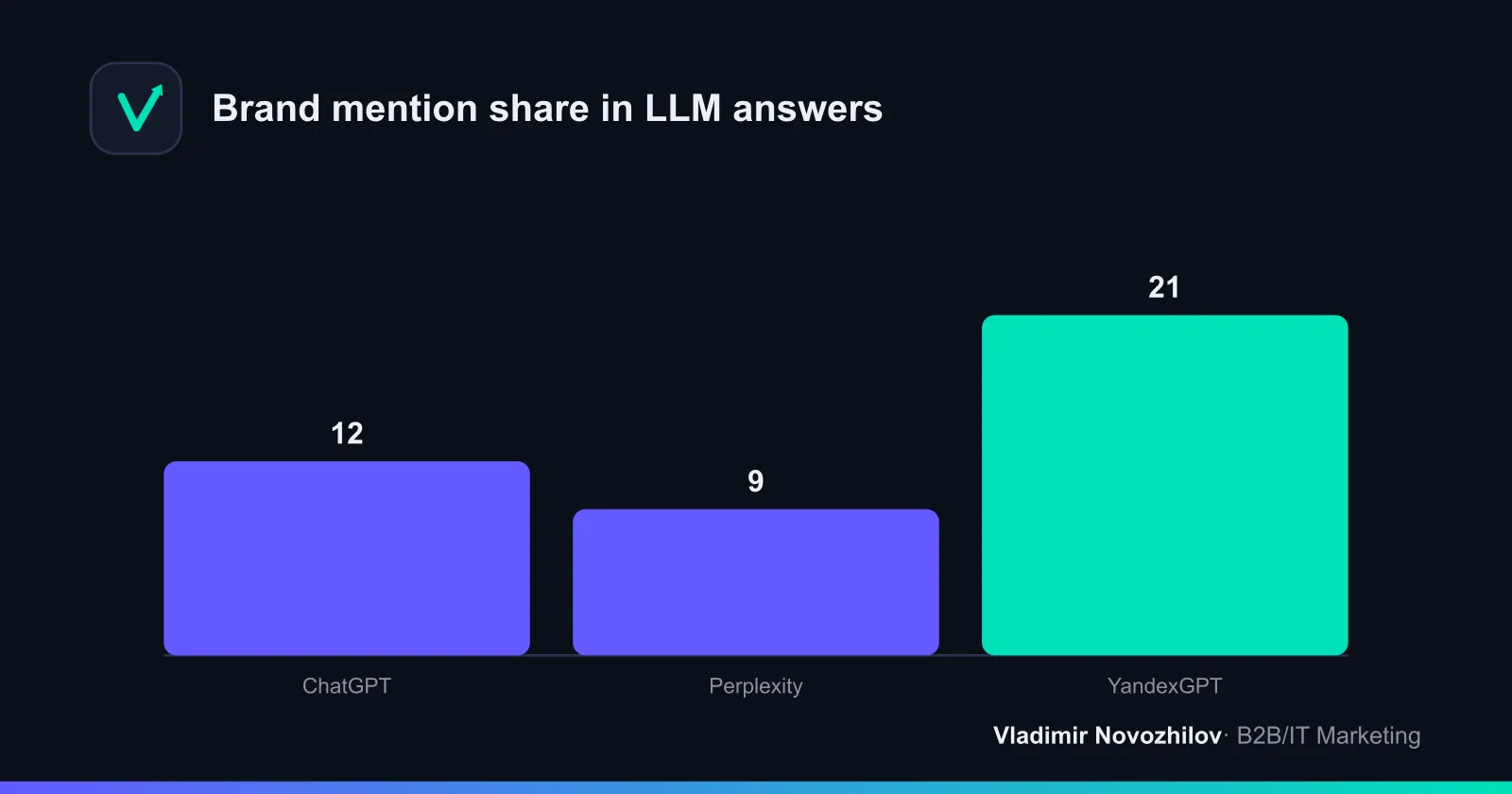
Key metric — SOV (Share of Voice) in neural answers: the share of answers where your brand is mentioned across a pool of relevant questions.
Formulas
- SOV per engine = (number of answers with mention / total number of questions) × 100%.
- Overall SOV = weighted average across engines (weight = share of your target audience per engine).
- GEO‑traffic = visits/leads that came after interacting with a neural answer (via source surveys, UTMs in returned links, branded search after a campaign).
- ROI GEO = (additional gross profit from GEO − GEO costs) / GEO costs.
Monitoring template (weekly)
- Brand queries: “who are you”, “reviews”, “prices”, “contacts”.
- Category queries: “best/top N providers [category] [region]”, “compare X vs Y for B2B”.
- Task queries: “how to choose”, “how much does it cost”, “risks/mistakes”, “implementation checklist”.
- Record: brand mention (yes/no), data accuracy, which domains are cited, presence of visual cards.
- Sum SOV across ChatGPT, Perplexity, YandexGPT, Gemini.
KPI/SLO examples
- SOV ≥ 20% in the key category and region within 90 days.
- 5+ externally cited domains (media/directories/niche blogs) within 60 days.
- 10 answer‑ready pages in the top cluster within 45 days.
- Accuracy of digital passport (NAP/description) ≥ 95% across three platforms (Yandex.Business, 2GIS, Google Business).
90‑day step‑by‑step plan with resources and roles
Roles: head of direction (strategy), content editor, technical specialist (SEO/frontend), PR/SERM manager, analyst.
Days 1–10: Audit and planning
- Brand audit in LLMs (using the checklist above), collect SOV0.
- Tech audit: robots, llms, sitemap, page accessibility.
- Content cluster plan: 10 “combat” pages and 10 supporting ones.
- Roles/schedule, KPI approval.
Days 11–30: Technical base and brand passport
- Configure robots.txt and llms.txt, publish sitemap.
- Synchronize NAP on Yandex.Business, 2GIS, Google Business.
- Create a “Brand Passport” on the site: About page, legal details, contacts, offices, FAQ answers.
- Markup Organization/LocalBusiness.
Days 31–60: Answer‑ready core
- Publish 5–7 pages with answer‑ready blocks (tables, checklists, prices, FAQ, Article/FAQPage/Product markup).
- Prepare 2–3 cases with figures.
- Submit URLs through webmaster tools and APIs.
- External mentions: agreements with 3–5 industry platforms.
Days 61–90: Consolidation and measurement
- Publish another 5–7 pages in the cluster.
- Monitor SOV weekly; adjust content.
- PR/SERM: respond to reviews, publications in media, update listings.
- 90‑day report: SOV dynamics, list of cited domains, lead effect.
Workload estimates (ranges)
- Tech base and indexing: 12–24 h.
- 10 “combat” pages (structure, copy, layout, markup): 60–100 h.
- External mentions (agreements, publications): 16–32 h.
- Monitoring and reporting: 8–12 h/month.
What to include in a client report: metrics, examples, timelines
- SOV by engines (table/chart) and weekly dynamics.
- List of answers where the brand is mentioned, with excerpted phrasings.
- List of cited domains with new entry points (directories, media, reviews).
- Map of brand passport fixes (what and where updated).
- List of published pages and their indexation status.
- Lead metrics: inquiries from branded search, calls from listings, conversions from regional pages.
- Plan for the next sprint: what to add and improve.
Common mistakes and how to avoid them (checklist)
- No clear “direct answer” paragraph — models pick text from the middle and distort meaning.
- Scattered NAP across platforms — the brand entity doesn’t hold, you “disappear” in regions.
- Empty robots/sitemap — important pages are under‑indexed.
- No FAQ and tables — models dislike unstructured “walls” of text.
- Default blocking of LLM bots — you disappear from neural answers despite strong content.
- No cases with figures — weak E‑E‑A‑T, you’re less often recommended in B2B.
Cases: 3 implementation examples with figures
Case 1. B2B IT systems integrator (regional network)
- Before: SOV 5% (YandexGPT 8%, ChatGPT 3%, Perplexity 4%), inconsistent NAP in 2GIS.
- Work: brand passport, 8 answer‑ready pages, LocalBusiness markup, unified listings, external reviews on 2 platforms.
- After 10 weeks: SOV 22% (YandexGPT 28%, ChatGPT 16%, Perplexity 21%), +31% branded search, 1.4× leads from listings.
Case 2. Medical clinic (million‑city)
- Before: absent from “top‑N clinics [service] in [city]”, prices only in images, no FAQ.
- Work: repackage price into a table, FAQ, 5 regional pages, replies to reviews, Product/Offer markup for key services.
- After 8 weeks: included in recommended lists of YandexGPT and ChatGPT for task queries, calls +27% vs baseline, SOV 18%.
Case 3. Industrial distributor of components
- Before: indexed, but the model confused the brand with a same‑named trademark from another region.
- Work: Organization/LocalBusiness markup, About page with history and legal details, 3 before/after cases, external publications in industry media.
- After 12 weeks: correct brand description across engines, SOV 24%, conversions from regional pages +19%.
Methodology for verification
- Record weekly SOV and provide answer excerpts before/after.
- Attribute contribution of measures: NAP fixes, new pages, external sources.
- Control group: at least 5 “old” questions with unchanged content to account for seasonality.
Ready Schema.org template tables (fields and examples)
| Type | Key fields | Minimum for GEO | Example value |
|---|---|---|---|
| Article | headline, datePublished, author, publisher, inLanguage | Yes | ”Guide to choosing ERP for manufacturers”, 2026‑10‑01 |
| FAQPage | mainEntity → Question/Answer | Yes | ”How long does implementation take? → 8–12 weeks” |
| LocalBusiness | name, address, telephone, openingHours, areaServed | Critical for local | ”IT Integration, Moscow, +7‑495‑…” |
| Product/Offer | name, description, price, priceCurrency, availability | Often needed | ”Audit 360°, 120000, RUB, InStock” |
Query templates for measuring mentions (ChatGPT/Perplexity/YandexGPT)
Use these exact phrasings for comparable responses over time:
- “Who are [Company_Name]? Brief and to the point.”
- “Best companies for [Category] in [City/Region] for B2B clients. Justify your picks.”
- “Compare [Company A] and [Company B] on [3–5 parameters]: price, terms, experience, certifications, support.”
- “How much does [service] cost for [client type] in [region]? Give a range and price factors.”
- “Give a 7‑step checklist for choosing [service/provider] for [situation].”
Monitoring rhythm
- Weekly: quick screening with a pool of 30–50 questions.
- Monthly: deep cut with recorded cited domains and sentiment.
- Quarterly: review content cluster and KPIs.
Promoting a brand in neural networks: other influencing factors
- Consistency of positioning: the same USP and vocabulary on the site, listings and publications.
- Reputation (SERM): answers to reviews, cases with figures, public bios of experts.
- Visual signals: high‑quality illustrations, diagrams, tables — models more often cite structured content.
- Freshness: up‑to‑date prices/data and update dates increase trust and citation chance.
Mini check‑list “right now” (10 minutes)
- Open 3 priority pages: add a “direct answer” paragraph and update date.
- Check robots.txt/llms.txt: allow LLM crawling for key sections.
- Update cards in Yandex.Business/2GIS/Google Business: NAP, hours, categories.
- Prepare 5 questions for the weekly SOV screening and record a baseline.
FAQ: short answers to key questions
(Full FAQ block at the bottom of the page, ready to embed in JSON‑LD.)
- GEO/AEO/SEO — which to choose? Do all three: SEO is the foundation, AEO — quick answers, GEO — citation and recommendations.
- How long to wait for effect? First stable mentions in 6–12 weeks with proper tech base and answer‑ready content.
- Is AI content needed? Use AI for drafts and structure, but final expertise and cases should be provided by humans.
- What breaks results? Scattered NAP, lack of tables/FAQ, blocked bots, outdated prices.
- How to scale? Work in clusters: 10 “combat” pages + 10 supporting pages per quarter, while strengthening external mentions.
FAQ
- Что такое GEO и чем оно отличается от SEO и AEO?
- GEO (Generative Engine Optimization) — оптимизация под генеративные ответы и нейропоиск, где модели формируют итоговый ответ и цитируют источники. Классическое SEO оптимизирует страницы под ранжирование в списке ссылок. AEO/AI‑SEO — подача информации в формате быстрых ответов и сниппетов. В реальности они дополняют друг друга: SEO — фундамент индексируемости, AEO — структура «вопрос‑ответ», GEO — узнаваемость сущности и цитирование в ответах моделей.
- Как понять, попадаю ли я в ответы ChatGPT, Perplexity и YandexGPT?
- Системно проверьте: 1) Брендовый вопрос «кто вы и что делаете?» в каждом движке; 2) Категорийные вопросы «лучшие/топ N в вашей нише и регионе»; 3) Вопросы с задачей «что выбрать/сколько стоит/как сравнить». Зафиксируйте, упоминается ли бренд, как он описан и есть ли ссылка/цитирование источника. Считайте SOV: долю ответов, где вы названы.
- Какие микроразметки и файлы нужны (Schema.org, llms.txt, robots.txt)? Пример.
- Минимум: JSON‑LD для Article/FAQPage/LocalBusiness/Product, корректные заголовки и FAQ на странице. В корне — llms.txt с явными правилами доступа для LLM‑ботов и robots.txt с Allow/Disallow для GPTBot, ClaudeBot, PerplexityBot, Bingbot, YandexBot и др. В статье ниже — готовые шаблоны, которые можно копировать.
- Сколько времени и бюджета требуется, чтобы увидеть первые результаты в нейросетях?
- Типовой горизонт — 6–12 недель до первых стабильных упоминаний. Критические факторы: индексируемость, консистентность NAP, наличие answer‑ready страниц и упоминаний на стороне. По трудозатратам: 40–120 человеко‑часов на запуск (аудит, техбаза, 5–10 целевых страниц, синхронизация профилей), затем 10–20 часов в месяц на сопровождение и мониторинг.
- Как замерять упоминания бренда в ответах моделей — чек‑лист и инструменты?
- 1) Сформируйте пул из 30–50 вопросов по бренду и категории. 2) Раз в неделю прогоняйте их в ChatGPT, Perplexity, YandexGPT, Gemini. 3) Фиксируйте: есть ли упоминание, корректность данных, какие домены цитируются. 4) Считайте SOV по каждой системе и в динамике. 5) Отмечайте новые площадки‑источники — это приоритет для SERM и линкбейтинга.