SWOT Analysis of Competitors: How to Conduct It (With Example)


TL;DR
A SWOT analysis of competitors evaluates a rival's strengths, weaknesses, opportunities, and threats to uncover open niches and sharpen your own positioning. This article explains how it differs from analyzing your own company, how to gather data, and offers a step-by-step guide with a ready-made matrix and example table.
A SWOT analysis of competitors is a structured assessment of rivals across four dimensions: strengths, weaknesses, opportunities, and threats. Unlike self-assessment, here you’re not looking inward at your own company but at other businesses — to find open niches, competitors’ vulnerabilities, and points for strengthening your own positioning. Below is a step-by-step guide to conducting a competitor SWOT analysis, complete with a ready-made matrix, table, and a running example you can replicate in any field — from IT services to retail.
What a Competitor SWOT Analysis Is and Why You Need It
SWOT is an acronym for four words: Strengths, Weaknesses, Opportunities, and Threats. The method was created back in the 1960s for strategic planning, but it remains the simplest way to break down the competitive landscape into clear pieces.
A competitive SWOT analysis helps you:
- see where rivals outperform you, so you don’t compete head-on where you’ll lose;
- find their weak spots and turn them into your own competitive advantage;
- assess business opportunities and threats before the market shifts;
- refine your positioning and unique selling proposition based on a realistic — not imagined — picture of the market.
The main value of the method is that it turns scattered observations (“they’re cheaper,” “they have bad reviews”) into an actual growth strategy.
What SWOT Analysis Consists Of: Strengths, Weaknesses, Opportunities, Threats
The SWOT matrix is divided into four quadrants. Two are internal factors, two are external.
- Strengths — what a competitor is objectively good at: a well-known brand, low prices, fast delivery, a strong team.
- Weaknesses — where they fall short: a narrow product range, poor service, an outdated website, negative reviews.
- Opportunities — external trends a competitor can capitalize on: rising demand, new channels, competitors exiting the market.
- Threats — external risks: dumping, regulatory restrictions, shifting audience habits.
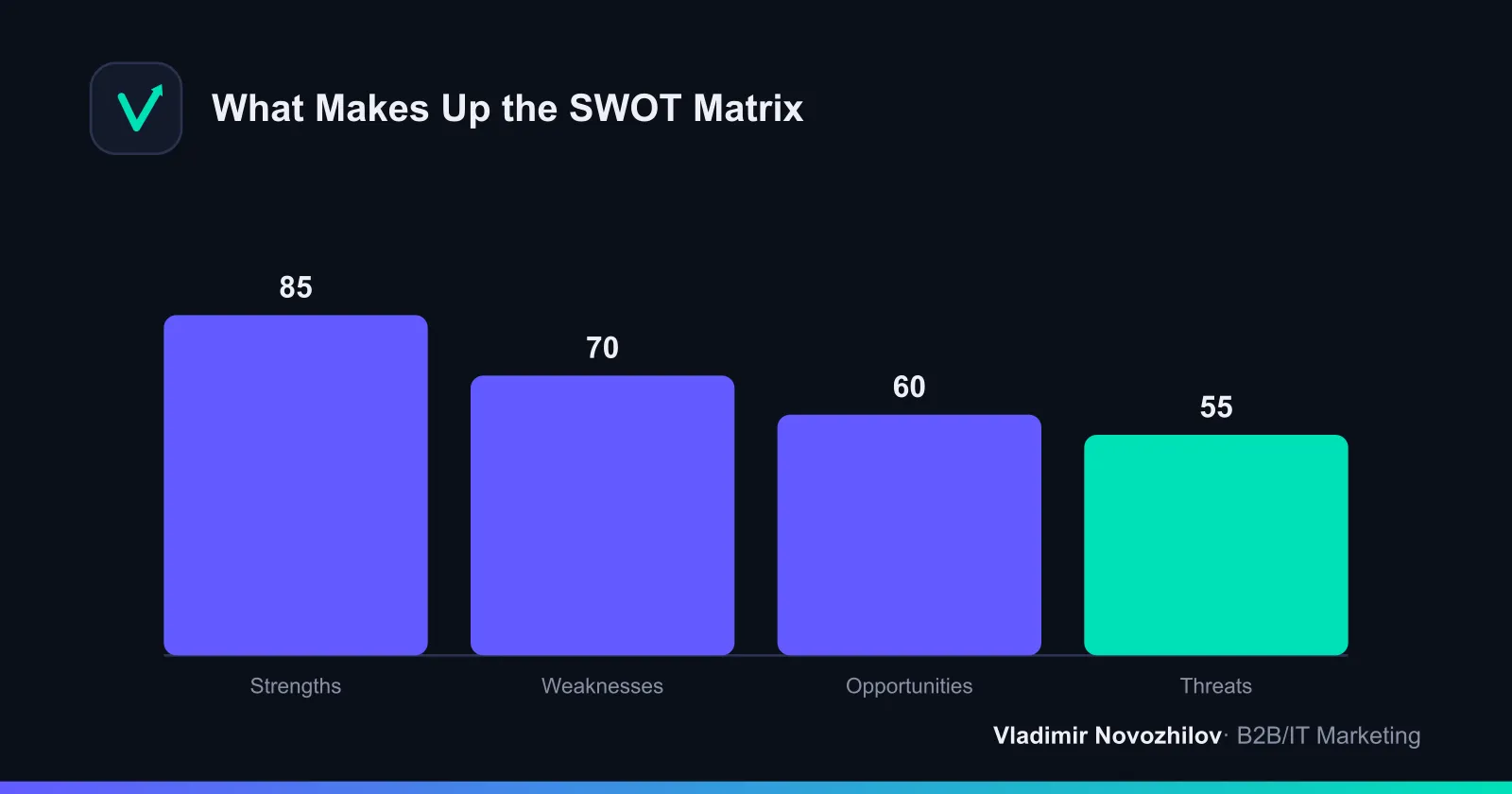
When analyzing competitors, it’s important not to mix up the blocks. A rival’s strengths and weaknesses are things that depend on the company itself. Opportunities and threats are things that affect the market as a whole and that particular company.
How Competitor Analysis Differs From a SWOT Analysis of Your Own Company
A classic SWOT is self-assessment: you take an honest look at your own strengths and weaknesses. A competitor SWOT analysis flips the focus: the object of study is someone else’s business, and you draw conclusions in relation to your own strategy.
The practical differences:
- In self-assessment, you know everything from the inside. In competitor analysis, you work with external data and hypotheses.
- A competitor’s strengths are your benchmarks and barriers. Their weaknesses are your entry points.
- You assess opportunities and threats not for the competitor’s sake, but through the lens of: “Will this help them get ahead of me?” and “Is this dangerous for us?”
That’s why strategic competitor analysis is almost always done in a summary table — so you can compare several players at once instead of examining each one in isolation.
Direct and Indirect Competitors: Who to Include in the Analysis
Before filling in the matrix, decide who you’re actually analyzing. Competitors come in two types: direct and indirect.
Direct competitors are companies selling the same product to the same target audience. A coffee shop competes with the coffee shop next door.
Indirect competitors meet the same customer need in a different way. For a coffee shop, that’s a vending machine, coffee delivery, or even energy drinks at the supermarket.
| Criterion | Direct Competitors | Indirect Competitors |
|---|---|---|
| Product | The same | Different, but meets the same need |
| Target audience | Fully overlaps | Partially overlaps |
| Example (IT services) | Another web development agency | A website builder, a freelancer, a no-code platform |
| Danger | Direct fight for the customer | Reshapes market habits and expectations |
| Analysis priority | High | Medium, but can’t be ignored |
It’s optimal to include 2–3 direct competitors and 1–2 indirect ones. This way you cover both head-to-head competition and disruptive alternatives.
How to Gather Competitor Data: Sources and Tools
A SWOT is only as good as the data behind it. Competitive intelligence doesn’t require espionage — most facts are readily available.
Key sources for assessing competitors’ strengths and weaknesses:
- Customer reviews — on maps, marketplaces, review sites. The most honest source of weaknesses.
- Websites and price lists — product range, pricing, USP, delivery terms.
- Social media and advertising — what offers they’re running, how they engage with their audience.
- Job postings — reveal where a company is growing and what problems it’s hiring to fix.
- Mystery shopping — a personal purchase experience reveals the real level of service.
- Traffic and advertising analytics tools — an assessment of channels and reach.
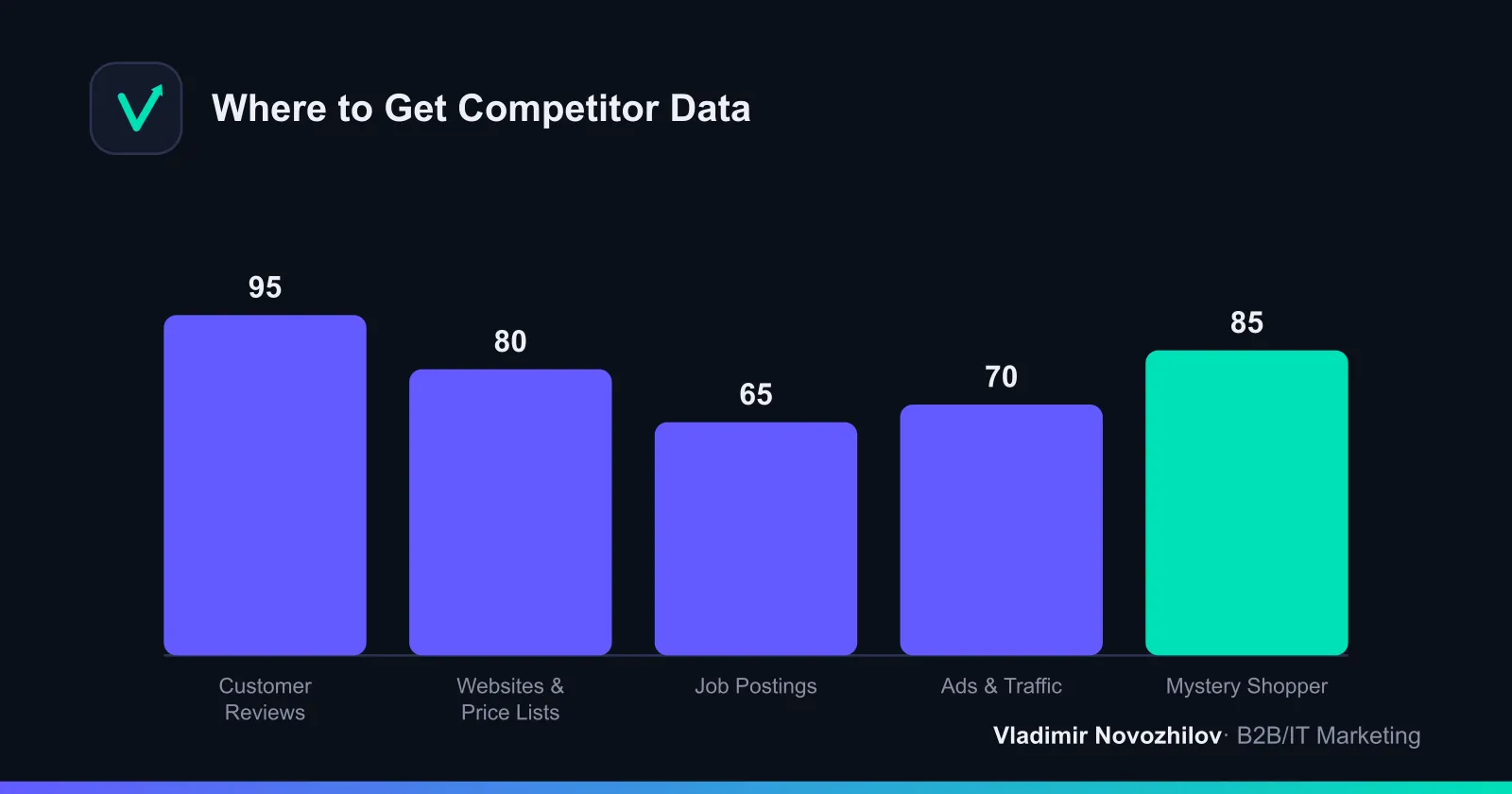
Collect the facts into a single document before filling out the matrix — otherwise your SWOT will turn into a set of subjective guesses.
Step-by-Step Guide: How to Conduct a Competitor SWOT Analysis
Below is a step-by-step SWOT analysis guide broken into four steps. It’s a universal checklist that works for both products and services.
Step 1. Define the Niche and List of Competitors
Pin down your market niche and target audience. Then compile a list: 2–3 direct competitors and 1–2 indirect ones. Look for them the way a customer would — through search, maps, marketplaces, recommendations.
Step 2. Gather Information on Strengths and Weaknesses
For each competitor, go through the sources listed above and write down the facts. Guiding questions for analyzing competitors’ strengths and weaknesses:
- What do customers praise most often?
- What do they complain about in reviews?
- What are the prices, and is there a unique selling proposition?
- How convenient is the website, the purchase process, and support?
Step 3. Identify Opportunities and Threats
Move on to external factors. Assess the business opportunities and threats facing your competitor: is demand in the niche growing, are new channels emerging, are there risks of regulation or price dumping. Here it’s important to look at the market, not the company itself.
Step 4. Build the SWOT Matrix
Consolidate everything into a 2×2 matrix for each competitor, then into an overall comparison table. Solutions emerge from the intersections of the quadrants: how to exploit a rival’s weaknesses (W) using your own strengths, and how to address threats (T).
Example of a Competitor SWOT Analysis With a Ready-Made Table
Let’s walk through a competitor SWOT analysis example using a hypothetical case: you’re launching a web development studio, and you’re analyzing “AlphaWeb,” a large network agency and a direct competitor.
Here’s the ready-made SWOT matrix (example table):
| Strengths (S) | Weaknesses (W) |
|---|---|
| Well-known brand, case studies with federal-level clients | High prices, out of reach for small businesses |
| Large team, tight turnaround times | Template-based approach, little customization |
| Strong sales department | Slow post-project support (complaints in reviews) |
| Opportunities (O) | Threats (T) |
| Growing demand for digital services among mid-sized businesses | No-code tools and website builders are eating into the lower segment |
| Expansion into new regions | Price dumping by freelancers |
| Partnerships with marketplaces | Customer churn due to weak post-sale service |
What this product and service SWOT analysis of a competitor reveals: their weak spots are pricing and post-sale service. Your strategy: affordable packages for small businesses and a contract with a guaranteed support SLA. That’s how a competitor’s weakness (W) becomes your competitive advantage.
If you’re analyzing several players, combine them into a single comparison table — columns for competitors, rows for S/W/O/T. This template is easy to replicate in any spreadsheet: set up four blocks and fill them in for each rival, adding a final row for your “next move.”
Types of SWOT Analysis: Express and Comprehensive
There are two main types of SWOT analysis by depth.
- Express SWOT — a quick matrix built in 1–2 hours from publicly available data. Good for testing a hypothesis or monitoring a new player.
- Comprehensive SWOT — an in-depth study involving surveys, mystery shopping, traffic analytics, and quantitative scoring. Needed for a product launch or a strategy overhaul.
There’s also a distinction between qualitative SWOT (descriptive) and quantitative SWOT, where each factor is assigned a weight and score for objective comparison between competitors.
Common Mistakes in Competitor Analysis
- Confusing internal and external factors. A competitor’s price is an S or a W, while market growth is an O. Mixing these up breaks the matrix’s logic.
- Relying on gut feeling. Without data, a SWOT turns into a collection of opinions. Always base it on reviews, numbers, and facts.
- Drawing “general” conclusions. A matrix that isn’t tied to your own strategy is useless.
- Abandoning the analysis once it’s filled in. The table is only half the work — the real value lies in the actions that follow.
- Including too many competitors. Twenty companies can’t be analyzed in depth.
What to Do With the Results of a SWOT Analysis
A completed matrix isn’t the finish line — it’s the entry point into strategy. Work with the intersections of the quadrants:
- S → O: how to seize market opportunities the competitor hasn’t claimed yet.
- Competitor’s W → your move: where to hit their weakness with your own offer.
- T → defense: how to reduce market-wide threats before your rivals do.
Turn each conclusion into a specific task with an owner and a deadline. That’s exactly what separates strategic competitor analysis from a nice-looking but lifeless table.
How Often to Repeat Competitor Analysis
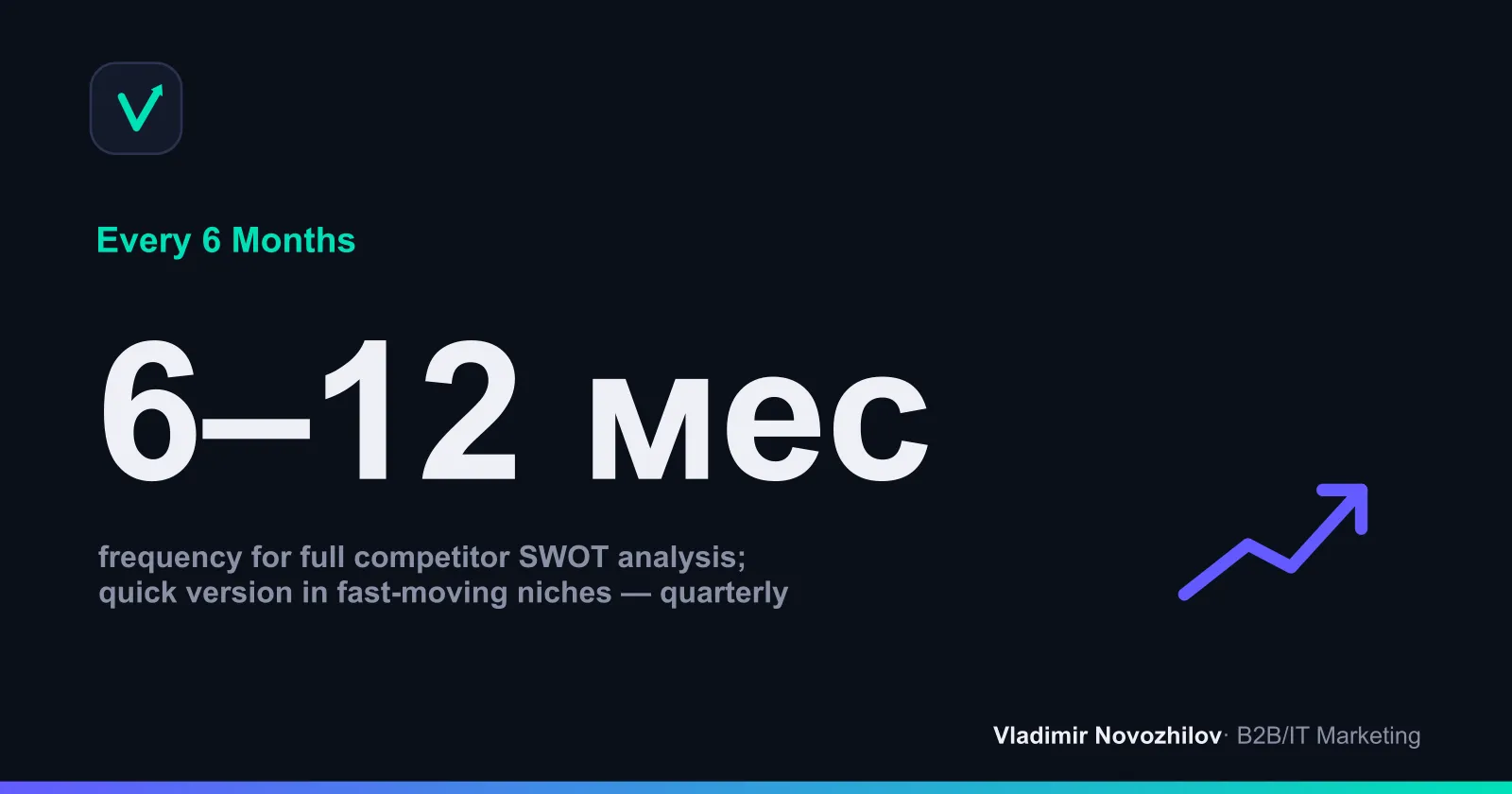
A full SWOT is worth updating every 6–12 months, plus on an unscheduled basis whenever the market shifts significantly. In fast-moving niches, keep an express monitoring routine on competitor prices and activity every quarter. That way, competitive SWOT analysis stays a living tool rather than a one-off report gathering dust in a folder.
FAQ on Competitor SWOT Analysis
Below are short answers to common questions about competitor SWOT analysis that will help fill in any remaining gaps and apply the methodology to your own business.
FAQ
- How does a SWOT analysis of competitors differ from a SWOT analysis of your own company?
- In a classic SWOT, strengths and weaknesses are internal factors of your own company, while opportunities and threats are external. In a competitor analysis, you're looking at someone else's business: S and W describe their product, service, pricing, and team, while O and T are assessed through the lens of your own strategy — where the competitor could grow stronger and what risks they pose to you. The outcome isn't self-assessment — it's a map of open niches and rivals' vulnerabilities.
- How many competitors should you analyze?
- For a workable decision, 3–5 companies are enough: 2–3 direct competitors fighting for the same customers, and 1–2 indirect ones meeting the same need in a different way. There's little point going beyond 7 — the analysis becomes bloated and conclusions get diluted. It's better to deeply examine five key players than to skim through twenty.
- Where do you get data on competitors' strengths and weaknesses?
- Key sources include: competitor websites and price lists, reviews on marketplaces and maps, social media and ad accounts, job postings (which reveal where a company is growing and what problems it's hiring to solve), mystery shopping, and traffic and advertising analytics tools. Customer reviews are the most honest source of weaknesses, because people openly write about what disappointed them.
- How often should you conduct a SWOT analysis of competitors?
- A full competitive SWOT analysis is enough to update every 6–12 months, plus whenever there are notable market shifts — a strong new player, pricing changes, a new product launch. In fast-moving niches (e-commerce, IT services), it's useful to refresh an express version quarterly, tracking competitor prices and activity in between.
- What mistakes are most common in a competitor SWOT analysis?
- The most frequent ones: confusing internal and external factors, evaluating a competitor subjectively without data, drawing 'general' conclusions unrelated to your own strategy, and abandoning the matrix once it's filled in. A SWOT's value isn't the table itself — it's the actions that follow: where to strike a competitor's weakness and how to address your own risks.