ABM Marketing in B2B: What It Is and How to Launch It

TL;DR
ABM (account-based marketing) is a B2B marketing strategy where a company works not with a stream of leads, but with a pre-selected list of target accounts, personalizing communication for a specific company and its decision-makers. Below: the definition, how it differs from inbound and ABX, the three types of ABM, a step-by-step launch algorithm, metrics instead of MQL/CPL, plus realistic timelines and budget for the Russian market.
What account-based marketing is: the definition and a letter-by-letter breakdown
Account-based marketing (ABM), or key-account marketing, is a B2B strategy in which a company works not with a wide stream of leads, but with a pre-selected list of target accounts (companies), personalizing marketing and sales for each of them and for the specific decision-makers.
Let’s break the term down into parts:
- Account — the account, that is, the entire client company rather than an individual contact. The unit of work in ABM is the organization, not the person.
- Based — “built upon.” The whole strategy is built around the chosen list of accounts.
- Marketing — marketing that in ABM is inseparable from sales and works with it as a single team.
The core idea: in complex B2B, the buying decision is made not by one person but by a group (the DMU, decision making unit), deals are large, and the cycle is long. That is why it is more profitable to focus resources on 30–100 “right” companies than to spread the budget across thousands of random leads.
How ABM differs from classic lead generation and inbound marketing
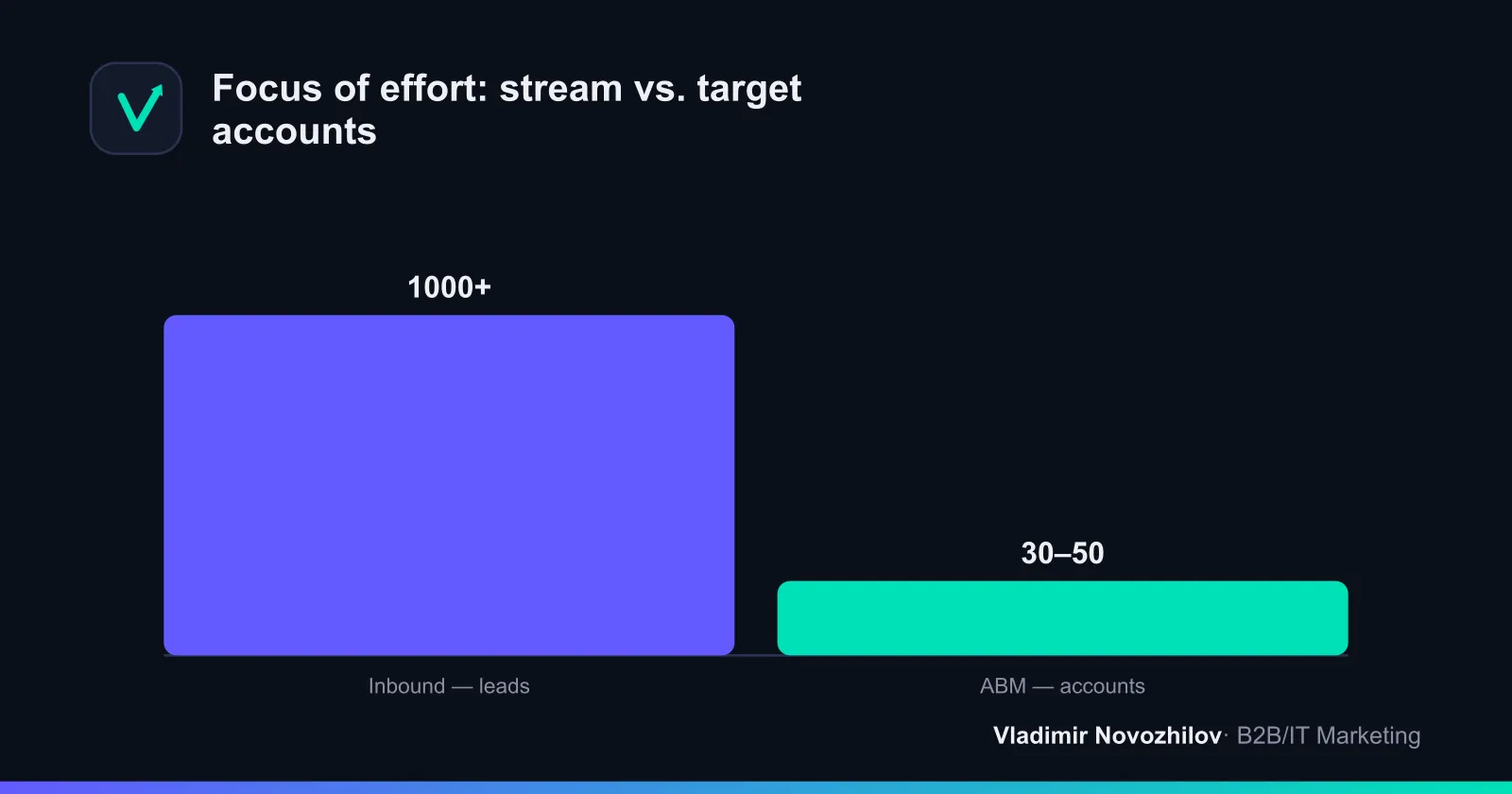
Classic inbound and lead generation are structured as a top-down funnel: we attract the widest possible audience, warm them up with content, filter out MQLs, and hand them to sales. The metrics are CPL (cost per lead) and the number of MQLs.
ABM flips the funnel. First we decide exactly who we want to work with, and only then do we build the communication. This is an “inverted funnel”: a narrow entry of selected accounts and deep personalization inside.
Key differences:
- Unit of work. Inbound — the lead (a person). ABM — the account (a company and its entire DMU).
- Direction. Inbound attracts incoming demand. ABM generates demand in a targeted way and often combines outbound touches.
- Success metric. Inbound — the volume and cost of leads. ABM — engagement and revenue in target accounts.
- Role of sales. In inbound, sales receive leads “at the output.” In ABM there is sales-marketing alignment: marketing and the account executive work on the same accounts with shared KPIs.
ABM and inbound do not contradict each other. In practice, inbound generates demand and data, while ABM concentrates effort on the most valuable companies.
ABM vs. ABX: what’s the difference and when to move on
ABX (account-based experience) is the logical evolution of ABM. If ABM is responsible for attracting and closing the deal in target accounts, then ABX extends the personalized approach across the whole customer lifecycle: onboarding, support, upsell and retention.
| Parameter | Inbound | ABM | ABX |
|---|---|---|---|
| Focus | Stream of leads | Target accounts | Account experience across the whole cycle |
| Unit | Lead | Company | Company + customer success |
| Horizon | Up to MQL | Up to the deal | Acquisition → retention |
| Teams | Marketing | Marketing + sales | Marketing + sales + CS |
| Metric | CPL, MQL | Engagement, pipeline, win-rate | LTV, retention, NRR |
It’s worth moving to ABX when ABM is already delivering results and the core value of the business lies in retaining and growing existing clients, not just in new deals.
Types of ABM: one-to-one, one-to-few, one-to-many
The choice of type depends on how many accounts you can afford to serve deeply.
- One-to-one (strategic ABM). Individual work with a single large account: personal content, company-specific landing pages, custom offers. Usually 5–20 Tier 1 accounts. Expensive, but with the maximum deal size.
- One-to-few (ABM lite). Work with small clusters of similar companies (by industry or pain point), 20–50 Tier 2 accounts. Content is personalized at the segment level.
- One-to-many (programmatic ABM). Scaling to hundreds of Tier 3 accounts through technology: dynamic segments, personalization by firmographics. Closer to targeted marketing, but still at the company level.
A healthy program combines all three levels: top accounts get one-to-one, mid-tier ones get one-to-few, and the rest get one-to-many.
A step-by-step algorithm for launching ABM in B2B
Here is an end-to-end implementation plan that works for both large and mid-sized B2B companies:
- Build the ICP and select target accounts by tier.
- Gather data and map the stakeholders (DMU) in each account.
- Develop personalized content and offers for the tier and role.
- Align marketing and sales, set up a single process and stack.
- Launch multichannel touches (email, social, ads, direct contacts).
- Track engagement and pipeline metrics, adjust the account list.
- Scale what worked and move on to ABX.
Below are three critical steps in more detail.
Step 1. Building the ICP and selecting target accounts (Tier 1/2/3)
ICP (Ideal Customer Profile) is a description of the companies your product brings the most value to. It is built on firmographics (industry, revenue, headcount, region), technographics (the stack) and behavior. A practical method: take 10–20 of your best deals by LTV, closing speed and retention and find the shared traits.
Then distribute the accounts across tiers. I suggest a simple selection framework of my own:
- Tier 1 — strategic. High potential deal size, an exact fit with the ICP, an existing “point of entry” and a clear pain. Handled one-to-one.
- Tier 2 — priority. A fit with the ICP, but a lower deal size or a weaker contact. Handled one-to-few by clusters.
- Tier 3 — promising. Formally fit the ICP, but there is little data. Handled one-to-many, watching for signals of interest.
It makes sense to start with 20–50 accounts so the pilot stays manageable.
Step 2. Mapping stakeholders (DMU) and personalizing content
In a large deal the decision is made by the DMU (decision making unit) — a group of 5–10 people: the economic buyer, the technical expert, the end user, the finance person, and sometimes “blockers.” For each account you need to understand who is in this group and what their motives are.
For each role, there is a different emphasis in the content:
- Economic buyer — ROI, payback, impact on business metrics.
- Technical expert — integrations, security, compatibility with the stack.
- End user — convenience, time savings, taking the routine off their plate.
Personalization can range from named landing pages and analyses tailored to a specific company (Tier 1) to industry case studies and curated collections (Tier 2–3).
Step 3. Integrating marketing and sales, the technology stack (CRM, analytics)
ABM does not work if marketing and sales live in different worlds. Sales-marketing alignment means: a shared account list, shared KPIs (pipeline, revenue), regular syncs and a single understanding of what a “hot” account is.
A minimal stack for launching in Russia without Western platforms like Demandbase or 6sense:
- CRM (Bitrix24, amoCRM, domestic analogues) — the core where accounts and deals live.
- Email and newsletters for personalized touches.
- Ad accounts (Yandex) for follow-up campaigns on company lists and retargeting.
- Analytics and dashboards for account-level metrics rather than lead-level ones.
- Data enrichment — manual research plus open sources and scraping.
You can start with CRM + content + ads — and that is exactly ABM-lite without big investments.
ABM metrics: what to measure instead of MQL and CPL
In ABM the familiar CPL and number of MQLs are of little use — the goal is not the number of leads, but penetration into specific companies. Measure:
- Engagement rate per account — the depth of engagement of all the company’s contacts (opens, visits, meetings).
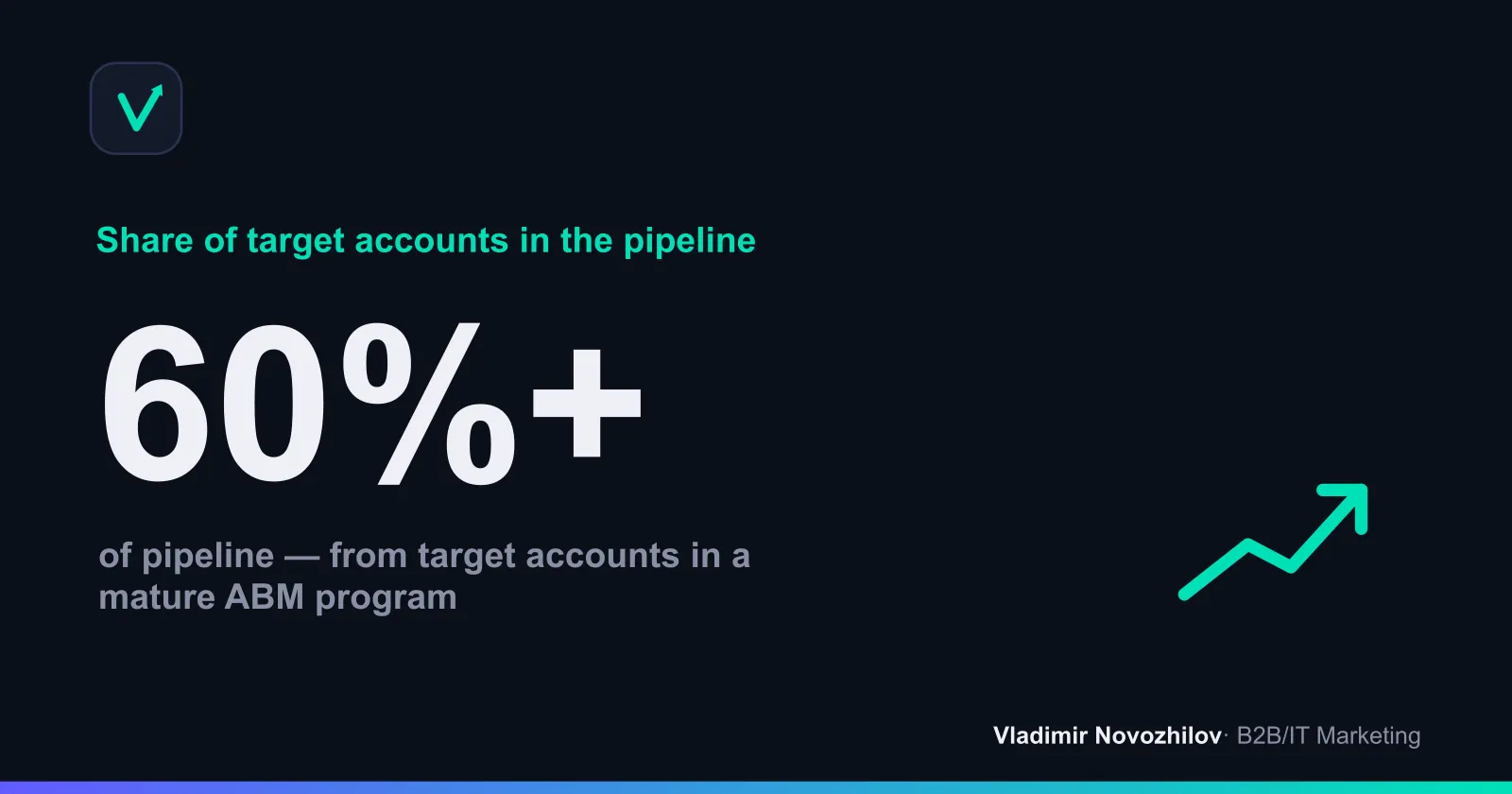
- Share of target accounts in the pipeline — how many from the list reached active deals.
- Pipeline velocity — how fast deals move through stages.
- ACV (Average Contract Value) — the average annual contract; in ABM it should grow.
- Win-rate on target accounts — the share of deals won.
- Revenue impact — how much money the target accounts specifically brought in.
Timeline and budget: how much time and money launching ABM takes
The main thing to accept: ABM is a long game. The B2B deal cycle lasts from 6 months to 1.5 years, so the first deals from an ABM program should not be expected before six months in.
Reference points:
- ABM-lite (one-to-many/few): launch in 1.5–3 months, by a duo of “a marketer + 1–2 salespeople.” The budget is essentially the cost of a CRM, content and ads.
- Dedicated ABM (one-to-one): 3–6 months of preparation, a separate team, custom content for each account. The budget is many times higher because of the depth of personalization.
The right strategy is to start with an ABM-lite pilot on 20–50 accounts, prove effectiveness with numbers, and only then invest in one-to-one.
Cases and numbers from Russian practice
The Russian market already has measurable results. In a published case study, applying ABM delivered up to 67% confirmed leads from target accounts and closed deals worth tens of millions of rubles — even though the work was done with a limited list of companies rather than a mass stream. This illustrates the main principle: fewer accounts, but deeper work and a higher average deal size.
Practitioners also note the realistic side: results are not instant, the deal cycle is long, and success depends critically on the quality of account selection and the marketing-sales pairing.
Limitations of ABM: when the approach isn’t a fit
ABM is not a universal solution. It is not justified when:
- The product is cheap and mass-market. If the deal size is low, the cost of personalization won’t pay off — inbound is more efficient.
- A short deal cycle with a single decision-maker. There is no point in complex DMU mapping if one person makes the decision in a week.
- No resources to align sales and marketing. Without alignment, ABM falls apart.
- Poor market data. Without a quality ICP, you are simply personalizing communication for the wrong people.
There is also a critical view: some experts consider ABM a repackaging of the long-known practice of working with key accounts. There is a grain of truth in this — but it is precisely the systematization, the metrics and the technology stack that make modern ABM a manageable process rather than one-off efforts.
FAQ on account-based marketing
Answers to frequent questions are collected in the FAQ block above — from how ABM differs from lead generation to choosing tools and launching without big budgets. To sum up: start with a clear ICP, a narrow list of accounts and the pairing of marketing with sales, measure engagement and revenue per account rather than CPL, and give the program at least six months for the first results.
FAQ
- How does ABM differ from regular B2B marketing and lead generation?
- Classic lead generation works with a wide stream: the more leads, the better, and the metric is CPL and the number of MQLs. ABM flips the funnel: first a limited list of target companies (ICP) is chosen, and then marketing and sales jointly personalize communication for each of them. The goal is not lead volume, but closed deals in the right accounts and growth of the average deal size.
- What is an ICP and how do you build one for ABM?
- ICP (Ideal Customer Profile) is the profile of your ideal client: a description of the companies your product brings the most value to. It is built on firmographics (industry, revenue, headcount, region), technographics (the stack in use) and behavioral signals. A practical approach is to analyze 10–20 of your best deals by LTV, closing speed and retention and find the shared traits.
- How much does launching ABM cost and how long does it take?
- An ABM-lite pilot on 20–50 accounts can be launched in 1.5–3 months by a duo of a marketer plus a couple of salespeople. A full-fledged one-to-one program requires 3–6 months of preparation and accounting for the fact that the B2B deal cycle lasts from 6 months to 1.5 years. The budget varies: ABM-lite can realistically start at the cost of a CRM and content, while dedicated programs cost many times more because of the personalization.
- What metrics should you use instead of MQL and CPL?
- In ABM you measure the engagement rate per account (the depth of engagement of all the company's contacts), the share of target accounts in the pipeline, pipeline velocity (how fast deals move), ACV (average annual contract), win-rate on target accounts, and revenue impact. MQL and CPL are of little use here, because the goal is not the number of leads, but penetration into specific companies.
- Does a small business need ABM, or is it only for Enterprise?
- ABM is justified when the average deal size is high, deals are few, and the decision is made by a group of people (DMU). This is more often Enterprise and complex B2B. For a small business with a cheap mass-market product and a short deal cycle, ABM is usually not a fit — it is cheaper to work through inbound. But the ABM-lite format (one-to-many) is also accessible to mid-sized companies.
- ABM and ABX — what's the difference?
- ABM focuses on marketing and sales to target accounts up to the deal. ABX (account-based experience) is an evolution of the approach: a single personalized experience for the account across the whole lifecycle, including onboarding, support and retention. ABX adds customer success to ABM and makes the approach end-to-end, not just about acquisition.