Content Distribution: Channels and Promotion Strategies

TL;DR
Content distribution is a system for spreading and promoting materials across owned, earned, shared and paid channels so your target audience actually sees them. This article covers content distribution types, the PESO model, a channel comparison table, tools, a step-by-step plan and performance metrics.
Content distribution is a system for spreading and promoting finished materials across channels so your target audience sees and consumes them. If content creation answers the question “what are we saying,” content distribution answers the question “how does it reach people.” In B2B, IT and services, distribution is most often the bottleneck: many people write articles, case studies and research, but very few deliver them to an audience systematically.
In this article, we’ll cover what content distribution is and why businesses need it, the types of content distribution, how the PESO model works, which channels and tools to choose, how to build a distribution strategy, and how to measure its effectiveness. Inside: a channel comparison table, a launch checklist, and a breakdown of common mistakes.
What content distribution is and why businesses need it
Content distribution is the deliberate placement and promotion of content on platforms where your audience already is, with a measurable goal in mind: reach, traffic, leads, sales or reputation. The key word here is “system” — a one-off post on a corporate blog doesn’t count as distribution.
Why businesses need content distribution:
- To recoup investment in content. A single piece can be broken down into dozens of touchpoints across different channels — this sharply lowers the cost per contact.
- To expand reach. Your own platforms have limited reach; distribution takes content beyond your existing base.
- To accelerate sales. In B2B, decisions take time, and a series of touchpoints across different channels warms up the decision-maker.
- To strengthen SEO and citability. Mentions, links and presence across multiple platforms help both classic search and the newer AI search.
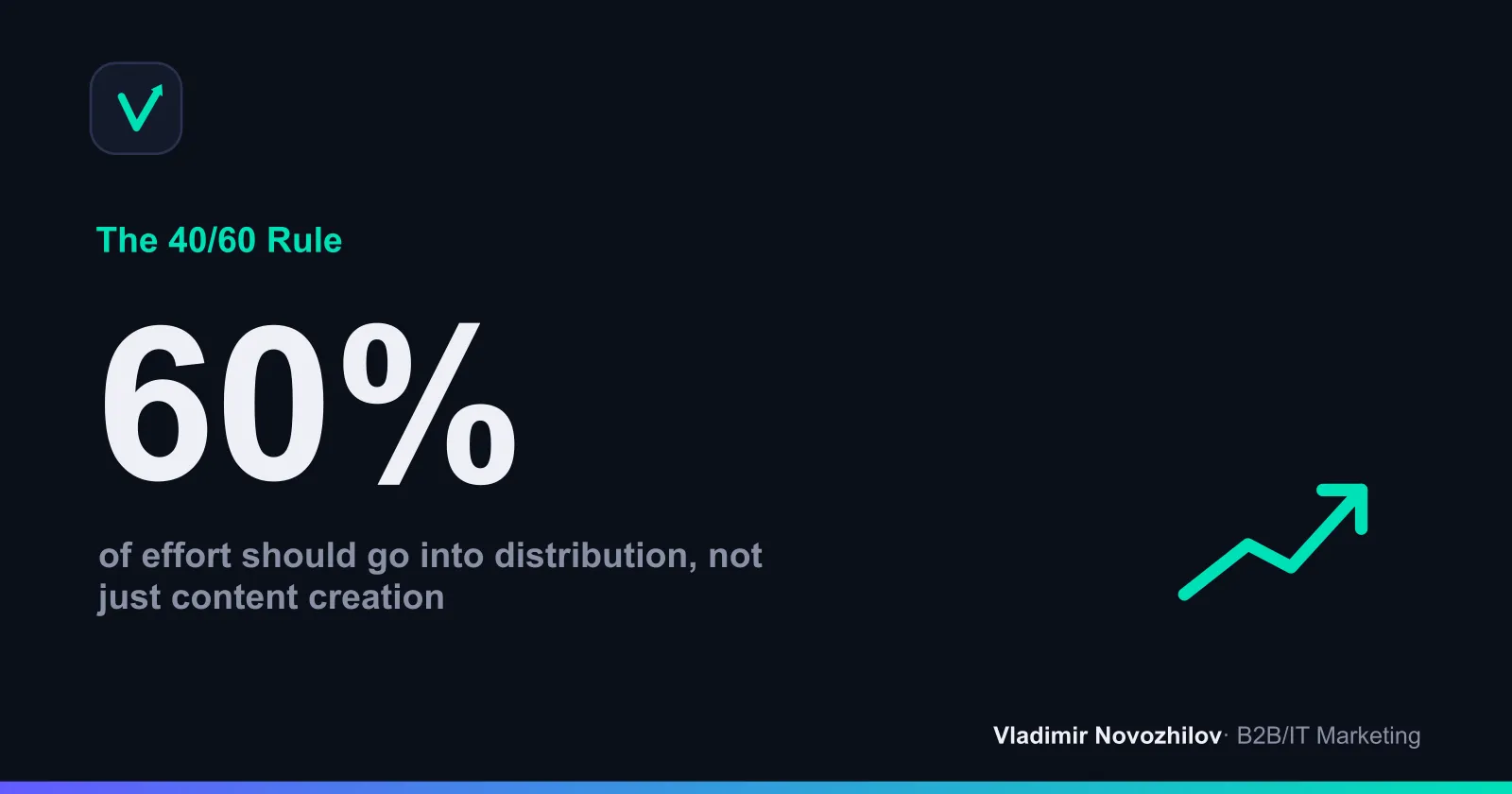
A simple rule I use in projects: content creation and content promotion should get comparable resources. A common mistake is spending 90% of effort on the text and 10% on distribution.
Content distribution vs. content creation: what’s the difference
These are two different stages of the same process. Creation is producing the asset (an article, video, research, case study). Distribution is delivering that asset to the audience. Content marketing combines both stages plus strategy and analytics.
| Parameter | Content creation | Content distribution |
|---|---|---|
| Core question | What and how do we say it | Where and how will it be seen |
| Output | Finished material | Reach, traffic, leads |
| Key skill | Expertise, editing | Media planning, analytics |
| Success metric | Quality and depth | Distribution effectiveness: reach, CTR, CPA |
The takeaway is simple: good content doesn’t work without distribution, and distributing weak content just shows the audience faster that the material is weak.
Types of content distribution: free, paid, organic
There are several types of content distribution, conveniently split by traffic source and payment model.
- Organic distribution — content reaches the audience without direct payment for placement: SEO, social media posts, newsletters to your own list, reposts. Slower, but builds a cumulative effect.
- Paid distribution — you pay for impressions or placement: targeted advertising, contextual advertising, seeding with bloggers and channels, native placements in media. Fast and predictable, but requires budget.
- Free distribution — essentially a subset of organic: activities that don’t cost direct money but require team time (cross-promotion, listings in free directories, engaging in niche communities).
In practice, a healthy strategy combines all types: organic builds a base and reputation, while paid distribution accelerates reach at launch and for campaigns.
The PESO model: owned, earned, shared, paid channels
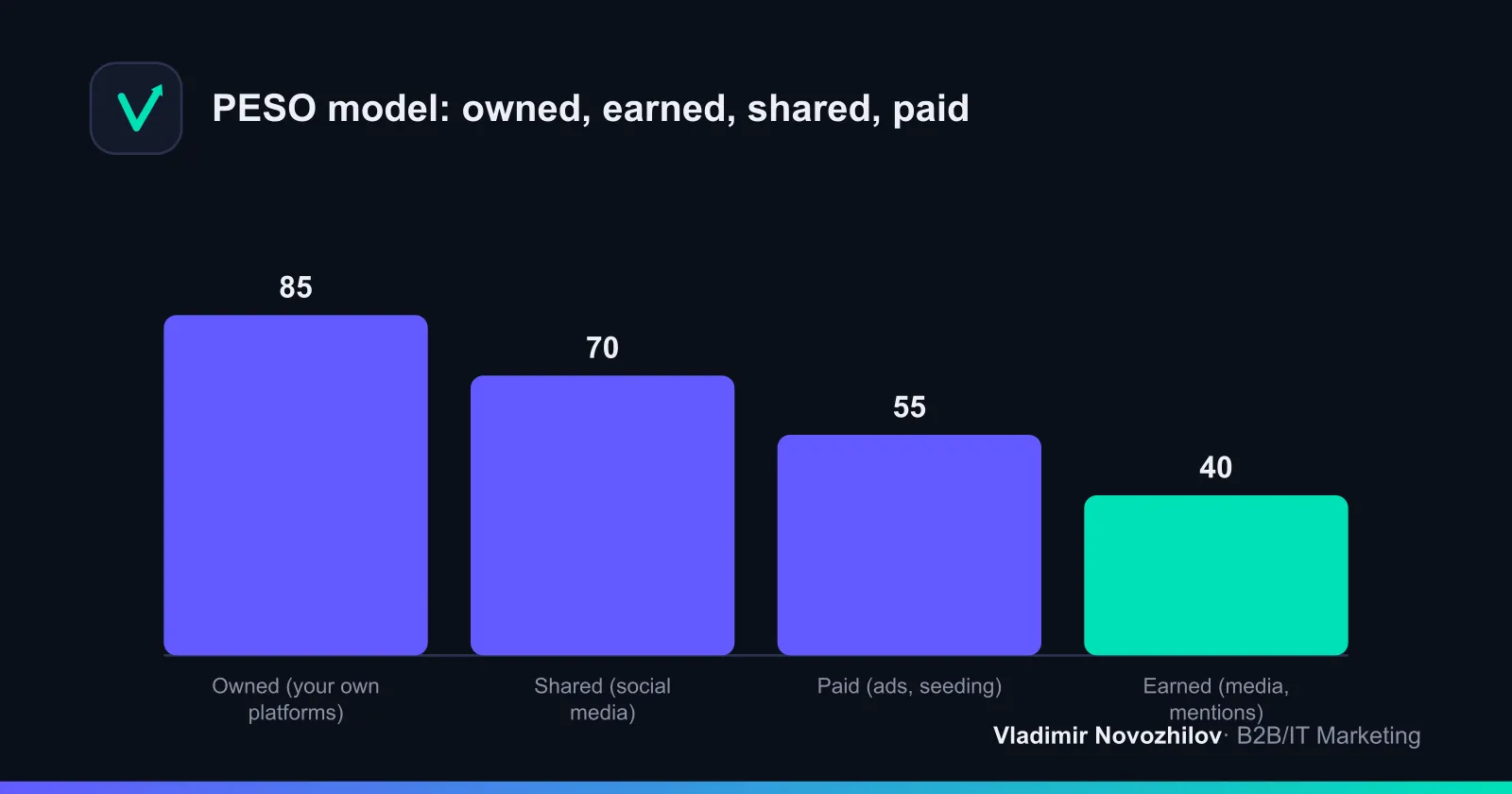
The most convenient way to break down content distribution channels is the PESO model. It splits all platforms into four types.
- Owned media — what you own: your website, blog, email list, app, corporate channels. Full control, but limited reach.
- Earned media — mentions you’ve earned: press coverage, reviews, reposts, expert commentary. High trust, but little control.
- Shared media — social networks and communities where you distribute content together with the platform and its audience.
- Paid media — paid placements: advertising, seeding, native integrations.
The strength of the PESO model is that it forces you not to overlook any channel type. A common weakness for many companies is over-relying on owned media (just their own blog) while completely neglecting earned and shared.
Content distribution channels: website, social media, email, media, messengers
Here are the main content distribution channels relevant to the Russian market in 2025–2026.
- Company website and blog — the foundation of owned media, where all other traffic eventually leads.
- Search engines (SEO) — an organic channel with a cumulative effect; works slowly but steadily.
- Social networks — VK, plus niche business platforms for B2B.
- Messengers — Telegram channels, chats and newsletters; one of the fastest-growing channels for expert content.
- Email newsletters — an underrated channel with high ROI, especially for nurturing a B2B database.
- Targeted advertising — precise targeting by interest and behavior segments.
- Contextual advertising — capturing warm demand for commercial search queries.
- Blogging platforms and media — VC.ru, Zen, industry publications and press-release aggregators.
- Media and niche publications — earned media with high trust.
- Seeding and cross-promotion — placements with bloggers, in topical channels, audience exchanges with partners.
Worth calling out separately is UGC (user-generated content): reviews, customer case studies, breakdowns — this is both content and a trust-building channel at once.
Comparison table of content distribution channels
Below is a comparison of the main content distribution platforms by reach, cost, speed of results and setup complexity. This kind of table is usually missing from overviews, yet it’s exactly what helps you pick the right channel for the task.
| Channel | Reach | Cost | Speed of results | Complexity | PESO type |
|---|---|---|---|---|---|
| SEO / blog | High | Low (labor) | Slow (3–6 months) | High | Owned |
| Email newsletter | Medium | Low | Fast (1–3 days) | Medium | Owned |
| Social media (organic) | Medium | Low | Medium (days) | Medium | Shared |
| Telegram channels | Medium | Low | Fast | Low | Owned/Shared |
| Targeted advertising | High | Medium | Fast | Medium | Paid |
| Contextual advertising | Medium | High | Fast | Medium | Paid |
| Seeding with bloggers | High | Medium–high | Medium | Medium | Paid |
| Media and niche publications | High | High/free | Medium | High | Earned |
| Cross-promotion with partners | Medium | Low | Medium | Low | Shared |
How to read this table: for fast reach, use paid distribution and seeding; for trust, use earned media and case studies; for sustainable long-term traffic, use SEO and email.
Tools for content distribution: analytics, posting, email, SEO
Content distribution tools fall into several groups. You don’t need to adopt everything at once — start with a minimum viable toolkit.
- Scheduling and posting — services for scheduled publishing and multi-posting across several channels from a single dashboard.
- Email and newsletters — platforms for list segmentation, automated funnels and triggered emails.
- Analytics and tracking — web analytics systems, end-to-end analytics, UTM tags for tracking sources.
- SEO tools — keyword research, audits, rank tracking.
- CDP and CRM — customer data platforms (CDP) for personalizing distribution by segment.
- AI tools — neural networks for adapting one piece of content into different formats: turning a long article into posts, generating announcements, newsletter drafts and subtitles. This solves the main pain point of small teams — not enough hands to “repackage” content for every channel.
AI is especially useful for automating the routine part of distribution: one article turns into a series of posts, an email, cards and a video script in minutes, freeing the team to focus on meaning and quality control.
How to choose a distribution strategy for your business goals
Distribution strategies should always be built around a goal, not around a trendy channel. Here are three typical scenarios.
- Goal — reach and awareness. Bet on shared and paid: social media, seeding, targeted ads, collaborations. Metric: reach and cost per contact.
- Goal — leads and sales. Bet on owned and paid with a clear call to action: SEO for commercial queries, email funnels, contextual ads. Metric: CPA and conversion rate.
- Goal — reputation and expertise. Bet on earned: press coverage, expert columns, industry media. Metric: quality of mentions and citability.
The general selection algorithm: define the goal → describe where your audience actually “lives” → pick 2–3 channels for that goal → test → scale the combinations that work. Spreading yourself across ten channels at once is a sure way to succeed at none of them.
Step-by-step plan: building a content distribution system
Here’s a working sequence for promoting content systematically rather than chaotically.
- Define the goal and metric. What counts as success: reach, clicks, leads, revenue.
- Describe your audience and its platforms. Where they read, what they watch, which sources they trust.
- Take inventory of your content. What already exists and what can be repackaged for different channels.
- Build a channel map using PESO. Cover all four types with at least one channel each.
- Build a distribution content plan. One piece of content = a series of formats and touchpoints across different channels.
- Set up the technical side. UTM tags for tracking, canonical tags for syndication (so search engines understand the original source and don’t treat copies as duplicates).
- Launch and test. Small budgets across several hypotheses, quick iterations.
- Measure and reallocate. Cut what’s unprofitable, double down on what works.
Example distribution content plan for one piece of content (template):
| Day | Channel | Format |
|---|---|---|
| 1 | Blog/website | Main article |
| 1 | Announcement to list | |
| 2 | Telegram | Post with key takeaway |
| 3 | Social media | Cards/quote |
| 5 | Seeding/partner | Repost in a topical channel |
| 7 | Media | Expert summary for press |
Measuring content distribution effectiveness: metrics and KPIs
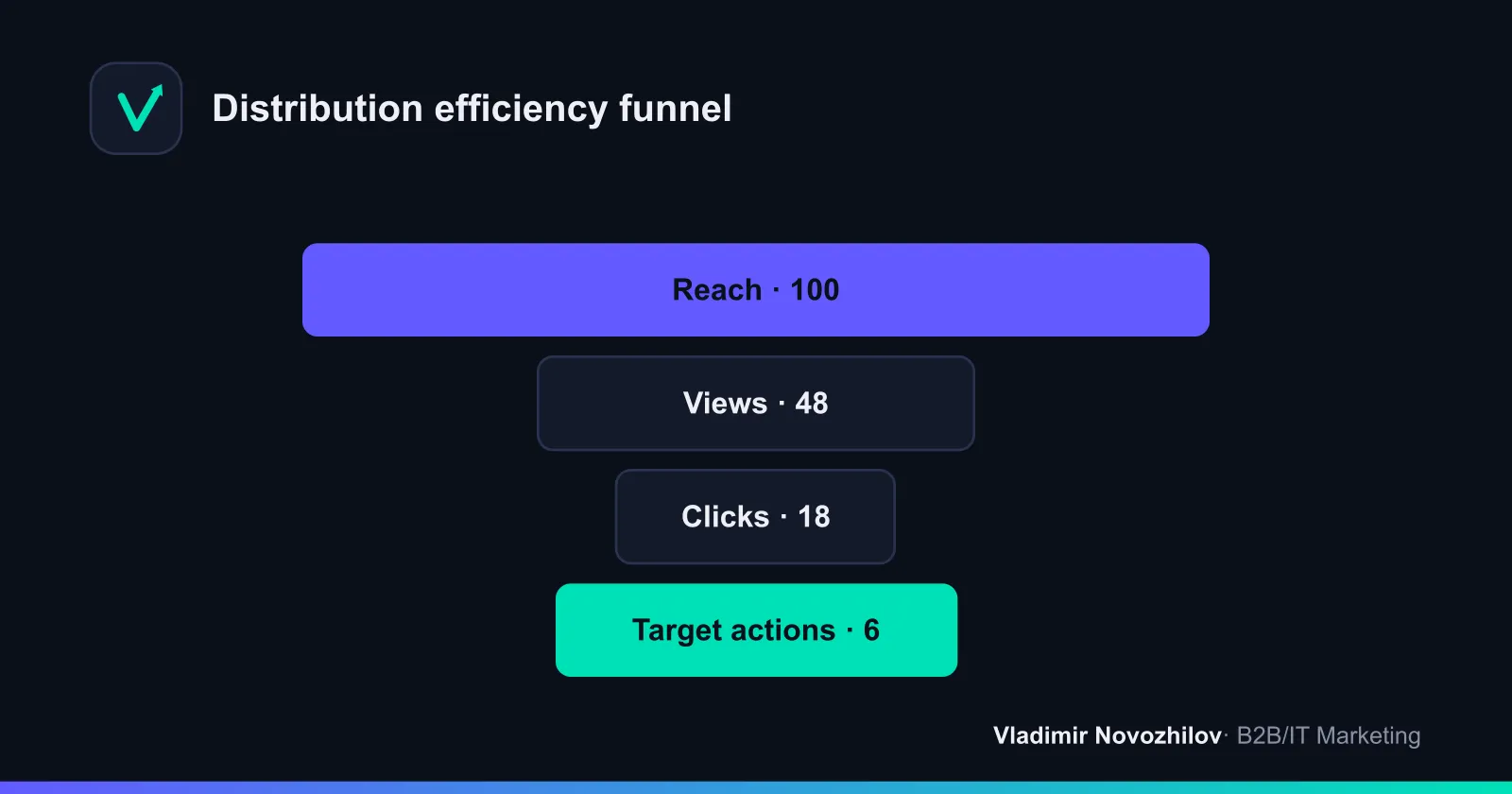
Distribution effectiveness should be measured across every stage of the funnel — from reach to revenue. Looking only at views isn’t enough.
- Reach — how many people saw the material.
- Engagement — likes, comments, time on page, completion rate.
- Clicks and CTR — how many people clicked the link.
- Conversion — share of target actions (form submission, subscription, download).
- CPA / cost per lead — how much a target action cost in paid channels.
- Virality — the rate of reposts and organic spread.
- Revenue contribution — based on end-to-end analytics data.
Quick channel evaluation formula: Channel ROI = (revenue from channel − costs) / costs × 100%. Example calculation: seeding cost 30,000 ₽, brought 12 leads, of which 3 deals generated 150,000 ₽ in margin → ROI = (150,000 − 30,000) / 30,000 × 100% = 400%. Running this calculation for each channel shows where to shift your budget.
An important trend: the role of GEO (optimization for AI search) is growing. To get cited by generative answers, it’s not enough to rank first on one site — you need presence and mentions across multiple platforms, clear definitions, and structured data.
Examples of successful content distribution by Russian brands
Without naming specific budgets, but based on recognizable patterns:
- Online school media teams. They break one expert-level long-form piece into posts, a newsletter and video clips, then boost it with seeding — so the article keeps driving blog traffic for months.
- B2B analytics services. They focus on earned media and expert columns in industry publications: this builds trust and delivers quality leads that are cheaper than direct targeted advertising.
- IT companies and system integrators. They publish data-driven case studies on niche platforms (VC.ru, industry media) and mirror them on Telegram — the material simultaneously drives reach and builds reputation.
The common thread across successful examples: repackaging one asset for multiple channels and consistently tracking results.
Common content distribution mistakes and how to avoid them
- Publish and forget. Posting an article only to the blog and stopping there. Fix: prepare a plan of 5–7 touchpoints across different channels for every piece in advance.
- One format for every platform. Copy-pasting an article into social media doesn’t work. Fix: adapt the format to the channel (cards, short posts, video).
- No tracking. Without UTM tags, you can’t tell what worked. Fix: a unified tagging system and end-to-end analytics.
- Duplicates without canonical tags. Syndication without pointing to the original source hurts SEO. Fix: set canonical tags pointing to the original.
- Spreading budget too thin. A little bit everywhere means nothing anywhere. Fix: pick 2–3 priority channels for your goal.
- Evaluating only by reach. Reach without conversion is a vanity metric. Fix: track contribution to leads and revenue.
Checklist for launching content distribution
A short checklist you can save and use before every launch:
- Goal and primary metric are defined
- Audience and its platforms are described
- 2–3 priority channels are chosen for the goal
- All four PESO channel types are covered (at least one each)
- The material is repackaged into 4–6 formats
- A distribution content plan with dates and channels is prepared
- UTM tags and canonical tags are set up
- A test budget is allocated for paid distribution
- Thresholds for cutting unprofitable combinations are defined
- A dashboard for measuring distribution effectiveness is set up
If every box is checked, you’re ready to distribute content systematically rather than as a one-off effort.
Answers to frequently asked questions about content distribution
Below are short answers to the questions most often asked about content distribution and promotion. Full answers are in the FAQ block.
FAQ
- How is content distribution different from content marketing?
- Content marketing is the whole cycle: strategy, creating materials, and distributing them. Content distribution is only the delivery stage — getting a finished piece to its audience through owned, earned, shared and paid channels. You can write a great article, but without distribution nobody will see it: in my experience, distribution should get at least half of your effort, not the 10–20% many teams allocate.
- Which distribution channels work best for B2B versus B2C?
- For B2B, industry media, expert articles on niche platforms, email newsletters, LinkedIn-style networks, niche Telegram channels, webinars and SEO targeting commercial queries all work well. B2C leans more on social media, short-form video, influencers, UGC and targeted advertising. The general principle is the same: go where your audience already is, rather than spreading budget thin across every platform.
- How much does paid content distribution cost and how do you budget for it?
- Paid distribution can start with just a few thousand rubles for a test campaign in targeted ads or seeding. Budget from your goal: take the desired number of target actions, multiply by projected cost (CPA), and add 20–30% for testing. Start with a small budget across 2–3 hypotheses, cut unprofitable combinations, and scale the ones where lead cost stays below your acceptable threshold.
- How quickly can you evaluate the effectiveness of content distribution?
- Early signals on reach and click-throughs appear within 1–3 days for social media and seeding, and 1–2 weeks for email and advertising. A full picture of conversion and revenue contribution takes 4–8 weeks, while SEO reveals its impact over 3–6 months. Use UTM tags and end-to-end analytics to separate a channel's real contribution from random traffic.
- Do you still need content distribution if your site already ranks well in search?
- Yes. SEO is just one channel, and it doesn't reach audiences who aren't searching for you in the first place. Distribution through social media, newsletters, media coverage and seeding creates additional touchpoints, links and mentions that in turn strengthen SEO itself. Plus, AI search is growing in importance: to get cited by generative answers, you need presence across multiple platforms, not just a top spot in search results.