Competitor Price Analysis: Methods, Metrics, and Monitoring


TL;DR
Competitor price analysis means collecting and comparing prices on comparable products and services to shape your own pricing strategy. This article covers monitoring methods (manual, parsing, services, mystery shopping), metrics and formulas for calculating a competitive price, a ready-made table template, a tool comparison, and how often to check.
Competitor price analysis is the regular process of collecting and comparing prices on comparable products and services to make informed decisions about your own pricing. Without it, a company either loses margin by selling too cheap or scares off customers with inflated prices. Below is a practical breakdown: the methods of price monitoring, which metrics and formulas to use, how to build a competitor price analysis table, which services to choose, and how often to run price monitoring.
The material is structured so you can run a competitive price analysis yourself — with a ready-made table template, a checklist, and numeric calculation examples.
What competitor price analysis is and why you need it
Competitor price analysis (also called competitive pricing analysis) is a process where you identify market players, collect their prices, bring them to a comparable format, and compare them with your own. The goal is to understand your position within the market’s price corridor and shape your pricing strategy accordingly.
Let’s fix the key terms up front so we’re speaking the same language going forward:
- Competitive price — a price that keeps you attractive to customers relative to the market without destroying your margin.
- Optimal price — a price that maximizes profit given demand, cost, and positioning, not simply the lowest price on the market.
- Manufacturer’s Suggested Retail Price (MSRP) — the price a manufacturer recommends retailers maintain; a benchmark, and sometimes a strict supply condition.
- Median price — the price at the midpoint of the sorted list of competitor prices; more resistant to outliers than the average.
- Price corridor — the range from the minimum to the maximum price on the market for a specific item.
Why does a business need all this? Analyzing competitors’ pricing policy reduces the risk of blind discounting, helps you respond to market changes in time, gives you grounds to justify price increases to owners, and highlights products where you’re underearning.
Types of competitors: direct, indirect, substitute
Before comparing prices, define exactly who you’re competing with — this is a basic step in any competitor analysis. Lumping all market sellers together is a common mistake that makes the conclusions useless.
- Direct competitors — offer the same product to the same segment in the same geography. They’re the core of the analysis, and their prices affect you the most.
- Indirect competitors — meet the same customer need through a different means (for example, car-sharing versus taxis). Treat them as background and an upper constraint.
- Substitute competitors — alternative products a customer switches to when prices rise (whole-bean coffee instead of capsules). Important for assessing demand elasticity.
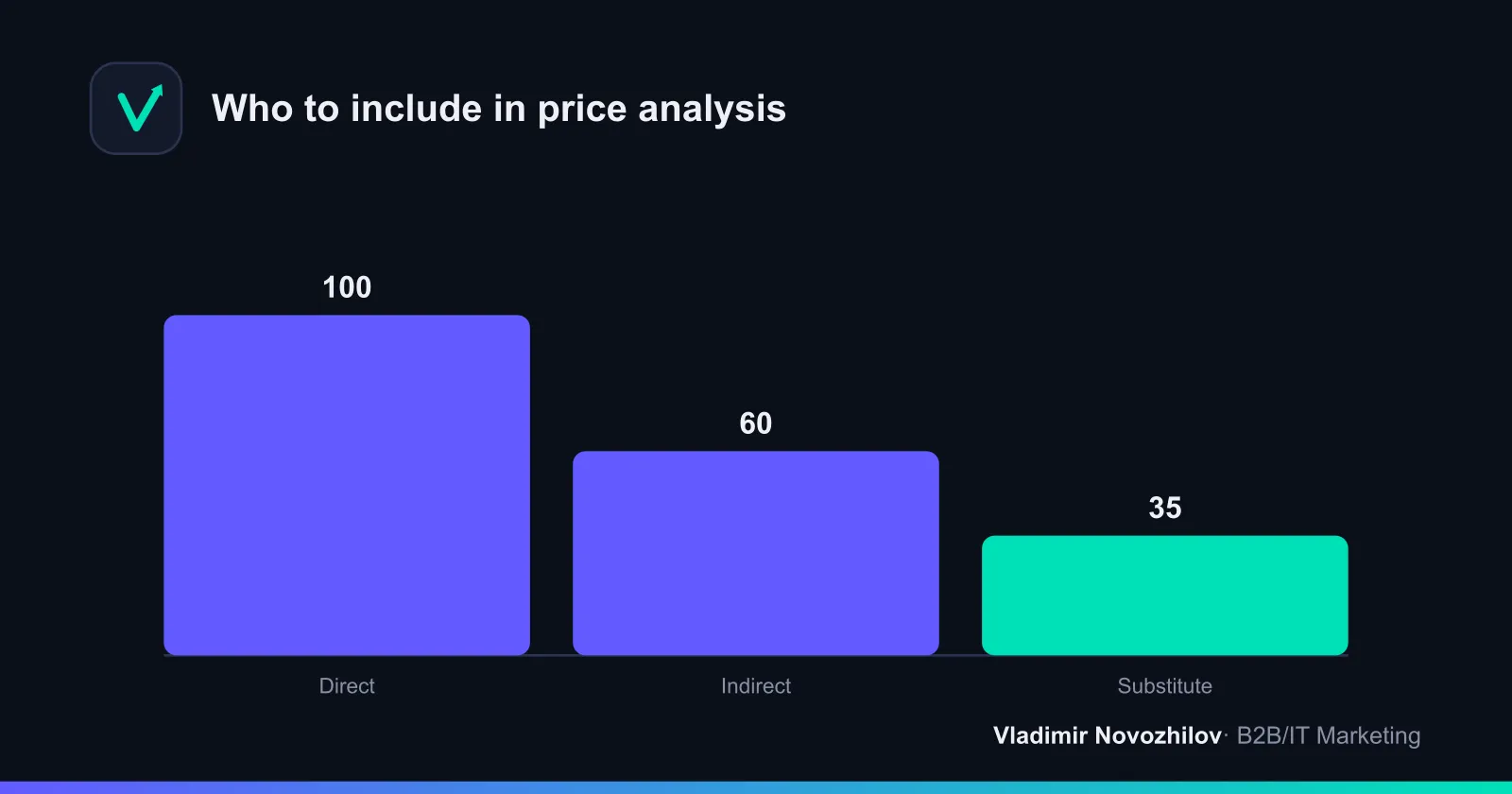
In practice, the weight in the analysis breaks down roughly like this: direct competitors form the basis of calculations, while indirect and substitute competitors provide context for understanding how far you can move your price.
Ways to find competitors
Finding competitors is a separate stage that determines the quality of the entire price analysis. Use several sources at once:
- Search results and paid search ads for your commercial queries — this is where the players truly fighting for the customer are.
- Marketplaces and aggregators — product listings with prices and sellers.
- Surveying customers and salespeople — asking “who else did you compare us to before buying” gives a more honest list than any analytics tool.
- Industry directories, tender platforms, review sites — especially useful in B2B and services.
Filter out anyone operating in a different price segment, region, or customer base. The final analysis list usually ends up with 5–15 direct competitors — enough for reliable conclusions.
What tasks competitor price analysis solves
Comparative competitor price analysis isn’t an end in itself — it’s a tool for specific tasks:
- Pricing. Understand where to move your price without losing demand or margin.
- Assortment. Find items where competitors are earning money that you’re not selling.
- Responding to discounting. Distinguish systematic price cuts from a one-off promotion and avoid panicking.
- Market assessment. Gauge the size and saturation of a niche based on the width of the price corridor.
- Price justification. Explain to a customer why you’re more expensive by pointing to real advantages.
Methods for matching products: identical, similar, differentiated
You can only compare comparable things. So before monitoring, define your product-matching method:
- Identical products — the same SKU, brand, model (the same smartphone sold by different sellers). Price comparison here is direct and accurate.
- Similar products — close in specifications but from different brands. These require normalization to comparable units (price per liter, per kilowatt, per hour of work).
- Differentiated products — unique products and services with no direct equivalents. Here you compare not price head-on, but value: configuration, service, lead times, warranty.
In B2B and services, you’re usually dealing with differentiated offers, so price analysis turns into an analysis of the price-to-value ratio rather than a search for the lowest number.
Step-by-step algorithm: how to run a competitor price analysis
Here’s the sequence I use myself. It also doubles as a checklist for running the analysis on your own.
- Define the goal. Repricing, entering a niche, responding to discounting — this determines the depth of the analysis.
- Build a list of competitors (5–15 direct ones) using the method described in the competitor-search section.
- Fix the list of products/services to compare and the matching method.
- Choose a data-collection method — manual, parsing, a service, or a mystery shopper.
- Collect prices into a single competitor price analysis table with a collection date.
- Clean the data — filter out one-off promotions and normalize to a single unit of measurement.
- Calculate the metrics — median, average, price corridor, price index.
- Draw conclusions and decisions — where to raise, where to hold, where to compete on value instead.
- Set a cadence — decide how often to run price monitoring.
- Track the results — margin, conversion, market share after the price change.
Monitoring methods: manual analysis, parsing, services, mystery shopping
There are four basic price-monitoring methods, each with its own use case.
Manual analysis
You or an employee manually opens competitors’ websites and enters prices into a spreadsheet. The upside is zero tool costs and full control. The downside is that it’s labor-intensive, doesn’t scale, and the data goes stale quickly. Suitable for 1–3 competitors and a small price list.
Parsing competitor prices
Parsing is the automated, scheduled collection of prices from websites and marketplaces by a bot. It lets you track thousands of SKUs several times a day. It requires technical setup and runs into websites’ anti-scraping defenses, but it’s the backbone of any serious online competitor price monitoring.
Dedicated price monitoring services
Ready-made platforms handle parsing, storage, and analytics for you. You upload your own products, link them to competitors’ products, and get dashboards, alerts, and exports. This is the optimal choice for most companies — see the comparison table below.
Mystery shopping
A person posing as a customer finds out real prices, discounts, and terms — especially valuable offline, in services, and anywhere prices aren’t publicly listed. It yields high-quality data but is expensive and slow, and isn’t suited to daily control of a large assortment.
Metrics and formulas: how to calculate a competitive and optimal price
Numbers matter more than gut feel. Here are the price-analysis metrics worth tracking, along with formulas and a numeric example.
Suppose you’ve collected prices from five competitors on a comparable product: $980, $1050, $1100, $1150, $1400.
Average price = (980 + 1050 + 1100 + 1150 + 1400) / 5 = $1,136.
Median price = the middle value of the sorted series = $1,100 (more resistant to the $1,400 outlier).
Price corridor = $980 to $1,400.
Price index = your price / market median. If you sell at $1,210, the index = 1210 / 1100 = 1.10 — you’re 10% above the median.
Now, calculating the competitive price. A simple benchmark is to stay within median ±5% or average ±10%:
- Median-based corridor: $1,045–$1,155.
- Average-based corridor: $1,022–$1,250.
If you have no significant advantages, a competitive price is around $1,100–$1,150. If you do have advantages (service, warranty, speed), you can position near the top of the corridor.
The optimal price also factors in cost. The formula for a minimum margin price:
Minimum price = Cost / (1 − Target margin).
At a cost of $780 and a target margin of 30%: 780 / (1 − 0.3) = $1,114. This is your “floor” — selling below it means operating at a loss relative to your target margin. The intersection of the floor ($1,114) and the market corridor ($1,045–$1,155) gives a working range of $1,114–$1,155 — that’s where the optimal price sits.
Mini case: what systematic monitoring delivers
A building-materials distributor tracked prices manually once a quarter and was losing on two fronts: it failed to notice when competitors raised prices (and kept selling below market), and it couldn’t spot systematic discounting on top-selling items. After switching to weekly monitoring via a service, the company:
- raised prices on 40% of its assortment where it had been below the market median;
- correctly held its price on items where competitors ran one-off promotions, avoiding a false discounting trap;
- shifted 12% of products to a “value over price” strategy, adding free delivery.
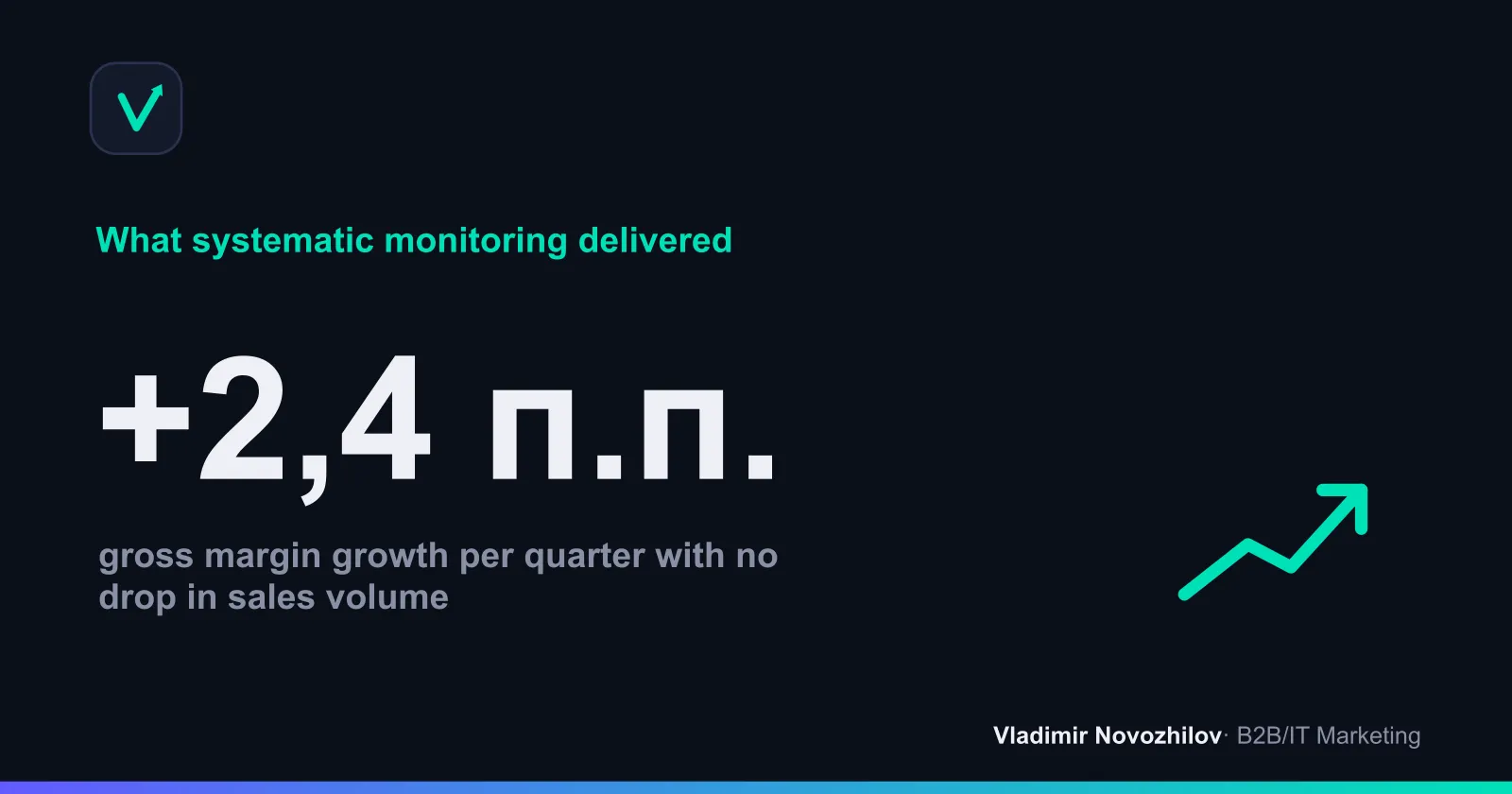
Over the quarter, gross margin grew by 2.4 percentage points without a drop in sales volume — an effect that paid for the monitoring subscription many times over.
Competitor price analysis table: template
Most standard materials on this topic don’t offer a ready-made table structure. Here’s a template you can copy straight into Excel or Google Sheets — just replicate the column headers and fill them in (for a broader breakdown, see the article on the competitor analysis table).
| Product/SKU | Our price | Comp. 1 | Comp. 2 | Comp. 3 | Median | Price index | Date | Decision |
|---|---|---|---|---|---|---|---|---|
| Product A | 1210 | 980 | 1100 | 1400 | 1100 | 1.10 | 05/12 | Hold |
| Product B | 750 | 690 | 720 | 810 | 720 | 1.04 | 05/12 | Cut to 720 |
| Product C | 2400 | 2600 | 2550 | 2700 | 2600 | 0.92 | 05/12 | Raise to 2550 |
Useful additional columns: competitor stock availability, delivery time, discount size, source link, person responsible. The “Decision” column is what turns the table from a statistics sheet into a working price-management tool.
Price monitoring services and tools: comparison
To avoid piecing together service data from scratch, here’s a comparative overview of the key parameters. Pricing figures are approximate — check with the vendor, as they change.
| Tool | Method | Best for | Features | Entry barrier |
|---|---|---|---|---|
| Excel/Google Sheets | Manual | Micro-business, 1–3 competitors | Free, full control, but all manual | Low |
| Priceva | Parsing + analytics | Small and mid-sized business | Dashboards, alerts, integrations | Medium |
| uXprice | Parsing | Online stores | URL-based tracking, easy start | Low |
| Price-Analytic | Parsing | Retail, marketplaces | Flexible pricing by product count | Low |
| Competera | Parsing + ML | Large-scale retail | Dynamic pricing, forecasts | High |
| Mystery shopper (agencies) | Field collection | Services, offline, B2B | Real prices and terms, but expensive | High |
The logic for choosing is simple: start with a spreadsheet, move to an affordable parsing service as your assortment grows, and switch to platforms with dynamic pricing and API integration once you need prices to change automatically based on rules.
What to include and what to exclude in price analysis
Must include:
- Wholesale and retail prices tracked separately — these are different markets.
- The manufacturer’s suggested retail price (MSRP), especially if the supplier enforces it.
- Price seasonality — compare comparable periods.
- Terms: delivery, warranty, configuration, service — these are part of the perceived price.
- Stock availability — the price of an out-of-stock item shouldn’t count.
What you can exclude (or filter out):
- One-off sales and short-term promotions — they distort the baseline price.
- Closed discount programs available only to a narrow group of customers.
- Competitors’ cost structure — you can never really know it, and basing decisions on guesses is harmful.
How often to monitor competitor prices
The question of “how often to monitor prices” is answered based on market volatility:
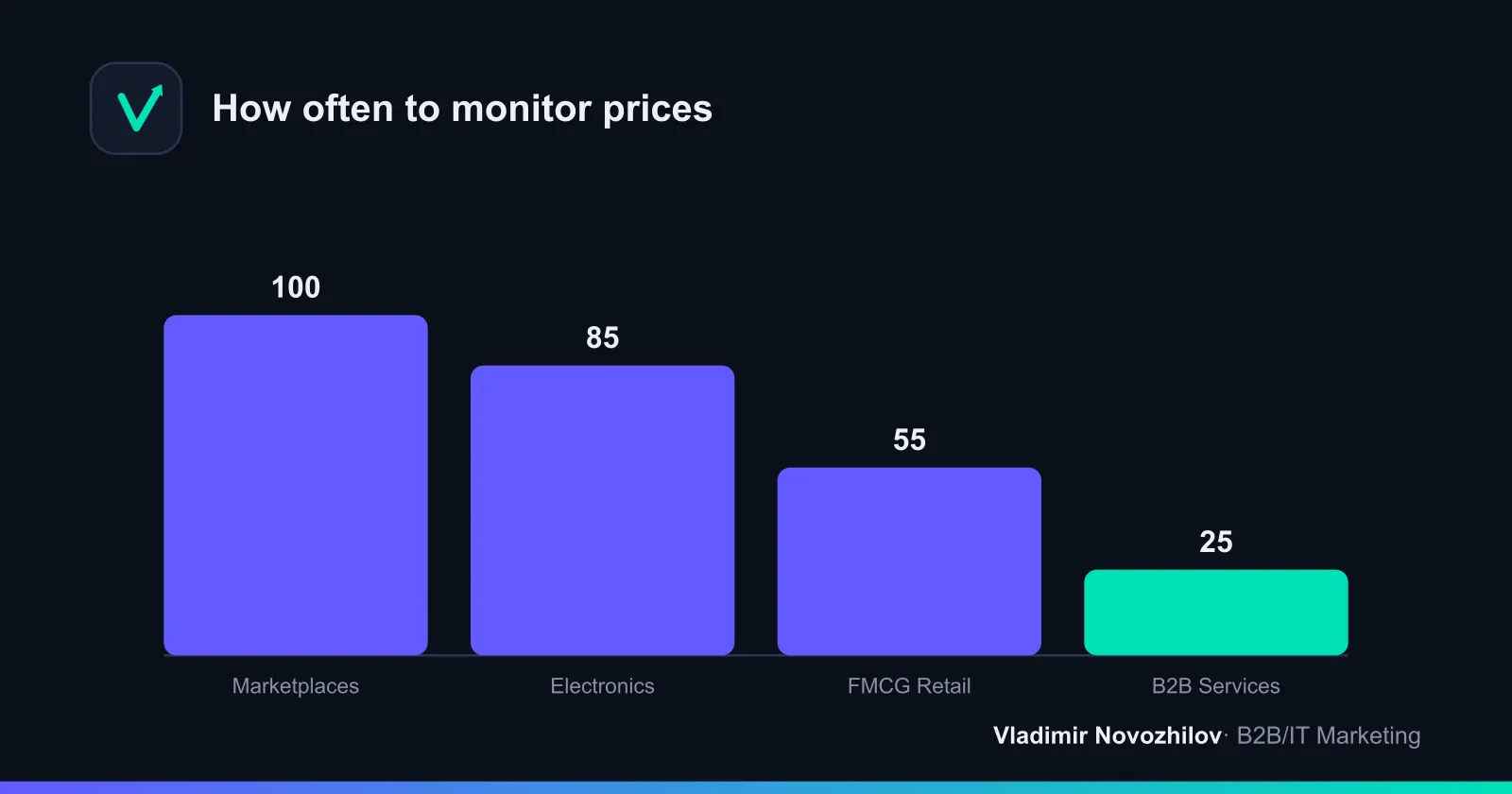
- Marketplaces, electronics, airfare — daily or several times a day, and only through automation.
- FMCG and chain retail — 1–2 times a week.
- Specialized retail, building materials — once every one or two weeks.
- B2B services, equipment, niches with infrequent deals — once a month or quarter.
Rule of thumb: if a competitor’s price changes more often than you check it, you’re falling behind and losing money. Also always run ad hoc monitoring before major promotions, seasonal peaks, and new product launches.
Common mistakes in competitor price analysis
- Comparing non-comparable items — a price per 0.7 liter against a price per liter. Always normalize to a single unit.
- Chasing only the lowest price and sliding into discounting that destroys margin across the whole market.
- Mixing direct and indirect competitors — this blurs the conclusions.
- Reacting to one-off promotions as if they were a systematic price cut.
- Collecting data without a date — stale pricing is worse than having no data at all.
- Forgetting about value — in services and B2B, the customer isn’t paying for a number, but for results and reliability.
- Monitoring irregularly — a one-off analysis goes stale within weeks.
Automating price monitoring and CRM integration
The next level of maturity is when pricing data doesn’t sit in a separate spreadsheet but flows automatically into your working systems. Through an API integration, a monitoring service feeds competitor prices into your accounting system or CRM, and pricing rules trigger without manual involvement.
What this delivers in practice:
- Automatic alerts to salespeople when a competitor drops their price below your threshold.
- Dynamic pricing based on rules: keeping the price index within a 0.98–1.05 range of the market median.
- A unified view in the CRM — the salesperson sees the competitor’s price right in the deal card and can justify the cost.
- Price history for analyzing seasonality and competitor behavior over time.
Even without complex automation, a setup combining a parsing service, a spreadsheet export, and CRM rules already removes most of the manual work and speeds up your response to market changes. Start with a simple scenario — alerts when a price falls outside the corridor — and scale up automation as your assortment grows.
Key takeaways
Competitor price analysis works when it’s systematic: competitors are chosen correctly, products are normalized to a comparable format, metrics are calculated using formulas, and data is refreshed at the right cadence. Start with a free spreadsheet and a manual method, add median and price-index calculations, then move on to monitoring services and CRM automation. That way your pricing strategy will rest on market facts rather than intuition — and that will show up directly in your margin.
FAQ
- How often should you monitor competitor prices?
- It depends on the segment. For stable B2B services and offline retail, once a month or quarter is enough. For electronics, marketplaces, and fast-turnover goods, do it daily or several times a day using automated parsing. The rule is simple: the higher the demand volatility and the more aggressive the discounting, the more often you need competitor price monitoring.
- How does parsing differ from mystery shopper analysis?
- Parsing competitor prices means automatically collecting prices from websites and marketplaces in real time — it's cheap and scalable, but it only sees publicly listed prices. A mystery shopper captures actual prices with discounts, service terms, and offline price lists, but it's more expensive and doesn't work for daily control of thousands of SKUs. In practice, the two are combined.
- How do you find real competitors instead of every seller in the market?
- Start with search results and paid search ads for your key queries — that's where the players fighting for the same customer show up. Add marketplaces, customer feedback ("who else did you compare us to"), and input from your sales team. Filter out companies with a different segment, price tier, or geography — those are indirect competitors and should be considered separately.
- Which metrics should you track in competitor price analysis?
- The basic set: median and average market price, price corridor (min–max), price index (your price vs. market median), share of items priced below and above competitors, and discount depth. These price analysis metrics show where you stand in the market and whether there's room to raise margin without losing demand.
- Should you factor in competitors' promotions and discounts when analyzing prices?
- One-off sales and short-term promotions are best filtered out — they distort the baseline price. But systematic discounts, loyalty programs, and a consistently discounted price level should be included, since that's what customers actually base their decisions on. Track both the "shelf price" and the actual purchase price.
- Which price monitoring service should a small business choose?
- Small businesses should look at affordable price monitoring services that charge based on the number of tracked SKUs and offer ready-made marketplace integrations — for example, Priceva, uXprice, or Price-Analytic. Start with a free or minimal plan for 100–500 items, and move to pricier platforms like Competera once you need dynamic pricing.