Competitor Product Analysis: Methods and Template


TL;DR
Competitor product analysis is a systematic comparison of rivals' products, assortment, pricing, and packaging using consistent criteria. This article covers a step-by-step algorithm, key criteria (assortment breadth and depth, price, quality), methods (comparative analysis, SWOT, Porter's Five Forces, market mapping), monitoring tools, and a ready-to-use comparison table template for shaping your USP and assortment strategy.
What Is Competitor Product and Assortment Analysis
Competitor product analysis is a systematic comparison of rivals’ products, services, and offerings using consistent criteria: functionality, quality, price, packaging, and positioning. Its goal is to understand objectively where your product is stronger or weaker, and where the market has open niches.
Competitor assortment analysis goes broader: it evaluates the entire product line — how many product groups are represented (assortment breadth), how many SKUs are within each group (assortment depth), and which price segments are covered. If product analysis answers the question “where are we stronger on a specific item,” assortment matrix analysis shows where the gaps are in your lineup.
These two perspectives complement each other. Below is a practical methodology: criteria, methods, tools, and a ready-to-use template that works equally well in B2B, IT, and services.
Why Assortment Analysis Matters: Business Goals and Objectives
Competitive product analysis solves three practical tasks:
- Shape your USP. Analyzing competitors’ USPs shows which promises are already taken and helps you find an open differentiator.
- Set pricing policy. Analyzing competitors’ pricing gives you a price corridor and shows where you can raise margins and where you’ll need to compete on price.
- Plan your assortment. Analyzing competitors’ offerings uncovers gaps — product groups and price segments that no one is covering.
In our experience, companies that run regular competitor monitoring respond to new launches and promotions 2-3 weeks faster than those who analyze the market only once a year.
Types of Competitors: Direct, Indirect, Potential
Before comparing competitors’ products, define exactly who you’re competing against:
- Direct competitors — offer the same product to the same target audience (two CRM integrators serving mid-sized businesses).
- Indirect competitors — solve the same customer problem differently (an outside agency versus hiring an in-house specialist).
- Potential competitors — leaders in adjacent markets who could enter your niche.
For an objective picture, take 5-7 companies: 3-4 direct, 1-2 indirect, and one potential.
Criteria for Analyzing Product Assortment
For comparative competitor analysis to be fair, fix a single set of criteria upfront. Here’s a working checklist of parameters:
- Assortment breadth — number of product groups and categories.
- Assortment depth — number of SKUs within each group.
- Price — minimum, maximum, and median per group, plus the promotional range.
- Quality — materials, warranty, rating, and number of reviews.
- Unique items — products no one else has.
- Offer packaging — configurations, plans, bundles, add-on services.
- Positioning and USP — the core promise on the product page.
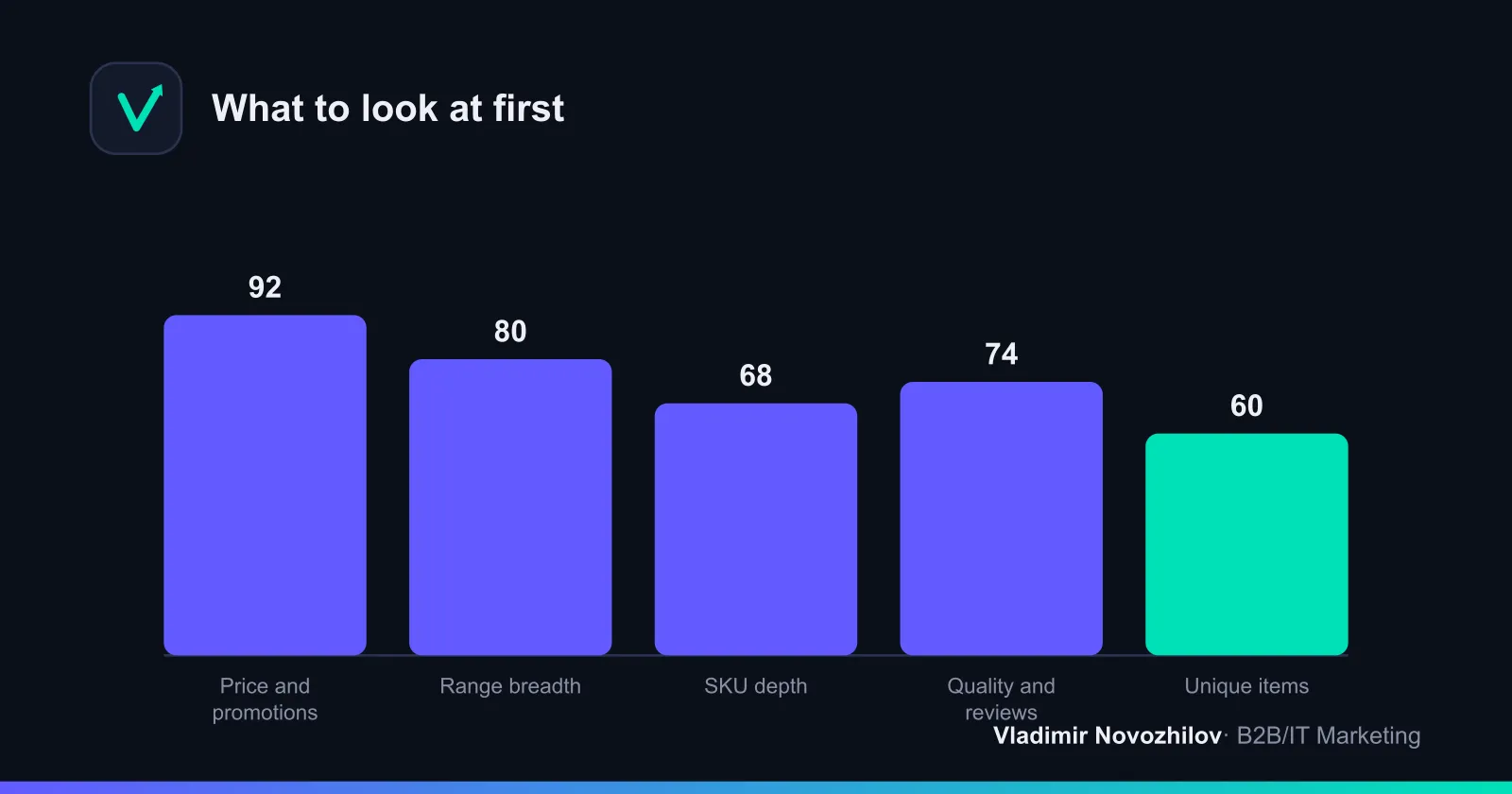
The weight of each criterion depends on the niche: in e-commerce, price and SKU depth take priority; in B2B and services, offer packaging, warranties, and USP matter more.
Competitor Analysis Methods: Comparison
There are several proven methods for competitor analysis. Below is a comparison table with pros, cons, and effort required to help you pick the right one.
| Method | What It Provides | Pros | Cons | Effort |
|---|---|---|---|---|
| Comparative analysis (product benchmarking) | A “product vs. product” table by criteria | Visual, quick to apply | Doesn’t explain causes | Low (1-2 days) |
| Competitor SWOT analysis | Strengths/weaknesses, opportunities, threats | Structures conclusions | Subjective assessments | Medium |
| Porter’s Five Forces | Assessment of pressure from suppliers, customers, new entrants | Strategic perspective | Not product-specific | Medium |
| PESTEL | External factors (political, economic, trends) | Accounts for market context | Too broad for SKU-level detail | Medium |
| Competitor market map | Positioning along 2 axes | Reveals open niches | Simplifies the picture | Low |
In practice, the combination works like this: comparative analysis and product benchmarking gather the facts, competitor SWOT analysis turns them into conclusions, and the market map shows where to move next.
Market Map and Positioning
A competitor market map is a visualization along two axes that matter to the customer — for example, “price” × “assortment breadth” or “service level” × “specialization.” Each competitor is a point. Empty quadrants are potential niches for your own positioning.
Step-by-Step Algorithm for Competitor Product Analysis
- Define your goal. What are you solving for: USP, pricing, or assortment gaps.
- Build a list of competitors — 5-7 companies across the three types.
- Fix your criteria from the checklist above.
- Collect data for each product and SKU.
- Fill in a comparison table — a single consistent format for all.
- Run a SWOT analysis and build a market map.
- Identify gaps and points of differentiation.
- Draw conclusions for your assortment and pricing strategy.

How to Collect Data: Websites, Marketplaces, Reviews, Advertising
Sources for analyzing competitors’ products:
- Websites and catalogs — assortment, prices, configurations, pricing pages.
- Marketplaces — number of SKUs, ratings, review counts, trends over time.
- Customer reviews — real pain points and product strengths.
- Demos and trial versions — for IT products and services.
- Advertising — Facebook Ads Library and promotions reveal emphasis and offers.
- Job postings — hint at plans for lineup expansion.
Collect everything into a single table from the start — it’s much easier to keep a consistent format that way.
Tools and Services for Automating Monitoring
Manual data collection is fine for a one-time snapshot. For ongoing competitor monitoring, use dedicated competitor analysis tools:
- Page-change tracking (tools like visualping) — catches new launches and price edits.
- Price monitoring — scrapers and services like Price2Spy, Competera for retail and e-commerce.
- Similarweb, SEMrush, Ahrefs — traffic, channels, digital presence.
- Google Trends and Wordstat — demand and seasonality.
- Similarweb + review aggregators — market share and reputation.
Automation closes the main gap for most teams: without it, competitor assortment analysis quickly becomes outdated.
Product and Price Comparison Table Template
A ready-made framework — consolidate competitors into a single matrix. Example with hypothetical figures:
| Criterion | Us | Competitor A | Competitor B | Competitor C |
|---|---|---|---|---|
| Product groups (breadth) | 6 | 8 | 5 | 9 |
| Total SKUs (depth) | 120 | 180 | 90 | 240 |
| Median price, ₽ | 4,900 | 5,400 | 4,200 | 6,100 |
| Promotional range | −15% | −25% | −10% | −20% |
| Rating / reviews | 4.7 / 320 | 4.5 / 900 | 4.8 / 150 | 4.4 / 1400 |
| Unique items | 8 | 12 | 3 | 20 |
| Market share (estimate) | 14% | 22% | 9% | 31% |
This kind of table immediately reveals: Competitor C is broader and deeper but more expensive and has a lower rating — meaning your growth opportunity lies in the mid-price segment with an emphasis on quality.
How to Present Results and Conclusions
To make sure the results don’t just sit in a drawer, present them in three layers:
- Comparison table — facts on SKUs and pricing.
- Market map — visual positioning.
- A single slide of conclusions — 3-5 takeaways with concrete actions.
For the team, a short document is enough: the table, the map, and a list of decisions on assortment and pricing.
Common Mistakes in Competitor Product Analysis
- Comparing against inconsistent criteria — the table becomes useless.
- Only considering direct competitors and skipping indirect ones.
- Copying a competitor’s assortment instead of finding a differentiator.
- Doing the analysis just once — without monitoring, data becomes outdated within a month.
- Drowning in data with no conclusions — collecting for the sake of collecting.
How to Turn Results into Strategy
Convert your findings into decisions:
- Assortment: fill empty product groups and price segments, drop items where you lose on every criterion.
- Price: set prices within the identified corridor, plan promotions with an eye on competitors’ pricing policy.
- USP: take the differentiator from the market map — something no one else occupies.
- Positioning: craft a promise for the open quadrant.
Competitor product analysis isn’t a one-off study — it’s an ongoing competitive intelligence process. Set up monitoring, update your table quarterly, and your assortment and pricing decisions will be grounded in facts rather than intuition.
FAQ on Competitor Product and Assortment Analysis
Brief answers to common questions are collected in the FAQ block above — from how often to run the analysis to choosing free tools and key comparison metrics.
FAQ
- How often should you analyze competitors' product assortment?
- A full assortment analysis is usually enough once a quarter, though in seasonal or highly competitive niches (e-commerce, retail) monthly reviews make sense. Track prices and new SKUs weekly through automated competitor monitoring so you don't miss promotions or new launches.
- How is assortment analysis different from overall product analysis?
- Product analysis evaluates a single item: features, quality, USP, price. Competitor assortment analysis looks at the entire lineup — breadth (how many product groups), depth (how many SKUs within each group), price segment coverage, and gaps in the assortment matrix. The first answers 'how are we better,' the second answers 'where are the gaps in our lineup.'
- What free tools can you use to analyze competitors' products?
- Free options include competitor websites and catalogs, marketplace listings, customer reviews, Google Trends, Yandex Wordstat, Facebook Ads Library for advertising, and free tiers of Similarweb and page-change tracking services. This is enough to map assortment, pricing, and positioning for 5-7 competitors.
- How many competitors should you analyze for an objective picture?
- Five to seven companies is optimal: 3-4 direct competitors, 1-2 indirect ones, and one potential entrant (a leader from an adjacent market). Fewer than three gives a distorted picture, while more than ten spreads your efforts too thin. Depth of comparison against consistent criteria matters more than sheer count.
- Which metrics matter most when comparing competitors' assortments?
- Key metrics include assortment breadth (number of product groups), depth (number of SKUs per group), price range and median, price segment coverage, share of new items, rating and review count, and presence of unique items. It's convenient to consolidate these into a single comparison table and flag areas where you have an advantage or a gap.