Competitor Website Analysis: Step-by-Step Guide and Tools


TL;DR
Competitor website analysis is the process of collecting and evaluating data on a rival's traffic, visits, structure, keywords, backlink profile, and commercial factors to make informed decisions for your own site. This article covers a step-by-step algorithm, a checklist, a comparison of tools (Serpstat, SimilarWeb, PR-CY, BE1, ARSENKIN), a table template, and a real-world example.
Competitor website analysis is a structured process of collecting and evaluating data about a rival’s resource: its traffic, visits, structure, keyword set, backlink profile, and commercial factors, in order to make informed decisions for your own site. Put simply, you figure out what’s driving a competitor’s online customer acquisition, then adopt the tactics that work while exploiting their weak spots.
This article walks through a step-by-step algorithm for analyzing a competitor’s website: where to find direct and indirect competitors, which metrics to track, which tools to use, and how to compile everything into a summary table. The material is equally useful for B2B, IT companies, and service businesses — the logic of competitive website analysis is the same everywhere, only the emphasis shifts.
What competitor website analysis is and why it matters
Competitive website analysis answers three questions: what’s driving the competitor’s growth, where are the gaps, and what applies to you. This isn’t “snooping” — it’s a standard marketing tool: a competitor’s site is an open source of data on demand, channels, and tactics that have already been market-tested.
Why bother analyzing competitor websites at all:
- Understand real demand. Competitors’ keyword sets show which queries bring in traffic and what you’re missing.
- Find growth opportunities. Gaps in traffic, pages, and links translate directly into a task list.
- Save budget. You see which formats and sections already work, so you’re not spending money on blind guesses.
- Gauge the difficulty of promotion. A competitor’s domain age, ICS score, and backlink profile hint at how much effort it will take to catch up.
- Sharpen positioning. Comparing offers and commercial factors shows you how to genuinely differentiate.
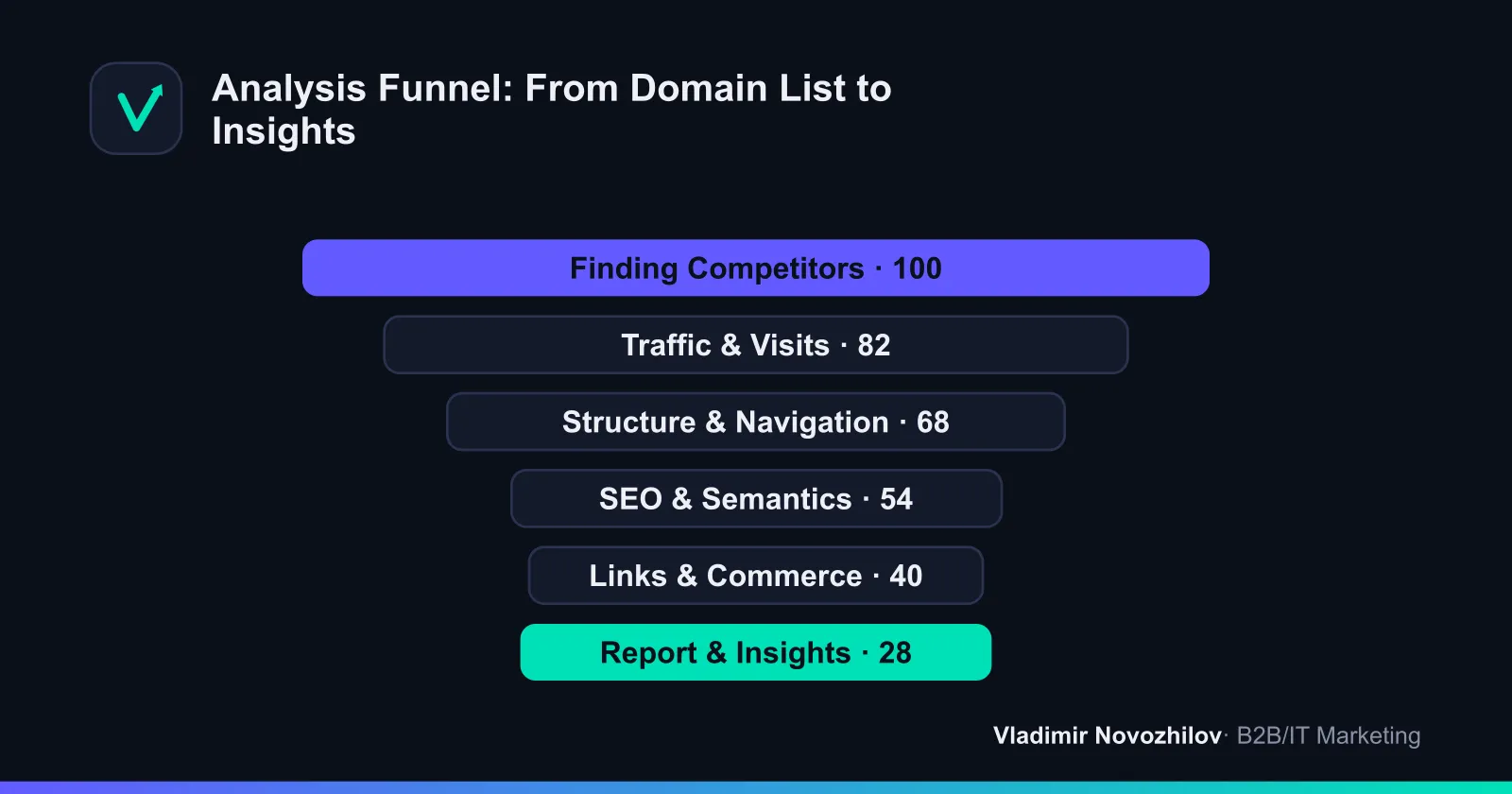
It’s important from the start to separate website analysis from broader business analysis. Market mapping, SWOT analysis, and pricing matrices are about strategy and the market as a whole. Here the focus is narrow: the website itself as an acquisition and conversion channel. This specificity is exactly what’s often missing from general overviews.
How to find direct and indirect competitors for analysis
Finding direct and indirect competitors is step zero, and it determines the quality of the entire analysis. Pick the wrong ones, and your conclusions will be worthless.
Direct competitors are companies selling the same product to the same audience, competing with you for the same queries in organic search. Indirect competitors solve the same customer problem in a different way or address an adjacent need.
| Competitor type | Who they are | Example (web development studio) | Why analyze them |
|---|---|---|---|
| Direct | Same product, same audience | Another web studio of similar scale and region | Head-to-head comparison, query interception |
| Indirect | Different model, same job to be done | Website builders, freelancers, full-service agencies | Understand the client’s alternatives and hesitations |
| Informational | Competes for the same queries but doesn’t sell | Blogs, media, directories ranking for your topics | Content ideas and top-of-funnel capture |
Where to look for competitors to analyze:
- Organic search results. Enter 5–10 of your key commercial queries into Yandex and Google, and list the domains in the top 10. Whichever domains keep showing up form the core of your direct competitors.
- Domain-based competitor analysis in tools. Serpstat and similar services can surface “competitor sites” — resources ranking for the same queries as you. This is a fast way to spot less obvious players.
- Paid search ads. Whoever is running ads on your queries is a direct commercial competitor willing to pay for the same traffic.
- Reviews and aggregators. Service marketplaces, directories, and rating sites reveal who clients consider alongside you.
- Ask your sales team. They know who you’re being compared to in negotiations — these are often your most important competitors.
The optimal number for a solid analysis is 3–5 direct competitors plus 1–2 indirect ones. That’s enough to spot patterns without so much data that you abandon the analysis halfway through.
Preparation: goals, tasks, and choosing how many competitors to analyze
Before you start analyzing a competitor’s website, define your goal. Without one, you’ll collect a mountain of numbers with nowhere to apply them.
Frame your goal around a decision: “understand why a competitor gets more organic traffic,” “find sections we’re missing,” “assess whether reaching top 5 in six months is realistic.” The metrics and depth of analysis follow from the goal.
Minimum set of starting tasks:
- identify a list of 3–5 competitors;
- choose metrics (traffic, visits, structure, SEO, links, commercial factors);
- prepare a comparison table template;
- assign tools to each metric;
- allocate time: a one-off deep analysis takes 1 to 3 working days.
Agree upfront on what you’ll do with the results. A report for its own sake is useless — the output should be a prioritized list of tasks for your own site.
What metrics to analyze: traffic, visits, structure, SEO
For a comprehensive competitive website analysis, evaluate six groups of metrics. Below is a map of what to look at and why; we’ll break down each group in detail in the following sections.
| Group | Key metrics | What it shows |
|---|---|---|
| Traffic and visits | Sessions, sources, engagement, geography | Scale and channels of acquisition |
| Structure | Sections, nesting depth, number of pages | Site logic and topic coverage |
| Keywords and SEO | Keywords, top pages, meta tags | Which queries bring in visitors |
| Backlink profile | Link volume, referring domains, anchor text | Authority and link-building strategy |
| Commercial factors | Pricing, forms, contacts, USP | The site’s readiness to convert |
| Technical indicators | Domain age, ICS, indexing, speed | Baseline resource health |
Next, we’ll go through these blocks in sequence — this is the unified step-by-step algorithm for analyzing the website itself, not the business as a whole.
Analyzing a competitor’s traffic and site visits
Analyzing a competitor’s traffic shows how successful the site is as a channel and where its visitors come from. It’s important to distinguish two concepts here. Visits refer to how many people arrive (sessions, unique users). Traffic analysis is broader: it covers sources, channels, geography, and behavior.
What exactly to look at when analyzing competitors’ visits and traffic:
- Monthly session volume — overall scale.
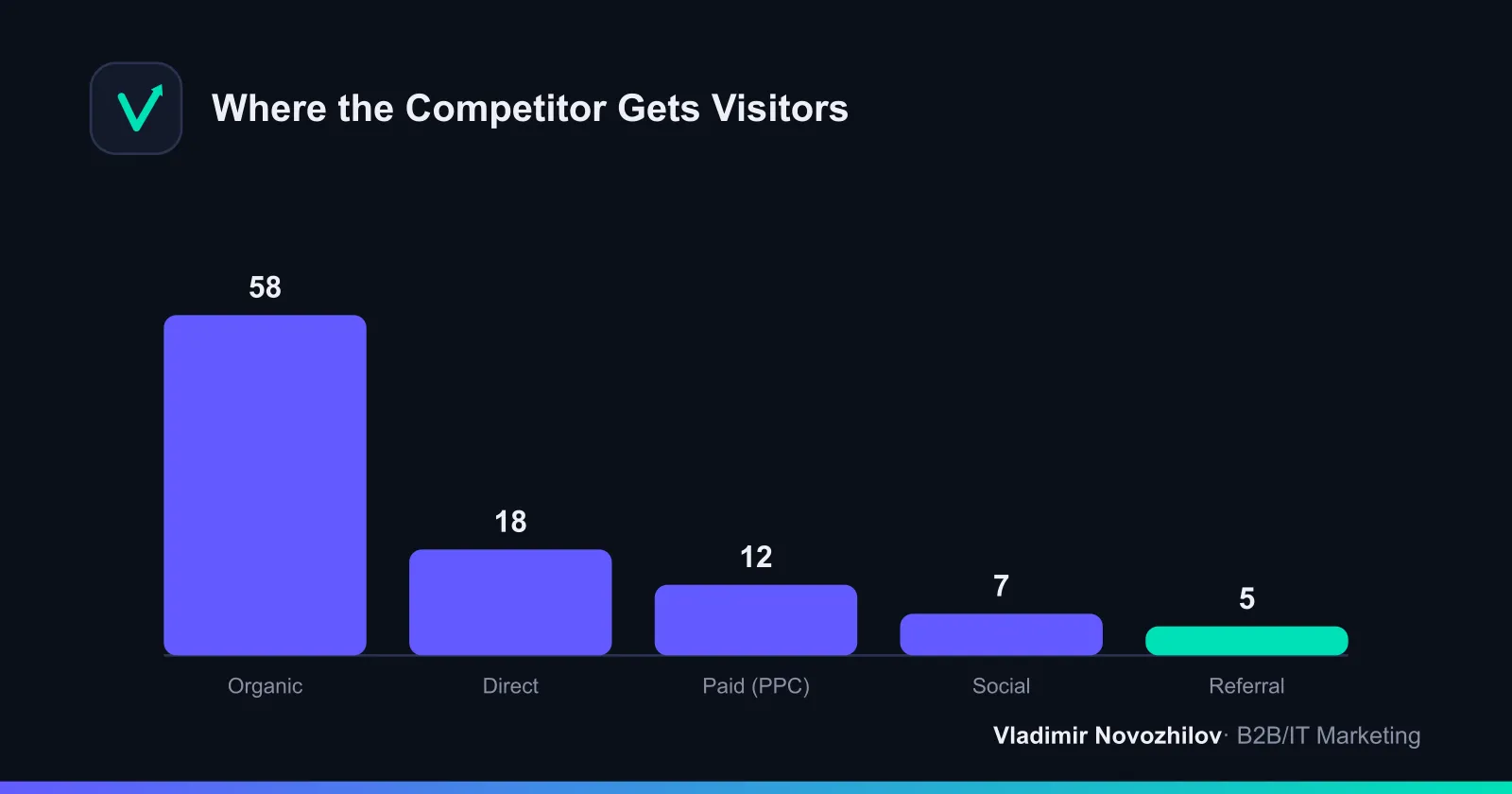
- Source breakdown — the share of organic, direct, paid, social, and referral traffic.
- Geography and devices — where the audience is located and what they browse on.
- Engagement — time on site, pages per session, bounce rate.
- Trends — whether the resource is growing or declining, and whether there’s seasonality.
Which tools to use. SimilarWeb offers estimates of traffic, sources, geography, and engagement, while PR-CY and BE1 give approximate visit numbers by domain. You won’t get exact figures for someone else’s analytics — all external tools produce estimates, so it’s more important to compare competitors consistently against each other and against yourself using the same methodology than to chase absolute precision.
The practical takeaway from this block is usually something like: if a competitor gets 58% of traffic from organic search while your main channel is paid ads, their SEO is strong, and it’s worth digging into their keyword set and structure specifically.
Analyzing a competitor’s website structure and navigation
Competitor site structure analysis is rarely covered in detail elsewhere, which is a shame — structure directly affects keyword coverage and usability. A well-designed section hierarchy lets a site cover more topics and capture more traffic.
What to evaluate in the structure:
- Section map. What primary and secondary sections exist, and how are products or services grouped.
- Nesting depth. Important pages should be reachable within 2–3 clicks; anything deeper hurts usability and indexing.
- Navigation. Menu logic, breadcrumbs, internal linking, and a footer with quick links.
- Page count. An indirect indicator of keyword coverage and content scale.
- Page types. Does the site have a blog, case studies, dedicated landing pages per service, an FAQ, or reference sections.
How to map the structure without access to the competitor’s analytics:
- Manually go through the menu, footer, and breadcrumbs, and sketch the tree.
- Open the sitemap at
/sitemap.xml— it lists the URLs. - Estimate the number of indexed pages using the
site:domainsearch operator. - Run the domain through a crawler (structure parser) to get a URL tree and nesting depth.
- Check page indexing in search — not everything on a site actually appears in results.
This is often where the quick wins are found: if a competitor has a “case studies” section or separate pages for each service while yours are all crammed onto one page, that’s an immediate structural task.
SEO analysis: keywords, meta tags, top pages
SEO analysis of competitors reveals the most valuable insight — which queries drive their organic traffic and which pages generate it. This is the most valuable part of the analysis because it gives you a ready-made demand map.
Here’s how to analyze competitors’ keywords:
- Collect the competitor’s keyword set. Tools show which keywords put a domain in the top 10 or top 50, giving you a full picture of their keyword footprint.
- Find missed and overlooked queries. Queries where a competitor ranks in the top but you don’t represent a direct growth opportunity.
- Identify top pages. Which URLs drive the most traffic and for which queries — their structure and scope are worth studying separately.
- Review meta tags and headings. How title, description, and H1 are written on top-performing pages, and which phrases and keywords they include.
- Assess visibility. The share of queries ranking in positions 1, top 5, top 10, or top 50 indicates the site’s overall organic strength.
Yandex Wordstat is also useful for gathering demand data — it shows search volume and surfaces queries missing from paid exports. You can check keywords for a specific domain or URL for free in PR-CY, and for deeper analysis, use Serpstat and SpyWords via domain-based competitor search.
Also separately assess commercial versus informational demand. If a competitor actively runs a blog and captures the top of the funnel while you only target “hot” queries, that’s a strategic gap visible through SEO analysis as well.
Backlink profile and anchor text distribution
A competitor’s backlink profile shows what external authority is keeping them in the top rankings. Link volume is one of the ranking factors, and studying it tells you how much work it will take to catch up.
What to look at:
- Link volume — total external links and referring domains.
- Donor quality — relevant, authoritative sites versus spam.
- Growth pace — how quickly links are being acquired, and whether there are any suspicious spikes.
- Anchor text distribution — the split between branded, commercial, and generic anchors. A heavy skew toward commercial anchors signals a risky strategy.
- Link types — articles, directories, crowd-sourced links, PR mentions.
Analyzing anchor text distribution is doubly useful: it reveals which queries a competitor is deliberately targeting through link building. Specialized tools are used to assess backlink volume in depth; on a basic level, you can check referring domain counts and ICS scores in PR-CY and BE1.
The takeaway from this block is usually an effort estimate: if a competitor has hundreds of quality referring domains while you have dozens, you won’t catch up quickly — you’ll need a link-building plan spanning a quarter or two.
Auditing commercial factors and usability
Traffic without conversion is useless, which is why analyzing commercial factors matters just as much as SEO. Commercial factors are the elements that help a visitor decide and submit a lead.
Audit template for commercial factors and functional elements — fill in “yes/no/how implemented” for each competitor:
| Block | What to check | You | Competitor A | Competitor B |
|---|---|---|---|---|
| Pricing | Prices/calculator/starting amount shown | |||
| Contacts | Phone, email, messengers, multiple offices | |||
| Lead capture forms | Request form, callback, chat, quiz | |||
| Trust signals | Case studies, reviews, certificates, clients | |||
| USP | Clear differentiation, guarantees, timelines | |||
| Catalog/services | Dedicated pages, descriptions, photos | |||
| Usability | Load speed, mobile version, menu ease | |||
| Content | Blog, FAQ, educational materials |
When auditing usability, pay attention to load speed, mobile responsiveness, readability, and how easy it is to find pricing and submit a request. Often small details — a visible “order now” button, an online calculator, genuine video reviews — explain differences in conversion rates despite similar traffic levels.
Overview of tools for analyzing competitor websites
Choosing tools depends on your task and budget. Below is a comparison table of popular competitor analysis tools: what each one is built for, whether it has a free tier, and a rough price range. Exact pricing changes, so use this as a guide to the order of magnitude and the logic of your choice.
| Tool | Strength | Free access | Price range | Best for |
|---|---|---|---|---|
| Serpstat | Keyword research, domain-based competitor search, competitor graph | Limited trial | from ~$25–35/month | SEO analysis, keywords, finding competitors |
| SimilarWeb | Traffic estimates, sources, geography, engagement | Basic data free | premium plans are pricey | Traffic and visit analysis |
| PR-CY | Comprehensive quick audit, ICS score, visits, keywords | Free checks available | from ~$15/month | Fast overall domain snapshot |
| BE1 | Ranking checks, visits, technical parameters | Many free tools | affordable packages | Budget analysis, spot checks |
| ARSENKIN TOOLS | Suite of SEO tools, SERP parsing, structure analysis | Some tools free | from ~$10/month | Technical and SEO tasks, SERP parsing |
How to combine tools for competitor website analysis:
- Minimum free toolkit: Yandex Wordstat + free tiers of PR-CY and BE1 + the site: operator + manual review. Enough for a first pass across 3 competitors.
- Mid-level setup: add Serpstat or ARSENKIN for keywords and SimilarWeb for traffic.
- Full setup: a specialized backlink analysis tool plus a structure crawler.
Don’t chase the number of subscriptions. For most B2B and service business tasks, one paid keyword-tracking tool plus a combination of free tools for everything else is enough.
How to present the results: a table template
Collected data is useless until it’s consolidated into a single table. A universal template for comparing competitor websites works well in Google Sheets: rows are metrics, columns are “you” and your competitors.
| Metric | You | Competitor A | Competitor B | Competitor C | Conclusion / task |
|---|---|---|---|---|---|
| Monthly visits | |||||
| Share of organic traffic | |||||
| Keywords in top 10 | |||||
| Indexed pages | |||||
| Domain age | |||||
| ICS score | |||||
| Referring domains | |||||
| Sections / depth | |||||
| Commercial factors (out of 8) | |||||
| Speed / mobile |
Rule for filling in the last column: every row should turn into a concrete action. Not “the competitor has more pages,” but “build keyword targeting for 20 new service pages in Q2.”
Competitor analysis checklist
Save this competitor analysis checklist and check off items as you complete them:
- A list of 3–5 direct and 1–2 indirect competitors is compiled.
- The analysis goal and related metrics are defined.
- Traffic, visits, and sources are assessed for each competitor.
- A structure map is built and nesting depth calculated.
- Keywords are collected: top-ranking terms, top pages, missed queries.
- Meta tags and headings on top pages are reviewed.
- Backlink volume, referring domains, and anchor text distribution are assessed.
- Commercial factors and usability are audited using the template.
- Technical parameters are checked: domain age, ICS, indexing, speed.
- Data is consolidated into a table, with a task defined for each row.
- Tasks are prioritized by impact on traffic and revenue.
Common mistakes in competitor website analysis
Even a thorough competitor website analysis loses value due to systemic mistakes. Here are the most common ones:
- Choosing the wrong competitors. A large national platform isn’t your direct competitor if you’re a local business. Comparing yourself to an unreachable leader is demoralizing and skews the conclusions.
- Collecting data without a goal. A 200-row table that produces zero actionable tasks is wasted time.
- Blind copying. What works for a competitor might not work for you — different audience, budget, product. Copy the logic, not the pixels.
- One-off analysis. Markets change, so a single analysis becomes outdated within a quarter. Regular monitoring is necessary.
- Ignoring commercial factors. Many people get caught up in traffic and forget that conversion is what matters. Analyzing commercial factors is essential.
- Trusting absolute numbers from tools. External traffic estimates are approximate — compare them relatively, using a consistent methodology.
- Forgetting about AI search. More and more queries are being answered directly in search results and AI-generated answers without a click. Check whether a competitor appears in these zero-click answers — it’s a new frontier of visibility.
Example: step-by-step breakdown of a real competitor site
Here’s the logic applied to a hypothetical but typical case in the services sector — a CRM implementation company. Figures are rounded for clarity, but the methodology is real.
Step 1. Finding competitors. Across 8 commercial queries (“CRM implementation,” “turnkey CRM setup,” etc.), 4 domains consistently appear in the top 10. We select three for analysis.
Step 2. Traffic and visits. According to tool estimates, the leader gets ~12,000 monthly visits versus our ~3,500. Their share of organic traffic is 58% versus our 34% — the rest is paid ads. Conclusion: they rely on SEO, while we’re overspending on PPC.
Step 3. Structure. The leader has 240 indexed pages versus our 60. They have dedicated landing pages for each industry (CRM for construction, for healthcare, for wholesale) plus a case studies section. We have everything crammed into a single service page. This is the main structural gap.
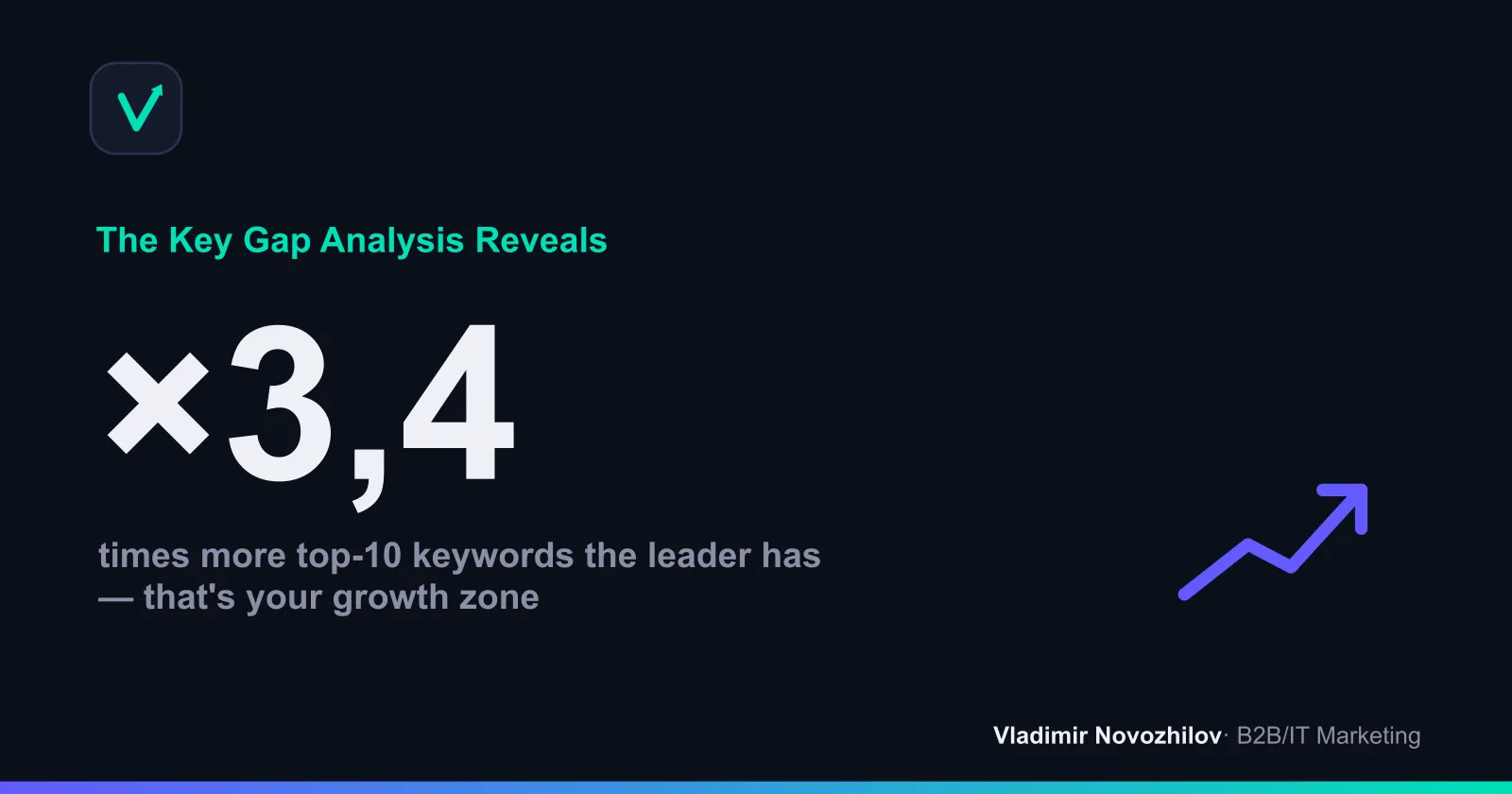
Step 4. Keywords. The leader ranks in the top 10 for ~1,700 queries, we rank for ~500 (a 3.4x gap). Most of their queries are industry-specific and informational — topics we don’t cover at all. We compile a list of ~40 missed phrases.
Step 5. Links. The leader has ~180 referring domains, including industry articles and media mentions; we have ~40, mostly directories. Their anchor text is well balanced (lots of branded and generic anchors). Conclusion: we need a PR link-building plan.
Step 6. Commercial factors. Both sites have forms and pricing, but the leader offers a cost calculator, 30+ case studies with real numbers, and video testimonials. Our commercial factors are weaker on trust.
Step 7. Report and tasks. The analysis produced quarterly priorities: build industry-specific landing pages, collect and implement the missed keywords, launch a blog for top-of-funnel content, strengthen case studies and reviews, and start building topical backlinks. Every task traces back to a specific row in the comparison table.
This final step is exactly what separates a working competitive website analysis from a nice-looking but useless report: the output isn’t observations — it’s an action plan tied to traffic and revenue.
In short: how to analyze a competitor’s website
To run a competitor website analysis from start to finish: identify 3–5 direct and 1–2 indirect competitors, set a goal, then systematically review traffic and visits, structure and navigation, keywords and SEO, backlink profile, and commercial factors. Use a combination of free tools (Wordstat, PR-CY, BE1, the site: operator) alongside one paid keyword or traffic tool (Serpstat, SimilarWeb, ARSENKIN). Consolidate everything into a single table where every row becomes a task, prioritize by revenue impact, and repeat the analysis quarterly with monthly monitoring of key metrics.
FAQ
- How many competitors should you analyze for a solid analysis?
- For a workable result, 3–5 direct competitors from the top 10 organic results for your key queries plus 1–2 indirect competitors are enough. Fewer than three won't reveal patterns, while more than seven will bury you in data before you reach any conclusions. Start with the niche leaders and the sites closest to your own rankings.
- How often should you repeat competitor website analysis?
- A full competitive website analysis makes sense once a quarter, while monitoring key metrics (rankings, new pages, traffic dynamics, fresh backlinks) should happen monthly. In seasonal niches or when launching a new direction, increase the frequency to every 2–4 weeks.
- What free tools can you use to analyze a competitor's website?
- Free options include Yandex Wordstat (demand and keywords), free tiers of PR-CY and BE1 (ICS score, domain age, traffic estimates), keyword checks by domain in PR-CY, the site: search operator to estimate indexed pages, and manual review of structure and commercial factors. For deeper traffic and backlink data, you'll need paid plans.
- How is traffic analysis different from analyzing a competitor's site visits?
- Visits refer to the total volume of sessions and unique users over a period. Traffic analysis is broader: it shows sources (organic, ads, social, referrals), channel distribution, geography, engagement, and the queries people use to arrive. Visits answer 'how many,' while traffic analysis answers 'from where and why.'
- How can you find out a competitor's site structure without access to their analytics?
- Review the main and side menus, footer, and breadcrumbs, check the XML sitemap at /sitemap.xml, estimate the number of indexed pages using the site: operator, and review the sections shown in search results. Dedicated crawlers (structure parsers) can build a URL tree and reveal nesting depth without any access to the competitor's analytics.
- What should you do with the results of competitor website analysis once the data is collected?
- Consolidate the data into a single table, highlight where competitors outperform you, and turn the gaps into tasks: build out missing keywords, fill empty sections in your structure, strengthen commercial factors, and grow your backlink profile. Prioritize by impact on traffic and revenue and add the tasks to your quarterly plan.