Cold Lead Generation: Calls and Emails Without Spam

TL;DR
Cold lead generation means reaching people who don't know you yet through calls, emails, or messages you initiate. To avoid spam, you need a segmented cold list, a relevant offer, careful email sequences and scripts, plus tracking of open rate, response rate, and lead cost.
Cold lead generation means reaching customers through a first contact you initiate with people who don’t know you yet: cold calls, cold emails, and messenger outreach. The main challenge isn’t sending as many touches as possible — it’s doing it precisely and appropriately, that is, without turning into spam. Below we’ll look at how cold lead generation differs from warm, where to source a cold list, how to write emails and scripts, which metrics to track, and how to calculate lead cost.
What cold lead generation is and how it differs from warm
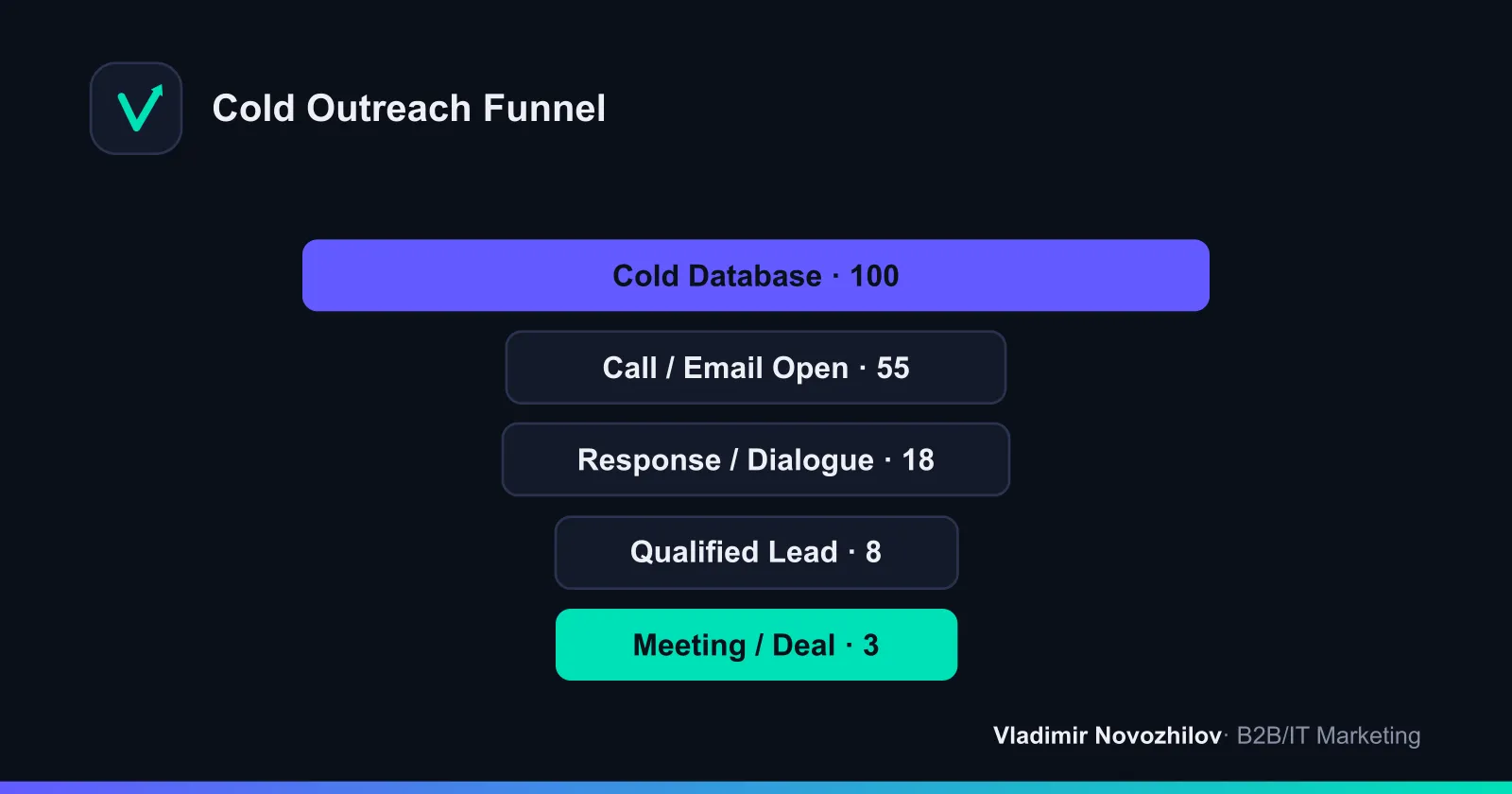
In short: with a cold approach, you initiate contact yourself; with a warm approach, you work with people who’ve already shown interest; with inbound, the customer finds you.
- Cold lead generation — a first contact you initiate (cold outreach): the person hasn’t submitted a request and is often hearing about you for the first time.
- Warm — contact with people who’ve visited your site, downloaded material, or subscribed, but haven’t bought yet.
- Inbound — the customer comes to you through ads, SEO, or referrals.
Cold channels offer predictability: you choose who to reach out to and can scale lead generation for a specific segment. The trade-off is a higher bar for relevance. In cold contact you have no built-in trust, so the cost of a mistake (wrong person, wrong pain point, wrong timing) is higher.
Types of cold contact: calls, emails, messengers, outreach
Several formats fall under the “outreach” umbrella, and strong teams use them together rather than in isolation.
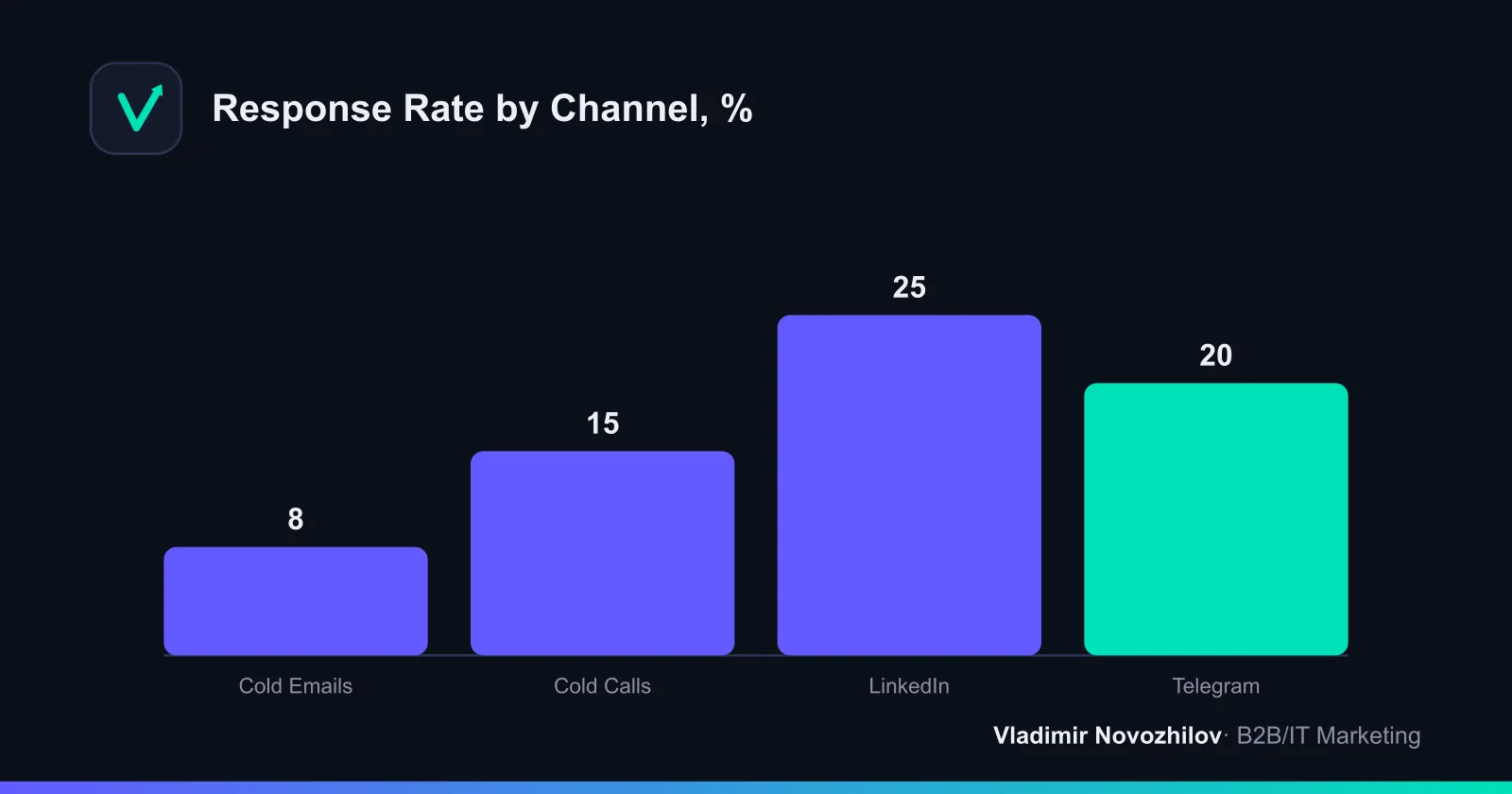
| Channel | Response rate | Setup speed | Cost per touch | When to use |
|---|---|---|---|---|
| Cold emails | 5–10% | Medium | Low | Mass coverage of a segment, long sales cycle |
| Cold calling | 10–20% | Fast | Medium | Quick qualification, expensive product |
| Telegram | 15–25% | Fast | Low | SMB, digital niches, fast dialogue |
| 20–30% | Medium | Medium | B2B, reaching decision-makers, expert content |
These figures are approximate and depend on the niche, list quality, and offer. The best results come from a multi-channel sequence: email → reminder → call → messenger message.
Where to source a cold list and how to validate it
Working with a cold list starts not with sending, but with data quality. A poor list kills even a great offer: emails end up in spam, calls go nowhere.
Where to legally source a cold list:
- Open sources — company websites, industry directories, registries, exhibition and conference attendees.
- Professional networks — LinkedIn and industry communities for finding decision-makers.
- Your own research — manual collection based on ICP (ideal customer profile) criteria.
- Vetted vendors — with transparent disclosure of where contacts came from.
Before launch, the list must always be validated:
- verify emails through verification services to keep bounce rate below 3–5%;
- remove duplicates and non-working numbers;
- segment the list by industry, company size, contact role, and pain point.
Segmentation is what turns a mass mailing into personal outreach. The narrower the segment, the more precise the offer and the higher the response rate.
B2B cold calling: scripts, stages, and common mistakes
B2B cold calling works when the caller has a conversation rather than “reading from a script.” A cold call script is a framework, not a word-for-word scenario.
Stages of a cold call:
- Greeting and introduction — who you are and why you’re calling them specifically (10 seconds).
- Hook — a short, relevant reason: an observation about their business or segment.
- Qualification — 2–3 questions to understand whether there’s a need.
- Value proposition — one benefit, not a list of services.
- Call to action — agree on a next step (meeting, demo), rather than trying to “sell” right away.
Example framework: “Hello, [Name]. My name is [Name] from [Company X]. We help [segment] reduce [problem]. I noticed that you [fact about the company]. Is [pain point] relevant for you right now? — If yes: I’d suggest 15 minutes next week to show how we solve it.”
Handling objections using the “acknowledge → clarify → respond” framework:
| Objection | Response |
|---|---|
| ”We don’t need anything" | "Understood. Just briefly — how do you currently deal with [pain point]?" |
| "Send it by email" | "Sure. To send something relevant, let me clarify a couple of things…" |
| "No time" | "I’ll take 30 seconds. If it’s not relevant, we’ll wrap up right away" |
| "Too expensive" | "Compared to what? Let’s compare it with the impact you’re getting” |
Common mistakes: monologue instead of dialogue, trying to close the deal on the first call, skipping qualification, and calling without a CRM, which loses the history of touches.
Cold emails: structure, examples, and what counts as spam
Cold emails win through brevity and personalization. A good email can be read in 15 seconds and contains one clear ask.
Email structure:
- Subject line — short, no caps or trigger words (“free,” “promo”).
- First line — about the recipient, not about you.
- Core message — what problem you solve and for whom.
- Proof — a short fact or mini case study.
- CTA — one question or an offer for a brief call.
Cold email template for B2B outreach:
Subject: question about [process] at [Company]
Hello, [Name]. I noticed that you [fact about the company/role]. We help [segment] deal with [pain point] — for example, [client] got [result] within [timeframe]. How relevant is [pain point] for you right now? If it is — I can show in 15 minutes how it applies to you.
Follow-up email template:
Subject: Re: question about [process]
[Name], bumping this up — it may have gotten buried. If this isn’t a priority right now, just let me know and I won’t bother you further. If it’s relevant, I’ll suggest a convenient time.
Anything irrelevant and pushy counts as spam: mass mailing without segmentation, sensational subject lines, no unsubscribe option, dozens of emails in a row, purchased lists without consent. A single sales template sent to thousands without adaptation is spam in substance, even if it technically passes filters.
How to avoid spam: legal and anti-spam rules for outreach
Anti-spam rules fall into legal and technical categories. In Russia, personal data processing is governed by Federal Law 152-FZ, and advertising messages fall under the Advertising Law (Article 18): sending ads and making calls is only allowed with prior consent. In B2B, it’s safer to run business correspondence to corporate addresses, introduce yourself, and offer an opt-out. For international contacts, GDPR applies.
Technical “how not to end up in spam” checklist:
- Set up SPF, DKIM, and DMARC for your sending domain.
- Use a separate domain that doesn’t match your main corporate one.
- Warm up a new address gradually: 20–40 emails a day, increasing steadily.
- Keep bounce rate below 3–5% through list validation.
- Write plain-text emails without heavy images or excessive links.
- Always include a clear way to opt out of further emails.
- Don’t send identical text to the whole list — vary the opening lines.
Cold outreach on LinkedIn and Telegram: channel specifics
Messengers and professional networks deliver higher response rates but require a different tone.
- LinkedIn — works for reaching decision-makers in B2B. Start with content and connection, then a soft offer. Mass identical connection requests quickly lead to account restrictions.
- Telegram — fast dialogue for SMB and digital niches. A human tone matters here: the first message should be short, without links or a wall of text.
In both channels, email sequences and calls remain part of the overall sequence — the messenger is just one of the touches.
Tools and services for automating cold lead generation
Automation saves SDR time but doesn’t replace strategy. A basic stack includes:
- CRM — stores the history of touches, tasks, and lead statuses; without it, outreach falls apart.
- Email sequencing services — automatic email sequences with pauses and stop-on-reply logic.
- Email verifiers — reduce bounce rate.
- Calling services — number dialing, recording, and call analytics.
- Data enrichment tools — supplement contacts with company and role information.
The main rule: automate the routine (sending, reminders, logging), but leave personalization and qualification to a human.
Performance metrics: open rate, response rate, conversion to lead
Without metrics, cold lead generation becomes a lottery. Key indicators:
- Open rate — the share of opened emails. Normal for cold B2B emails is 40–60%.
- Response rate — the share of replies. A good level is 5–10%, an excellent one is above 10%.
- Lead conversion rate — the share of contacts that became qualified leads.
- Connect rate — the share of successful calls out of total attempts.
- Call-to-meeting conversion — how well the script moves prospects to the next step.
Track the dynamics by segment: often the problem isn’t the channel itself but a single bottleneck in the cold lead sales funnel.
How to calculate cold lead cost (CPL) and campaign ROI
Lead cost shows how much you pay for one qualified contact. The formula is simple:
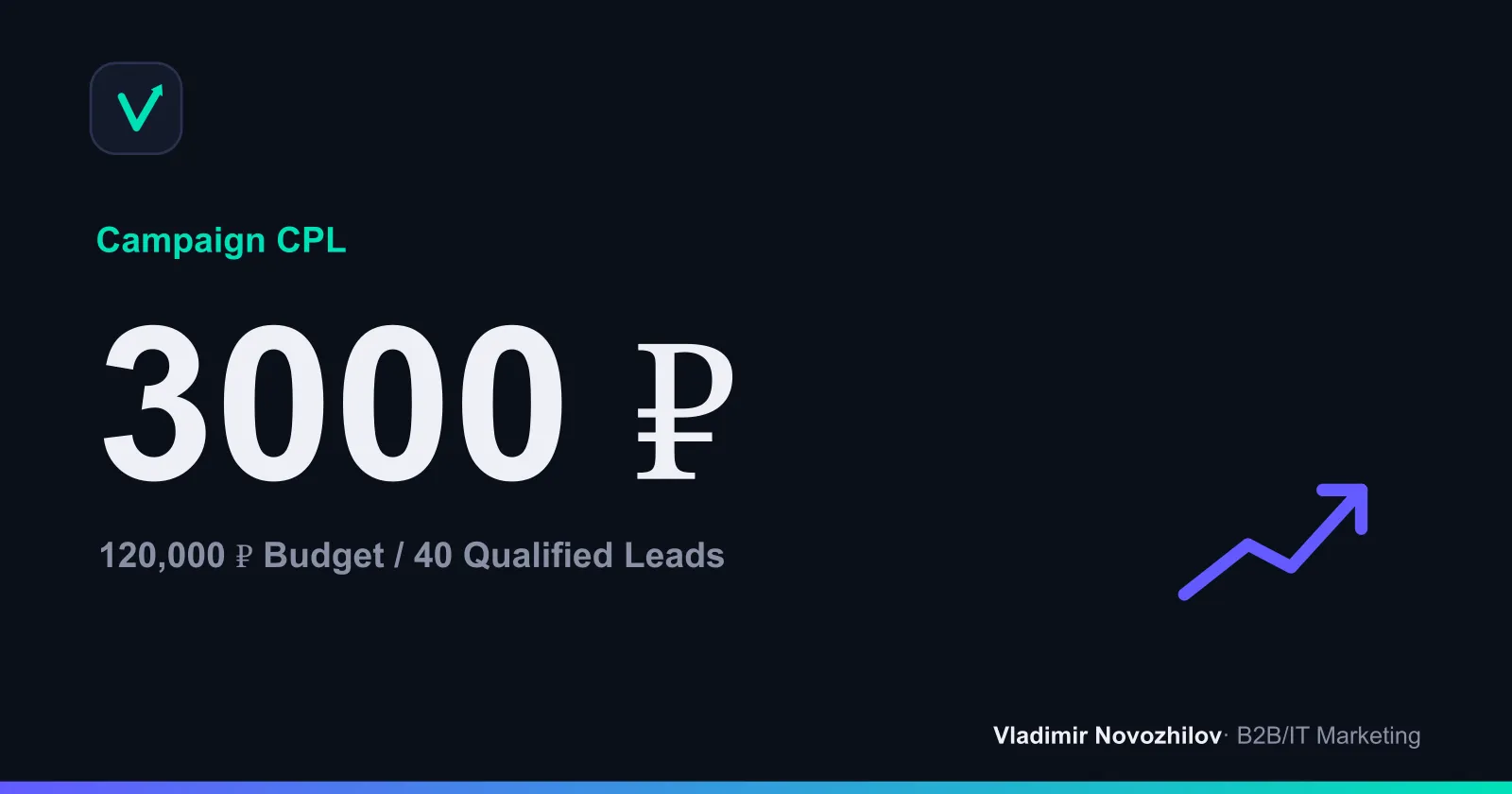
CPL = total campaign costs / number of qualified leads.
Step-by-step calculation example:
- Monthly costs: SDR salary 80,000 rubles + services 20,000 rubles + list and validation 20,000 rubles = 120,000 rubles.
- Qualified leads generated: 40.
- CPL = 120,000 / 40 = 3,000 rubles per lead.
Next, calculate the economics: if 4 out of 40 leads close as deals with an average ticket of 150,000 rubles, revenue is 600,000 rubles against 120,000 rubles in costs — the campaign pays off. ROI = (revenue − costs) / costs. It’s the combination of CPL and conversion to deal — not lead cost alone — that shows real effectiveness.
7-step checklist for launching a cold campaign
- Define your ICP and one narrow segment.
- Collect and validate a cold list for that segment.
- Formulate an offer targeting a specific pain point.
- Prepare a cold call script and an email sequence of 3–5 emails.
- Set up the technical side: domain, warm-up, CRM, anti-spam rules.
- Launch a pilot on 100–200 contacts and measure the metrics.
- Optimize the funnel’s bottleneck and scale what worked.
Case studies and examples of successful cold emails and calls
- B2B services. Segmented the list by industry and rewrote the first line of the email to address each segment’s pain point — response rate rose from 4% to 11%, and CPL nearly halved.
- IT integrator. Added a follow-up call the day after the email — conversion from response to meeting rose from 20% to 34%.
- Agency. Switched from mass mailing to 300 personalized touches per month — fewer leads in number, but their quality and deal conversion rate improved.
Common mistakes when working with a cold list
- Buying a raw list without validation or segmentation.
- Using one template for everyone instead of personalizing.
- A single touch instead of a sequence of 3–5 steps.
- Ignoring anti-spam rules and Federal Law 152-FZ.
- No CRM, resulting in lost history of contacts.
- Judging a campaign by send volume instead of lead conversion and lead cost.
Cold lead generation stops being spam the moment every touch is backed by an understanding of who you’re writing to and why. An accurate list, a relevant offer, careful emails and calls, plus honest metric tracking — that’s enough to get qualified leads legally and predictably.
FAQ
- How does cold lead generation differ from warm and inbound lead generation
- Cold lead generation is a first contact you initiate with people who don't know you yet and haven't submitted a request. Warm lead generation targets people who've already shown interest (visited your site, downloaded material), while inbound means the customer finds you themselves through ads, SEO, or referrals. Cold outreach delivers a predictable flow of contacts but requires more precise targeting of needs and care to avoid coming across as spam.
- Are cold calls and cold emails legal in Russia
- Yes, provided the rules are followed. Personal data processing is governed by Federal Law 152-FZ, and advertising messages fall under the Advertising Law (Article 18): sending advertising via email or making calls is only allowed with prior consent from the recipient. In B2B, it's safer to write to corporate addresses with a business-oriented message rather than an advertising one, always identify yourself, and clearly offer a way to opt out of further contact.
- How do you avoid spam filters in cold email outreach
- Set up your domain's technical records (SPF, DKIM, DMARC), warm up a new address gradually (20–40 emails a day, increasing volume over time), write short personalized emails without heavy images or suspicious links, keep bounce rate below 3–5% through list validation, and always include an unsubscribe option. It's best to use a separate domain for cold outreach rather than your main corporate one.
- How much does a cold lead cost and how do you calculate CPL
- CPL (cost per lead) = total campaign costs divided by the number of qualified leads generated. Costs include SDR salary, mailing and calling services, and list purchase and validation. For example, with a budget of 120,000 rubles and 40 leads, the CPL would be 3,000 rubles. In cold B2B channels, CPL varies significantly by niche and is usually measured in thousands of rubles per qualified lead.
- What response rate is considered good for cold B2B emails
- For cold B2B emails, an open rate of 40–60% and a response rate of 5–10% are considered normal. A response rate above 10% is already a strong result, achieved through precise segmentation, personalized opening lines, and a relevant offer. A single email almost always underperforms compared to a sequence of 3–5 touches.