How to Appear in Yandex Neuro and Alice Answers: Plan with SoV

TL;DR
To regularly appear in Yandex Neuro and Alice answers you need a combination: a clear direct answer on the page, correct Schema.org markup, openness to retrieval bots (llms.txt/robots) and monitoring Share of Voice in Webmaster — only together will deliver results: organic positions → extractability → trust → technical accessibility.
Short answer — what your site actually needs
If the goal is sustainable promotion in Yandex AI (neuro results / Alice AI), build a system of four links:
- the page gives a direct answer that is easy to extract; 2) the page is competitive in organic search; 3) there are trust signals (expert author, brand entities, local profiles); 4) the site is technically accessible to retrieval bots. Measure results by Share of Voice (SoV) and examples in the “Site visibility in Alice AI” section in Yandex Webmaster.
Key: one “magic” action doesn’t work. Only the chain “position → extractability → trust → technical accessibility” yields stable mentions.
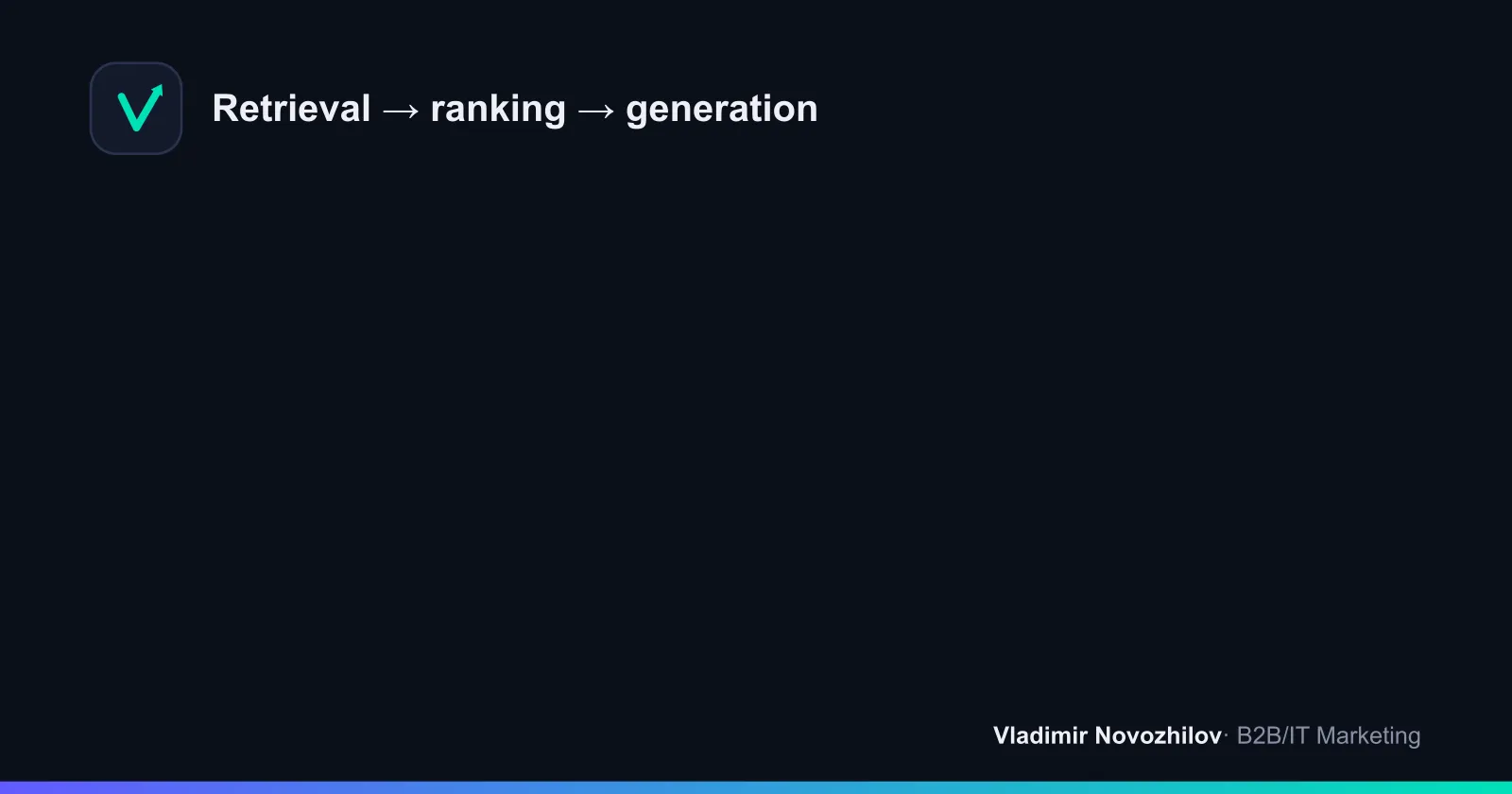
How Yandex forms an answer (brief, extraction algorithm)
In short: the system finds candidates (retrieval), reorders them by quality (ranking), and generates the final text (generation), inserting citations and sources. To be selected it matters that:
- your text can be singled out as a self-contained fragment (2–3 sentences or a short list);
- the page has correct markup (Article/FAQPage/QAPage) and clear H2 questions;
- the page is indexed and competitive for relevance;
- bots are allowed to extract and content loads quickly.
Five key signals for being selected
Practical weights depend on the topic, but the picture is similar.
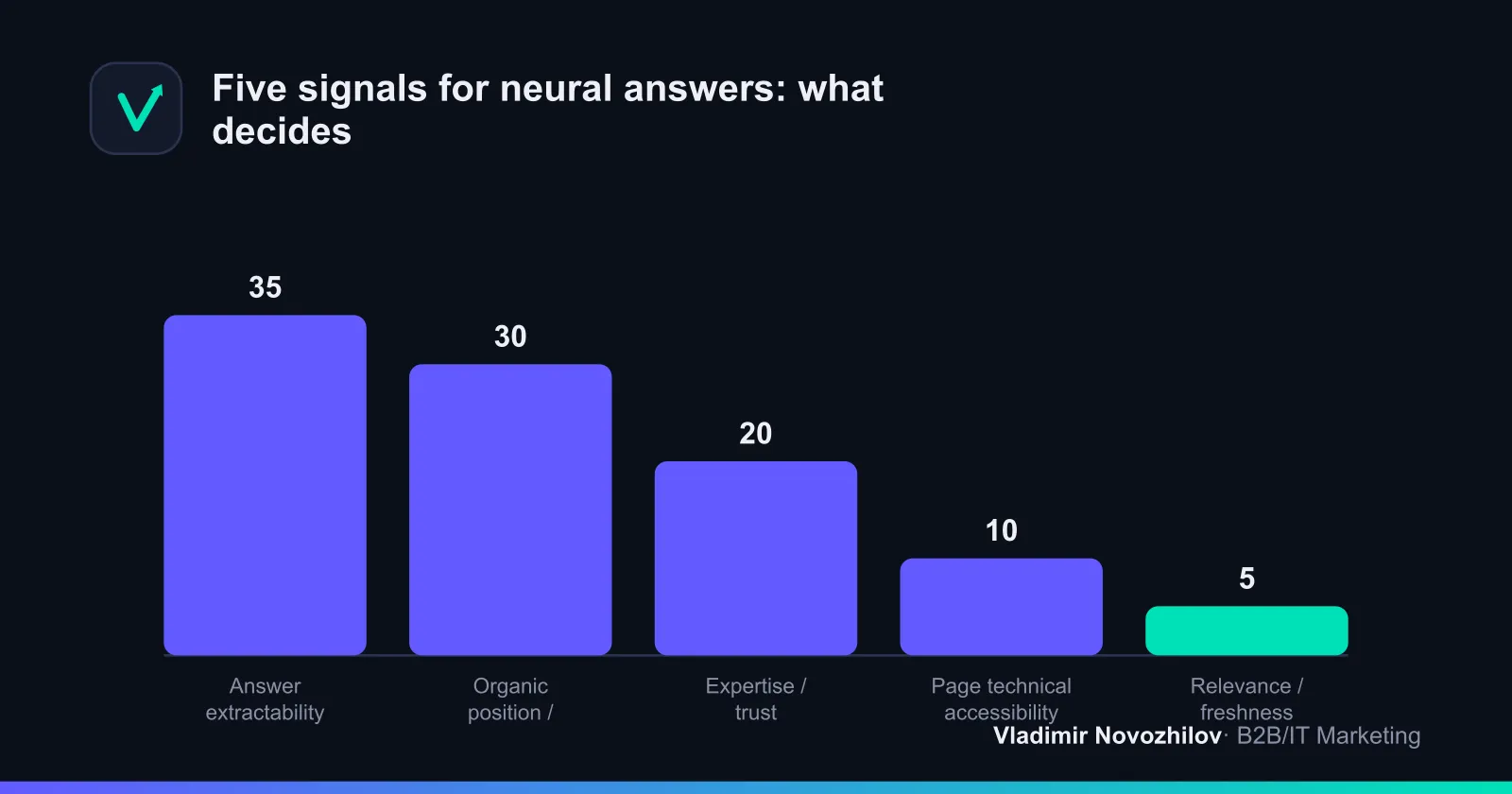
- Extractability of the answer: formulate a direct answer, provide a table/list, highlight a subheading with the question.
- Position/relevance in organic: typically candidates are pages from the top blocks of the relevant SERP.
- Expertise/trust: a real author with credentials and an update date, local profiles (Yandex Business/Maps), brand mentions.
- Technical accessibility: do not block LLM bots, ensure fast load and valid JSON‑LD.
- Timeliness: update data, especially in changing topics (prices, terms, regulations).
Step-by-step work plan (technical check → content → markup → external signals)
- Collect and prioritize queries: export queries from “Visibility in Alice AI”, supplement with organic semantics. Group by user tasks.
- Audit candidate pages: if there is no direct answer — add one; if the answer is weak — strengthen with examples and tables; if no page exists — create it.
- Markup: add Article and, if needed, FAQPage/QAPage. Validate markup.
- Tech: check robots.txt, add llms.txt, ensure indexing, speed, canonical tags.
- Trust: specify author with credentials, update date, add Yandex Business and accurate Maps data, collect mentions.
- Measurements: track SoV and “Queries and pages” in Yandex Webmaster. Record gains and recrawl time.
Technical checklist (robots.txt, llms.txt, speed, indexability)
Check and confirm:
- Indexability: no noindex/nofollow on key blocks; correct canonicals; pages in sitemap.
- robots.txt: access for main Yandex bots and LLM agents is not blocked.
- llms.txt: placed in root, does not duplicate unnecessary prohibitions from robots, gives explicit Allow for needed sections.
- Speed: LCP ≤ 2.5 s, CLS ≤ 0.1; no heavy blocking scripts above the fold.
- Markup: one valid JSON‑LD per page type; no conflicts (duplicated authors/dates).
- Dates: have datePublished and dateModified; automated substitution should reflect real updates.
- Safety: 200 responses on key URLs, no 302 loops, no mass 404s in navigation.
Example robots.txt (base for a site open to extraction):
User-agent: *
Allow: /
Disallow: /admin/
Disallow: /cart/
Sitemap: /sitemap.xml
# Important: do not disallow sections with answers/FAQ/articles
Example llms.txt (minimal version):
# Rules for LLM-agents (as of 2026)
User-agent: *
Allow: /
Disallow: /admin/
Disallow: /personal/
Sitemap: /sitemap.xml
Source: /ai-source
Policy: public-extract-with-attribution
# Do not duplicate prohibitions on public articles here
Notes:
- Source — a page with citation policy and editorial contacts.
- Policy — a human-readable extraction policy label.
Content template: how to write a direct answer + expanded section
Template for an extractable fragment (at top of page, under intro):
Short: [user question] — [clear answer in 2–3 sentences].
How to apply: [1–2 steps or criteria]. Current as of: [month/year].
Example for a B2B service:
Short: an IT infrastructure audit takes 10–15 business days and consists of interviews, configuration analysis and a report with a roadmap.
Start with system inventory and SLA: this reduces audit time by 20–30%. Current as of: March 2026.
Build a structural “backbone” for LLM extraction:
- H2 questions phrased as natural queries.
- If‑then lists, control tables, numeric criteria.
- FAQ block (at least 3–5 questions) as a separate section and Schema.org FAQPage.
Examples: 3 typical edits
- Page missing — create it.
- Before: queries “pentest cost for a bank”, “stages” point to a generic landing.
- After: a separate article “Cost and stages of a pentest for the financial sector: calculation and benchmarks” with a direct answer at the top and a calculation table. Result: 0 → 1.6% SoV in 5 weeks.
- Answer exists — strengthen it.
- Before: a paragraph with no structure.
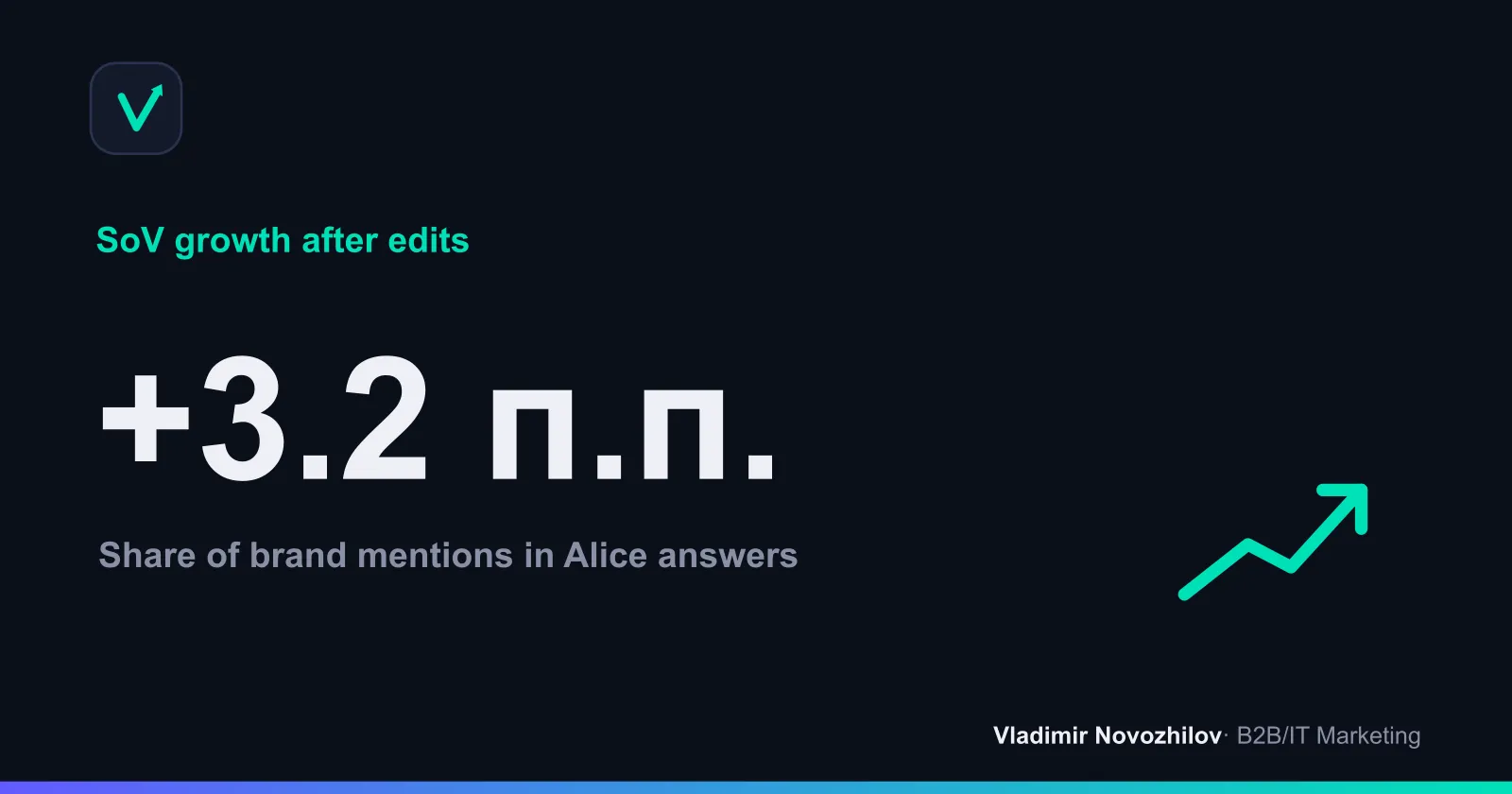
- After: 2–3 sentence “short answer”, H2 question, list of criteria, mini table of timelines. Result: +1.2 p.p. SoV, mentions rose from 12 to 31 in 6 weeks.
- Weak answer — add examples.
- Before: generic formulations without numbers.
- After: reference figures, step-by-step guide, mini calculator in a table. Result: organic CTR +0.8 p.p., SoV +0.7 p.p.
Schema examples (Article, FAQPage) and ready snippets
Article (JSON‑LD):
{
  "@context": "https://schema.org",
  "@type": "Article",
  "headline": "Как выбрать MSP для ИТ‑аутсорсинга в 2026",
  "datePublished": "2026-03-10",
  "dateModified": "2026-03-28",
  "author": {
    "@type": "Person",
    "name": "Иван Петров",
    "jobTitle": "Руководитель практики ИТ‑аудита",
    "affiliation": {"@type": "Organization", "name": "TechConsult"}
  },
  "publisher": {"@type": "Organization", "name": "TechConsult"}
}
FAQPage (JSON‑LD):
{
  "@context": "https://schema.org",
  "@type": "FAQPage",
  "mainEntity": [
    {
      "@type": "Question",
      "name": "Сколько длится пилот SOC?",
      "acceptedAnswer": {"@type": "Answer", "text": "Обычно 2–4 недели: подключение, калибровка, отчёт."}
    },
    {
      "@type": "Question",
      "name": "Как считать TCO аутсорсинга?",
      "acceptedAnswer": {"@type": "Answer", "text": "TCO = лицензии + трудозатраты + простои + обучение + риски."}
    }
  ]
}
QAPage (for Q&A pages):
{
  "@context": "https://schema.org",
  "@type": "QAPage",
  "mainEntity": {
    "@type": "Question",
    "name": "Как подготовиться к аудиту ИБ?",
    "acceptedAnswer": {
      "@type": "Answer",
      "text": "Соберите реестр систем, доступов и инцидентов за 12 месяцев; назначьте ответственное лицо."
    }
  }
}
Tips:
- Place one valid JSON‑LD block per page type.
- Ensure the author name in markup matches the page.
- Update dateModified on real updates.
How to work with Yandex Webmaster: exports, SoV and what to look for in reports
In “Site visibility in Alice AI” you can find:
- SoV (Share of Voice) — share of your site mentions in Alice answers within the selected query sample.
- SoV dynamics — inspect week‑to‑week slices after edits.
- Examples: pairs “query → page” and context (other sources).
Working cycle:
- Record baseline SoV and export examples.
- Group queries by topic and intent.
- Check candidate pages: extractability, structure, markup, trust.
- Make edits, note the date.
- After 2–6 weeks compare SoV, number of mentions and organic CTR.
Where to find trust sources: Yandex Business, Maps, mentions
- Yandex Business: correct category, address, opening hours, photos, services, answers to questions.
- Maps: consistent NAP data (name, address, phone), recent photos and reviews.
- External mentions: industry directories, niche publications, expert reports.
- On the page: author with position, experience, publications, update date, editorial contact.
Templates and files to copy (adapt as needed)
-
llms.txt — see above.
-
Control queries table (CSV structure as a table):
| Cluster | Query | Target page | Priority (1–5) | Edit type | Status | Comment |
|---|---|---|---|---|---|---|
| Pentest | стоимость пентеста банк | /blog/pentest-cost | 5 | Create “Short” section + calculation table | In progress | No direct answer |
| SOC | пилот SOC сроки | /services/soc-pilot | 4 | Add H2 question + step list | Done | Needs update date |
| IT outsourcing | tco аутсорсинг | /blog/it-outsourcing-tco | 3 | Add FAQPage | Planned | Requires examples |
- Content edit checklist:
- At the top: “Short” 2–3 sentences with a currency date.
- Next: H2 questions, lists, tables, short checklists.
- Bottom: FAQ with 3–5 questions and clear answers.
- Prominently: author with credentials and update date.
- Author block template:
Author: Firstname Lastname — position, N years of experience, relevant publications/certificates.
Updated: DD.MM.YYYY (notes: what was changed).
Editorial contacts: editorial@domain (for fact checks).
Case studies: edits → metrics (SoV/visibility/traffic)
De‑identified B2B/IT cases (Russia), sample — 2026.
Case A (infosec audit, regions):
- Baseline: SoV 0.9%, mentions 8/28 days, CTR 2.1% on branded clusters.
- Edits: “short answer”, H2 questions, FAQPage, author with credentials, llms.txt.
- 6 weeks: SoV 3.7% (+2.8 p.p.), mentions 29/28 days, CTR 2.9% (+0.8 p.p.).
Case B (financial pentest):
- Baseline: SoV 0%, no candidate pages.
- Edits: new article with pricing table, Article markup, robots/llms.txt fixed.
- 5 weeks: SoV 1.6%, 11 mentions, 420 organic visits (+26%).
Case C (SOC outsourcing):
- Baseline: SoV 1.2%, weak extractability (long paragraphs).
- Edits: short answer, pilot steps list, QAPage.
- 6 weeks: SoV 2.5% (+1.3 p.p.), share of queries with quoting rose from 3 to 9.
Case D (IT outsourcing, multi‑geo):
- Baseline: inconsistent NAP data, no author.
- Edits: unify profiles in Yandex Business/Maps, add author and date, update pricing.
- 8 weeks: SoV 4.1% (+2.1 p.p.), branded mentions grow evenly across regions.
Table examples: query → Alice source → what is useful → how to reproduce
| Query | Alice source (type) | What is useful | How to reproduce |
|---|---|---|---|
| пилот SOC сроки | Article (guide) | Short answer + steps | Add 2–3 sentences and a 1–5 step list |
| стоимость пентеста банк | Calculator/table | Price ranges, conditions | Provide a table with parameters and calculation formula |
| tco аутсорсинг | Overview with formula | Clear TCO formula | Extract the formula and an example calculation in 2 lines |
Comparison: classic SEO vs promotion in neuro results
| Parameter | Classic SEO | Neuro results (Alice AI) |
|---|---|---|
| Goal | Top positions and clicks | Be quoted in an answer |
| Main artifact | Full text | Short extractable answer + structure |
| Markup | Article, Breadcrumb | Article + FAQPage/QAPage |
| Metric | Positions, CTR | SoV, number of mentions, reach |
| Tech | Index/speed | Plus access for LLM bots, llms.txt |
Interactive checklist/priority calculator (static template)
Priority formula P:
- P = Impact × Confidence × Reach ÷ Effort, where
- Impact — expected SoV gain (0.5–5.0 p.p.),
- Confidence — confidence (0.3–0.9),
- Reach — cluster coverage (1–5),
- Effort — labor intensity (1 — easy, 5 — hard).
Example calculation:
| Task | Impact (p.p.) | Confidence | Reach | Effort | P |
|---|---|---|---|---|---|
| Add “short” + FAQ | 1.2 | 0.7 | 4 | 2 | 1.68 |
| Create new article | 1.6 | 0.6 | 3 | 4 | 0.72 |
| QAPage markup | 0.7 | 0.8 | 5 | 1 | 2.80 |
| With this layout do QAPage first, then “short” + FAQ. |
Common mistakes and how to avoid them
- No direct answer at the top of the page. Fix: 2–3 sentences + current date.
- Blocks in robots.txt / missing llms.txt. Fix: check permissions and add explicit Allow.
- Empty or conflicting JSON‑LD. Fix: one valid Article block and separate FAQPage.
- No author/dates. Fix: add author with credentials and real publish/update dates.
- Narrow “SEO‑only” answer. Fix: write for humans; use criteria and numbers.
For other search engines and platforms (brief)
- Terminology swap: speak of “generative answers” and “extractability” — principles are the same.
- Policy files: keep explicit extraction rules in llms.txt / ai.txt.
- Markup: Article/FAQPage/QAPage are universal; validity and consistency of author/dates is key.
- Metrics: analogues of SoV can be estimated as share of mentions in assistant query exports.
Everything above is a practical foundation for promoting via Yandex AI neuro results: make the answer extractable, check tech and structure, strengthen author and brand trust, and measure results by SoV and examples in Webmaster.
FAQ
- How can I find which queries Alice already mentions my site for?
- Go to Yandex Webmaster → “Site visibility in Alice AI”. There you can see Share of Voice (SoV), dynamics and a list of examples with pairs “query → page”. Export the queries, note the share of mentions and start with clusters that have the greatest SoV growth potential.
- Do I need to write content specifically “for Alice” or is regular SEO enough?
- There is no separate “Alice language.” Base SEO works plus extractability: provide a short direct answer on the page in 2–3 sentences, structure H2 as questions, add lists and tables, and implement Article/FAQPage markup. This increases the chance of citation without harming organic performance.
- What is llms.txt and how to form it correctly?
- llms.txt is a file with rules for LLM agents, analogous to robots.txt. Place it in the root: specify User-agent, Allow/Disallow for sections, indicate sitemap and a source/policy section. Do not duplicate public article prohibitions from robots.txt if you want to be available for extraction.
- What technical errors most often prevent appearing in Alice answers?
- Common causes: blocking LLM bots in robots.txt, missing llms.txt, slow pages, closed or incorrect JSON‑LD, duplicate canonicals, broken FAQ pagination, incorrect dates/author without credentials, and thin content without a direct answer.
- How long does it usually take to see effects after changes?
- In our observations it takes 2–6 weeks for recrawl and SoV stabilization in Alice AI. Small gains are possible in 7–10 days if edits are targeted and strong. In competitive topics and regions — 6–10 weeks. Timelines cannot be guaranteed.