Promotion in ChatGPT: How to Appear in AI Answers

TL;DR
In short: to appear in ChatGPT and other LLM answers, give crawlers access to your important pages, publish succinct "direct answer + supporting fact" fragments, provide clear entity signals and structured data, build external mentions, and measure results regularly with control queries.
Promotion in ChatGPT: what it is and why it matters for your business
If briefly: promotion in ChatGPT is the work to make your site and brand a source of facts for LLM answers. Practically, this means OAI-SearchBot access to important pages, the “direct answer + fact” format, clear entity signals (who you are, where you operate, what you offer), structured data and external mentions, plus regular measurement with control queries.
Short answer — how it works and what to expect
- The AI collects facts from accessible and clear pages, cross-checks them across sources and synthesizes an answer.
- You can appear in an answer as: a link, navigation to your brand/page, or a mention without a link.
- Time to results: 4–12 weeks with systematic work. Progress is measured by mention share on control queries and growth in visits/leads.
Types of appearance in answers (link, navigation, mention without link)
- Link: your material is cited as the primary source of a fact or instruction.
- Navigation: the assistant suggests “go to <your_brand> site” or “here is the page with terms”.
- Mention: the brand is named as a relevant provider/product without a clickable link.
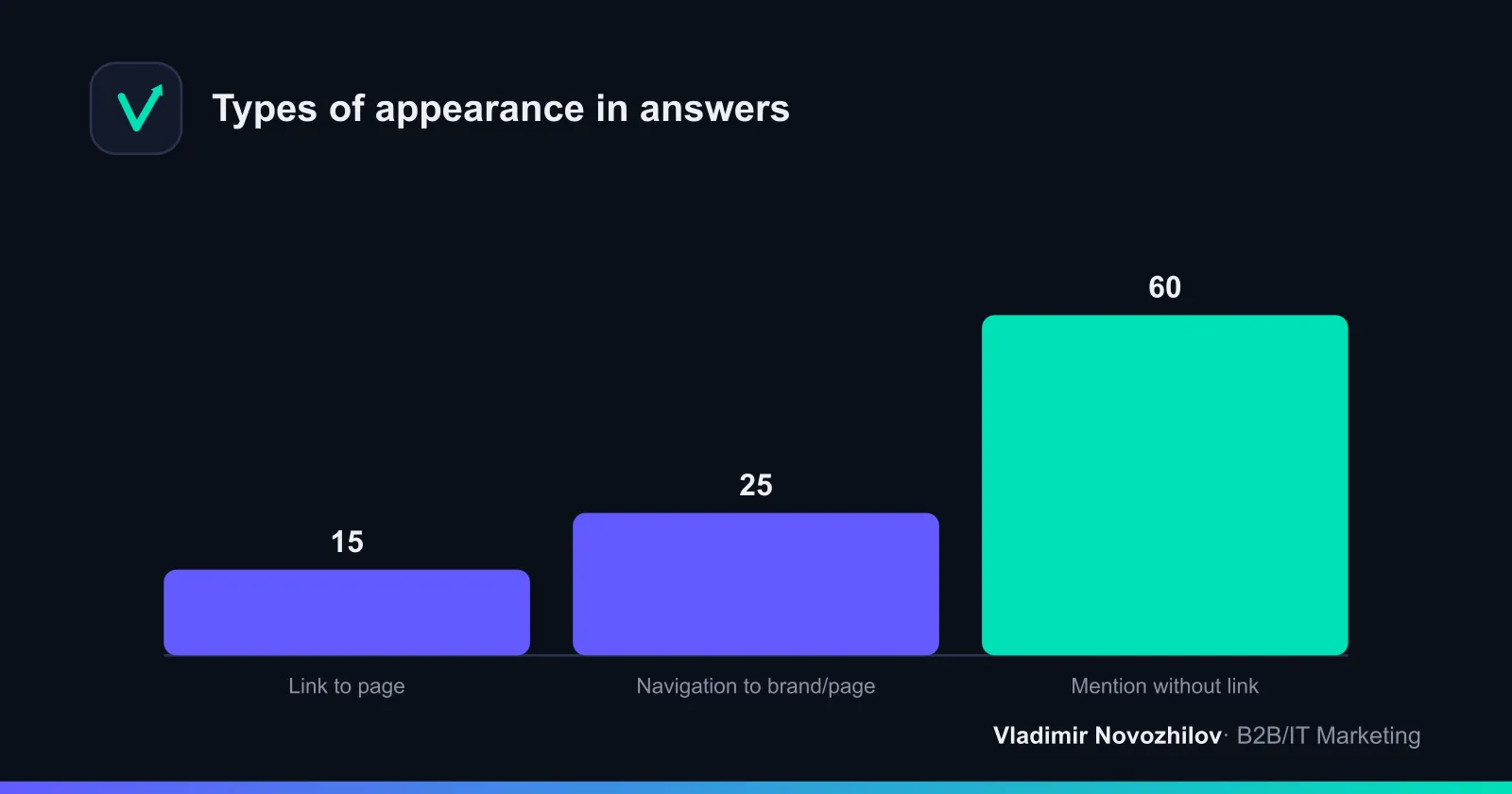
Prioritization: start with pages where a “link” is possible (FAQ, guides, comparisons), then strengthen navigation (clear page titles, brand anchors), and then increase the total number of mentions.
Bots and indexes: OAI-SearchBot, GPTBot, Bing and Yandex — who does what
- OAI-SearchBot: crawls public pages for ChatGPT answers and built‑in search. Its access is priority #1.
- GPTBot: about model training; it might be restricted if business policy prevents it.
- Indexes: for English/international niches presence in Western indexes and availability via tools like Bing Webmaster Tools and URL notification protocols (e.g., IndexNow) is important. For RU geo — coverage by Yandex is critical.
- Russian assistants: Alysa and YandexGPT rely on the Yandex ecosystem; GigaChat uses its own and partner indexing. Perplexity often shows sources explicitly, which is convenient to monitor citation.
Technical check: robots.txt, page access, CDN and errors
15-minute checklist:
- Allow OAI-SearchBot and, if desired, GPTBot.
- Ensure important pages are not closed by noindex/Disallow/login.
- Set speed targets: TTFB < 500 ms for FAQ/guides; fix 4xx/5xx errors.
- Stable slugs and canonical; working hreflang for multilingual sites.
- CDN for static assets and geo-proximity.
- Sitemap and fresh modification dates.
Example robots.txt (minimum):
User-agent: OAI-SearchBot
Allow: /

User-agent: GPTBot
Allow: /

User-agent: *
Disallow: /admin/
Sitemap: /sitemap.xml
Mini llms.txt at the root:
# Settings for LLM crawlers
User-agent: *
Allow: /
Crawl-delay: 2
Contact: content@<ваш_домен>
Policy: summarize, cite-with-brand
Notify updates via IndexNow: send URLs on publish/edit. Place the key in indexnow.txt at the root; trigger the request from the server or CI/CD (recipient address is the service endpoint with url and key parameters). Avoid massive batches — send incrementally.
Bot monitoring in logs (example UAs):
- OAI-SearchBot
- GPTBot
- bingbot (to check discovery in Western indices)
Content format that gets cited: “direct answer + facts”
AI prefers unambiguous, short fragments and verifiable statements.
Paragraph template:
- Direct answer: one sentence of 10–20 words.
- Fact/number: a concrete criterion, threshold, date or range.
- Context: 1–2 sentences “when it’s true/when it’s not”.
Ready-to-use “direct answer + fact” fragments:
- How to choose a CRM implementation contractor?
- Direct answer: pick an integrator who proves expertise with cases in your industry.
- Fact: at least 3 relevant case studies in the last 12 months and a certified team.
- Context: for complex customization add a 2–4 week pilot.
- How long does an IT infrastructure audit take for a mid‑sized business?
- Direct answer: a basic audit takes 2–4 weeks.
- Fact: with 50–200 servers average time is about 3 weeks.
- Context: up-to-date documentation reduces time by 20–30%.
- When is Alysa more important than ChatGPT for a local service?
- Direct answer: if 80% of demand is from RU and services are bought offline, prioritize Alysa/Yandex.
- Fact: map listings and reviews have a stronger effect on visibility for local queries.
- Context: English pages are an option for export.
Entity signals: how to tell the AI who you are (templates)
What matters:
- Consistent brand and legal entity name, NAP (name, address, phone) and region.
- List of services/products on a single page with clear H2–H3 headings.
- Team/authors with roles, certifications, experience — contribution to E-E-A-T.
- “About us” page and contacts with structured blocks.
“About company” block template (skeleton):
- Who we are:
, , . - Where we operate: <city/region>, service areas.
- What we do: 5–7 service formulations.
- Proof: client numbers, case studies, industry rankings.
- Contacts: phone, email, office hours.
Structured data and microdata examples (Organization, FAQPage, Article)
Organization example (JSON-LD, skeleton without links):
{
  "@context": "https://schema.org",
  "@type": "Organization",
  "name": "<Бренд>",
  "legalName": "<Юрлицо>",
  "areaServed": "RU",
  "address": {"@type": "PostalAddress", "addressLocality": "<Город>", "streetAddress": "<Улица, дом>"},
  "contactPoint": [{"@type": "ContactPoint","telephone": "+7-<...>","contactType": "sales"}]
}
FAQPage example:
{
  "@context": "https://schema.org",
  "@type": "FAQPage",
  "mainEntity": [{
    "@type": "Question",
    "name": "Сколько длится внедрение?",
    "acceptedAnswer": {"@type": "Answer","text": "Обычно 4–8 недель..."}
  }]
}
Article example:
{
  "@context": "https://schema.org",
  "@type": "Article",
  "headline": "Как выбрать SI-подрядчика",
  "datePublished": "2026-07-01",
  "author": {"@type": "Person", "name": "<Автор>"}
}
External signals: mentions, directories and industry reviews
- For RU: cards in Yandex Business/Maps, 2GIS, vertical directories, certificates and reviews.
- For export: industry reviews, integrator rankings, English case studies and service pages.
- Universal: mentions in media and blogs, inclusion in comparison reviews, citation of research.
Measurement methodology: control queries set and how to count mention share
Collect 30–100 seed queries: brand, product, task and comparison queries. For each query record: link presence, navigation, mention.
Formula: mention share = (number of answers with your brand ÷ total control queries) × 100%.
Example measurement table (every 2–4 weeks):
| Query | Geo | Intent type | Link | Navigation | Mention | Comment |
|---|---|---|---|---|---|---|
| внедрение crm для b2b | RU | task | 1 | 0 | 1 | guide excerpt cited |
| сравнение msp-провайдеров | EN | comparison | 0 | 1 | 1 | navigation to brand |
| аудит кибербезопасности цена | RU | commercial | 0 | 0 | 0 | no hits |
Report template:
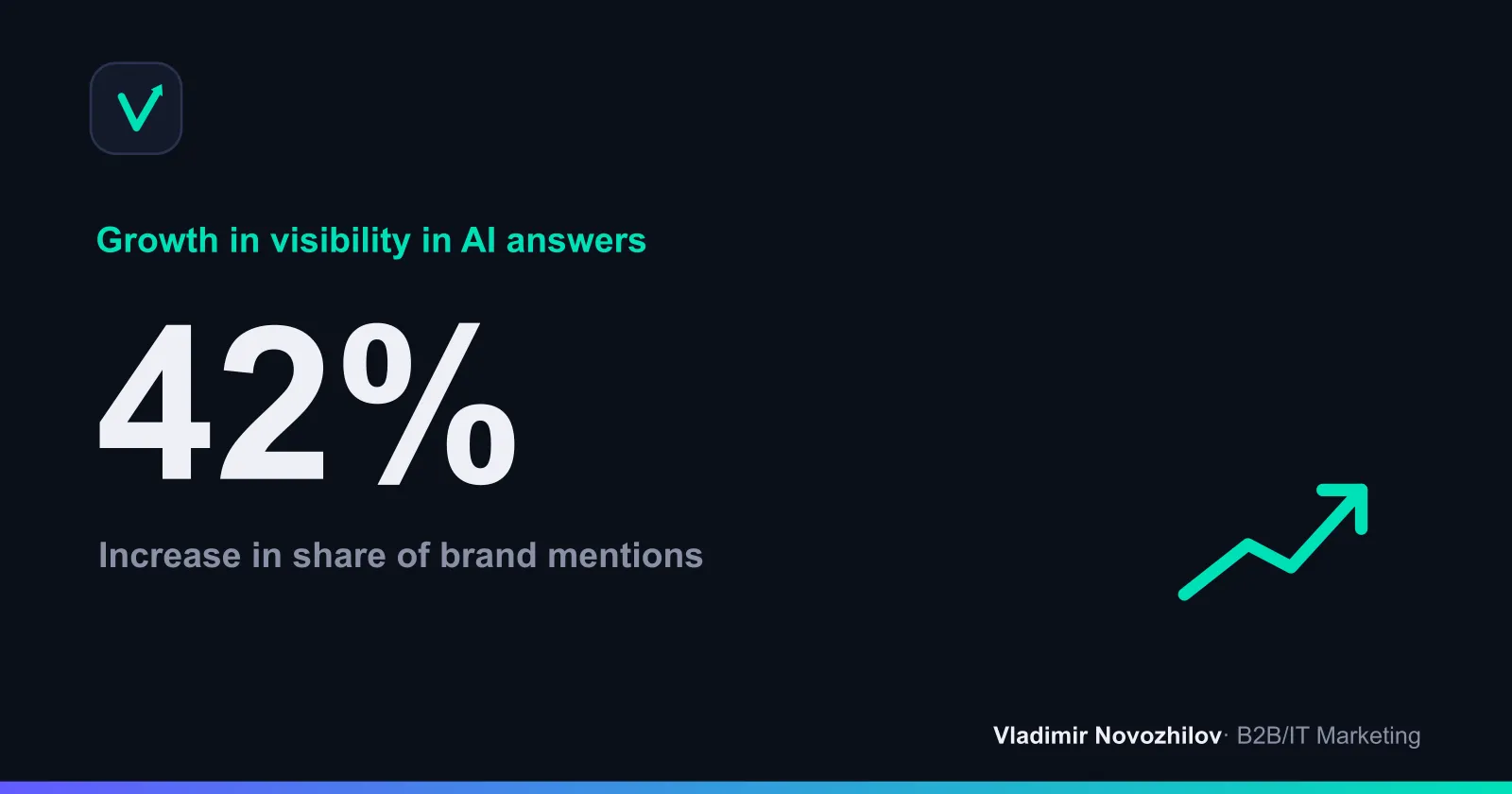
- Mention share: 34% → 48% (+14 pp)
- Link share: 6% → 12% (+6 pp)
- Top source pages: /faq-security, /guides/crm-selection
- Breakthrough queries: “внедрение crm b2b”, “аудит инфраструктуры этапы”
Practical 30/90 day plan (fix checklist and priorities)
Quick technical fixes (1–2 weeks)
- Allow OAI-SearchBot and, if needed, GPTBot in robots.txt.
- Check key pages are accessible (200 OK, no noindex).
- Add llms.txt at root; include contact and basic citation policy.
- Configure sitemap, correct canonical, Last-Modified.
- Enable update notifications via IndexNow on publish.
- Logs: start tracking OAI-SearchBot/GPTBot and bingbot.
Content fixes and creating citable fragments (3–6 weeks)
- For 10–20 priority queries create “direct answer + fact” blocks.
- Rewrite H2/H3 into question/task formulations.
- Add tables and comparisons where relevant (AI prefers structure).
- Implement Schema.org (Organization, Article, FAQPage), specify region in Organization.
- Publish 2–3 case studies with numbers: baseline metric → actions → result.
- Start external signals: 3–5 mentions in niche directories/reviews.
Weeks 7–12: systematization and GEO
- Reconcile NAP across profiles, normalize spelling.
- For export niches add English pages with hreflang.
- Strengthen “About” section: authors, certificates, quality policy (E-E-A-T).
- Run a repeated measurement on control queries and adjust the plan.
Common mistakes and how to avoid them
- “Allowed GPTBot — and that’s it”: without OAI-SearchBot chances are low.
- Empty “marketing” text without facts: AI has nothing to latch onto.
- Microdata that doesn’t match content: reduces trust.
- No external mentions: AI can’t find confirmations.
- No measurement: you can’t tell what works.
Templates and files: robots.txt, llms.txt, schema.org examples
Extended robots.txt template:
User-agent: OAI-SearchBot
Allow: /

User-agent: GPTBot
Allow: /

User-agent: *
Disallow: /admin/
Allow: /guides/
Sitemap: /sitemap.xml
llms.txt template (local business, RU):
User-agent: *
Allow: /
Crawl-delay: 2
Business-Region: RU-<регион>
Preferred-Content: ru
Contact: pr@<ваш_домен>
Policy: cite-with-brand, respect-robots
llms.txt template (export):
User-agent: *
Allow: /
Crawl-delay: 2
Business-Region: Global
Preferred-Content: en, ru
Contact: press@<ваш_домен>
Policy: cite-with-brand, prefer-english-if-available
Ready tags for tracking AI-sourced visits/leads:
- Pages: add utm_source=ai, utm_medium=assistant, utm_campaign=brand-entity
- Forms/chat: record source “AI/Assistant” in CRM when UTM present.
Comparison: ChatGPT, Perplexity, Alysa/YandexGPT, GigaChat (priorities for local niches)
| Assistant | Data source | How to appear | What matters most | Priority for local RU |
|---|---|---|---|---|
| ChatGPT | own crawlers + Western indices | OAI-SearchBot access, structured answers, external confirmations | entity clarity, facts, indexability | medium, higher for export |
| Perplexity | active web-citation with visible sources | structured “answer + fact”, technical accessibility | citable fragments, tables | medium |
| Alysa/YandexGPT | Yandex ecosystem | cards in Yandex services, content and reviews | local directories, NAP, reviews | high |
| GigaChat | own/partner indexing | clean technical base and facts | local sources, Russian content | medium/high for B2G/B2B RU |
Mini case studies (before/after and timelines)
- B2B integrator (RU): in 90 days allowed OAI-SearchBot, added 14 “answer + fact” blocks, 2 numeric case studies, 5 external mentions. Mention share rose from 19% to 31% (+12 pp), links from 4% to 9%. 3 leads marked AI in CRM.
- Export MSP (EN+RU): hreflang, English how-to pages and IndexNow in CI. In 8 weeks: mentions 22% → 38% (+16 pp), 12 new citations in reviews, 2 demo requests with UTM.
Briefly on GEO-promotion: if 70–80% of revenue is from RU and services are local, start with the Yandex ecosystem and reviews; keep Western indexing as insurance. If you have export or regions outside RU — invest in English content and accessibility for Western indexes.
FAQ
- Is it possible to guarantee appearing in ChatGPT answers?
- There are no guarantees: LLMs select sources based on a mix of factors — crawler access, factual quality, brand trust and citability. But systematic work on technical signals, the “direct answer + fact” format, structured data and external mentions predictably increases share of mentions.
- Which is more important: allowing GPTBot or OAI-SearchBot?
- More critical is access for OAI-SearchBot: it handles search and retrieval of fresh sources. GPTBot is about model training and may be limited. If you must prioritize, start by allowing OAI-SearchBot and basic indexing in Western indices.
- How long will it take for a site to appear in ChatGPT answers?
- Typical horizon is 4–12 weeks: 1–2 weeks for technical fixes and page discovery, 2–6 weeks to accumulate external mentions and stabilize signals, plus another 2–4 weeks to appear in answers for some control queries.
- Do I need Schema.org microdata and llms.txt to get into answers?
- Microdata helps clarify entities and structure — it increases chances of being cited. llms.txt is an auxiliary file for LLM crawlers; useful but not sufficient on its own. The foundation is crawler access, factual content, entity clarity and external mentions.
- How to correctly measure brand mention share in AI answers?
- Collect 30–100 control queries, record ChatGPT/Perplexity answers every 2–4 weeks, counting mentions and links. Supplement the metric with bot logs and AI referral tags. Formula: mention share = mentions ÷ total queries × 100%.