How to внедрить AI in Marketing: 30‑Day Pilot, Checklists & ROI


TL;DR
Short version: implementing AI in marketing is about saving hours and growing revenue, not about a "magic" tool. Start with a short pilot on low‑risk processes, record the baseline and metrics. This article provides a 30‑day plan, a priority matrix, prompts, checklists and an ROI calculation to guide implementation.
Introduction: why implement AI in marketing — the practical case
Implementing AI in marketing isn’t about a “fashionable neural network for everyone” — it’s about accelerating what already generates revenue: hypothesis testing, content production, reports and analytics. A good start is a 30‑day pilot with clear metrics, a process owner and a narrow focus on 1–3 tasks. Below is a concrete plan, a priority matrix, prompts, checklists and an ROI calculation.
What to expect from AI marketing in reality:
- Minus 30–60% of time spent on routine (summaries, creative drafts, reports).
- Faster “time to first test” for ideas (3–5x), more sprints with the same team.
- Improved CTR/conversion thanks to systematic A/B testing and personalization.
Where AI generates revenue: key scenarios and KPIs
Short: AI pays off where there is repeatability + measurable metrics. Examples of AI use in marketing:
- Analytics and reporting: auto‑summaries of ad accounts, SQL drafts, briefs for Performance Max. KPI: hours saved, report speed, accuracy; links to CPL/CPA.
- Content and creatives: draft landing pages, posts, e‑mails, banners and video. Tools: YandexGPT, ChatGPT, Claude for text; Midjourney and Kandinsky for images. KPI: CTR, time to test, creative cost, conversion to lead.
- Research and JTBD: gather insights from reviews/forums using Perplexity and assistants; cluster topics, build a content matrix based on JTBD. KPI: research speed, depth of insights, impact on conversion.
- Performance: generate headline/description variants, extensions, dynamic feeds, remarketing segments. KPI: CTR, conversion, CPL, ROMI.
- Marketing automation: personalized mailings, segmentation, review moderation, Q&A knowledge bases for sales. KPI: response speed, NPS/CSAT, share of self‑service.
KPIs you should monitor weekly:
- CPL/CPA, CTR, conversion to lead/meeting/deal.
- Hours saved per process (hours × rate = currency).
- Time to first test and to a “winner”.
- Errors/escalations (for quality control).
When not to automate
Don’t hand AI tasks with high cost of error and narrow context:
- Legal/financial texts, promises to customers, public offers.
- Targeted crisis communications and PR comments from leaders.
- Decisions with irreversible consequences (e.g., pausing large budgets without checks).
Use a Human‑in‑the‑loop approach: AI prepares, a person verifies using a quality checklist (see below).
Preparation before starting: AI champion, metrics, mandate
- Appoint an AI champion — the owner of the implementation. This should be the head of marketing/growth with authority to change processes.
- Record the baseline: CPL, CTR, average hours on key processes, conversion, speed of A/B rollout.
- Obtain leadership approval for 30 days: team time, accesses, budget for 1–2 tools.
- Agree quality boundaries and risk appetite: what can be used for learning (low cost of error) and what must not be touched.
How to choose the first task: checklist and priority matrix (risk vs reward)
Criteria for selecting a pilot candidate:
- Repeatability: 10+ times per month or 10+ hours per month.
- Low cost of error: fixes are quick, brand risk is minimal.
- Clear metric: CTR, CPL, conversion, time to report, hours.
- Access to data/content: not blocked by legal barriers.
- Fast onboarding: tool and prompt frameworks available immediately.
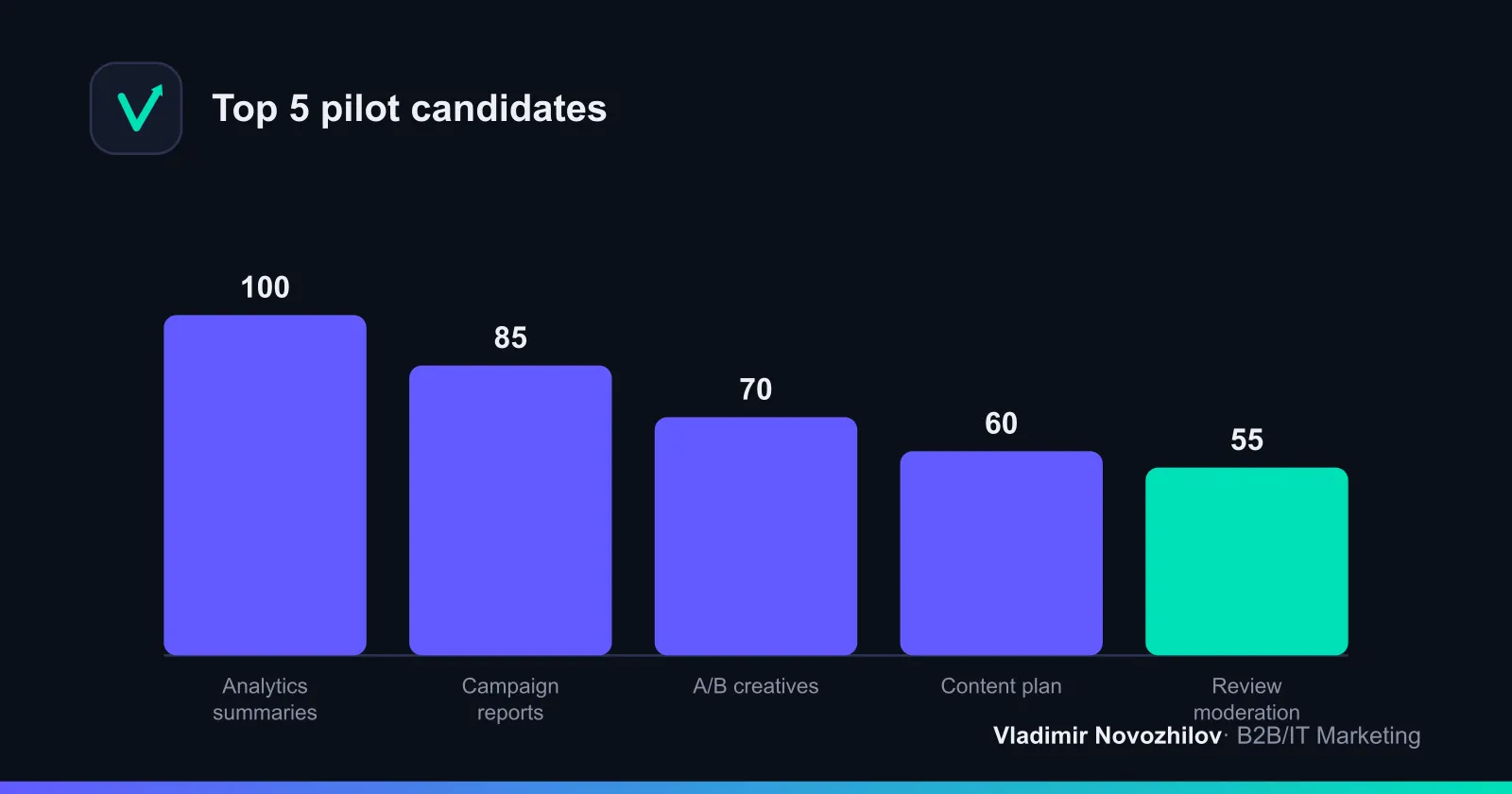
Priority table of processes (example):
| Process | Repeatability / month | Hours / month | Error risk | Expected hours saved | Budget savings, ₽ | Pilot pick |
|---|---|---|---|---|---|---|
| Analytics summary across channels | 16 | 24 | Low | 14 | 0 | Yes |
| Drafts for A/B creatives | 30 | 20 | Medium | 10 | 30 000 | Yes |
| Automation of e‑mail templates | 8 | 12 | Low | 6 | 10 000 | Yes |
| FAQ bot for leads | 4 | 10 | Medium | 5 | 0 | No (next) |
| Public PR comments | 2 | 6 | High | 0 | 0 | No |
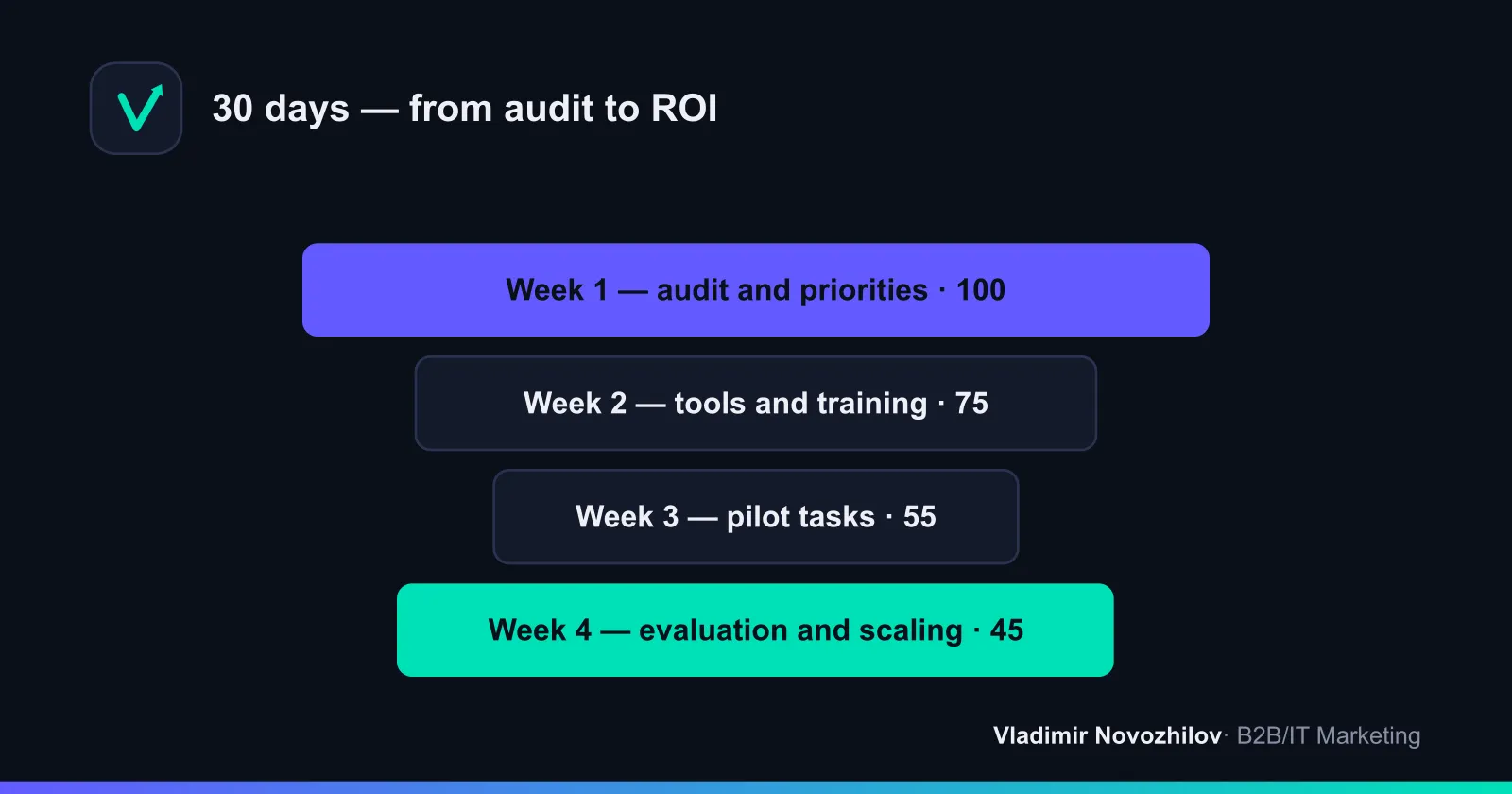
30‑day pilot plan (weeks 1–4)
Week 1 — audit and priorities
- Map processes: inputs/outputs, owners, frequency, hours, metrics.
- Select 1–3 tasks based on the matrix above.
- Define the baseline, create a pilot table (see checklist below).
Week 2 — tools and training
- Choose tools for the tasks: YandexGPT/ChatGPT/Claude for text; Kandinsky/Midjourney for creatives; spreadsheet assistants for reports; Perplexity for research.
- Set up accesses, prompt frameworks, quality control.
- Run a 4‑hour master class for the team (program below).
Week 3 — pilot
- Run in parallel: the person does the task as before + the AI version. Compare results.
- Record time, quality, performance metrics (CTR/CPL/conversion).
Week 4 — evaluation and scaling
- Calculate ROI: hours saved + impact on results − costs.
- Decide what goes into steady operations, what to refine, what to postpone. Update procedures.
Pilot launch checklist (fill before start):
| Field | What to enter |
|---|---|
| Pilot goal | Example: reduce report time by 50% and increase CTR of test banners by 20% |
| Task list | 1) Analytics summaries; 2) A/B creatives; 3) E‑mail templates |
| Baseline | Time per report — 180 min; Banner CTR — 0.9%; CPL — 2 400 ₽ |
| Metrics | Hours / task; CTR; CPL; % errors; time to test |
| Timeline | 30 days, with weekly checkpoints |
| Owner (AI champion) | Full name and role, 20% time |
| Roles/responsibilities | Author → Editor → Quality verifier |
| Tools | YandexGPT, Kandinsky, spreadsheet assistant, Perplexity |
| Acceptance criteria | Savings ≥30% hours; CTR +20% on test group; no critical errors |
90‑day roadmap and roles
Month 1 — pilot (see above). Month 2 — scale: move into regulations, train the “second wave”, onboard 2–3 new processes. Month 3 — integrations and standards: edits to content guides, prompt library, quality monitoring.
Example simplified RACI matrix:
| Process | Responsible (R) | Approves (A) | Consulted (C) | Informed (I) |
|---|---|---|---|---|
| Analytics summary | Analyst | Head of Marketing | AI champion | Team |
| A/B creatives | Designer | Head of Performance | Copywriter | Team |
| Content plan | Content lead | Head of Marketing | Product / Sales | Team |
Checklists and templates
AI strategy template (copy as document structure):
- 90‑day goals: metrics (CPL, CTR, conversion, hours, ROI).
- List of candidate processes + priority matrix.
- Tools and fallbacks (alternatives in case of blockages).
- Quality control and roles: guides, checklists, responsible people.
- Legal boundaries: Federal Law 152, data policy, what not to upload.
- Training plan: program, KPI, schedule.
- Metrics and reporting: dashboard, frequency, ownership.
Process audit table (fill once, update quarterly):
| Process | Owner | Frequency | Hours / cycle | Inputs/outputs | Cost of error | Potential savings |
|---|---|---|---|---|---|---|
| … | … | … | … | … | L/M/H | Time/budget |
Team prompt library (structure and 15 ready prompts)
Library structure:
- 01_Research (JTBD, content audit, segmentation)
- 02_Content (landing pages, posts, e‑mail, lead magnets)
- 03_Creatives (banners, video scripts, variations)
- 04_Analytics (summaries, Performance Max briefs, data QA)
- 05_QA and tone (brand voice, fact‑check, checklists)
Ready prompts (adapt to your brand and audience):
- Research — JTBD mapping: “You are a product researcher. From reviews and dialogues, identify 5–7 JTBD segments for [product/market], indicate triggers, barriers, success criteria. Return as a table.”
- Content matrix from JTBD: “Based on JTBD segments, build a content matrix: funnel stage, topic, format, KPI, key objections.”
- Brand tone: “Analyze sample brand texts [insert examples] and create a voice guide: vocabulary, taboos, examples ‘do/don’t’. Confirm the rules with a checklist.”
- Lead landing (draft): “Create a first draft landing for [offer] for audience [JTBD], blocks: value, pains, cases, CTA. Style — [tone].”
- E‑mail nurture series: “Create a 3‑email nurture series for segment [JTBD], objectives: [goal], metrics: OR/CTR/conversion, topics and draft emails.”
- A/B headlines: “Generate 20 headlines for a banner/ad for [offer], limit [characters], three USP variations, 3 emotional levels.”
- Banner brief for creative: “Create a designer brief: key visual, theses, variations, callouts, test plan for 4 creatives.”
- 30s video script: “Write a script in hook‑pain‑promise‑proof‑CTA structure for [offer]. 2 variants with different dramaturgy.”
- Content repackaging: “Reformat the article [topic] into 10 short social posts with CTA and hashtags. Preserve facts and numbers.”
- Analytics summary: “Compile a weekly summary: budgets, impressions, CTR, conversions, CPL by channel. Identify 3 insights and 3 actions.”
- Brief for Performance Max: “Based on current leads and USP create a brief: audiences, signals, target URLs, creative messages, geo, KPI.”
- Fact‑check: “Cross‑check the text against domain expertise sources [list], mark contentious places, propose corrections.”
- Q&A for sales: “Prepare answers to 20 frequent client objections about [product], style concise, with examples.”
- Local SEO/maps: “Create a checklist to improve map listings (photos, categories, sections, reply to reviews) for [city/niche].”
- Phone script: “Write a short qualification call script for leads from the form, 5 questions, fit scoring, transition to demo.”
Tools: selection by task (Russia + international)
Text/analytics:
- YandexGPT (Russian market), ChatGPT, Claude. Research:
- Perplexity, spreadsheet assistants and vector searches over your own base. Images/video:
- Kandinsky, Midjourney; subtitle/script generators. Advertising and performance:
- Assistants for briefs and structuring feeds, signals for Performance Max. Local integrations:
- Yandex.Maps and 2GIS: update listings, reply to reviews; path templates for 2GIS — ” /{city}/firm/{id}”, for Yandex.Maps — ” /org/{slug}/{id}” (use admin panels and APIs when you have rights).
Keep backup services in case primaries are unavailable (alternatives for each tool class).
Team training: 4‑hour master class and KPIs
4‑hour program:
- Hour 1 — principles and demos: where AI helps, ROI examples, mistakes.
- Hour 2 — practice on your tasks: analytics summary, creative drafts.
- Hour 3 — brand voice and QA: quality checklists, tone, fact‑check.
- Hour 4 — prompt practice: build your library, naming rules, version 1.0.
Training KPIs: 100% of participants submit 2 working prompts and complete 1 task 30%+ faster than baseline; run a retro session after the week.
Quality control: what to check before publishing
QA checklist for AI content:
- Facts: verified with domain expertise.
- Conformity to brand tone and terminology.
- Clear offer and next step (CTA).
- Legal risks and promises excluded.
- Grammar, uniqueness, no confidential data.
- A/B plan: what and where to measure, the winner criterion.
Metrics and reporting: how to link to P&L
Build measurement on three layers:
- Cost savings: hours × rate (multiply across processes).
- Marketing effectiveness: CTR, CPL, CPA, conversion to SQL/deal.
- Revenue: incremental leads/deals × average check × margin.
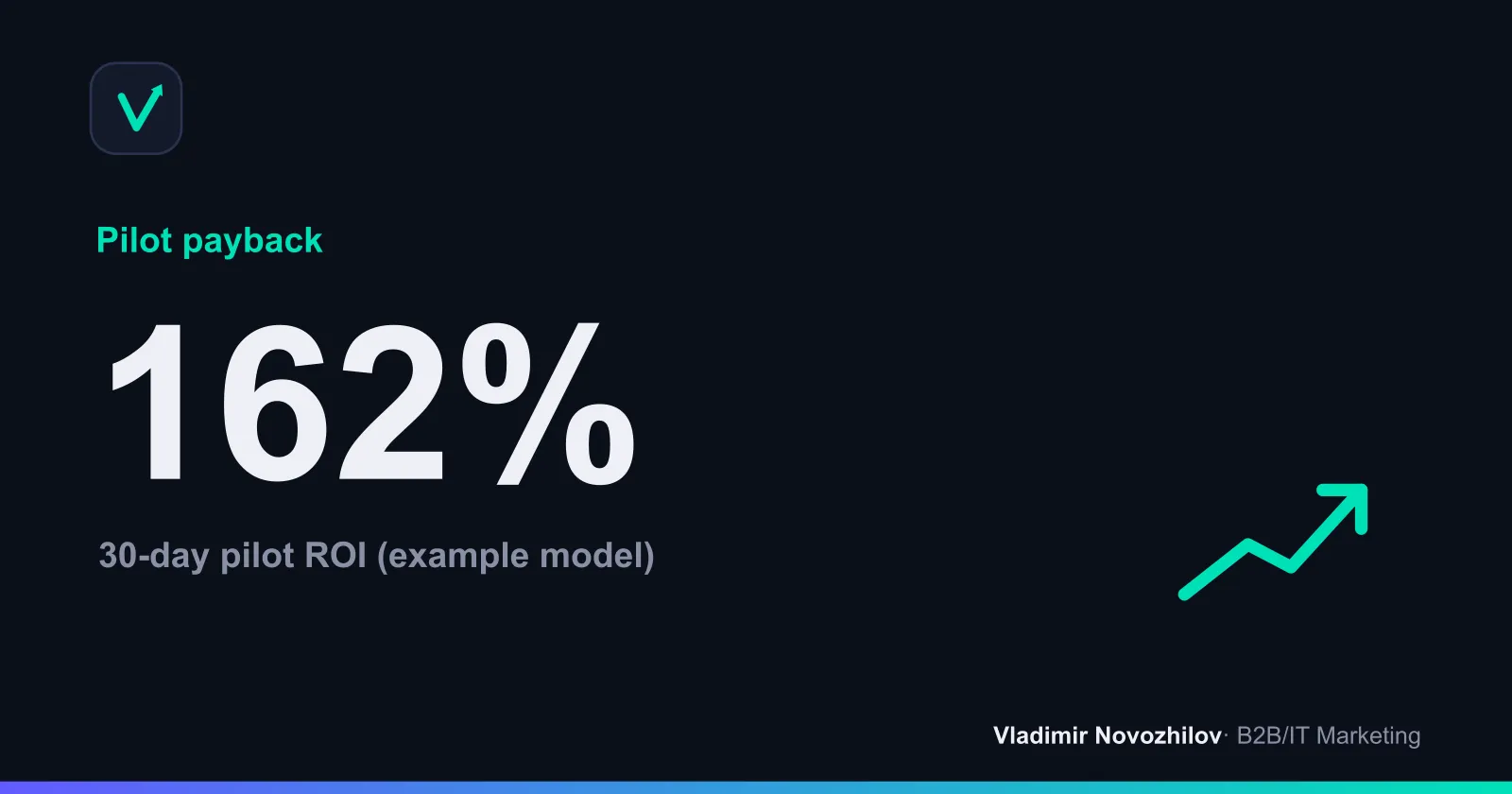
ROI formula for AI: ROI = (Hours saved in ₽ + Incremental revenue − Costs for tools and training) / Costs.
Example calculation (pilot, 30 days):
| Indicator | Value |
|---|---|
| Hours saved | 42 hours × 1 200 ₽ = 50 400 ₽ |
| Incremental revenue | +7 leads × 20 000 ₽ margin/lead = 140 000 ₽ |
| Costs | Tools 12 000 ₽ + training 8 000 ₽ = 20 000 ₽ |
| ROI | (50 400 + 140 000 − 20 000) / 20 000 = 8.53 = 853% |
Tie changes to P&L lines: revenue (incremental sales), marketing expenses (tools, contractors), operating expenses (team time). Update a short weekly report: goal → actions → metrics → decisions.
Legal and data security
For Russia: Federal Law 152 “On Personal Data” is the baseline. Practical rules:
- Do not upload PII (full name, e‑mail, phones, payment data) to public models.
- Use anonymization/pseudonymization and private/corporate versions where needed.
- Separate accesses: prompts and content — for the whole team; raw client data — only for responsible persons.
- Internal regulations: allowed/prohibited actions, data class by criticality, incident log.
- Follow cybersecurity practices and NIST recommendations.
Content matrix with AI based on JTBD
Example mini‑matrix:
| JTBD segment | Funnel stage | Format | KPI | Prompt skeleton |
|---|---|---|---|---|
| ”Reduce lead cost in B2B” | Consideration | Article/guide | CPL, conversion to demo | ”Create a guide with 5 tactics to reduce CPL for [niche]…" |
| "Quickly test an offer” | Awareness | Banners/video | CTR, time to test | ”Generate 10 creatives using hook‑pain‑proof structure…" |
| "Convince the board” | Decision | Presentation/case | Win‑rate, revenue | ”Compile a 10‑slide case with before/after numbers…” |
Examples and cases: before/after figures
Case 1 (B2B services): reports and A/B creatives
- Before: weekly report — 180 minutes; banner CTR — 0.9%; CPL — 2 400 ₽.
- After 30 days: report — 70 minutes (−61% time), CTR — 1.3% (+44%), CPL — 2 050 ₽ (−15%).
- Economics: 14 hours/month × 1 200 ₽ = 16 800 ₽ saved + 6 extra leads → margin 120 000 ₽; tools 18 000 ₽; ROI ≈ 614%.
Case 2 (IT product in regions): local marketing and maps
- Before: replies to reviews — 72 hours/month, NPS 43.
- After: auto‑reply templates + tone prioritization; 34 hours/month (−53%), NPS 51; 2GIS/Yandex.Maps listings unified (categories, photos, Q&A).
- Economics: 38 hours × 900 ₽ = 34 200 ₽ saved; organic growth +12%. Costs 10 000 ₽; ROI ~ 242%.
Case 3 (leadgen): e‑mail nurture and scripts
- Before: open rate 20%, CTR 1.8%, 4 demos/week.
- After: subject personalization + JTBD narratives; OR 28% (+40%), CTR 2.5% (+39%), 6 demos/week. Hours saved 10 hours/month.
Integrations with local tools: practical notes
- Yandex.Maps and 2GIS: create a listing template (categories, descriptions, attributes, photos), reply regulation and SLA. Path templates for listings: 2GIS — ” /{city}/firm/{id}”, Yandex.Maps — ” /org/{slug}/{id}”. For mass edits use admin panels and official APIs if you have permissions.
- Reviews: monitor tone, train AI to detect criticality and send “red” cases to responsible people.
- Spreadsheet summaries: export from ad accounts, give the AI assistant the field schema and a sample summary, then lock the format.
Common mistakes when implementing AI in marketing
- “Give everyone AI” without goals and metrics — effort dispersion.
- No AI champion and no changes to procedures — effect dissipates.
- Immediately touching high‑cost error zones — team resistance and rollback.
- No P&L accounting — “pretty” metrics without ruble impact.
”90‑day plan” in one paragraph
30 days — pilot and core processes. 60 days — scale and procedures. 90 days — integrations, prompt library, QA procedures, P&L‑level reporting. After that — quarterly priority review and tool updates.
”Templates to keep”: what to store internally
- Priority table (from the section above) — file “AI‑Priorities”.
- Pilot checklist — file “AI‑Pilot‑Checklist”.
- ROI calculator — file “AI‑ROI‑Month1” with ROI formula and input fields.
- Prompt library — folder with sections 01–05, version 1.0.
- AI strategy — document following the structure from “Checklists and templates”.
P.S. According to McKinsey benchmarks and team practice, 30–60% time savings on routine tasks is achievable in the first month with disciplined measurement and clear roles.
FAQ
- Will AI replace marketers and which people should fear being fired?
- AI does not replace strategists or those who understand JTBD, segmentation and the product. People at risk are those limited to manual, repeatable tasks without business understanding. Improve skills: task formulation for AI, quality control, analytics and P&L thinking.
- Which task is best to start an AI pilot in marketing with?
- Choose a process with high repeatability, 10+ hours per month, low cost of error and clear metrics (for example, reports, analytics summaries, quick creative drafts). Use the prioritization checklist and the risk/gain matrix from the article.
- How much time and resources are needed for the pilot and team training?
- 30 days is sufficient: 1 week — audit, 1 week — tools and training (4 hours), 1 week — pilot, 1 week — evaluation and scaling. Needed: an AI champion (owner), 3–5 hours of manager time per week, data access and 1–2 chosen tools.
- How to measure the effect of AI implementation and link changes to the P&L?
- Count three blocks: hours saved (translate into currency), efficiency improvements (CTR, CPL, conversion) and incremental revenue. Use the formula ROI = (savings + incremental revenue − costs) / costs. Tie changes to P&L lines: revenue, COGS, marketing expenses.
- Can client personal data be uploaded to public neural networks?
- Without consent and contractual guarantees — no. For Russia, Federal Law 152 applies. Do not upload PII (full names, phones, e‑mails, payment details) to public models. Use local/corporate solutions or anonymization when working with data.