B2B Lead Generation Channels: Where to Get Leads

TL;DR
B2B lead generation channels are ways to get targeted inquiries: PPC and paid social, SEO and content marketing, email and partner newsletters, referrals, trade shows, and lead marketplaces. No single channel works alone — you need a system. This article compares channels by CPL, conversion, and risk, provides a lead cost formula, breaks down MQL and SQL, and offers a checklist for choosing channels to fit your niche and budget.
Short answer: several B2B lead generation channels work best in tandem — PPC and SEO provide a predictable flow, content marketing and email warm up the audience, and referrals and trade shows deliver the highest-quality inquiries. No single lead source can carry the whole job on its own: where to get leads is a question of building a system, not finding one magic channel. Below we break down all the customer acquisition channels, compare them by lead cost and conversion, and provide a checklist for choosing the right ones for your niche.
What lead generation is and why B2B works differently
Lead generation is the process of attracting potential customers (leads) and turning them into inquiries that the sales team can work with. A lead is a contact from a person or company that has shown interest: submitted a form, downloaded a resource, messaged in chat, or visited a booth.
In B2C the chain is short: see an ad — buy. In B2B it’s different, and that changes the approach to channels:
- Long sales cycle. It can take anywhere from several weeks to a year from first contact to signed contract. A lead doesn’t buy right away — it needs to be nurtured.
- Multiple decision-makers. A deal involves a procurement specialist, a technical expert, a finance person, and an executive. One lead is an entry point into an entire group.
- High average deal size. A mistake in channel choice is costly, but a single client can pay for dozens of inquiries.
- Rational decision-making. Decisions are driven by calculation, not emotion: ROI, timelines, risks. That means content and expertise matter more than flashy creatives.
So B2B lead generation isn’t about “pouring budget into ads” — it’s about building a funnel where every lead source is evaluated by its contribution to the final deal, not by the number of inquiries it generates.
Targeted vs. off-target leads: how to tell them apart in B2B
Before comparing channels, you need to agree on what counts as a good lead. Let’s look at targeted and off-target leads.
A targeted lead is a contact that matches your customer profile: has a need, budget, authority, and a business scale that fits. An off-target lead is an inquiry that’s simply not a match: a student gathering data for a thesis, a micro-business with no budget, or a region you don’t serve.
By temperature, leads fall into three types:
- Cold lead — doesn’t know about you yet and hasn’t recognized the need. Typical for outbound and cold databases.
- Warm lead — interested in the topic, researching solutions, comparing options. Comes from content and SEO.
- Hot lead — ready to discuss a deal right now. Comes from commercial PPC queries and referrals.
The biggest mistake beginners make is chasing quantity while ignoring quality. In B2B, 100 off-target leads are worse than 10 targeted ones: they overload sales reps and skew the stats. That’s why, going forward, we’ll compare channels not just by cost but by conversion into qualified leads.
Lead sources: where B2B inquiries come from
It’s useful to sort all lead sources by traffic type — this classification helps you avoid missing entire categories of opportunity.
- Inbound marketing. The customer finds you: SEO, content marketing, lead magnets, organic social. Leads are warmer, but volume grows slowly.
- Outbound marketing. You reach out to the customer first: cold emails, calls, LinkedIn/Telegram outreach, database purchases. Fast start, but leads are cold.
- Paid traffic. PPC and paid social, Telegram Ads, display, lead marketplaces. Predictable and scalable, but requires budget.
- Viral and partner sources. Referrals, referral programs, cross-promotion, joint webinars. The cheapest and highest-quality leads, but hard to scale by team effort.
Next we’ll look at paid lead generation channels and free lead sources separately, then bring it all together in a comparison table.
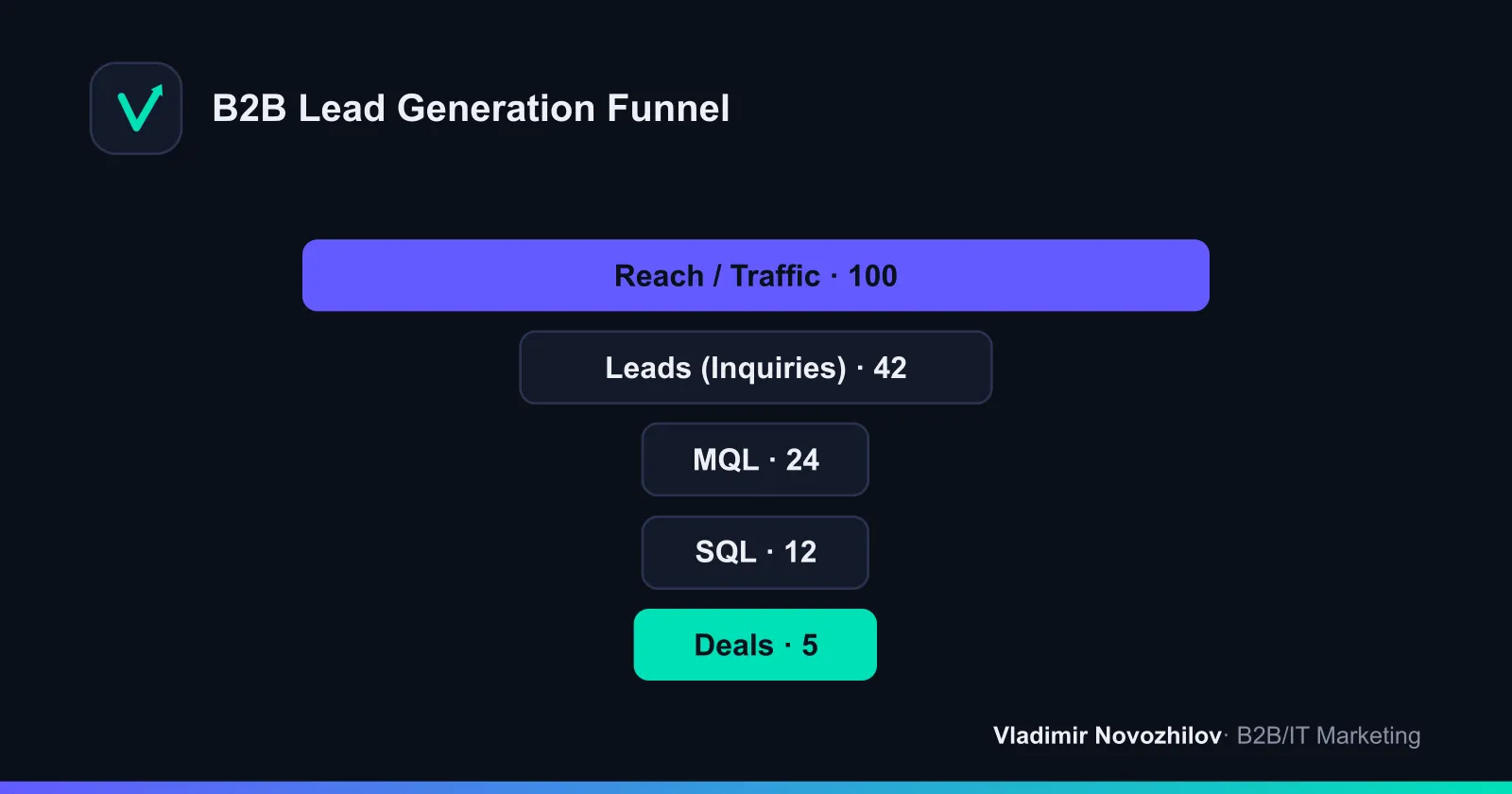
Paid B2B lead generation channels
Paid lead generation channels deliver a predictable flow of inquiries as early as the first month — the tradeoff is money rather than just time. Let’s look at the main tools in this group.
Paid search / PPC
Paid search (Yandex search and display network) is the workhorse of B2B. The user is already looking for a solution — you show up on a commercial query. Leads are hot, but clicks on narrow B2B queries are expensive.
What matters in B2B: segment campaigns by stage of demand, send traffic to landing pages built around a specific pain point, and filter out informational queries and individual consumers with negative keywords. As a real-world benchmark: PPC lead cost (CPL) in industrial B2B is usually 3–5 times higher than in services, but conversion into SQL is also higher.
Mini case study. An industrial equipment manufacturer split one generic campaign into 6 narrow campaigns by equipment type and added qualifying questions to the form. CPL rose by 20%, but the share of SQLs climbed from 18% to 34% — the cost per deal ultimately dropped.
Paid social and Telegram Ads
Paid social on VKontakte and Telegram Ads let you target by job title, industry, and interests. In B2B, it performs worse for direct sales but works well for building an audience for a lead magnet, channel subscriptions, or webinar registrations.
In 2025–2026, Telegram Ads has become a notable B2B customer acquisition channel: placements in niche industry channels reach a warm audience of decision-makers. Aim not for an instant inquiry but for nurturing through content.
Lead marketplaces and database purchases
A lead marketplace sells ready-made inquiries in your niche. The upside is a fast start with no ad setup required. The downsides are significant: the same inquiry is often sold to several companies simultaneously, contacts can be off-target or outdated, and there are ad-fraud and manipulation risks.
For B2B, test ready-made databases and marketplaces cautiously: start with a small volume, strictly track conversion into SQL, and calculate lead cost including rejects. Validated outbound targeting a narrow segment often turns out cheaper than mass purchases.
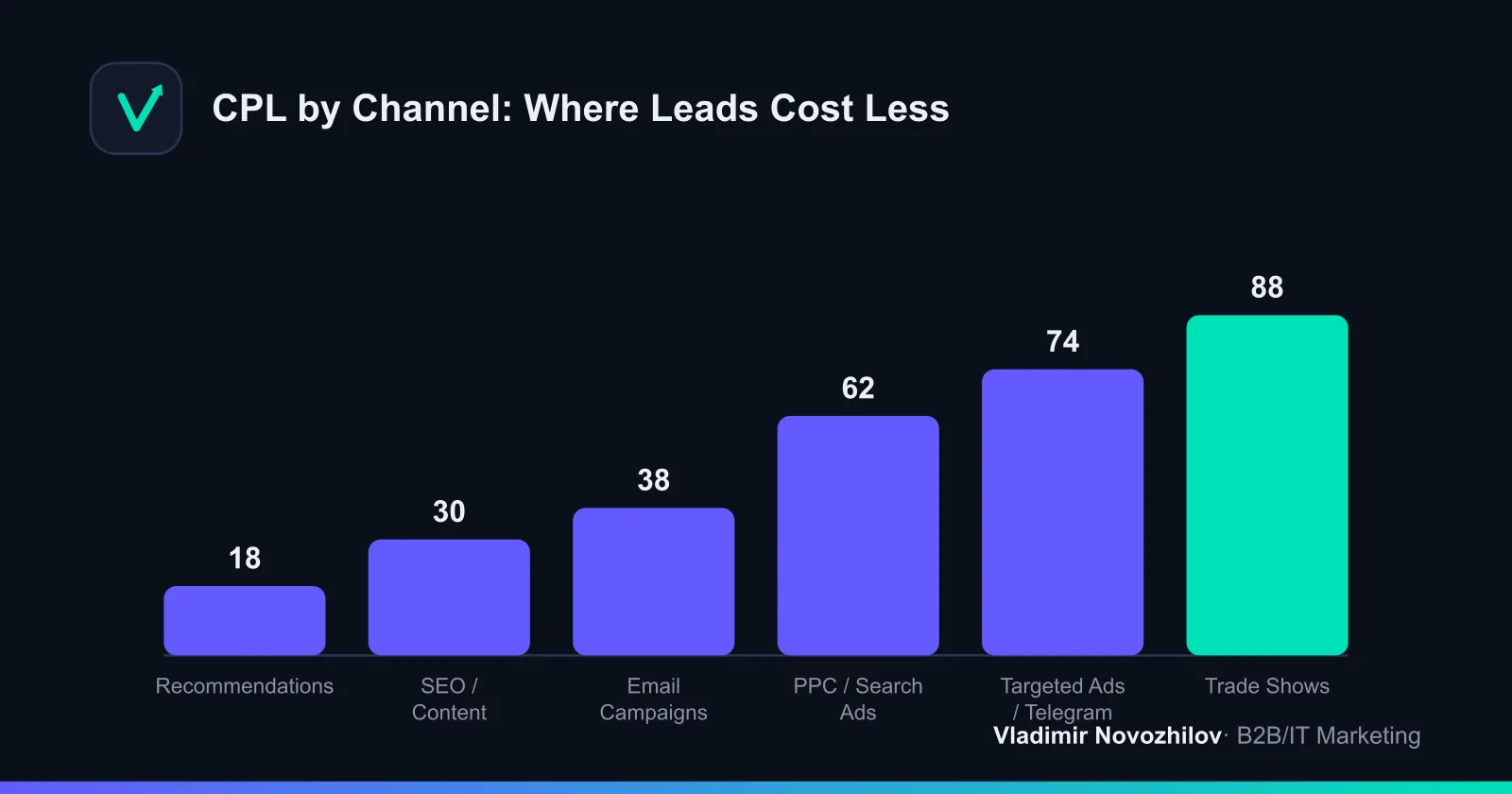
Free B2B lead sources
Free lead sources don’t require direct ad spend, but they do require time, expertise, and patience. Their strength lies in compounding returns and lead quality.
SEO and organic traffic
SEO is the foundation of long-term lead generation. Articles targeting commercial and informational queries bring in warm leads for months and years after publication. In B2B, expert breakdowns, solution comparisons, and industry guides work especially well.
The downside is inertia: the first inquiries arrive after 3–6 months. But as traffic grows, lead cost trends toward a minimum, and organic traffic doesn’t switch off when the budget runs out.
Content marketing and lead magnets
Content marketing is a way to demonstrate expertise and collect contacts through a lead magnet: a calculation template, checklist, white paper, webinar, or industry research report. In B2B, a lead magnet should solve a specific work problem for the decision-maker, not act as a “discount.”
Mini case study. An IT integrator launched an infrastructure savings calculator and gated the results behind a form. Over one quarter, it generated 340 inquiries with almost no ad spend, and a 22% conversion into SQL.
Email and partner newsletters
Email marketing in B2B isn’t spam — it’s nurturing your database with content and email sequences. Partner newsletters (sent through the database of a non-competing company with the same audience) give you access to someone else’s loyal audience. They work well for reactivating old leads and for upselling.
Referrals and referral programs
Referrals are the highest-quality lead source in B2B: trust has already been transferred along with the recommendation. A referral program formalizes this flow: a partner or client is rewarded for a deal they brought in. CPL here is minimal, and conversion into a deal is the highest of any channel — but the channel is hard to scale.
Offline and event marketing: trade shows, conferences
Event marketing — trade shows, industry conferences, roundtables — remains a powerful B2B channel. Face-to-face contact with decision-makers shortens the sales cycle. Lead cost is high (booth rental, travel), but lead quality and status are on par with referrals. Giving an expert talk is often more effective than staffing a booth.
Customer acquisition channels: a comparison table by CPL, deal cycle, and conversion
Let’s bring all the B2B acquisition channels together in one table. The figures are approximate — actual numbers depend on the niche, but the proportions hold. The last column shows what to track in your CRM for an honest evaluation.
| Channel | Traffic type | CPL (relative) | Conversion into SQL | Launch speed | Risk | What to track in CRM |
|---|---|---|---|---|---|---|
| Paid search / PPC | Paid | Medium–high | Medium–high | Fast | Budget wasted on informational queries | Query, campaign, lead cost |
| Paid social / Telegram Ads | Paid | Medium | Low–medium | Fast | Off-target reach | Ad, segment, lead magnet |
| Lead marketplaces / database purchases | Paid | Medium | Low | Very fast | Off-target leads, duplicates, ad fraud | Source, rejection reason |
| SEO / organic | Free | Low | Medium–high | Slow (3–6 months) | Inertia, algorithm dependency | Landing page, query |
| Content + lead magnet | Free | Low | Medium | Medium | Requires expertise | Which lead magnet converted |
| Email / partner newsletters | Free | Low | Medium | Medium | Database fatigue | Segment, email sequence |
| Referrals | Viral | Very low | Very high | Slow | Hard to scale | Who referred them |
| Trade shows / events | Offline | High | High | Tied to event dates | Expensive, one-off | Event, decision-maker contact |
Takeaway from the table: cheap leads don’t mean the best leads. Referrals deliver the lowest CPL but limited volume; PPC scales but costs more; trade shows are expensive but warm leads quickly. The right strategy is a portfolio of 3–4 channels with different traffic types.
How to assess lead quality: MQL, SQL, BANT
To compare channel effectiveness honestly, counting inquiries isn’t enough — you need lead qualification. Let’s break down the key concepts: MQL and SQL.
- MQL (Marketing Qualified Lead) — a lead marketing has deemed a good fit by profile: right industry, company size, demonstrated interest. It’s not yet ready to buy.
- SQL (Sales Qualified Lead) — a lead sales has confirmed as deal-ready: there’s a real need, budget, and timeline.
The BANT framework is used to move a lead to SQL status:
- Budget — is there budget for the solution;
- Authority — are we talking to the decision-maker;
- Need — is there a real need;
- Timeline — is there a defined timeframe.
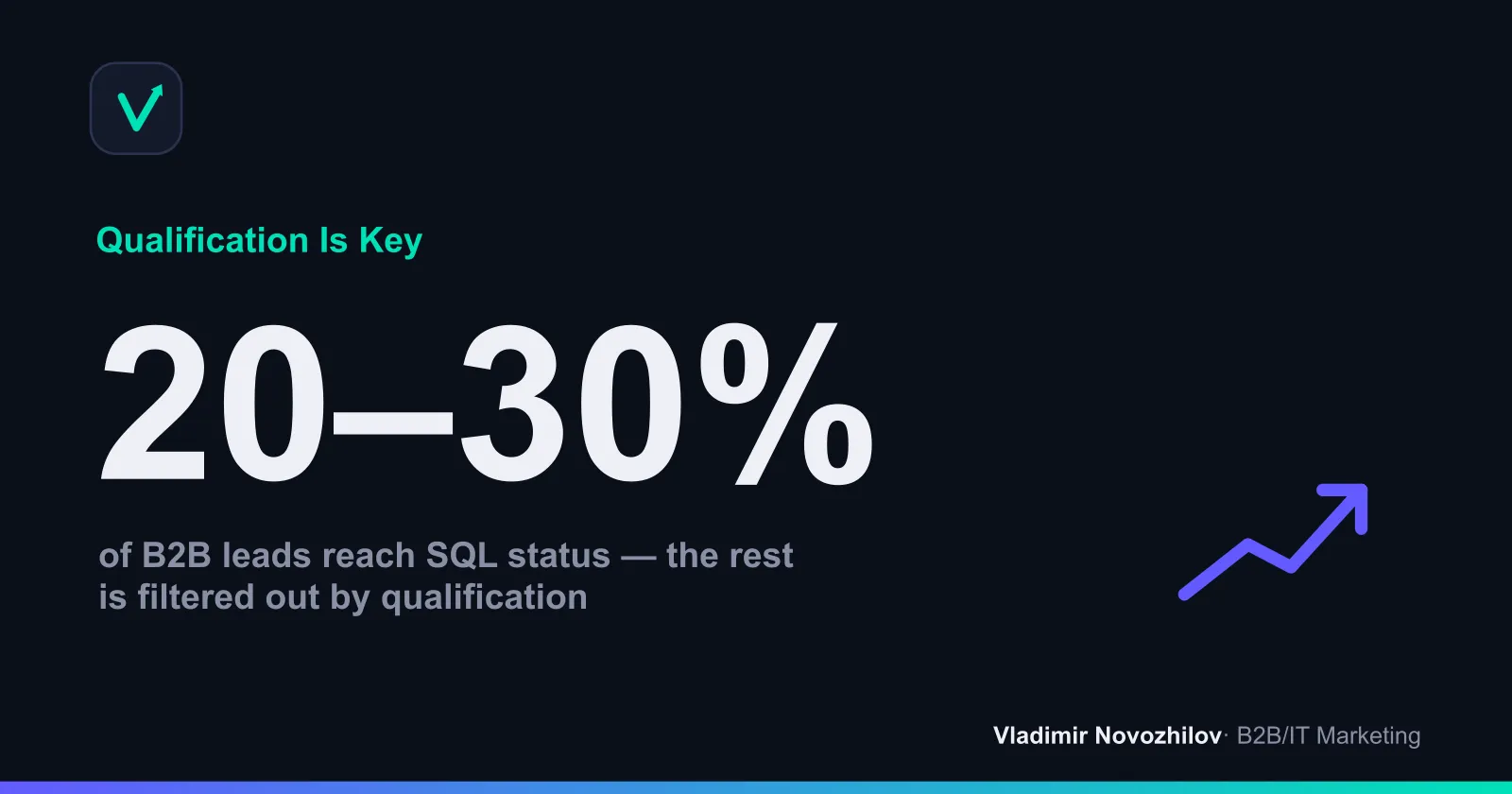
In an average B2B project, only 20–30% of inquiries reach SQL status — qualification filters out the rest. That’s why a channel delivering 200 cheap inquiries with a 5% conversion into SQL is worse than a channel with 100 inquiries and a 25% conversion.
How to calculate lead cost and channel payback
The basic metric is cost per lead (CPL).
CPL formula: CPL = Channel spend ÷ Number of leads.
But in B2B that’s not enough — you also need to calculate the cost of a qualified lead and overall payback.
- SQL cost = Spend ÷ Number of SQLs.
- CAC (customer acquisition cost) = Spend ÷ Number of deals.
- Channel ROI = (Profit from deals − Spend) ÷ Spend × 100%.
Sample calculation. PPC: spent 150,000 rubles, got 100 leads, 30 became MQLs, 12 became SQLs, and 3 turned into deals with an average profit of 120,000 rubles each.
- CPL = 150,000 ÷ 100 = 1,500 rubles;
- SQL cost = 150,000 ÷ 12 = 12,500 rubles;
- CAC = 150,000 ÷ 3 = 50,000 rubles;
- Profit = 3 × 120,000 = 360,000 rubles;
- ROI = (360,000 − 150,000) ÷ 150,000 × 100% = 140%.
A channel with a CPL of 1,500 rubles and a 140% ROI is clearly paying off. Always look at the whole chain: low CPL with zero conversion into deals is a loss, not a success.
Common mistakes in B2B lead generation
- Chasing inquiry volume instead of SQLs. Cheap off-target leads create an illusion of progress.
- Judging a channel by CPL without factoring in deal conversion. Look at CAC and ROI instead.
- Betting everything on one channel. If the ad account gets suspended or organic traffic drops, the whole flow stops.
- Not tracking lead source in CRM. Without attribution, you can’t tell what’s actually working.
- Forgetting to nurture leads. B2B has a long cycle: without content and email sequences, most leads go cold.
- Not aligning with sales on what counts as a lead. Marketing pushes volume while sales complains about “junk.”
- Ignoring ad fraud and database quality when working with marketplaces and cold databases.
How to choose lead generation channels for your niche and budget: a checklist
Use this checklist to build your own channel portfolio. Go through the steps in order.
- Define your ideal customer profile (ICP): industry, size, decision-maker’s job title, pain point. Without this you can’t distinguish targeted from off-target leads.
- Determine your deal cycle and average deal size. A long cycle requires nurturing and content; a short one can rely on PPC.
- Calculate your acceptable CAC. This sets a ceiling for allowable lead cost across channels.
- Split channels by time horizon. Fast channels (PPC, outbound) for immediate flow + slow channels (SEO, content) for cheaper leads down the road.
- Build a portfolio of 3–4 channels with different traffic types: paid + free + viral.
- Set up CRM attribution: source, campaign, MQL/SQL status, rejection reasons.
- Run a 2–3 month test with a fixed budget per channel.
- Track SQL cost and ROI, not just CPL. Scale what’s profitable, cut what’s not.
- Review the portfolio quarterly — markets and platforms change.
Save this list as a working template: it applies equally well to services, IT, and manufacturing B2B.
In-house or agency: which is better for B2B
The question of whether to build lead generation in-house or outsource it comes down to three criteria: cost, speed, and quality/control.
| Criterion | In-house team | Agency / contractor |
|---|---|---|
| Upfront cost | High (hiring, training, payroll) | Lower, pay per service or per lead (CPL) |
| Launch speed | Slower — team needs to be built | Faster — ready-made expertise |
| Quality and control | Full control, deep product knowledge | Depends on the contractor, requires oversight |
| Channel flexibility | Limited to team’s skill set | Wide toolkit of lead generation methods |
| Niche expertise | Grows over time internally | May lack knowledge of your specific niche |
| Risk | Lower with stable volume | Risk of off-target leads under pay-per-volume models |
Guidelines for choosing:
- In-house makes sense when lead generation is a core skill for you, the niche is narrow and requires deep immersion, and lead volume is stable and predictable.
- An agency makes sense at the start, for quickly testing new channels, and when you need expertise you don’t have internally. If paying per lead, define exactly what counts as a lead and monitor qualification closely.
In practice, mature B2B companies combine both: strategy and analytics stay in-house, while execution of specific channels (like PPC or outbound) goes to a contractor under internal oversight.
Key takeaways
B2B lead generation channels only work in combination. Don’t look for one perfect lead source — build a system instead: combine paid channels for fast flow with free channels for cheaper leads down the line, evaluate every channel by conversion into SQL and ROI rather than by inquiry count, and track everything in CRM. Then the question of where to get leads stops being a chaotic search and becomes a manageable process with predictable customer acquisition cost.
FAQ
- Which lead generation channel is most effective for B2B?
- There's no universal answer: in B2B, a combination of channels works best. Referrals and trade shows usually deliver the highest-quality leads, PPC and SEO provide the most predictable flow, and content marketing and email offer the cheapest reach. Channel effectiveness should be measured not by lead cost but by conversion into SQL and closed deals. Test 2–3 channels in parallel and keep the ones that deliver positive ROI over the deal cycle horizon.
- How much does a B2B lead cost in 2025–2026?
- B2B lead cost (CPL) varies widely depending on the niche and product complexity. As a market benchmark, it ranges from 800–1,500 rubles for a simple PPC inquiry to 15,000–50,000 rubles for a qualified lead in complex industrial and IT niches with long sales cycles. What matters more than absolute CPL is the cost of a qualified lead (SQL) and customer acquisition cost, factoring in funnel conversion.
- Can you generate B2B leads without an advertising budget?
- Yes. Free lead channels include SEO and organic traffic, content marketing, expert publications, referral programs, activity in industry communities, and conference speaking. They don't require direct ad spend but do require time and expertise. Payback comes slower than with paid channels, but the leads are often warmer and cheaper per deal.
- How do you tell if a lead generation channel is bringing in off-target leads?
- Look at the conversion rate from lead to MQL and SQL. If a channel produces many inquiries but sales reps massively disqualify them by BANT criteria (no budget, authority, need, or timeline), that's off-target traffic. Other signals: low call connect rates, short conversations, and mismatch with the target customer profile. Log disqualification reasons in your CRM for each lead source.
- Is it worth buying ready-made lead databases for B2B?
- Buying cold databases and lead marketplace inquiries should be done cautiously. The risks include off-target contacts, outdated data, duplicates, and ad-fraud issues. For B2B, validated outbound targeting a narrow segment usually works better than mass databases. If you're testing a marketplace, start with a small volume, track conversion into SQL, and calculate the real lead cost accounting for rejects.