Competitive Intelligence: Methods, Tools, and Stages

TL;DR
Competitive intelligence is the legal collection and analysis of open information about competitors, markets, and customers to support management decisions. Unlike industrial espionage, it relies only on accessible sources and stays within the law. This article covers goals, types, stages, sources, a tool comparison, case studies, and a checklist.
Competitive intelligence is the systematic, legal collection and analysis of open information about competitors, the market, customers, and suppliers to support management decisions. The key word here is “legal”: intelligence works with what’s already accessible, not with what’s protected as a trade secret. This is precisely what fundamentally distinguishes it from industrial espionage.
In this article, I’ll break down the topic the way I use it myself in marketing and growth projects in B2B, IT, and services: what competitive intelligence is and why business needs it, what types and stages of competitive intelligence exist, what legal sources of information about competitors and competitive intelligence tools are available, where the legal line lies, and how to bring it all together into a working process. There will be comparison tables, case studies, and a checklist.
What competitive intelligence is and why business needs it
Strictly speaking, competitive intelligence is a management process that turns scattered market facts into conclusions suitable for decision-making. It has synonyms that are often used interchangeably: commercial intelligence, business intelligence (in the sense of market intelligence, not the software category), corporate intelligence. Essentially it’s the same thing with different emphases — sometimes closer to marketing, sometimes to security.
Don’t confuse intelligence with ordinary competitive analysis done “once a year for a presentation.” The difference lies in regularity and purpose: analysis describes the picture, while intelligence serves a specific decision — whether to lower prices, whether to enter a niche, how to respond to a competitor’s launch.
Why it’s needed in practice:
- Reduces uncertainty. You make decisions based on facts about competitors’ prices, products, and strategies rather than gut feeling.
- Provides early warning. Intelligence catches weak signals — new job postings, patents, changes in suppliers — before they turn into a threat.
- Finds opportunities. Gaps in competitors’ products, their dissatisfied customers, unoccupied segments — all of these are growth points.
- Speeds up decisions. When data is at hand, the “saw it — understood it — reacted” cycle shrinks significantly.
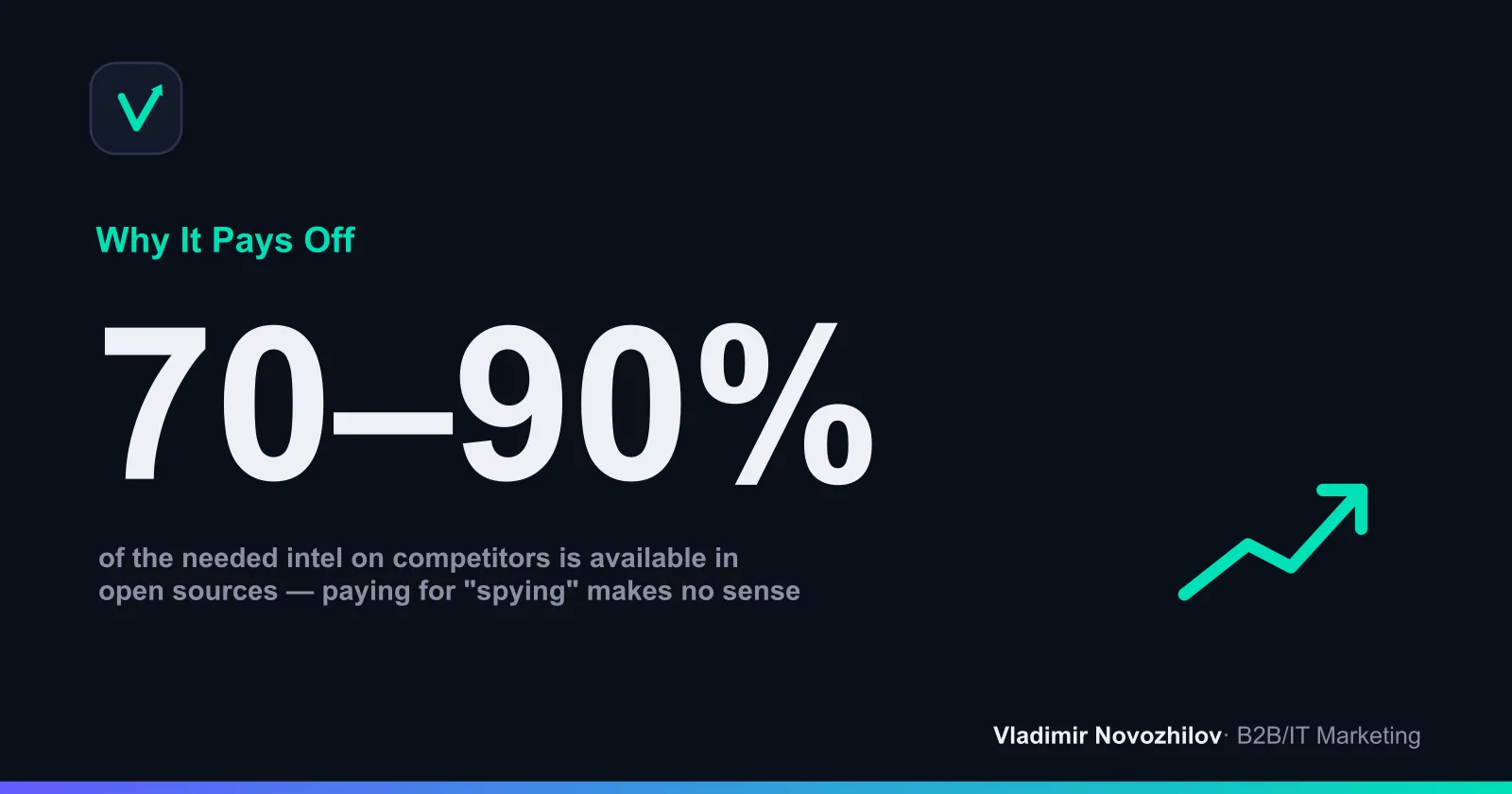
An important principle that saves budgets: the vast majority of needed information is publicly available. In my experience, 70–90% of valuable data about competitors can be gathered legally — through websites, financial reports, publications, and reviews. Chasing “secrets” is expensive, risky, and almost always pointless.
Competitive intelligence vs. industrial espionage: where the line is
This is almost always the first question people ask. The short answer: the line lies in the legality of methods and the type of information. Competitive intelligence collects open data. Industrial espionage illegally obtains what’s protected as a trade secret.
In Russia, several regulations define these boundaries:
- Article 183 of the Russian Criminal Code — “Illegal obtaining and disclosure of information constituting a commercial, tax, or banking secret.” This covers bribery, threats, document theft, and hacking.
- Federal Law 98-FZ “On Trade Secrets” — defines what information a company may protect and what constitutes its illegal acquisition.
- Federal Law 152-FZ “On Personal Data” — restricts the processing of personal data of a competitor’s employees and customers.
A simple rule: if obtaining information requires deceiving, bribing, hacking, or stealing from someone — it’s no longer intelligence, it’s a crime. If the information is publicly available or voluntarily disclosed by the source itself — you’re operating within the law.
Table: legal vs. illegal
| Action | Competitive intelligence (legal) | Industrial espionage (illegal) |
|---|---|---|
| Collecting data from a competitor’s website | Yes, it’s public information | — |
| Analyzing job postings and public employee posts | Yes | — |
| Studying financial statements from public registries | Yes | — |
| Ordering as a “mystery shopper” | Yes, it’s an ordinary purchase | — |
| Bribing an employee for internal data | — | Yes, Article 183 of the Criminal Code |
| Hacking email, CRM, servers | — | Yes, a legal violation |
| Wiretapping, hidden filming in the office | — | Yes |
| Extracting trade secrets through deception | — | Yes |
| Stealing documents and samples | — | Yes |
“The most common mistake is thinking that gray methods provide an advantage. In reality, they create legal and reputational risks disproportionate to the value of the data. 90% of tasks can be handled with open sources if you build a proper process,” is how most economic security specialists I’ve worked with put it.
Goals and objectives of competitive intelligence
The goals of competitive intelligence break down conveniently into four blocks.
1. Identifying market trends. Where demand is heading, which technologies are gaining traction, how target audience behavior is changing.
2. Analyzing competitors and their strategies. Product lineup, competitor pricing policy, promotion channels, positioning, strengths and weaknesses.
3. Discovering opportunities. Unoccupied segments, competitors’ dissatisfied customers, product gaps, partnerships.
4. Assessing risks and threats. New players, aggressive price dumping, regulatory changes, departing suppliers.
The objectives that flow from these goals are equally concrete: gathering information about competitors, assessing their strengths and weaknesses, supporting pricing decisions, helping develop a unique selling proposition, and developing strategies based on the data collected. Good intelligence always ends not with a report but with a decision.
Types of competitive intelligence: tactical, strategic, passive, active
Intelligence is divided by time horizon and by the nature of the actions involved.
Tactical
Answers the question “what to do right now.” Monitoring competitors’ prices, promotions, and new offers. Horizon — days and weeks. Example: a competitor launches a discount — you prepare a response within a day.
Strategic
Operates on a horizon of months and years. Assessing where the market is heading, who might become a new player, which technologies will transform the industry. This is the foundation for strategic planning and decisions about entering new markets.
Passive
Constant background monitoring without a specific immediate task. Configured alerts, regular source reviews. Cheap and creates a “radar.”
Active
Targeted collection for a specific goal: an in-depth study of one competitor before a deal, an analysis of their technology platform, a review of their customers’ feedback. Resource-intensive but precise.
In practice, a mature business intelligence system combines all four types: passive background monitoring + tactical tracking + strategic reviews + active research tied to specific tasks.
Who should handle competitive intelligence in a company
There’s usually no single “owner” of competitive intelligence — and that’s normal. Different departments generate data; the task is to bring it together.
| Department | What it collects and why |
|---|---|
| Marketing | Prices, advertising, positioning, channels, competitors’ USPs |
| Sales | Deal insights: why a competitor was chosen, their arguments and terms |
| Product / R&D | Features, technologies, patents, roadmaps |
| Security | Legal risks, counterparty checks, protection of own trade secrets |
| Analytics / BI | Data processing, dashboards, metrics |
My advice for mid-sized businesses: appoint a competitive intelligence coordinator — someone who consolidates data from departments into a unified picture and is responsible for regularity. Without this role, information gets stuck in people’s heads and gets lost. In large companies, corporate intelligence is often allocated a dedicated function, sometimes at the intersection of marketing and security.
Stages of competitive intelligence: from setting a goal to implementing conclusions
The stages of competitive intelligence form a cycle that repeats. The classic model includes five steps.
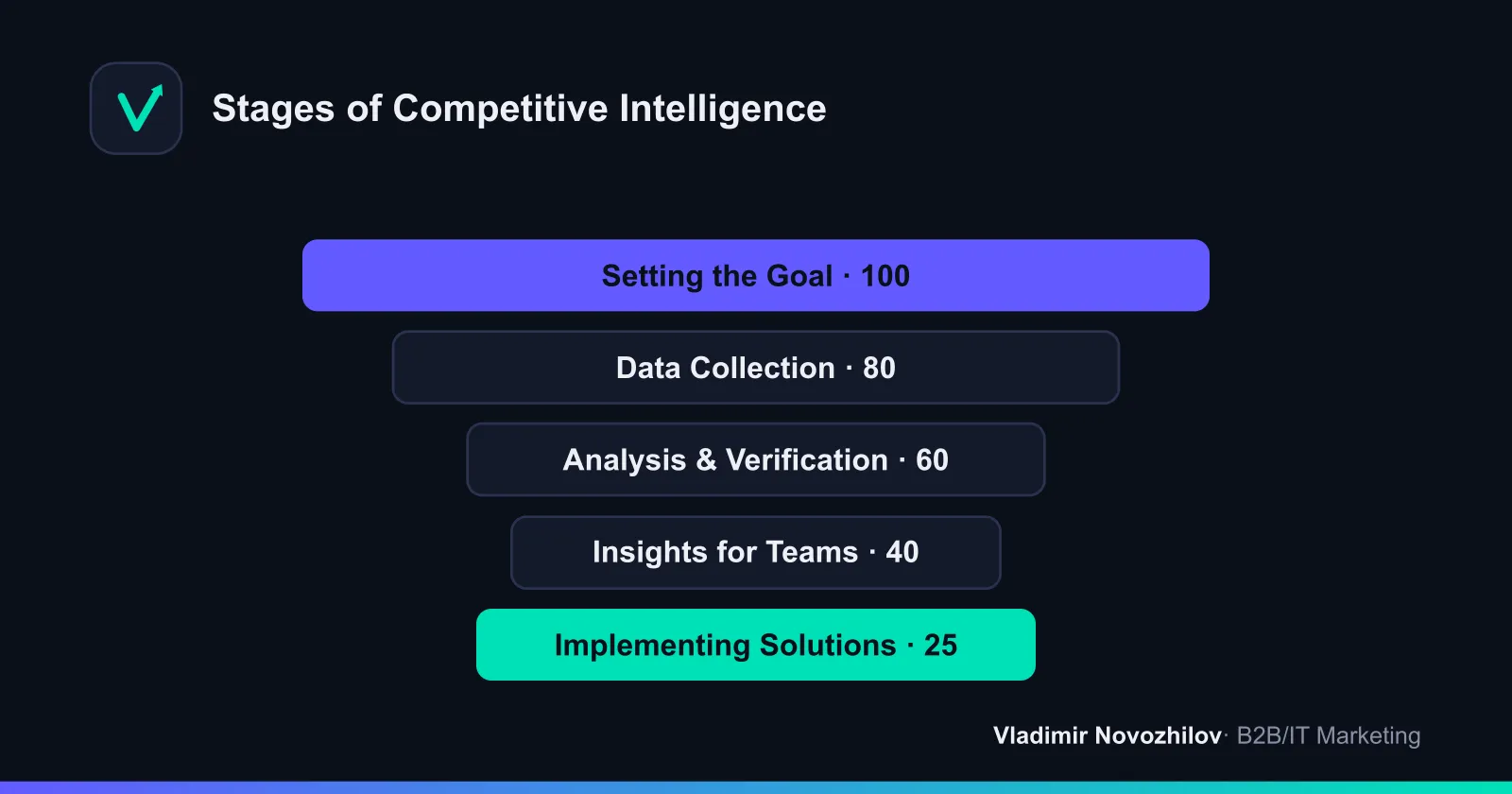
Step 1. Setting a goal. Formulate the question you need an answer to. Not “study the competitor,” but “understand what allows competitor X to win tenders and whether we can offer something better.” A poor goal means useless data.
Step 2. Data collection. Identify sources appropriate to the goal and gather information — a separate section on this follows below. Discipline is key here: record the source and date for every fact.
Step 3. Analysis and verification. Raw data turns into conclusions. This is where SWOT analysis of competitors, criteria-based comparison, and cross-checking facts across multiple sources come into play. One source is a hypothesis; three independent sources are a fact.
Step 4. Communicating to decision-makers. Conclusions need to reach decision-makers in a clear format. Not a 40-page report, but a short summary with recommendations.
Step 5. Implementation and feedback. Decisions are made, results are tracked, and the cycle repeats. Intelligence without implementation is just expensive reading material.
Legal sources and methods for gathering information about competitors
Competitive intelligence methods are traditionally divided into two groups.
Desk research methods — working with existing information without going “into the field”: analyzing websites, financial reports, publications, registries. Cheap and fast, covers most tasks.
Field methods — obtaining new data through direct interaction: surveys, interviews, mystery shopping, participation in industry events. More expensive, but yields what open databases don’t have.
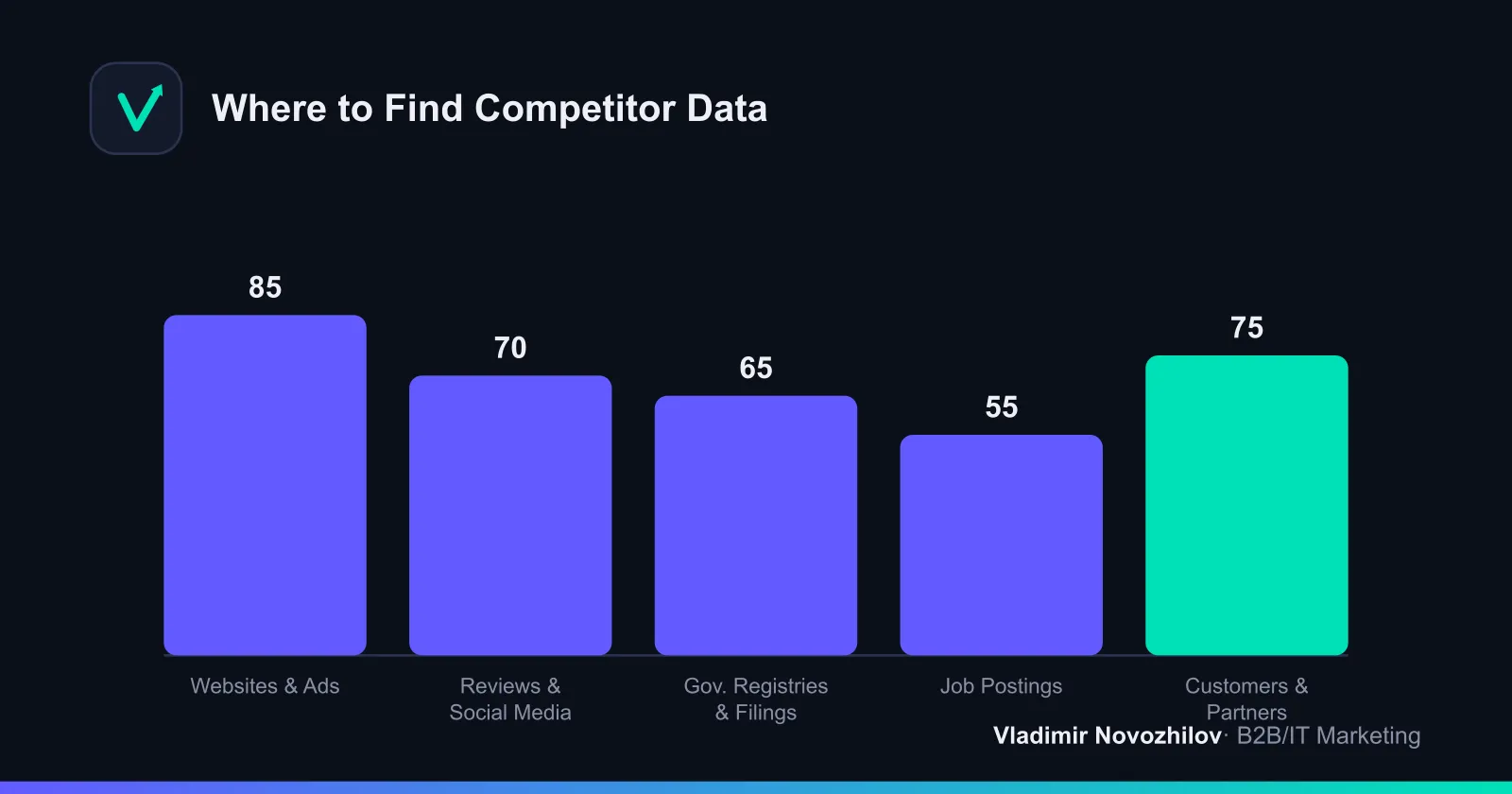
Table of information sources on competitors
| Source | What it provides | How to use it |
|---|---|---|
| Competitor’s website and landing pages | Products, prices, USPs, promotions | Regular monitoring of changes, offer comparison |
| Advertising and search results | Channels, keywords, estimated budgets | SEO/PPC services, manual ad analysis |
| Reviews and social media | Customer pain points, reputation, strengths/weaknesses | Review aggregators, platform search, social media |
| Government registries (business registers, financial statements) | Finances, founders, revenue | Official counterparty verification services |
| Arbitration case databases | Disputes, risks, problematic counterparties | Search by company name |
| Public procurement registries | Contract prices, clients, volumes | Analysis of won tenders |
| Job postings | Technologies, growth plans, salaries, pain points | Monitoring competitor job sites |
| Patents and trademarks | R&D developments and directions | Patent databases |
| Customers and partners | Real-world experience working with the competitor | Market interviews, sales insights |
| Mystery shopping | Service quality, scripts, actual terms | Ordinary purchase/inquiry posing as a customer |
One source deserves special mention because it’s underrated: your own CRM. Reasons for lost deals, arguments used by customers, mentions of competitors in correspondence — this is ready-made intelligence you’ve already paid for. Set up tracking of rejection reasons, and you’ll get a stream of insights at zero additional cost.
Competitive intelligence tools: services, scrapers, analytics
Competitive intelligence tools are conveniently grouped by task type. Below is an overview table of categories (without tying it to specific brands, so it doesn’t go out of date).
| Tool category | What it does | When to use it |
|---|---|---|
| SEO and ad analytics | Shows traffic, keywords, and a competitor’s ads | Assessing a rival’s channels and digital strategy |
| Scrapers | Automatically collect data from websites (prices, products, text) | Large-scale monitoring of assortment and pricing |
| Alert services | Send notifications about new brand/topic mentions | Passive, real-time intelligence |
| Databases and registries | Financials, registration data, court cases, procurement | Counterparty checks, scale assessment |
| Marketplace analytics and bidding tools | Sales, rankings, prices on platforms | E-commerce and product-based niches |
| Social media and review aggregators | Customer sentiment, reputation, pain points | Product and content intelligence |
| BI and dashboards | Consolidate data into a unified picture | Regular reporting and reviews |
| AI tools | Summarization, review clustering, text processing | Speeding up analysis of large datasets |
Automation: how to avoid manual collection
Manual collection is a weak point for many companies. It doesn’t scale and quickly becomes tedious. What gets automated first:
- Price and assortment monitoring — scheduled scrapers, exports to spreadsheets or BI.
- Competitor brand mentions — alert services and social media monitoring.
- Website changes — trackers that record edits to key pages.
- Review processing — AI tools cluster thousands of reviews by topic in minutes.
A big-data-and-automation approach turns intelligence from a fire-drill task into an always-on radar. Start small: a single price scraper and a single alert already deliver noticeable value.
Benchmarking against competitors: comparing yourself to the market
Competitor benchmarking is a method where you compare your own metrics and practices against the best in the market to find gaps and growth areas. If intelligence answers “what are others doing,” benchmarking answers “how much worse or better are we, and what should we do about it.”
How to benchmark step by step:
- Select 3–5 significant competitors and an industry benchmark.
- Define comparison criteria: price, timelines, product range, response speed, guarantees, reach, reviews.
- Collect data for each criterion (this is where intelligence comes in).
- Build a comparison table and highlight where you’re lagging.
- Identify 2–3 priority gaps and a plan to close them.
Example of a simplified comparison matrix:
| Criterion | Us | Competitor A | Competitor B |
|---|---|---|---|
| Average price | Mid-range | High | Low |
| Response time to inquiry | 2 hours | 1 day | 30 minutes |
| Warranty | 1 year | 6 months | 1 year |
| Review rating | 4.6 | 4.2 | 4.8 |
| Promotion channels | 2 | 4 | 3 |
This kind of table immediately shows: we’re losing to Competitor B on response speed, we’re holding the middle ground on price, and we’re underperforming on channels. These are ready-made points for decisions.
Legal risks and impermissible methods
I’ve already drawn the line between intelligence and industrial espionage, but let me repeat the impermissible methods as a separate list — it’s important to know them so you don’t accidentally cross the line:
- Bribing or coercing a competitor’s employees into disclosing trade secrets.
- Gaining access to closed systems, email, or CRM (hacking).
- Wiretapping, hidden filming, trespassing on premises.
- Extracting secrets through deception, posing as a client, partner, or job applicant.
- Illegally collecting and processing employees’ personal data (violation of Federal Law 152-FZ).
- Stealing or copying documents, samples, drawings.
Most of these carry liability under Article 183 of the Criminal Code, and disclosing protected information violates Federal Law 98-FZ. Also keep the reputational risk in mind: even if a “gray” method formally goes unpunished, exposure can cost far more than any deal is worth. My principle is simple: if you’d be embarrassed to describe a method out loud in a meeting, don’t use it.
Examples and case studies of applying competitive intelligence
Here are three generalized case studies from different niches showing how this works in practice.
Case 1. B2B services: revising pricing policy
A service company kept losing tenders and didn’t understand why. Intelligence via the procurement registry revealed the actual prices of contracts won by competitors, while interviews with departed clients (a field method) showed the issue wasn’t price but timelines. Conclusion: don’t dump prices — guarantee delivery times instead. After reworking the offer, tender conversion rose without hurting margin.
Case 2. IT company: reading a competitor’s job postings
Analyzing a rival’s job postings is an underrated method. An IT company noticed that a competitor was hiring heavily for a specific tech stack and roles tied to a new direction. This signaled a product launch months before the official announcement. The company had time to prepare a response and strengthen its own positioning before the competitor entered the market.
Case 3. E-commerce: price monitoring via scrapers
A marketplace seller set up a price scraper for competitors and alerts for promotions. Automated data collection allowed the company to react to price changes within an hour instead of days. In addition, AI-based clustering of competitors’ reviews revealed a frequent complaint about packaging — the company strengthened this in its own USP and saw its rating improve.
The overall takeaway from these cases: value comes not from the volume of data collected, but from the chain “the right question → the right source → a fast decision.”
How to assess the effectiveness of competitive intelligence
This section is often skipped, which is a mistake: without metrics, intelligence turns into a cost item with no clear payoff. Effectiveness can be measured across three groups of indicators.
Process metrics — is the system working:
- Reaction speed to a competitor’s action (from event to decision).
- Regularity of reviews (is the cadence being maintained).
- Share of decisions made based on intelligence data.
Outcome metrics — what changed in the business:
- Change in conversion to deals after adjusting the offer.
- Change in the share of won tenders.
- Margin preserved by avoiding unnecessary price dumping.
- Speed of rolling out response products/promotions.
Data quality metrics:
- Share of conclusions confirmed by multiple sources.
- Number of false signals (unconfirmed predictions).
Simple evaluation logic: if decisions became faster and more accurate after implementing intelligence, and specific sales or margin metrics improved, the system is paying for itself. Tie at least 2–3 business indicators to intelligence work, and the conversation about its value becomes concrete.
Checklist for conducting competitive intelligence
Here’s a step-by-step checklist for conducting competitive intelligence on your own.
Preparation
- Formulated a specific goal-question (not “study,” but “answer the question of…”).
- Identified 3–5 key competitors (direct and indirect).
- Chose comparison criteria appropriate to the goal.
Collection
- Went through desk research sources: websites, advertising, registries, financial reports, court records, procurement data, job postings.
- Collected reviews and sentiment about competitors’ customers.
- Added field data: sales insights, interviews, mystery shopping.
- Checked your own CRM for reasons behind lost deals.
- Set up automation: price scrapers, mention alerts.
Analysis
- Verified key facts against at least two or three sources.
- Conducted SWOT analysis of competitors and criteria-based benchmarking.
- Identified 2–3 main conclusions and opportunities.
Implementation
- Prepared a short summary with recommendations for teams.
- Communicated conclusions to decision-makers.
- Recorded metrics for evaluating results.
- Set the date for the next intelligence cycle.
Legal check
- All methods are legal; no trade secrets were touched.
- Personal data is processed in compliance with Federal Law 152-FZ.
Frequently asked questions about competitive intelligence
Does a small business need competitive intelligence? Yes, and in a lightweight form it’s especially useful: resources are scarce and the cost of mistakes is high. Regular monitoring of prices, reviews, and job postings of a couple of key competitors is enough.
Where to start if you’ve never done this before? With one question and three competitors. Manually gather open data, build a comparison table, make one decision. Then add automation.
Can everything be automated? Collection can be largely automated (scrapers, alerts, AI processing). But setting the goal, verifying facts, and drawing conclusions still require a human. Automation speeds things up but doesn’t replace thinking.
Competitive intelligence isn’t about “spy thrills” — it’s about the discipline of working with open information. Companies that turn scattered market facts into a regular process and fast decisions consistently outpace those acting blindly. Start with one goal, one competitor, and one table — and gradually grow your own business intelligence system from there.
FAQ
- What is competitive intelligence in simple terms?
- It's the systematic collection and analysis of open information about competitors, markets, customers, and suppliers to make more informed decisions. It relies only on legal sources — websites, financial statements, publications, social media, reviews — turning scattered facts into strategic conclusions.
- How does competitive intelligence differ from industrial espionage?
- The line is drawn by the legality of methods. Competitive intelligence uses open sources and stays within the law. Industrial espionage is the unlawful acquisition of trade secrets: bribing employees, hacking, stealing documents, wiretapping. This carries liability under Article 183 of the Russian Criminal Code and violates Federal Law 98-FZ 'On Trade Secrets.'
- What free tools can be used for competitive intelligence?
- Start with free options: search engines and the site: operator, Yandex.Webmaster and free SEO service tiers, business registry extracts and public financial statements, arbitration case databases, procurement registries, social media and review aggregators, and alert services for new mentions of a competitor's brand.
- Who in a company should handle competitive intelligence?
- There's no single owner: marketing handles positioning and pricing, sales gathers market insights, product covers features and technology, and security manages legal risks. It's best to appoint a coordinator who consolidates the data and establishes a regular rhythm of collection and review.
- Is it legal to gather information about competitors through social media and job postings?
- Yes, if it's open, publicly available information. Analyzing job postings, posts, reviews, and websites is legal. Caution is needed with employees' personal data — its processing is regulated by Federal Law 152-FZ. You cannot extract trade secrets through deception, bribe employees, or gain access to closed systems.
- How often should competitive intelligence be conducted?
- A strategic market review should happen quarterly, while monitoring competitors' prices, promotions, and job postings should be weekly or in real time via alerts. One-off in-depth studies are launched for specific decisions: entering a new market, launching a product, or revising pricing policy.