Lead Qualification: MQL, SQL, and Implementation Stages

TL;DR
Lead qualification is the process of screening potential customers against predefined criteria so the sales team only engages with those ready to buy. We break down the MQL, SAL, and SQL levels, qualification criteria and methods (BANT, MEDDIC, CHAMP), lead scoring, and step-by-step implementation of the process in a CRM.
The sales team spends up to half its time on inquiries that will never convert: wrong profile, no budget, or people who are “just looking.” Lead qualification solves this problem — it filters out non-target inquiries and leaves reps with only those who are genuinely ready for a conversation. In this article, we’ll break down what lead qualification is, how MQL differs from SQL, which criteria and methods to use (BANT, MEDDIC, CHAMP), and how to build the process step by step in a CRM.
What Is Lead Qualification
Lead qualification is the process of evaluating potential customers against predefined criteria to determine how well they match your target customer profile and how ready they are to buy. Based on the qualification outcome, each lead gets a status: sales should work it right now, it should go into nurturing, or it should be filtered out as non-target.
A lead is any contact who has shown interest: submitted a form, downloaded a price list, messaged in chat. But interest ≠ readiness to buy. The job of qualification is to separate the two. A qualified lead is a contact who has passed a check and confirmed they’re a fit for you as a customer, and you’re a fit for them as a vendor.
By “temperature,” leads are traditionally split into three groups:
- Hot lead — a clear need, budget, and timeline exist; ready to discuss a deal now.
- Warm lead — a need exists, but the decision is on hold: researching the market, comparing options.
- Cold lead — interest is superficial, need isn’t yet formed.
The hot/warm/cold split is convenient for prioritization, but it’s not enough for systematic work — you need qualification levels.
Why a Business Needs Lead Qualification
Lead qualification directly affects sales unit economics. Here’s what it delivers:
- Time savings for reps. Sales stops spreading itself thin on non-target inquiries and focuses on deals with a high probability of closing.
- Higher conversion to sale. When only qualified leads move forward, the conversion from inquiry to deal rises and the sales cycle shortens.
- A transparent funnel. You can see exactly where leads drop off and where the bottleneck is — marketing or sales.
- Accurate forecasting. You can forecast revenue based on the number of SQLs rather than guessing from the total inquiry count.
- Alignment between marketing and sales. Shared criteria remove the perpetual argument of “marketing sends junk” versus “sales wastes leads.”
MQL, SAL, SQL: Three Qualification Levels and How They Differ
A three-tier model has become standard in B2B and IT. Let’s break down MQL and SQL, plus the intermediate SAL status, with clear definitions.
MQL (Marketing Qualified Lead) is a marketing-qualified lead. What is MQL: it’s a contact who matches your target customer profile and has shown notable interest (filled out a form, visited the site multiple times, downloaded a case study). MQL is evaluated by marketing, most often through lead scoring.
SAL (Sales Accepted Lead) is a lead accepted by sales. This is a transitional status: the sales team reviews the MQL handed to them and agrees to work it. If there’s too little data or the lead is clearly non-target, sales sends it back to marketing with a comment.
SQL (Sales Qualified Lead) is a lead ready for the sale. What is SQL: it’s a contact who, after a conversation with a rep, has confirmed need, budget, timeline, and the presence of a decision-maker. Sales qualified leads are the ones already discussing deal terms.
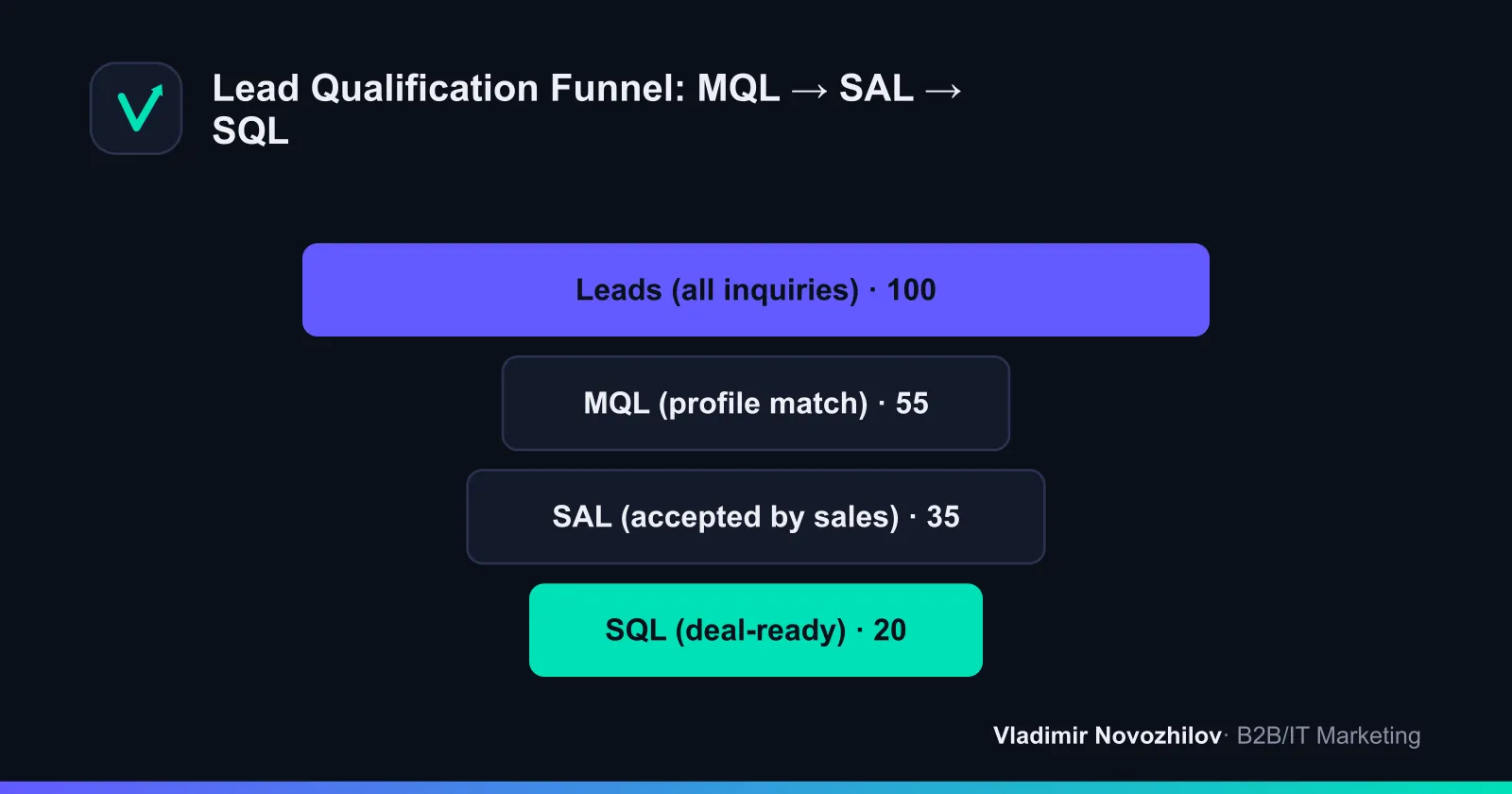
Table: Levels vs. Team Actions
| Level | Who’s Responsible | What’s Confirmed | Team Action |
|---|---|---|---|
| Lead | Marketing | Left contact info | Collect data, run scoring |
| MQL (marketing qualified leads) | Marketing | Profile fit + interest | Hand off to sales per SLA |
| SAL | Sales | Lead accepted for work | Assign rep, first contact |
| SQL (sales qualified leads) | Sales | Need, budget, timeline, decision-maker | Run the deal, prepare a proposal |
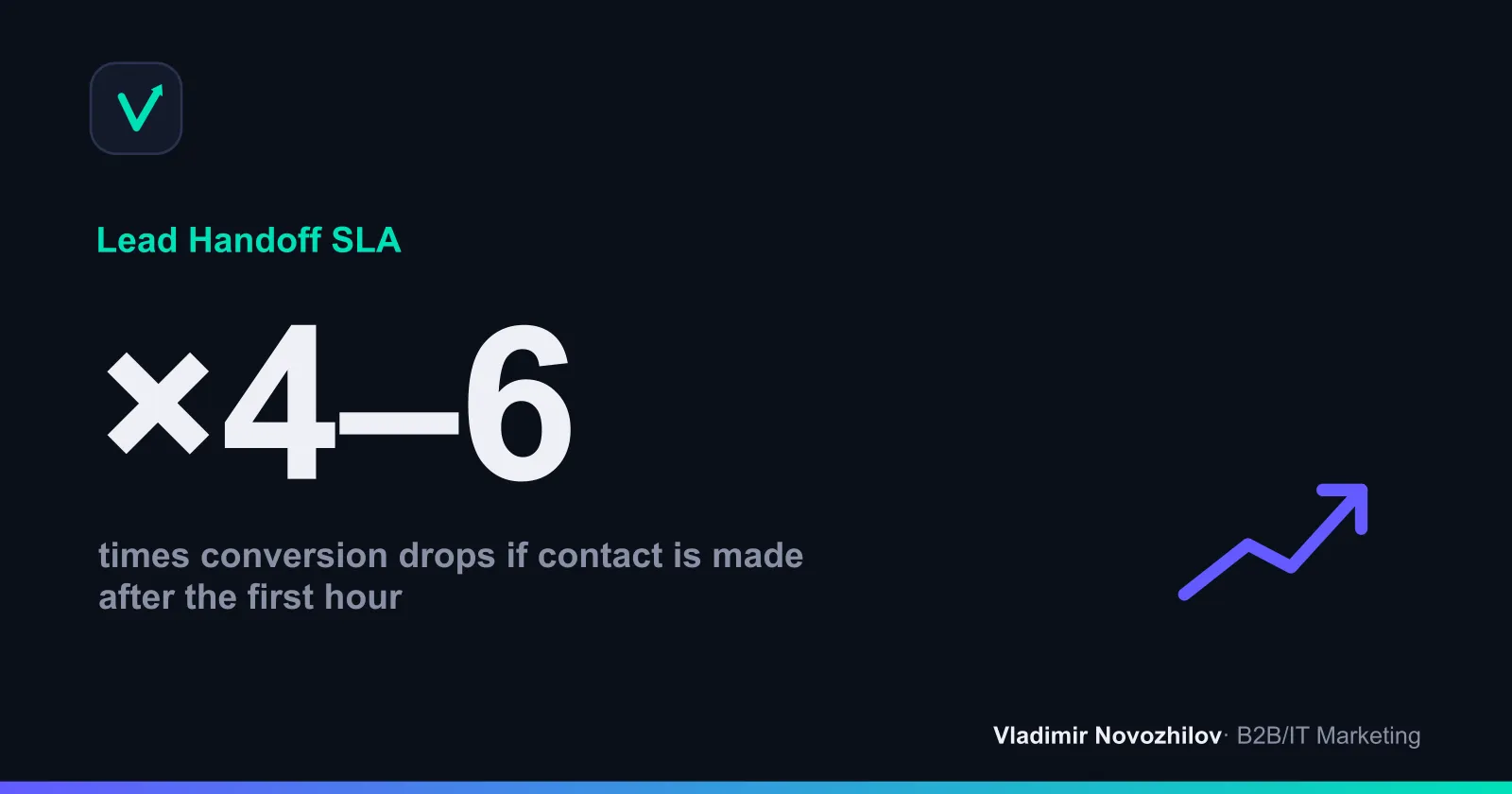
The lead handoff SLA — an agreement on speed — is critically important. According to industry data, if you contact a lead more than an hour after first contact, conversion drops 4–6x. A reasonable standard: marketing hands off an MQL within 24 hours, sales makes first contact within 1 hour.
Lead Qualification Criteria: What to Evaluate
Lead qualification criteria are the set of parameters you use to decide whether a lead is a target fit or not. There’s no universal list, but there is a basic framework.
Checklist of criteria for identifying a target lead:
- Company profile fit — industry, size, region, revenue.
- Need — is there a problem your product solves.
- Budget — willingness and ability to pay within your range.
- Authority — are you talking to the decision-maker.
- Timeline — when is the purchase or launch planned.
- Inquiry source — how well the channel produces quality leads.
- Activity — number of visits, what they viewed, whether they respond.
The rule is simple: 4–7 criteria are enough. Fewer makes qualification shallow; more, and reps stop filling in the CRM.
Template Script for Qualifying Questions
So the rep doesn’t have to improvise, give them a ready-made list of questions:
- “What problem are you trying to solve, and why now?” — need.
- “Have you tried solving it before, and what didn’t work?” — pain point.
- “Who else is involved in the decision?” — authority, decision-maker.
- “Do you have a dedicated budget for this?” — budget.
- “What’s your timeline for launching?” — timing.
- “What criteria will you use to choose a vendor?” — decision criteria.
Lead Qualification Methods: BANT, MEDDIC, CHAMP, GPCTBA/C&I
Lead qualification methods are ready-made frameworks that structure your questions. Let’s look at four popular ones.
BANT — Budget, Authority, Need, Timeline. A classic from IBM: a simple, universal method for quick screening.
MEDDIC — Metrics, Economic buyer, Decision criteria, Decision process, Identify pain, Champion. Built for complex B2B sales: it works in detail on the economic buyer (the person who controls the budget) and the deal’s champion — an internal advocate on the client’s side.
CHAMP — Challenges, Authority, Money, Prioritization. Puts the client’s problem front and center rather than budget: pain first, money second.
GPCTBA/C&I — Goals, Plans, Challenges, Timeline, Budget, Authority, Consequences & Implications. An expanded model from HubSpot for consultative selling with deep focus on the client’s goals.
Comparison Table of Qualification Methodologies
| Method | What It Evaluates | Best Fit | Complexity |
|---|---|---|---|
| BANT | Budget, authority, need, timeline | Short and mid-length deals | Low |
| MEDDIC | Metrics, decision-maker, criteria, process, pain, champion | Complex B2B, high ticket | High |
| CHAMP | Challenges, authority, money, priority | Mid-length, pain-focused | Medium |
| GPCTBA/C&I | Goals, plans, challenges, timeline, budget, consequences | Consultative, long cycle | High |
I’d recommend not inventing your own framework from scratch: use BANT as a base, and for larger deals, add MEDDIC elements — economic buyer and champion.
Lead Qualification Stages: A Step-by-Step Process
The stages of lead qualification form a repeatable process:
- Data collection. A form, chatbot, call, or enrichment by email/tax ID gathers information about the company and contact.
- Initial assessment (scoring). Marketing assigns points — the lead becomes an MQL once it hits the threshold.
- Handoff to sales. The MQL goes to a rep per the SLA; sales confirms the SAL status.
- Deep qualification. The rep asks qualifying questions using BANT/MEDDIC.
- SQL assignment or return. A target lead becomes an SQL and moves into a deal; a non-target lead goes into nurturing or the archive.
How to Set Up Scoring and a Points System
Lead scoring is assigning points for a lead’s attributes and actions. Once the total hits a threshold, the lead automatically becomes an MQL.
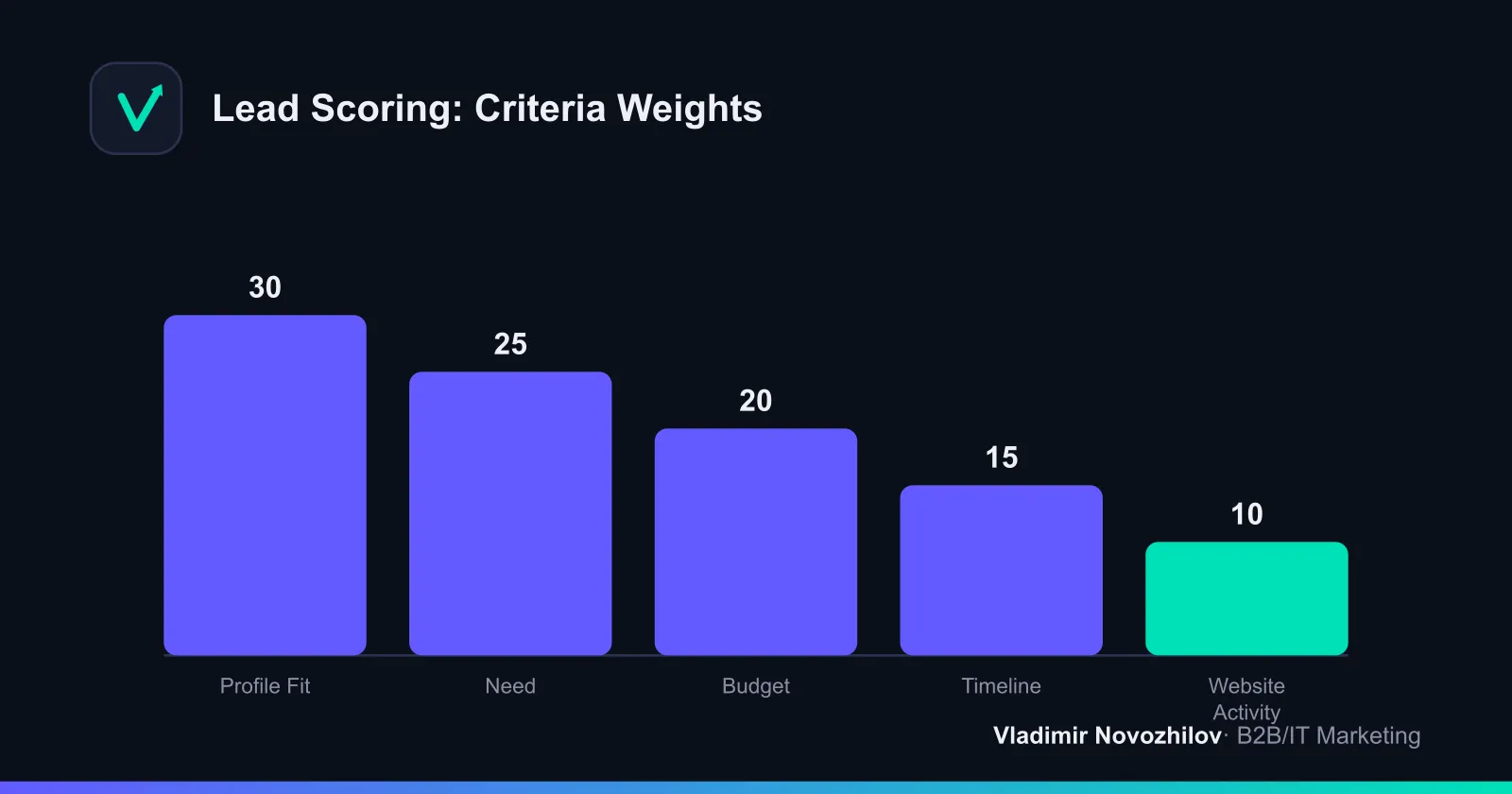
The formula is simple: total score = sum (criterion weight × value). Example scale:
| Criterion | Condition | Points |
|---|---|---|
| Company profile | Target industry and size | +30 |
| Need | Clearly stated | +25 |
| Budget | Within range | +20 |
| Timeline | Within 3 months | +15 |
| Activity | ≥3 site visits | +10 |
| Deal-breaker | Wrong region | −40 |
The MQL threshold might be, say, 60 points. A lead with profile fit + need (55) is still in nurturing; adding activity (65) moves it to sales.
How to Implement Lead Qualification in a CRM
Lead qualification in a CRM turns theory into a working process. Step-by-step setup instructions:
- Define your target lead profile and criteria — this is the foundation for fields and scoring.
- Create a separate funnel or stages: “New Lead → MQL → SAL → SQL” in your CRM (amoCRM, Bitrix24, or another).
- Add mandatory qualification fields to the record card: budget, timeline, decision-maker, need.
- Set up auto-scoring — rules for awarding points and automatically moving to MQL.
- Define assignment rules for distributing leads to reps and SLA notifications.
- Set up automation to return non-target leads to nurturing.
- Build a funnel report — conversion between levels and response speed.
Mini case study. A 1C implementation company was getting around 400 inquiries a month, but sales was drowning. They introduced scoring and an MQL stage: about 55% of profile-matching inquiries started reaching sales. They set an SLA of 1 hour for first contact. Over a quarter, conversion from inquiry to deal rose from 6% to 11%, and the average deal cycle shrank by nearly a third — reps stopped wasting time on non-target inquiries.
Automating Qualification: Chatbots and AI Tools
Part of qualification can be taken off people’s plates. What to automate:
- A website chatbot asks qualifying questions and immediately filters out non-target inquiries, while booking target leads for a meeting.
- An AI assistant analyzes correspondence and calls (speech analytics), tags them, and suggests a lead status.
- Data enrichment — services automatically pull industry, revenue, and region from email or tax ID, removing some of the manual questions.
- Auto-scoring in the CRM recalculates points in real time based on lead actions.
Automation doesn’t replace live qualification for complex deals, but it saves dozens of hours on initial screening and speeds up lead handoff.
Common Mistakes in Lead Qualification
- No shared criteria between marketing and sales. Each side defines a “good lead” differently — mutual finger-pointing follows.
- Too many criteria. Reps stop filling in fields, and CRM data becomes incomplete.
- Ignoring the SLA. MQLs sit untouched for days, and conversion drops sharply.
- Deleting cold leads. You lose the nurturing base that could have produced sales a few months later.
- Scoring that’s never revisited. Criteria weights are set once and never adjusted based on actual deal outcomes.
- Qualification as a box-ticking exercise. Statuses get assigned formally, without a real conversation.
Periodically check whether your SQLs are actually closing into deals. If SQL-to-sale conversion is low, your qualification criteria are set too high or too low and need recalibrating against real data.
Key Takeaways
Lead qualification is a system, not a one-time action. Start with a target customer profile and 4–7 criteria, split the funnel into MQL, SAL, and SQL levels, pick a method (BANT for fast deals, MEDDIC for complex ones), set up lead scoring and a handoff SLA, and lock it all into your CRM. This kind of process turns a stream of scattered inquiries into a predictable funnel where the sales team only works with those who are genuinely ready to buy.
FAQ
- What's the difference between MQL and SQL?
- MQL (Marketing Qualified Lead) is a lead who has shown interest through marketing channels (downloaded content, submitted a form) and matches your target customer profile, but isn't yet ready for a deal. SQL (Sales Qualified Lead) is a lead who has been vetted by the sales team on need, budget, and timeline and is ready for a substantive conversation about purchasing. Simply put: MQL is interested, SQL wants to buy.
- Which qualification methodology should I choose: BANT or MEDDIC?
- BANT (budget, authority, need, timeline) works well for short and mid-length deals where you need to quickly filter out non-target inquiries. MEDDIC was built for complex B2B sales with a long cycle and multiple decision-makers: it digs deeper into the economic buyer, decision criteria, and the deal's champion. If your sales cycle is under a month, go with BANT; if it's several months with a high price tag, use MEDDIC.
- How many criteria are needed to qualify a lead?
- 4–7 criteria is optimal. Fewer, and qualification becomes superficial and lets non-target leads through. More, and reps get overloaded and stop filling in CRM fields. Start with a basic set: fit with company profile, need, budget, timeline, and decision-maker, then add industry-specific criteria as you accumulate data.
- Who should handle lead qualification — marketing or sales?
- Qualification is split between teams. Marketing owns the MQL stage: it assesses profile fit and initial interest via scoring. Sales confirms the lead as SAL and moves it to SQL through a live conversation. The key element is the SLA — an agreement on how quickly sales will pick up a handed-off lead (usually within one hour to one day).
- How do you automate lead qualification with a CRM?
- Set up lead scoring: assign points to a lead's actions and attributes, and define the threshold for moving to MQL. Add mandatory qualification fields to the record, automatic funnel statuses, and rules for assigning leads to reps. Initial data collection can be handed to a chatbot or a web form with qualifying questions, while enrichment by email/tax ID can be handled by data services.
- What should you do with cold and unqualified leads?
- Don't delete them. Send cold and warm leads into nurture sequences: email campaigns, useful content, retargeting. Some will warm up and return to the qualification funnel within 1–6 months. Clearly non-target inquiries (wrong region, no budget, wrong profile) should be tagged with a separate status so sales doesn't waste time on them.