AI for Competitor Analysis: 10 Prompts

TL;DR
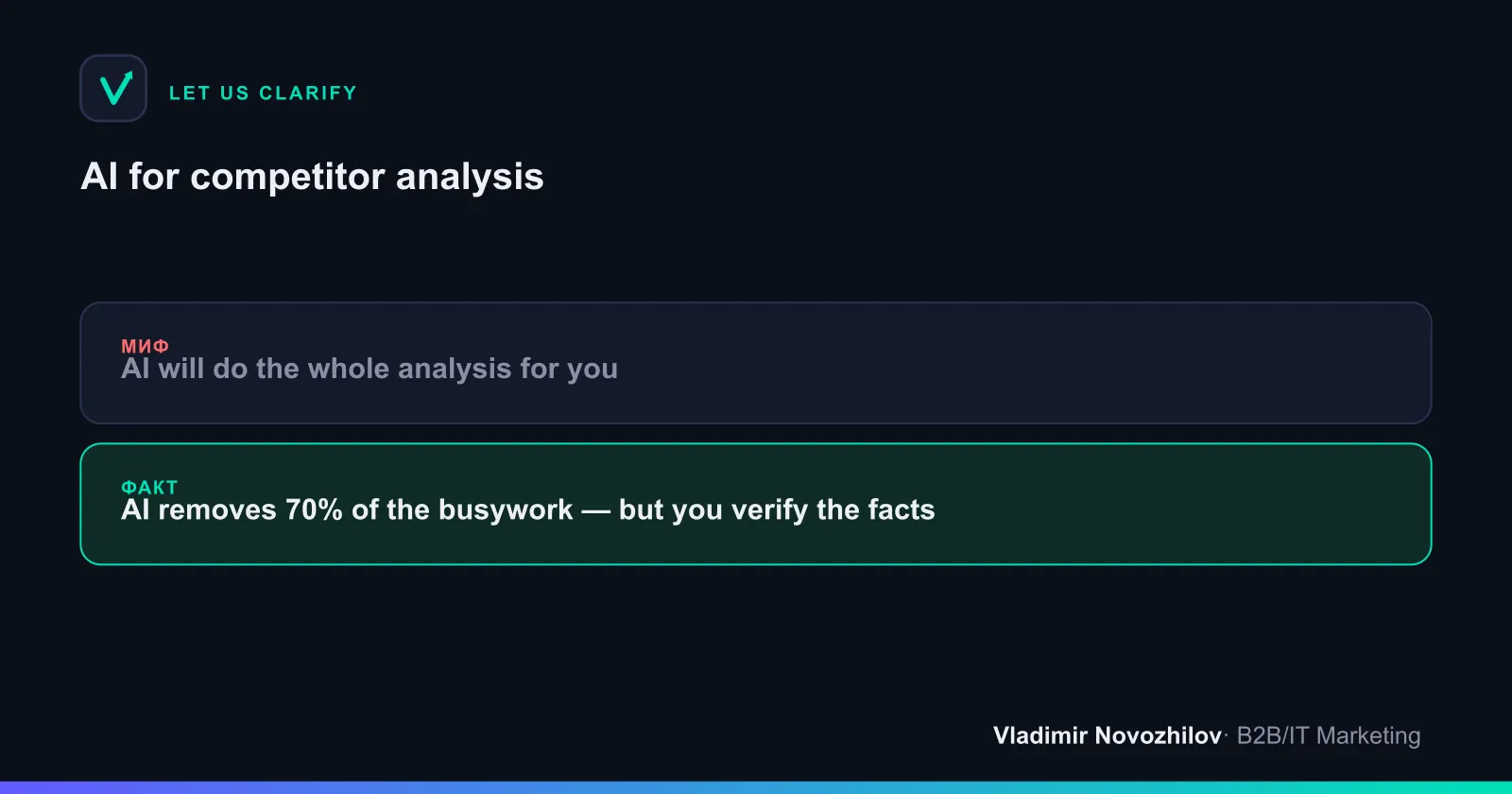
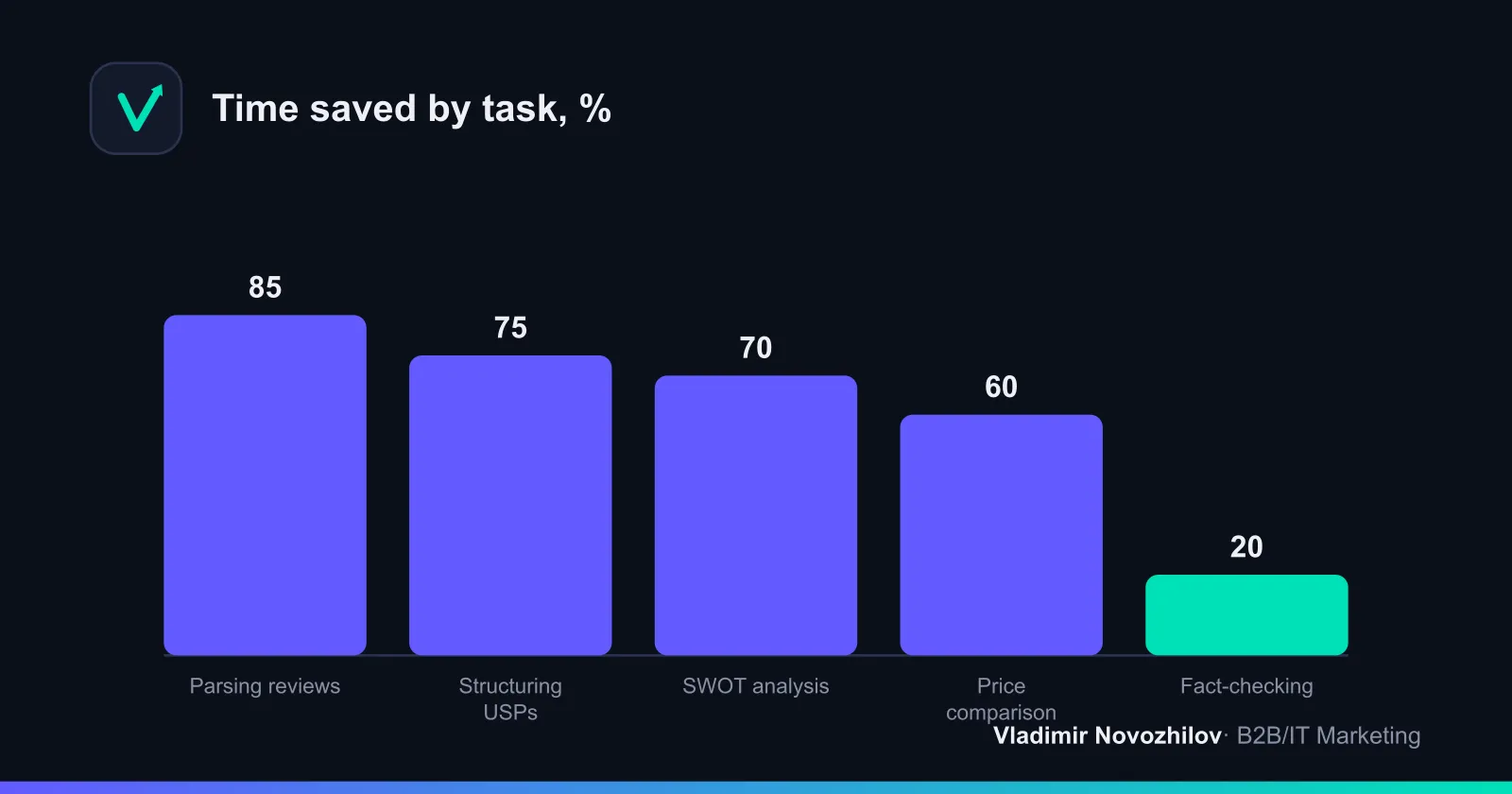
AI for competitor analysis speeds up collecting and structuring data: in an hour you get a SWOT, a breakdown of USPs, prices and reviews. This article has a step-by-step workflow, 10 ready-made ChatGPT prompts, a comparison table of AI services and a checklist. AI doesn't replace fact-checking, but it removes 70% of the busywork.
AI for competitor analysis is a way to cover in a single workday the ground that used to take weeks by hand. AI reads websites, reviews and price lists, consolidates them into tables, builds SWOT analyses and highlights rivals’ weak spots. Below is a step-by-step workflow, 10 ready-made ChatGPT prompts, a comparison of AI services and a checklist so you can run a competitor analysis with AI on your own.
Reading time: ~8 minutes. Updated: 2025.
Why you need competitor analysis and why it’s worth handing to AI
Competitor analysis is the systematic study of the companies fighting for the same customers: their products, prices, positioning, channels and reputation. The goal is to find unoccupied niches, strengthen your own USP and avoid repeating others’ mistakes.
This used to be manual drudgery: open 15 websites, copy prices into a table, read through hundreds of reviews. Artificial intelligence takes most of that load off. AI doesn’t get tired, processes large volumes of text and instantly brings it all into a single format. The human, meanwhile, stays the arbiter: verifying facts and drawing conclusions.
What AI can do in competitor analysis: capabilities and limitations
To keep AI-driven competitive intelligence honest, let’s separate what AI does well from where it can’t be trusted.
Strengths:
- structuring text — turns the chaos of websites and reviews into tables and lists;
- comparison by criteria — prices, plans, features, communication tone;
- SWOT analysis and positioning breakdowns;
- generating hypotheses: how you can differentiate.
Limitations:
- AI doesn’t know closed data (revenue, margins, contracts);
- it can invent numbers and facts — this is called hallucination;
- traffic and advertising estimates are more accurate coming from SimilarWeb and similar services;
- the model’s knowledge can go stale — feed in fresh data manually.
How to run a competitor analysis with AI — step by step
Step 1. Gather data on your competitors
Identify 5–7 direct competitors and gather, for each: the copy from their homepage and service pages, pricing, product descriptions from marketplaces, 20–50 reviews, social media posts. Get traffic and source data from SimilarWeb. The more concrete the source material, the more useful the AI’s answer.
Step 2. Write the competitor-analysis prompt
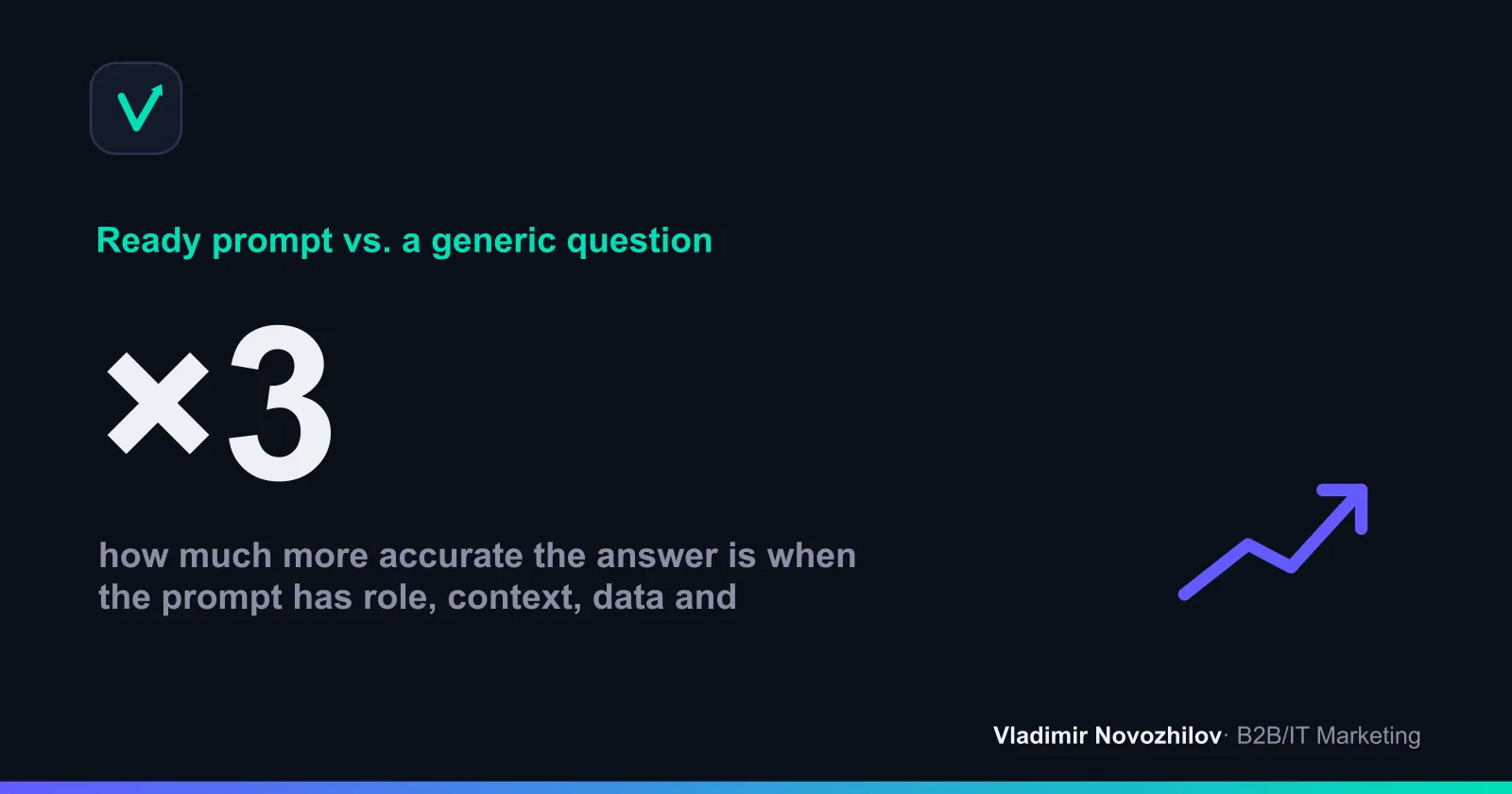
A prompt is a text instruction for the AI. A working prompt has four parts: role, context, task, answer format. Skip even one and you’ll get vague text with no value.
Step 3. Verify and structure the AI’s answer
Never take an answer on faith. Check the numbers against primary sources, cut generic wording, and ask the AI to justify contentious conclusions. Record the final table and decisions on your own end, not in a chat with a bot.
Competitor-analysis prompts: 10 ready-made templates
Copy the ChatGPT prompts, substituting your own data into the square brackets.
Prompt for a competitor SWOT analysis
You are a marketing analyst. Here is a description of a competitor: [paste the site and service copy]. Build a SWOT analysis with AI: strengths and weaknesses, opportunities and threats. Give the answer as a 2×2 table, with a short justification for each item.
Prompt for USP and positioning analysis
Analyze the competitors’ positioning based on their copy: [paste the copy]. For each one, identify the core promise, target audience and communication tone. Find an unoccupied niche where we, [your product], can differentiate.
Prompt for price and assortment analysis
Here are the competitors’ plans and products: [data]. Consolidate them into a table: company, product, price, what’s included. Determine the price segments and point out where there’s a gap we could occupy.
Prompt for review and reputation analysis
Here are 40 reviews of a competitor: [paste]. Group them by theme, highlight recurring complaints and praise, and rate sentiment as percentages. Formulate 5 customer pains that we could address better.
6 more quick prompts
- Content: “Break down the competitor’s content strategy from these posts and suggest what they’re missing.”
- Funnel: “Describe the customer journey on the competitor’s site and the weak spots in their funnel.”
- Advertising: “From these ads, identify the competitors’ offers and triggers.”
- Product: “Compare the products’ features in a table and flag each one’s unique perks.”
- Hypotheses: “Based on the analysis, propose 7 hypotheses for differentiating our brand.”
- Summary: “Compress the whole analysis into 10 talking points for a presentation to management.”
The best AI models and services for competitor analysis: a comparison table
| Service | What it does | What it’s good for | Price |
|---|---|---|---|
| ChatGPT | Reasoning, SWOT, parsing copy and reviews | General-purpose analysis and conclusions | Free tier available, Plus ~$20/mo |
| SimilarWeb | Estimates of traffic, sources, keywords | Numbers on visits and channels | Limited free tier, paid from $125/mo |
| Kompyte | Automatic competitor monitoring | Regular tracking of changes | On request, enterprise |
| Klue | Collecting and distributing competitive intelligence | Large sales and marketing teams | On request, enterprise |
| AI Wiz | AI assistant for marketing tasks | Quick breakdowns and idea generation | Freemium + paid plans |
The optimal combo for a small business: ChatGPT for analysis and conclusions plus SimilarWeb for the numbers. Kompyte and Klue are justified when competitor monitoring is needed constantly and at the team level.
Competitor analysis via ChatGPT: an example dialogue with a breakdown of the answer
Request: “You are a marketing analyst. Here is the copy from two competitors in the online-accounting niche: [copy]. Build a SWOT for each and suggest a niche to differentiate in.”
AI’s answer (abridged): “Competitor A — strong brand and low price, but weak support (complaints in reviews). Competitor B — a premium service with a dedicated account manager, but a high barrier to entry. A possible niche: a fast start with human support at a mid-range price.”
Breakdown: the conclusion is logical, but it needs checking. “Weak support” is a hypothesis from the reviews — you need to confirm it with the volume of mentions. “Mid-range price” — pin it down with figures from the price lists. In other words, ChatGPT gave you a framework in a minute, and you fill it in with facts in an hour — instead of three days of work from scratch.
Automating competitor analysis: regular monitoring with AI
Automating competitor analysis is when data collection and initial processing run on a schedule, and you receive ready-made summaries. The scheme is simple:
- Set up regular data collection (a site scraper, a review export, SimilarWeb reports).
- Run the new data through the same prompt in ChatGPT (via the web interface or the API).
- Ask the AI to compare “before and after” and highlight the changes: new prices, promotions, products.
- Send the summary to the team once a week.
The specialized services Kompyte and Klue do this out of the box, but the “scraper + ChatGPT via API” combo is realistically something you can put together yourself.
Common mistakes in AI-assisted competitor analysis
- Trusting numbers without checking — AI hallucinates, so cross-check against sources.
- A generic prompt with no data — “analyze the competitors in niche X” will give you fluff.
- One competitor instead of the market — take 5–7, otherwise the picture is distorted.
- A one-off analysis — the market changes, you need competitor monitoring.
- Blindly copying others’ solutions — look for differentiation, not imitation.
Checklist: how to run an AI competitor analysis quickly and correctly
- Identified 5–7 direct competitors
- Gathered site copy, prices, reviews, posts
- Pulled traffic numbers from SimilarWeb
- Wrote the prompt: role + context + task + format
- Requested SWOT, a breakdown of USPs, prices and reviews
- Verified all facts and numbers against primary sources
- Formulated hypotheses for differentiation
- Set up regular monitoring of changes
- Consolidated the conclusions into a table and decisions
Save this checklist — and any competitor analysis with AI will take you hours, not weeks.
FAQ
- Which AI is best for competitor analysis?
- For general-purpose tasks — ChatGPT (GPT-4o and newer): it builds SWOT analyses well, compares USPs and structures reviews. For traffic and competitor sources use SimilarWeb; for systematic monitoring — Kompyte or Klue. The optimal approach is to combine them: ChatGPT for reasoning and conclusions, a specialized service for precise numbers on traffic and advertising.
- How do you write a good competitor-analysis prompt for ChatGPT?
- A good prompt has four elements: a role ("you are a marketing analyst"), context (the niche, your product, the list of competitors), a task (SWOT, price comparison, review breakdown) and an answer format (table, bullets, length). Always paste in the raw data — site copy, reviews, prices. Without source material, the AI produces generic phrases.
- Can competitor analysis be fully automated with AI?
- Fully — no. You can automate data collection, initial structuring and regular monitoring of changes through APIs and specialized services. But leave interpretation, fact-checking and strategic conclusions to a human: AI makes mistakes with numbers and can invent details that don't exist.
- What competitor data can AI gather, and what can't it?
- AI handles well what you give it: site copy, reviews, product descriptions, social media posts. Estimates of traffic, ad budgets and keywords come from SimilarWeb and similar services. Closed data — real revenue, margins, supplier terms — AI doesn't know and will at best guess a range.
- How often should you run an AI competitor analysis?
- A full analysis — once a quarter. Monitoring of key changes (prices, promotions, new products, communication tone) — weekly, or the moment a competitor launches something notable. Set up regular data collection, and use AI for a quick "before and after" comparison.