Lead Generation Mistakes: Why You're Not Getting Leads

TL;DR
Lead generation mistakes are systemic failures in attracting, qualifying, and processing leads that leave a business with too few leads or low-quality ones. The root cause is usually not budget but confusion between 'lead' and 'contact,' missing ICP, weak lead scoring, and a gap between marketing and sales. Below are eight common mistakes with fixes, an audit checklist, and the metrics that matter more than lead volume.
Budget is being spent, ads are running, but there are no results. Sound familiar? In most cases, the issue isn’t money or a ‘bad market.’ Lead generation mistakes are systemic failures in attracting, qualifying, and processing leads that leave a business with too few leads or low-quality ones. Below are eight common mistakes with fixes, a comparison table of ‘mistake → cause → fix → metric,’ an audit checklist, and the metrics that matter more than lead volume. This material draws on experience in B2B, IT, and services, but applies to anyone selling through a funnel.
What counts as a lead generation mistake: lead vs. contact
Before fixing the system, let’s agree on terminology — otherwise half of your lead generation problems remain invisible.
- Lead — a potential customer who has shown interest and left their contact information with the intent to solve a problem (filled out a form, requested a quote, booked a demo).
- Contact — just a piece of data: an email from a list, a business card from a conference, a newsletter subscriber. No purchase interest has been shown yet.
- Lead magnet — value offered in exchange for contact info (a checklist, calculator, guide, demo) that kicks off the relationship.
- Lead scoring — a point-based system for evaluating a lead’s readiness to buy.
- ICP (Ideal Customer Profile) — a description of the ideal customer: industry, size, decision-maker role, pain point, budget.
The key mix-up that makes a business believe it ‘has leads’: contacts are being counted as leads. This is the root of sales team frustration and the question ‘why am I not getting leads,’ even though there are technically incoming submissions.
Why you’re not getting leads: technical and strategic causes
A short answer to ‘why am I not getting leads’: either submissions aren’t reaching you due to technical failures, or your offer and targeting don’t match your audience. Let’s break down the causes.
Technical causes (leads exist, but you don’t see them or lose them):
- Broken analytics: UTM tags are missing or duplicated, goals in analytics tools aren’t firing.
- No end-to-end analytics — you can’t see the path from channel to revenue.
- The form submits with an error, emails land in spam, or the CRM integration is broken.
- Slow site: pages loading longer than 3 seconds cause visitors to leave before filling out the form.
Strategic causes (lead volume really is low):
- No documented ICP — ads are being shown to everyone indiscriminately.
- Weak offer and a vague lead magnet that doesn’t address the pain point.
- Wrong channels — you’re present where your customers aren’t.
- Low site-to-lead conversion rate due to overloaded forms and weak landing pages.
The first thing to do when facing ‘too few leads’ complaints is to submit a test lead yourself and trace its path all the way to the CRM. This catches up to half of technical failures in 15 minutes.
Top lead generation mistakes and how to avoid them
Below are eight of the most costly mistakes. For each: the essence, why it happens, and what to do. A summary table at the end of the section links each mistake to a control metric.
Mistake 1: You confuse leads and contacts
The most common of all lead generation problems. Marketing reports hundreds of ‘leads,’ while sales receives cold contacts who never requested anything. This mistake occurs when marketing’s KPI is lead quantity rather than quality.
How to fix it: agree on a single definition of a lead together with sales. Agree that only submissions that pass minimal qualification (correct role, an actual need) count. Introduce lead statuses in the CRM.
Mistake 2: You don’t analyze metrics and indicators
If you’re not tracking CPL (cost per lead), stage-by-stage conversion, LTV, and NPS, you’re flying blind. A classic symptom of weak lead generation is a report like ‘we spent X, got Y leads’ with no connection to revenue.
How to fix it: set up end-to-end analytics from channel to deal. Track CPL for each channel, conversion from lead to qualified lead to closed deal, and LTV and customer NPS by source. A channel with a higher CPL can be more profitable than a cheaper one if it brings in customers with higher LTV.
Mistake 3: You’re targeting the wrong customers
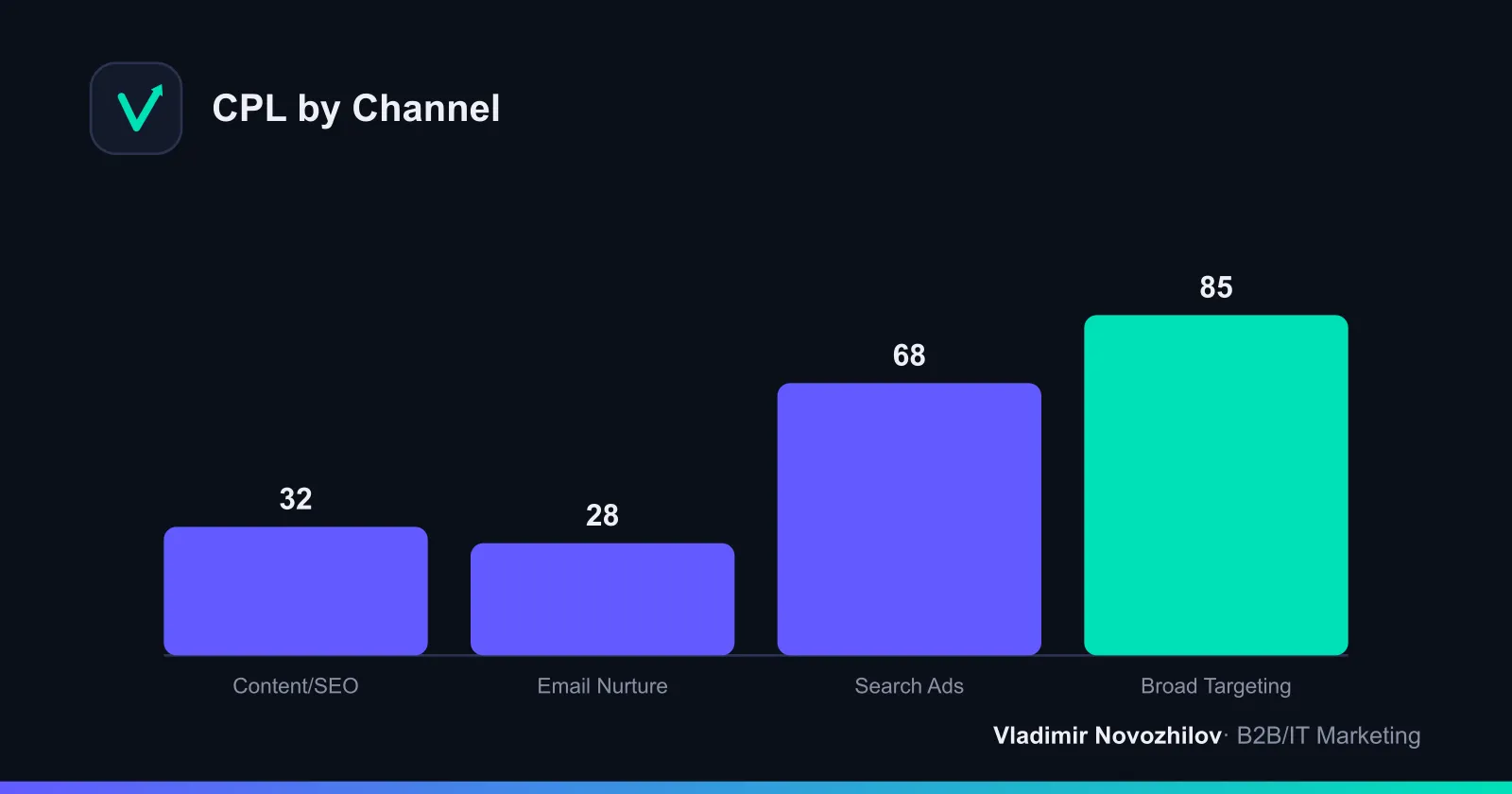
Without an ICP and audience profile, advertising attracts bad leads: people with no budget, no authority, or the wrong need. Broad targeting maximizes volume while destroying lead quality.
How to fix it: define your ICP using 5–7 attributes, build look-alike audiences based on your best customers, and speak the language of a specific segment in your offer. Build a CJM (Customer Journey Map) to understand at what stage a customer searches for a solution.
Mistake 4: Poor lead nurturing and qualification
With a long sales cycle (typical for B2B lead generation), a lead rarely buys immediately. If they aren’t nurtured and qualified, the money spent acquiring them goes to waste.
How to fix it: implement lead scoring and email lead nurturing — a series of emails featuring case studies, objection handling, and demo invitations. Below is a working scoring template.
Lead scoring template (example criteria and points):
| Criterion | Condition | Points |
|---|---|---|
| Role | Decision-maker / influences the decision | +30 |
| Industry | Matches ICP | +20 |
| Company size | Falls within target range | +15 |
| Need | Clear pain point/deadline exists | +20 |
| Budget | Confirmed | +25 |
| Activity | Opened 3+ emails, attended a demo | +15 |
| Disqualifier | Student/competitor/off-target region | −40 |
Leads scoring 70+ should go straight to sales; 40–69 go into email nurturing; below 40 go into deferred handling or are disqualified.
Mistake 5: You ignore segmentation and personalization
A one-size-fits-all message reduces conversion. A factory director and a startup marketer need different arguments.
How to fix it: segment your database by ICP and funnel stage, and personalize offers and emails. Even simple division into 3–4 segments noticeably boosts response rates.
Mistake 6: Wrong choice of lead generation channels
Businesses often stick to platforms where their customers aren’t, simply because ‘everyone does it that way.’ As a result, CPL rises while lead flow doesn’t grow.
How to fix it: test channels with small budgets and compare them not by cost per click, but by CPL and deal conversion. For B2B lead generation, content, SEO, webinars, and targeted outreach to decision-makers are often more effective than broad targeting.
Mistake 7: A gap between marketing and sales
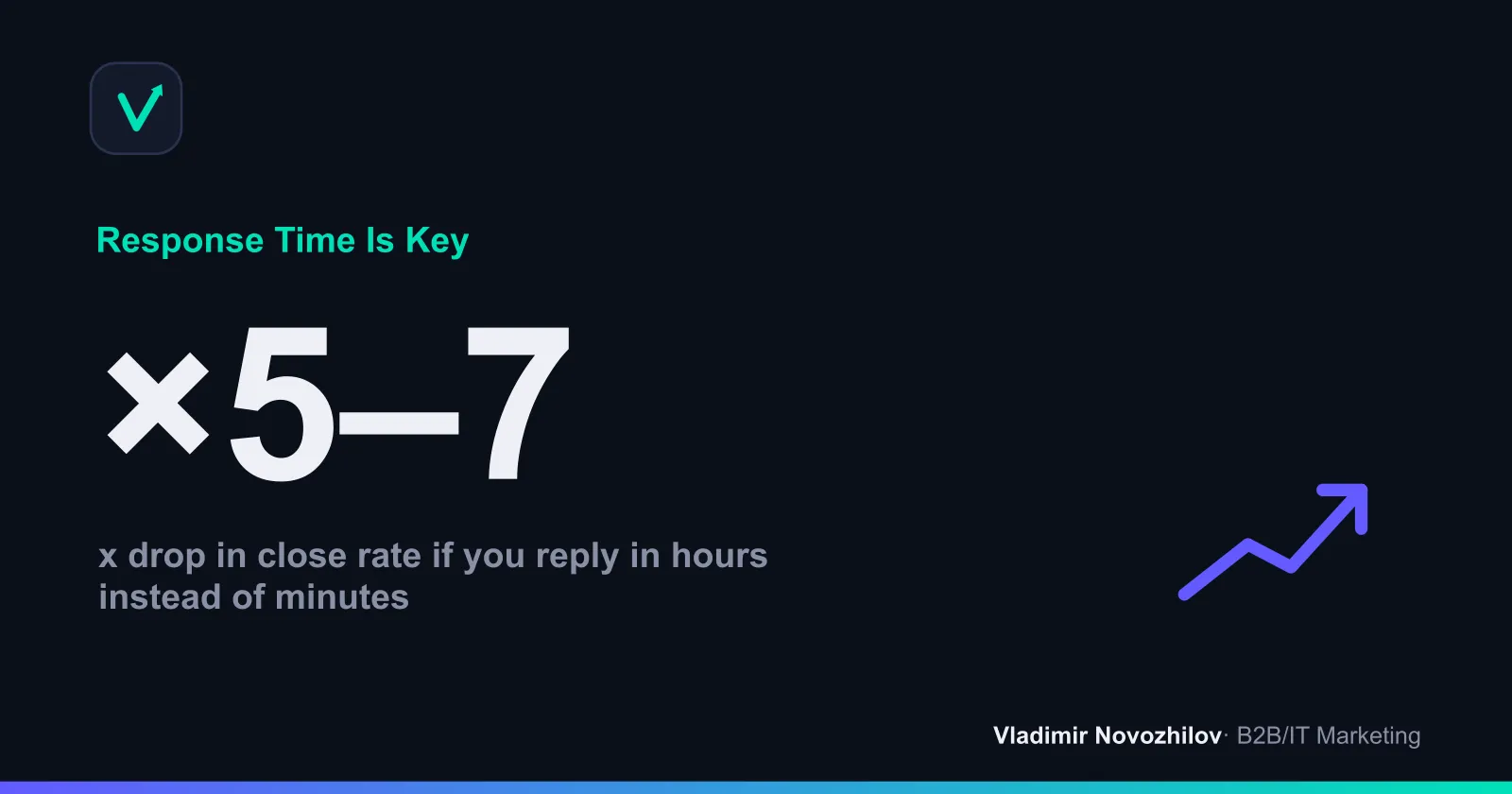
Slow lead processing is a silent conversion killer. A lead goes cold within hours. If there’s no SLA between marketing and sales, leads fall through the cracks during handoff.
How to fix it: define an SLA: how many minutes sales has to pick up a lead, how many contact attempts to make, and how quickly to give feedback to marketing. Set up automatic lead routing in the CRM.
Mistake 8: You neglect site and landing page conversion
You have traffic, but site-to-lead conversion is low — meaning you’re losing money at the top of the funnel. Causes: overloaded forms, weak offer, lack of trust.
How to fix it: shorten forms to 2–3 fields, add social proof, and run A/B testing of headlines, offers, and buttons. A 1-percentage-point increase in conversion is often cheaper than scaling traffic.
Summary table: mistake → cause → fix → metric
| Mistake | Cause | Fix | Control metric |
|---|---|---|---|
| Lead/contact confusion | KPI tied to volume | Single lead definition, CRM statuses | Share of qualified leads |
| No metrics analysis | No end-to-end analytics | Track CPL, LTV, NPS, conversion | CPL, stage-by-stage conversion |
| Wrong customer | No ICP | ICP + look-alike | Lead quality, dropout % |
| Weak nurturing | No scoring or nurturing | Lead scoring, email nurturing | Lead → deal conversion |
| No personalization | One message for everyone | Database segmentation | Open/click rate, response |
| Wrong channels | ’Follow the crowd’ choice | Test by CPL and deals | CPL by channel |
| Sales disconnect | No SLA | SLA + auto-routing | Time to first contact |
| Low site conversion | Weak landing page | A/B tests, short forms | Site-to-lead conversion |
Why leads turn out bad: quality over quantity
The direct answer: bad leads appear when a system is built for volume. A discount-based lead magnet attracts bargain hunters, broad targeting attracts off-target audiences, and lack of qualification lets everyone through further down the funnel.
To improve lead quality, not just quantity:
- Replace ‘discount’ lead magnets with expert value (a calculator, audit, or industry guide).
- Add 1–2 qualifying questions to your form.
- Evaluate channels by the share of leads reaching a closed deal, not by lead count.
Mini case 1 (B2B services). A company complained about ‘too few leads’ and high CPL in paid search. After narrowing targeting to match the ICP and adding a qualifying question to the form, lead volume dropped by 20%, but the share of qualified leads rose from 35% to 68%, and cost per deal nearly halved.
Mini case 2 (IT integrator). They implemented a ‘15-minute first contact’ SLA and automatic lead routing in the CRM. Lead-to-qualified-lead conversion rose by 40% with no increase in budget — previously, leads simply went cold in the queue.
Mini case 3 (education services). A 5-email lead nurturing sequence was launched for those who didn’t buy right away. Over a quarter, 18% of ‘dormant’ leads re-entered the funnel and generated additional sales at zero extra traffic cost.
How to check your lead generation: audit checklist
Go through this list. Every ‘no’ is a growth opportunity and a potential reason why you’re not getting leads or why they’re low quality.
- There’s a single lead definition agreed upon with sales.
- ICP is documented using 5–7 attributes.
- UTM tags are set on all campaigns, and analytics goals are firing correctly.
- End-to-end analytics from channel to revenue is set up.
- You track CPL for each channel.
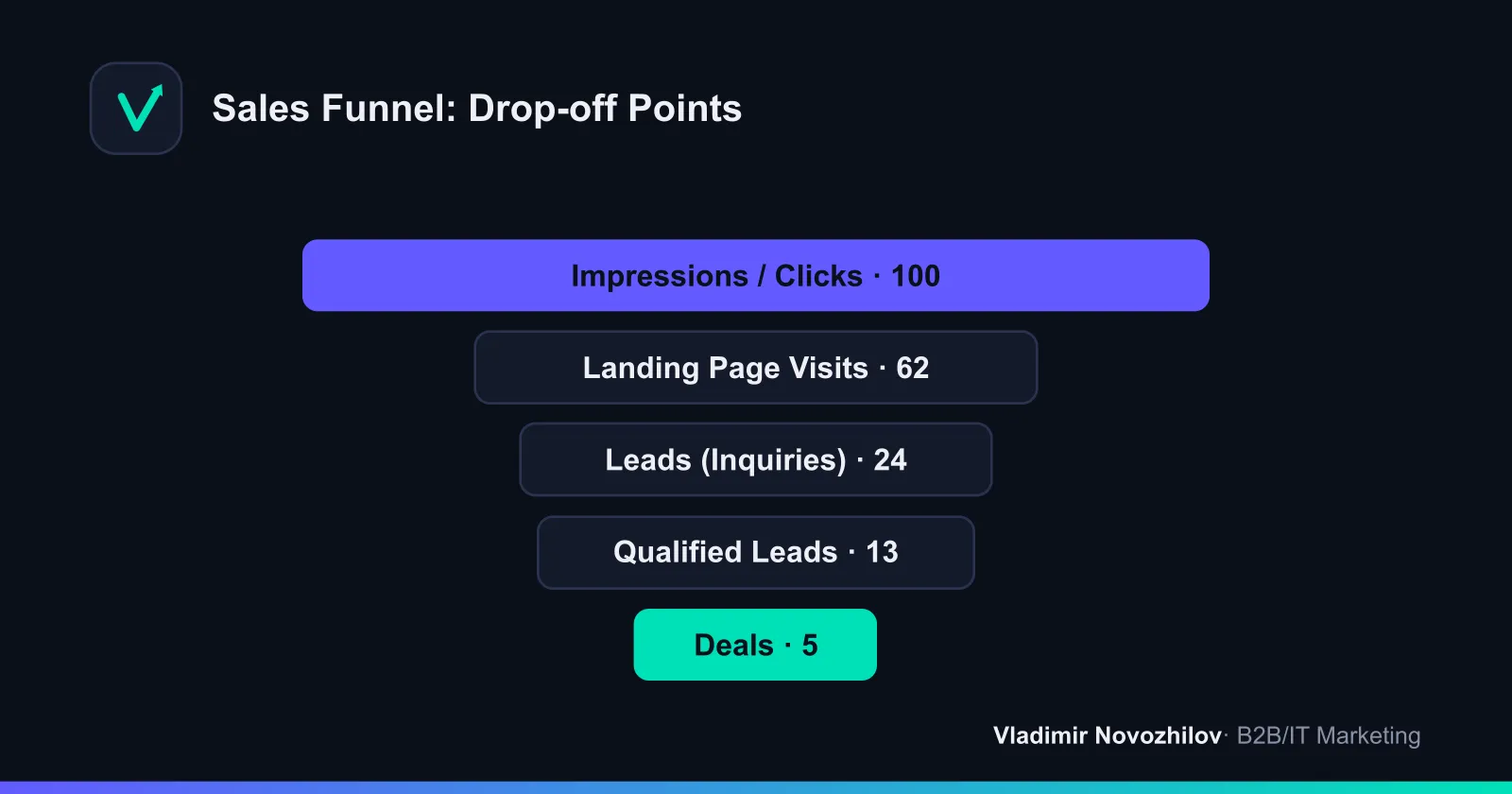
- You know the conversion rate at every stage of the sales funnel.
- You track LTV and NPS of customers from different channels.
- Lead scoring with clear criteria is in place.
- Email lead nurturing is running for long sales cycles.
- There’s an SLA between marketing and sales, and automatic CRM routing.
- Forms are short (2–3 fields), landing pages undergo A/B testing.
- A test submission reaches the CRM without any loss.
If you checked fewer than 8 items, your lead generation has systemic weaknesses, and it’s too early to increase your budget.
Metrics to track instead of lead count
Lead count is a vanity metric. Here’s what actually shows the health of your system:
- CPL (cost per lead) — how much one submission costs per channel.
- Stage-by-stage conversion — lead → qualified lead → deal.
- Site-to-lead conversion — landing page effectiveness.
- LTV — how much revenue a customer generates over their lifetime; connects lead generation to profit.
- NPS — loyalty of customers from different channels (sometimes a cheap channel brings in dissatisfied customers).
- Time to first contact — a direct driver of conversion.
- Share of qualified leads — an indicator of quality, not volume.
The connection between CRM and lead generation is key here: without a CRM, you can’t trace a lead’s path or calculate these metrics. Start small — record the source, status, and deal amount for every lead, and within a month the picture of ‘where the money is being lost’ will become clear.
The bottom line is simple: most lead generation mistakes are fixed not with budget, but with order — shared definitions, ICP, analytics, scoring, and SLAs. Run the audit checklist, close the weak spots, and shift your focus from chasing lead volume to lead quality and revenue.
FAQ
- Why am I not getting leads even though ads are running and budget is being spent?
- The cause is usually technical or strategic: analytics and UTM tags are misconfigured (leads come in but aren't tracked), ads point to a slow or unconvincing landing page, the offer doesn't address the audience's pain point, or you're targeting the wrong ICP. Manually test the 'click → form → CRM' chain by submitting a test lead, and check the site's actual conversion rate into leads for each channel.
- What should I do if lead volume is low despite a decent ad budget?
- Break the funnel down by stage and find where the money is being lost. If you have lots of clicks but few leads, the problem is the offer and landing page. If you have plenty of leads but no sales, the problem is lead quality and qualification. Compare CPL (cost per lead) across channels and shut down those with high CPL and low deal conversion; redirect the freed-up budget to channels that work.
- Why am I getting bad leads and how can I improve lead quality?
- Bad leads result from overly broad targeting, a 'greedy' lead magnet (a discount instead of expertise), and lack of qualification. Set up lead scoring based on ICP criteria, add 1–2 qualifying questions to your form (budget, role, timeline), and agree on an SLA with your sales team. This way you pay for lead quality, not just volume.
- How do I recognize weak lead generation, and what should I do about it?
- Weak lead generation shows up as symptoms: rising CPL, declining site-to-lead conversion, sales complaining about bad leads, and no end-to-end analytics from channel to revenue. Run an audit using the checklist in this article, and start tracking CPL, stage-by-stage conversion, LTV, and customer NPS by channel instead of just lead volume.
- What are the most common B2B lead generation problems?
- Typical B2B lead generation issues include: no documented ICP, prioritizing lead volume over quality, slow lead processing (first contact happens hours or days later), no email nurturing for long sales cycles, and a disconnect between marketing and sales with no shared SLA or unified CRM.