Lead Handoff to Sales: Marketing-Sales SLA Guide


TL;DR
Lead handoff to sales is a formal process for moving a qualified lead from marketing to a sales rep. A marketing-sales SLA defines what counts as a ready lead, how fast sales must respond, and how many contact attempts to make. This article covers the SLA definition, a metrics table (response time, lead leakage, MQL-to-SQL), a ready-to-use agreement template, a step-by-step algorithm, and an implementation checklist.
Lead handoff to sales breaks down not where there aren’t enough leads, but where there’s no agreement. Marketing pushes for volume and complains that sales is “dropping” leads. Sales brushes it off: “the leads are cold, there’s no one worth calling.” As a result, the traffic budget burns while lead-to-deal conversion falls. There’s one tool that fixes this — an SLA between marketing and sales, which turns lead handoff from a conflict zone into a measurable process.
In this article, we’ll break down what a marketing-sales SLA is, what it consists of, how to calculate target metrics, and I’ll give you a ready-to-use agreement template, a step-by-step lead handoff algorithm, and an implementation checklist. All of it is geared toward B2B, IT, and services with a long sales cycle.
What an SLA between marketing and sales is
An SLA (Service Level Agreement) between marketing and sales is a written agreement on mutual obligations: which lead marketing must hand off to sales (based on which lead qualification criteria), how fast, with how many touches, and with what discipline sales must work it. In simpler terms, it’s a contract between marketing and sales where both sides take on measurable commitments and are accountable for numbers, not feelings.
The approach where marketing and sales operate as one team with shared goals and a shared SLA is called smarketing (sales + marketing) or marketing sales alignment. The essence of marketing-sales alignment is simple: the two departments should share one funnel, one language (what counts as a lead, an MQL, an SQL), and one success metric — revenue, not the number of submitted forms.
Before we go further, let’s align on a basic term. What is a lead — it’s a contact from a potential customer who has shown interest: submitted a form, downloaded a resource, booked a demo. A lead is not yet a customer or a deal — it’s just an entry point into the sales funnel that still needs to be qualified and moved forward.
Why leads get lost without an SLA: typical department conflicts
Without formal agreements, marketing-sales collaboration devolves into blame-shifting. Here are the classic scenarios I see most often in companies:
- “The leads are bad.” Sales considers marketing leads cold because there’s no agreed definition of a quality lead. Each rep decides on their own who’s worth calling.
- “Sales isn’t calling.” Marketing sees that half the handed-off leads never get worked at all. This is lead leakage — leads slipping through the cracks between departments.
- Slow response. A form submission gets handled a day later, by which point the customer has already messaged three competitors. The absence of a response time standard costs the company real money.
- Misaligned goals. Marketing is rewarded for lead volume and low cost per lead (CPL), sales for closed deals. The departments optimize for different things and pull the funnel in different directions.
According to industry research (including Harvard Business Review publications on response speed to inbound inquiries), companies that reach out to a lead within the first few minutes qualify it far more often than those that respond after an hour or more. That’s exactly why lead handoff between departments needs to run on a defined process, not “whenever someone gets to it.”
MQL and SQL: where the line of responsibility falls
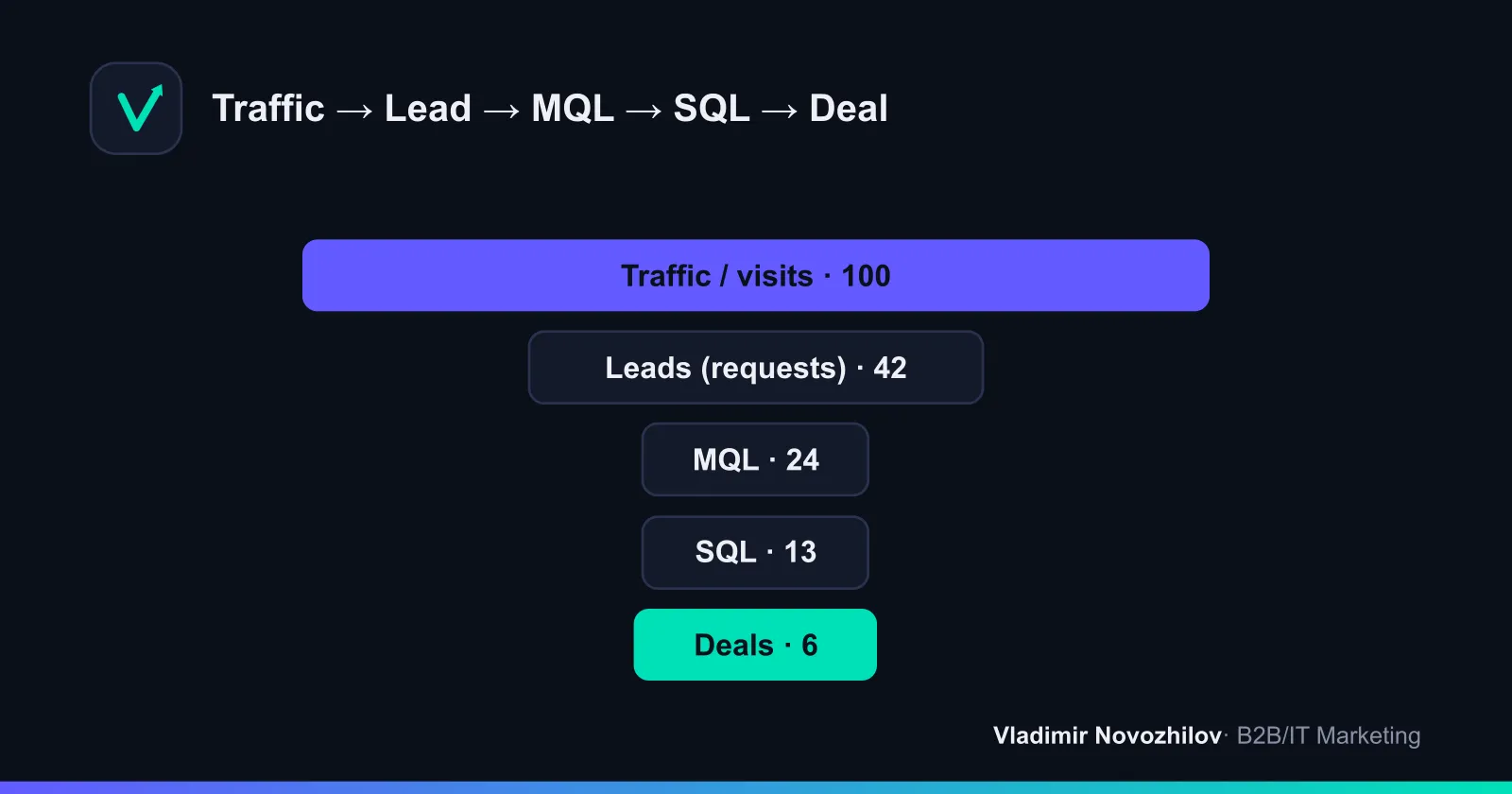
For lead handoff to sales to work, you need a shared frame of reference. It’s defined by two statuses — MQL and SQL.
- MQL (Marketing Qualified Lead) — a lead that marketing has deemed “ripe” enough for handoff: it matches the target customer profile and has shown engagement (demo request, repeat visits, response to nurturing). Marketing’s zone of responsibility ends here.
- SQL (Sales Qualified Lead) — a lead that sales has verified through a conversation and confirmed: there’s a need, a budget, and readiness to discuss a deal. This is now sales’ zone of responsibility.
The MQL → SQL boundary is the most contentious point. It’s exactly what the SLA defines: which signals make a lead an MQL, and which conditions make it an SQL. Below is a comparison worth agreeing on in writing.
| Criterion | MQL (handed off by marketing) | SQL (accepted by sales) |
|---|---|---|
| Who assigns the status | Marketing, via lead scoring | Sales, after the first conversation |
| Basis | Profile match + engagement | Confirmed need and budget |
| Data completeness | Name, company, contact, source | + decision-maker role, timeline, task |
| Deal readiness | Interested, no decision yet | Ready to discuss terms |
| Department metric | MQL-to-SQL rate, CPL | Deal conversion, revenue |
Lead qualification: BANT, SNAP, and lead scoring
For an MQL status not to be subjective, lead qualification relies on a methodology. The most common is the BANT methodology: Budget, Authority (decision-making power), Need, Timeline. If a lead passes three out of four criteria, it can move to SQL. For complex deals, teams use SNAP — focusing on simplicity for the customer and prioritizing their goals.
The second tool is lead scoring: every action and attribute of a lead is assigned points. For example: decision-maker title +20, target industry +15, downloaded a price list +10, opened an email +2, corporate email address +5, free email domain −10. Once the total exceeds a threshold (say, 50 points), the lead automatically becomes an MQL and moves to sales. Lead scoring removes arguments about “bad leads”: the criteria are set in advance and apply equally to everyone.
What makes up an SLA: marketing and sales obligations
An SLA is a two-way document. Each side takes on measurable commitments. Below is a comparison table of what marketing delivers and what sales delivers.
| Marketing’s obligations | Sales’ obligations |
|---|---|
| Hand off only leads meeting MQL criteria | Respond to an MQL within the response time target |
| Ensure data completeness (contact, company, source, score) | Make the agreed number of contact attempts (e.g., 5 within 3 days) |
| Maintain the agreed monthly MQL volume | Log accurate statuses and rejection reasons in the CRM |
| Don’t inflate scoring just to hit a lead quota | Return immature leads to marketing for nurturing instead of rejecting them |
| Control cost per lead (CPL) and channel quality | Provide weekly feedback on lead quality |
The key principle: every point is backed by a number. “Respond quickly” is not a commitment. “First contact within 5 minutes for hot leads and within 60 minutes during business hours for the rest” is.
How to calculate SLA target metrics
An SLA rests on four metrics. Let’s break down each one with a formula and a sample calculation — we’ll replace a calculator with clear arithmetic.
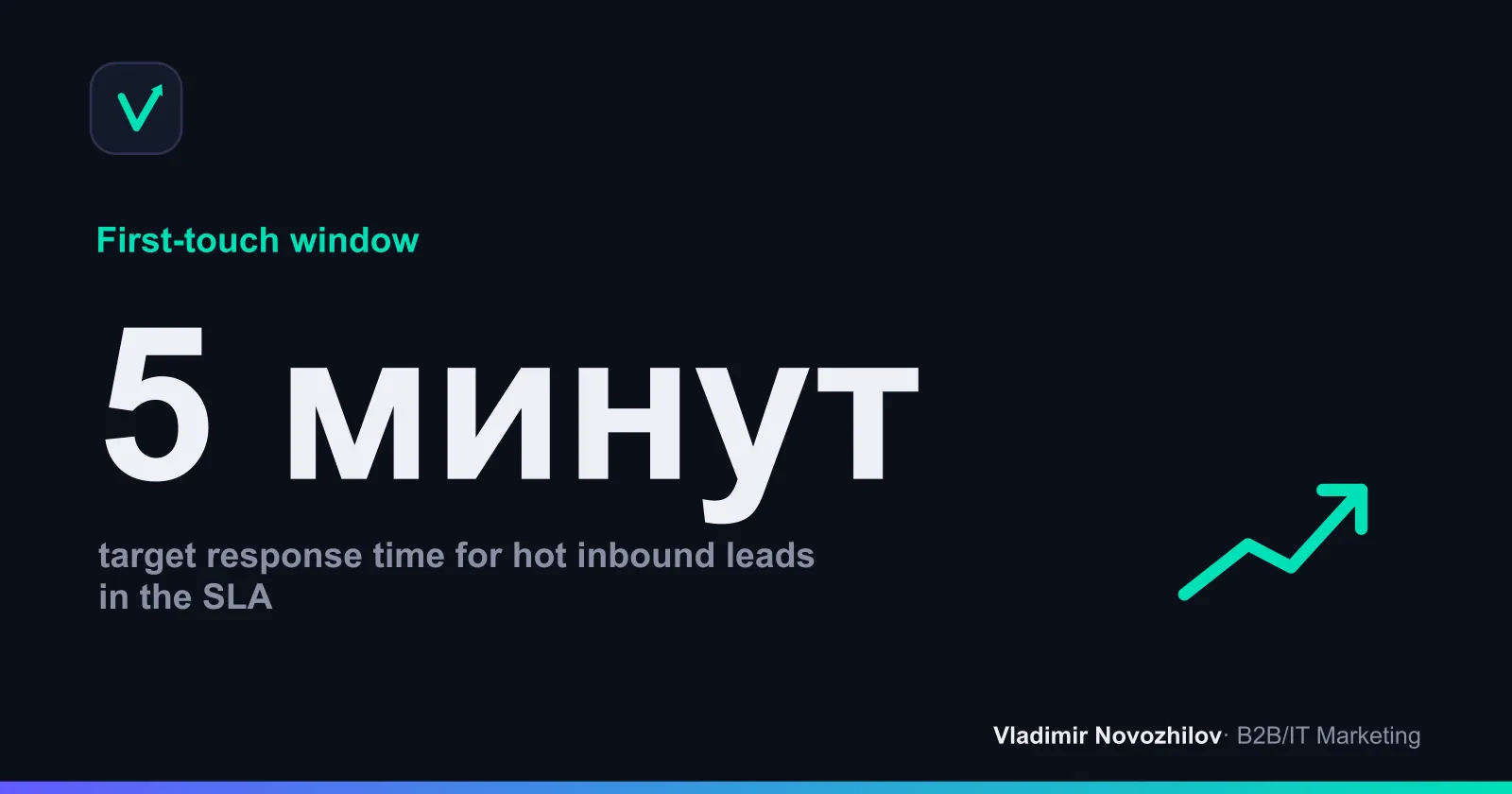
1. Response time (time to first contact). The average time from lead handoff to the first touch by a rep. The target for hot inbound leads is 5 minutes; for the rest in B2B, 30-60 minutes during business hours.
2. SLA compliance rate. The share of leads handled on time.
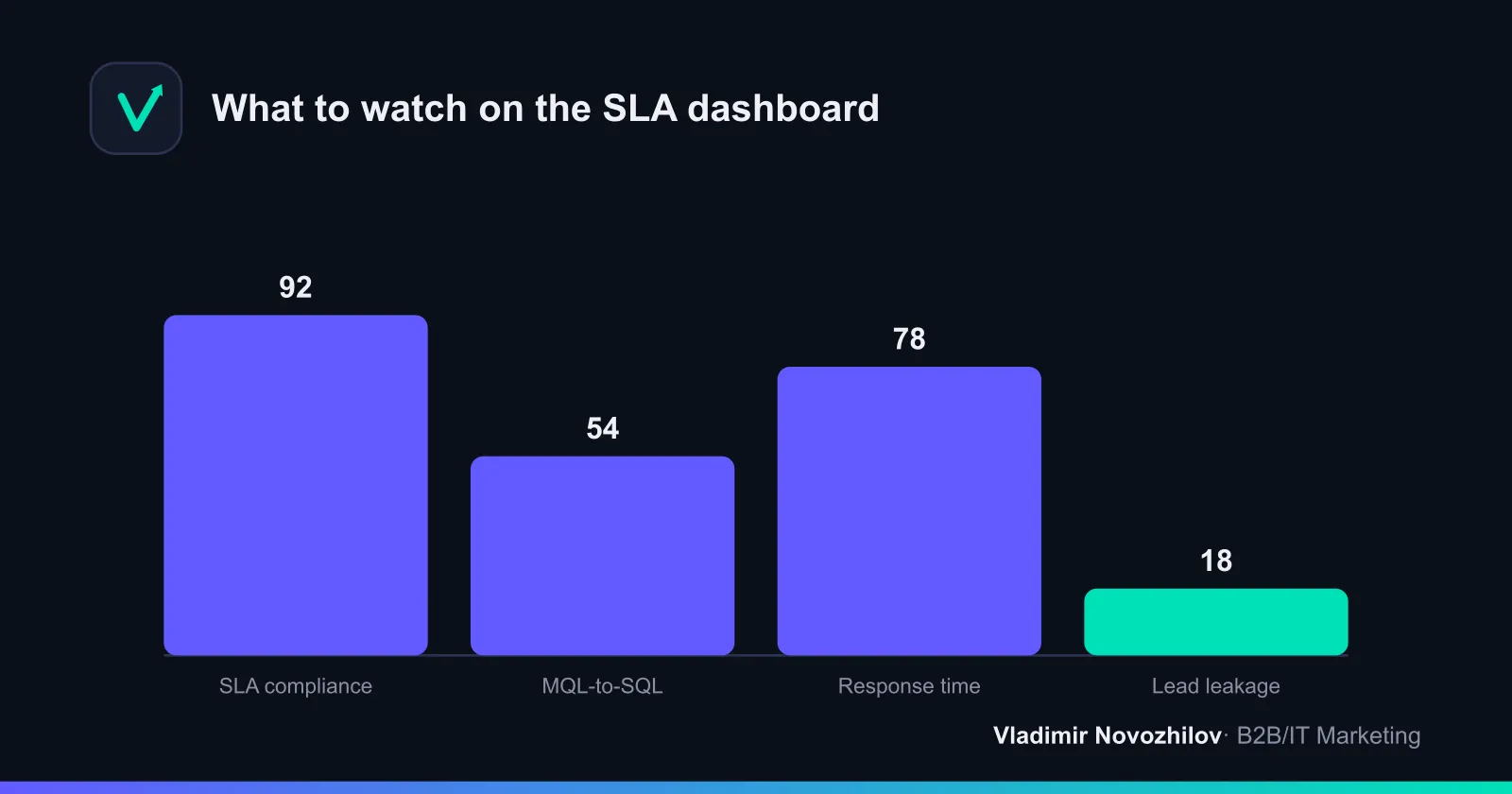
Formula: SLA compliance = (leads handled on time / all leads handed off) × 100%. Example: out of 200 MQLs, 184 were handled on time → 184 / 200 × 100 = 92%.
3. Lead leakage rate. The share of handed-off leads that received no follow-up at all.
Formula: lead leakage = (unhandled leads / all leads handed off) × 100%. Example: out of 200 MQLs, 24 got no touch at all → 24 / 200 × 100 = 12%. The target is to keep this below 10%.
4. MQL-to-SQL rate (qualification conversion). Shows how genuinely sales-ready the marketing leads actually are.
Formula: MQL-to-SQL = (number of SQLs / number of MQLs) × 100%. Example: out of 200 MQLs, sales confirmed 108 as SQLs → 108 / 200 × 100 = 54%.
Also track end-to-end lead-to-deal conversion and cost per lead (CPL) by channel — so you see not just speed, but the underlying economics.
| Metric | Formula | Benchmark (B2B/services) |
|---|---|---|
| Response time | time to first contact | 5 min (hot), ≤60 min (other) |
| SLA compliance rate | handled on time / total × 100% | ≥ 90% |
| Lead leakage rate | unhandled / total × 100% | < 10% |
| MQL-to-SQL rate | SQL / MQL × 100% | 40-60% |
| Deal conversion | deals / SQL × 100% | depends on niche |
Step-by-step algorithm for handing a lead off from marketing to sales
Here’s a lead handoff process you can implement on any team. It describes how to pass a lead to the sales department without losses.
- The lead enters the CRM. A form submission from the website, a landing page, or a call automatically creates a record with source and UTM data. Manual entry is a source of errors and leaks.
- Automatic lead scoring. The system calculates points based on profile and behavior. Once the threshold is crossed, the lead is marked MQL.
- Data completeness check. If key fields are missing (company, contact, industry), the lead goes back to marketing for nurturing instead of being sent to sales “as is.”
- Handoff and rep assignment. A CRM trigger assigns an owner and creates a task with a response-time deadline. The rep gets a notification.
- First touch on time. The rep reaches out within the standard and qualifies the lead using BANT.
- Status assignment. The lead either becomes an SQL and moves through the sales funnel, or is returned to marketing with a reason (“too early,” “no budget,” “not the decision-maker”).
- Escalation on missed deadlines. If the touch isn’t made on time, the task is automatically reassigned to another rep or escalated to a manager. This is the main safeguard against lead leakage.
- Feedback loop. Rejection reasons are aggregated and reviewed weekly with marketing to improve scoring and channel quality.
Marketing-sales SLA agreement template
Below is a ready-made structure for a contract between marketing and sales. Copy it into a document and fill in your own numbers.
1. Purpose. A unified funnel and shared revenue goal; eliminate losses in lead handoff between departments.
2. Definitions. What counts as a lead, an MQL, an SQL; the lead scoring threshold; BANT criteria for SQL.
3. Marketing’s obligations.
- MQL volume: ___ per month.
- MQL criteria: ___ (profile + score ≥ ___ points).
- Data completeness: required fields ___.
- Target cost per lead (CPL): no higher than ___.
4. Sales’ obligations.
- Response time: ___ minutes for hot leads, ___ for the rest.
- Number of contact attempts: ___ within ___ days.
- Mandatory status and reason logging in the CRM.
- Returning immature leads for nurturing instead of rejecting them.
5. Metrics and targets. SLA compliance ≥ ___%, lead leakage < ___%, MQL-to-SQL ___%.
6. Escalation process. What happens when a touch deadline is missed or the MQL plan is missed.
7. Rituals. Weekly sync, monthly retro, a shared dashboard.
8. Review cycle. Quarterly — update the numbers and criteria.
The role of CRM and automation in maintaining SLA compliance
Without automation, an SLA survives exactly until the first busy period. CRM for leads is the foundation: it logs source, the timing of every touch, statuses, and rejection reasons. This is the data that produces honest metrics.
What’s worth automating:
- Webhooks and auto-created records. A form submission from any channel goes straight into the CRM, with no manual transfer.
- Assignment triggers. MQLs are automatically assigned to reps based on rules (region, product, workload).
- Response-time timers. The system tracks the first-touch deadline and flags overdue leads.
- Auto-escalation. If a touch is overdue, the task moves to another rep or a manager. This is a direct hit against lead leakage.
- A dashboard. Real-time values for all SLA metrics on one screen, with no manual data pulls.
Smarketing: regular rituals for team alignment
A document without rituals is dead. Marketing-sales alignment is sustained by three regular practices:
- Weekly sync (30 minutes). Review the dashboard: response time, compliance, leakage, lead quality by channel. Discuss the numbers, not the people.
- Monthly retro. What to improve in scoring, MQL criteria, qualification scripts. This is where the SLA itself gets adjusted.
- Quarterly goal review. Update MQL volumes, CPL, and conversion targets to match the revenue plan.
These rituals are what smarketing actually looks like in practice: the departments stop being a “supplier” and a “consumer” of leads and become one team sharing a common sales funnel.
How to monitor SLA compliance: dashboards and reporting
One dashboard, one source of truth. Display: SLA compliance rate, average response time, lead leakage rate, MQL-to-SQL rate, deal conversion, and CPL by channel. Break it down by rep, channel, and lead type.
Rule of good reporting: both departments and leadership see the same metrics. When the numbers are transparent, the “who’s to blame” argument turns into “what do we fix in the process.” That’s exactly the goal of marketing-sales alignment.
Common mistakes when implementing an SLA and how to avoid them
- An SLA that only covers sales. If the obligations are one-sided, the document won’t stick. Both sides need measurable standards.
- MQL criteria that are too strict. Marketing stops passing leads through — volume drops. Find the balance using the MQL-to-SQL rate.
- No escalation. Without auto-reassignment, missed deadlines become the norm.
- Metrics for their own sake. If compliance is 100% but there are no deals, revisit the quality criteria, not just the speed.
- Discussing violations personally. Talk about the process and the numbers, or you’ll get sabotage instead of alignment.
- A document that’s never revisited. The market changes — update the numbers every quarter.
Marketing-sales SLA implementation checklist
- Agreed on unified definitions of a lead, an MQL, and an SQL.
- Set up lead scoring and the threshold for MQL status.
- Documented obligations for both sides with specific numbers.
- Set target metrics: response time, compliance, leakage, MQL-to-SQL.
- Configured the CRM: auto-creation, assignment, timers, escalation.
- Built a single dashboard accessible to both departments.
- Launched a weekly sync and a monthly retro.
- Scheduled a quarterly SLA review.
- Agreed on the process for returning immature leads for nurturing.
- Documented everything in a single contract between marketing and sales.
Lead handoff to sales stops being a source of conflict the moment it becomes a measurable process with shared rules. An SLA, honest metrics, a CRM with escalation, and regular smarketing rituals turn disconnected departments into a single team that drives a lead through to a closed deal instead of losing it somewhere in between.
FAQ
- What is an SLA between marketing and sales in simple terms?
- An SLA (Service Level Agreement) between marketing and sales is a written agreement that fixes the mutual obligations of both departments: which lead marketing considers qualified and hands off to sales, and how quickly and with how many touches sales must work it. Essentially, it's a contract between marketing and sales that removes disputes like 'the leads are bad' or 'sales isn't calling' and makes the work of both teams measurable.
- How fast should sales respond to a lead under an SLA?
- The benchmark for hot inbound leads is first contact within 5 minutes: research shows the chance of reaching and qualifying a lead in that window is many times higher than after an hour. In B2B with a long sales cycle, 30-60 minutes during business hours is acceptable. The exact response time target is set in the SLA and depends on lead type and channel.
- Who is responsible for lead quality: marketing or sales?
- Responsibility is split. Marketing is responsible for ensuring that the MQL handed off matches agreed lead qualification criteria (profile, need, data completeness). Sales is responsible for the speed and quality of follow-up: meeting response time, the number of contact attempts, and correctly logging statuses. The SLA defines both zones, so the 'whose fault is it' argument is settled with numbers, not emotions.
- How do you measure the effectiveness of a marketing-sales SLA?
- Track four metrics: SLA compliance rate (share of leads handled on time), response time (average time to first contact), lead leakage rate (share of leads lost without follow-up), and MQL-to-SQL rate (conversion from marketing lead to sales-qualified lead). Also monitor lead-to-deal conversion and cost per lead (CPL).
- What should you do if sales isn't meeting the lead-handling SLA?
- First, diagnose the cause using the dashboard: rep overload, an inconvenient handoff process, or genuinely weak leads. Then implement automatic lead escalation - if a touch isn't made in time, the task is reassigned or escalated to a manager. Discuss violations at a weekly sync meeting based on the numbers, not individuals, and adjust either the process or the MQL criteria.
- How do you implement an SLA if the company has no CRM?
- You can start with a shared spreadsheet and a messaging app: define MQL criteria, a target response time, and a lead handoff format, and track everything manually. But without a CRM for leads, you won't see real lead leakage or response times, and escalation will remain manual. So a spreadsheet is a temporary 1-2 month starting point, after which you should implement a CRM with triggers and a dashboard.