SEO Competitor Analysis: Keywords and Links Methodology


TL;DR
SEO competitor analysis means collecting and comparing keywords, links, SERPs, structure, and commercial factors of sites already ranking for your queries. The goal is to find gaps (Keyword Gap, Link Intersect) and turn them into a prioritized 90- and 180-day traffic growth plan.
SEO competitor analysis is a systematic collection and comparison of data about sites already ranking in the top for your queries: their keywords, backlink profile, SERP presence, structure, and commercial factors. The goal isn’t to copy the leaders, but to find gaps between you and the top and turn them into a prioritized growth plan. Below is a step-by-step methodology: how to find competitors, conduct competitor keyword analysis and competitor backlink analysis, consolidate everything into tables, and build a 90- and 180-day roadmap.
What SEO Competitor Analysis Is and Why You Need It
SEO competitor analysis answers three questions: which queries drive traffic to sites in the top, what keeps them there, and what of that you can replicate or do better. It’s the foundation of strategy: instead of guessing, you work with facts about the niche.
Why this matters for B2B, IT, and service businesses:
- Budget savings. You don’t test hypotheses blindly — you take the “query → page type → links” combinations that have already proven effective in the SERPs.
- Speed. Competitor analysis in SEO shortens the path to results: in a week you get a demand map that would otherwise take months to build on your own.
- Priorities. Data shows where the gap is critical (an entire cluster of pages missing) and where it’s cosmetic (just a few links short).
Quick Start: A 5-Step Checklist and Analysis Plan
If you’re short on time, run through this checklist — it covers 80% of the value for 20% of the effort.
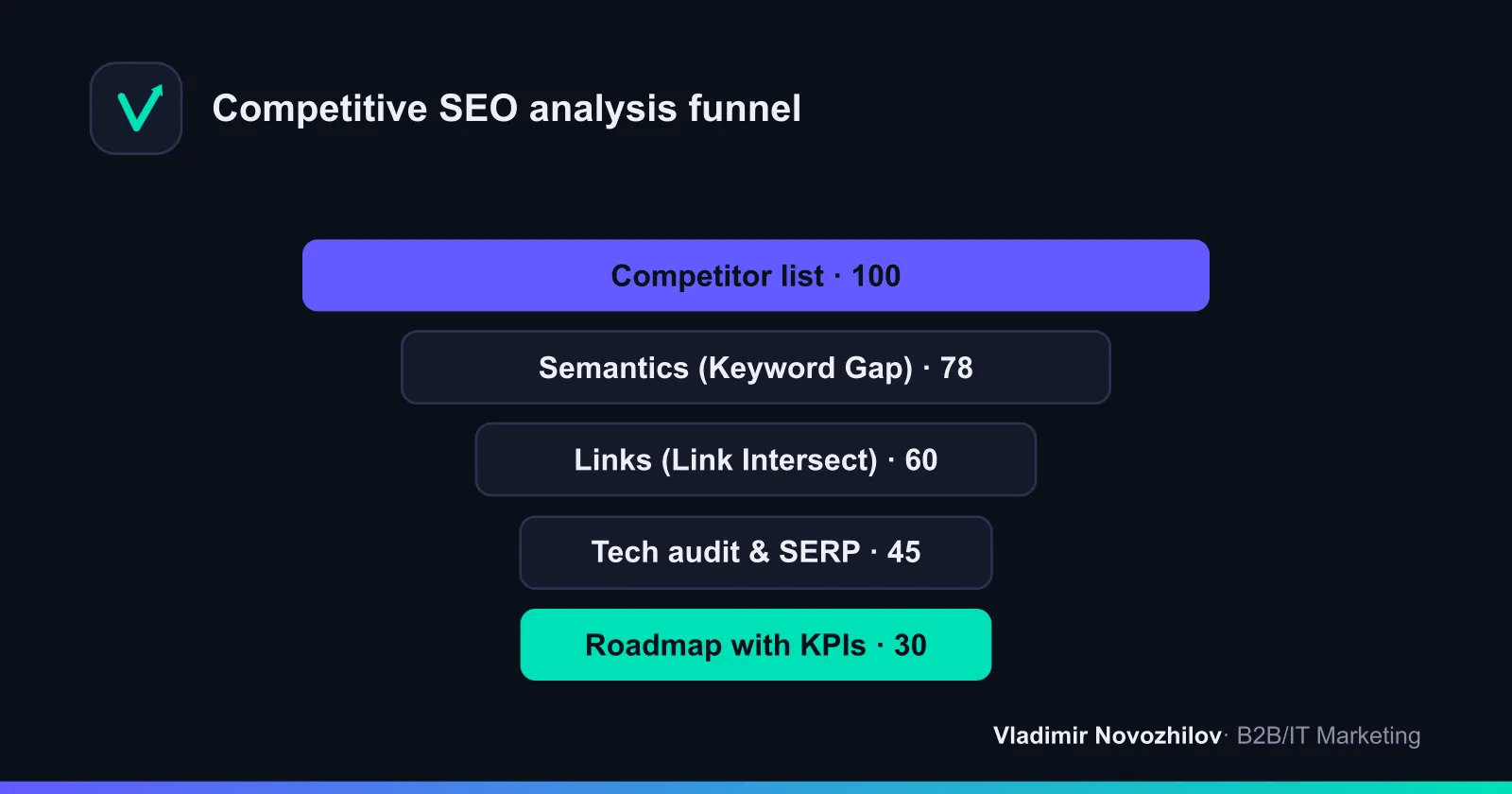
- Gather 5–7 competitors — from the top-10 SERPs and from visibility tools.
- Export keywords and find gaps through Keyword Gap analysis.
- Assess backlinks — donors, anchors, dynamics; highlight Link Intersect opportunities.
- Check technical setup and SERPs — Core Web Vitals, indexing, snippets.
- Consolidate data into tables and build a roadmap with KPIs.
Below is a detailed breakdown of each step.
How to Identify Direct, Indirect, and Potential Competitors
A common beginner mistake is picking competitors “by business type.” In SEO, a competitor is whoever sits next to you in the SERPs — even if they sell something different.
- Direct competitors — sites in the same niche ranking in the top 10 for your commercial queries.
- Indirect competitors — aggregators, marketplaces, and directories that intercept your demand.
- Potential competitors (info competitors) — blogs and media outlets capturing the top of the funnel for informational queries.
How to build the list: manually check 15–20 key queries, record the domains appearing in the top 10, then run the niche through visibility tools (Keyso, SE Ranking, Pixel Tools) and add leaders you missed manually. Aim to settle on 5–7 sites.
Analyzing Competitor Visibility and SERP Rankings
Site visibility analysis shows a domain’s total reach across the entire keyword set, not just one query. It’s the first metric used to compare competitors.
Simplified visibility formula (VIS):
VIS = Σ ( position_CTR × query_volume )where position_CTR is the click share typical for a position (roughly 30% for the first spot, 15% for the second, and so on), and query_volume is the search demand for the query. The more queries ranking in the top, and the higher their volume, the greater the visibility.
When analyzing competitor SERPs, track: the share of queries in the top 3 and top 10, the types of pages ranking, and the presence of special elements (sitelinks, images, AI overviews). Separately, look at competitor traffic analysis — the organic traffic estimate in Keyso or Ahrefs — which shows which sections feed the site.
Don’t Forget AI Search
Check who Yandex’s and Google’s generative answers cite for your queries. Often these are sites with clear definitions, tables, and a “question — short answer” structure. Presence in AI overviews is a new part of competitor SERP analysis that most people still ignore.
Analyzing Competitor Keywords and Semantic Core (Keyword Gap)
Competitor keyword analysis isn’t just exporting their queries — it’s finding what you’re missing. This is where Keyword Gap analysis comes in.
Keyword Gap is a method for finding queries where competitors rank in the top and you’re absent or below position 10. Step by step, competitor query analysis looks like this:
- Upload your domain and 3–5 competitors into a tool (Keyso, SE Ranking, Ahrefs).
- Build an intersection report — the tool will show who ranks for which queries.
- Filter rows where competitors are in the top 10 but you have no ranking.
- Sort by search volume and commercial intent.
- Cluster the queries — group them by meaning for future pages.
The result of competitor semantic core analysis is a ready-made list of topics. Sample Keyword Gap export fragment:
| Query | Volume | Your Position | Competitor A | Competitor B | Action |
|---|---|---|---|---|---|
| turnkey CRM implementation | 1,900 | — | 3 | 5 | New landing page |
| CRM integration with 1C | 720 | 34 | 6 | 8 | Update copy + internal linking |
| CRM data migration | 480 | — | 4 | 11 | New blog article |
| CRM implementation cost | 2,600 | 18 | 2 | 4 | Separate pricing page |
This report is a map of keyword gaps. Each row becomes a task: create a page, expand the copy, or strengthen internal linking.
Analyzing Competitor Traffic and Traffic Sources
Competitor traffic analysis complements keyword research: it shows not just queries but channels. Use tools to assess the organic traffic distribution across sections, the share of branded traffic, and seasonality. If a competitor gets 60% of its organic traffic from a blog and you don’t have one — that’s a strategic gap, not a minor fix. Also check whether the domain’s traffic is growing or declining over the past 12 months: a declining leader is a signal not to copy its tactics.
Analyzing Competitor Backlink Profiles (Link Intersect, Anchors, Donors)
Competitor link analysis answers the question of why, with similar content, one site outranks another. Backlink profiles are assessed across several parameters.
What to check in competitor backlink profile analysis:
- Number and quality of donors — how many unique domains link to the site, and what’s their DR (Domain Rating) and ICS.
- Anchor text list — the ratio of branded, generic, and commercial anchors. A skew toward exact-match commercial anchors signals risky link building.
- Follow/nofollow ratio — a healthy profile has a natural mix.
- Growth dynamics — steady growth versus sudden spikes (the latter often indicates purchased links).
Link Intersect is a method for finding donors that link to several of your competitors at once but not to you. The logic is simple: if a site already links to three players in the niche, it’s highly likely to agree to link to you too. These donors are priority #1 for building your link profile.
Step by step: upload 3–4 competitors into a Link Intersect report (Ahrefs, Keys.so, Megaindex), filter the intersections, sort by DR and topical relevance, and compile a list for outreach or link building.
Analyzing Competitor Site Structure and Content
A competitor’s structure is easy to crawl with Screaming Frog: you get a map of all URLs, page types, depth, meta tags, and headings. Compare it to your own: which categories and filters the leader has that you’re missing.
For content, track: typical word count on landing pages, presence of FAQ blocks, tables, and reviews, the H1–H3 heading structure, and use of Schema.org markup. Often the gap in the top isn’t about links — it’s a more complete structure that addresses more user intents.
Technical Audit of Competitors: Speed, Indexing, Core Web Vitals, Schema.org
A technical audit of competitors helps you understand the niche’s technical “ceiling.” Consolidate the parameters into a table.
| Parameter | Competitor A | Competitor B | Your Site | Tool |
|---|---|---|---|---|
| Core Web Vitals (LCP) | 2.1 s | 3.4 s | 3.9 s | PageSpeed Insights |
| HTTPS | Yes | Yes | Yes | Browser |
| Indexed pages | 1,240 | 860 | 610 | site:, Webmaster |
| robots.txt / sitemap.xml | Correct | Errors | Correct | Manual check |
| Schema.org | Product, FAQ | Absent | Organization | Markup validator |
| 404 page | Custom | Default | Custom | Manual check |
| Duplicate titles | None | Present | Present | Screaming Frog |
This kind of technical audit immediately highlights quick wins: if your LCP is worse and your Schema.org markup is thinner, those are fixes for the first few weeks.
Analyzing Commercial Factors and Behavioral Signals
Commercial ranking factors matter especially for services and B2B businesses: search engines assess how trustworthy and purchase-friendly a site is. Go through competitors and note where you stand on:
- pricing, plans, and calculators;
- contact details, business info, and multiple ways to get in touch;
- reviews, case studies, certificates, and guarantees;
- ease of use for cart/inquiry forms and the number of steps to contact.
Behavioral factors (scroll depth, time on site, pogo-sticking back to SERPs) can’t be exported directly, but the same work indirectly improves them: a clear structure, a fast site, and well-addressed intents.
Summary Table of Competitor Analysis Tools
Below is a working chain: “step → task → tool → result → deadline.” It also serves as a comparison of free and paid methods. A separate category of tools is AI for competitor analysis, which speeds up parsing keywords and content.
| Step | Task | Tool | Free/Paid | Result | Deadline |
|---|---|---|---|---|---|
| 1 | List of competitors | Keyso, Pixel Tools, manual search | Partial | 5–7 domains | Day 1–2 |
| 2 | Competitor keyword analysis | Keyso, SE Ranking, Ahrefs | Paid (with limits) | Keyword Gap report | Day 3–7 |
| 2 | Demand and search volume | Yandex.Wordstat, Keyword Planner | Free | Query clusters | Day 3–7 |
| 3 | Competitor backlink analysis | Ahrefs, Megaindex, Keys.so | Partial | List of donors, Link Intersect | Day 8–12 |
| 4 | Site structure | Screaming Frog, Topvisor | Partial | URL and meta map | Day 10–14 |
| 5 | Technical audit and CWV | PageSpeed Insights, Screaming Frog | Free | Parameter table | Day 12–16 |
| 6 | Visibility and rankings | Keyso, SEMrush, Topvisor | Paid | Visibility graph | Ongoing |
Comparing Competitors by Visibility and Reach
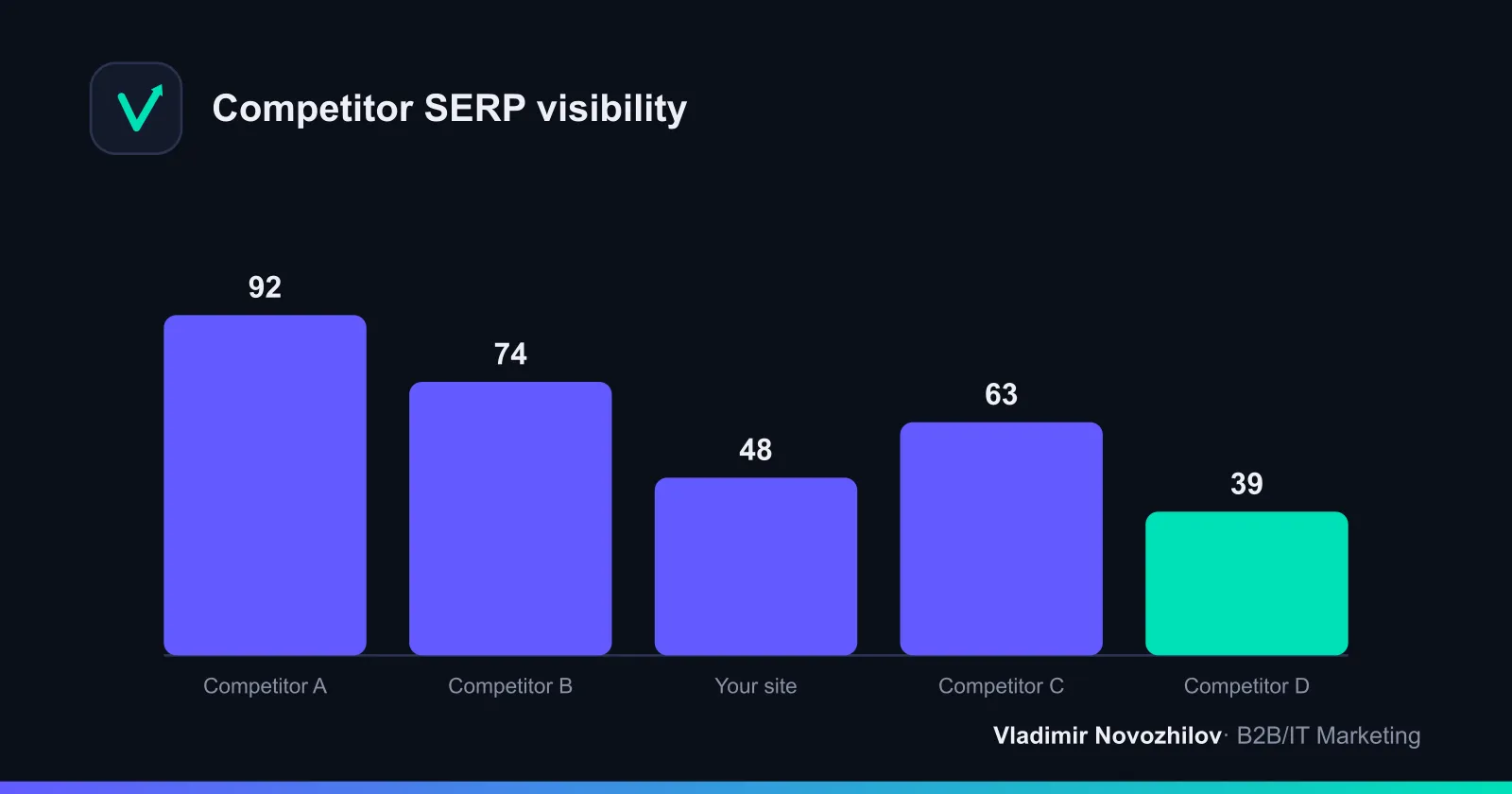
To base decisions on data, consolidate the leaders into a single table — this is the foundation of your strategy.
| Site | Visibility (VIS) | Queries in Top 10 | Donors | DR | Estimated Traffic/Month |
|---|---|---|---|---|---|
| Competitor A | 92 | 4,200 | 1,800 | 61 | 210,000 |
| Competitor B | 74 | 3,100 | 920 | 54 | 140,000 |
| Competitor C | 63 | 2,400 | 610 | 48 | 96,000 |
| Your site | 48 | 1,500 | 340 | 41 | 58,000 |
| Competitor D | 39 | 1,100 | 280 | 37 | 41,000 |
This comparison shows a realistic goal: not catching up to the leader right away, but closing the gap with the nearest competitor above you by addressing specific keyword and link gaps.
Common Mistakes in Competitor Analysis
- Picking competitors by business type rather than SERP presence — and analyzing sites that aren’t actually capturing your traffic.
- Copying word count instead of intent — meeting the user’s need matters more than hitting a character count.
- Focusing only on links — with weak structure and technical setup, links alone won’t help.
- Analyzing once and forgetting about it — SERPs are dynamic and require ongoing visibility monitoring.
- Ignoring commercial ranking factors — in services and B2B, these are often the deciding factor.
- Blindly copying a declining leader — check their traffic trend first.
Roadmap: Turning Analysis Data into a 90- and 180-Day Promotion Plan
Data is useless without a plan. Below is a roadmap template with KPIs that you can adapt to your site.
Days 1–30 (quick wins):
- close 5–10 priority Keyword Gap items on existing pages;
- fix technical errors from the table (Core Web Vitals, duplicates, Schema.org);
- KPI: +15% pages with correct markup, LCP < 2.5 s.
Days 31–90 (keyword growth):
- create 8–15 new pages for clusters identified in the Keyword Gap analysis;
- launch Link Intersect: 10–20 new donors;
- KPI: +25% queries in top 10, visibility +20%.
Days 91–180 (consolidation):
- scale content and internal linking, strengthen commercial factors;
- keep building the backlink profile with natural anchors;
- KPI: +50–60% organic traffic, parity in visibility with the closest competitor.
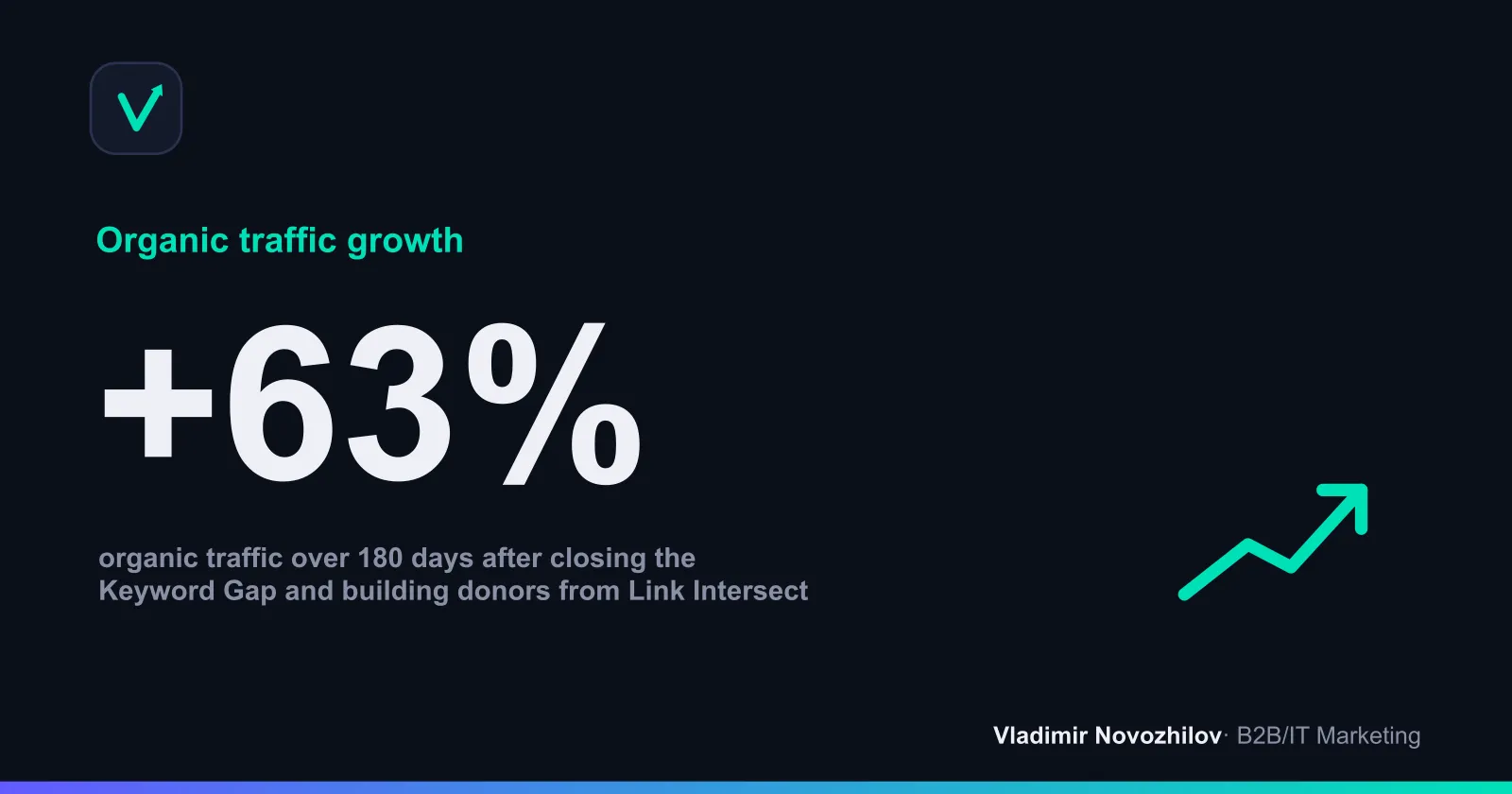
A real-world example from a B2B service site: after the team closed 40 gaps from the Keyword Gap report and added 18 donors from Link Intersect, organic traffic grew by 63% over 180 days, and the number of top-10 queries nearly doubled. The key wasn’t the volume of work but data-driven prioritization — starting with the highest-volume, most commercial gaps first.
Conclusion
SEO competitor analysis isn’t a one-time export — it’s an ongoing cycle: gather sites, find keyword and link gaps, check technical setup and SERPs, consolidate everything into tables, and turn it into a roadmap with KPIs. Start with the five-step checklist, close the quick wins first, then scale your keywords and backlink profile. This approach delivers predictable growth because you’re working with facts about the niche, not guesses.
FAQ
- How often should you conduct SEO competitor analysis?
- A full competitor analysis in SEO is worth doing quarterly, while monitoring visibility and new backlinks should happen monthly. In highly competitive niches (law, finance, medicine), track SERPs weekly — rankings and top-10 composition change faster there, and gaps need to be closed more promptly.
- How many competitors are enough to analyze — 3, 5, or 10?
- For a workable result, take 5–7 sites: 3–4 direct competitors from the top 10 for commercial queries and 2–3 visibility leaders from analytics tools. Fewer than three gives too little data for comparison, while more than ten dilutes the analysis and slows decision-making.
- What free tools work for basic competitor analysis?
- Free tiers are enough to start: Yandex.Wordstat and Google Keyword Planner for queries, Screaming Frog (up to 500 URLs) for structure, PageSpeed Insights for Core Web Vitals, free Ahrefs Webmaster Tools and Megaindex reports for links, and the Yandex.Webmaster panel for ICS.
- What is Keyword Gap analysis and how do you use it?
- Keyword Gap analysis finds queries where competitors rank in the top and you're absent or below position 10. Load 3–5 domains into a tool (Keyso, SE Ranking, Ahrefs), export the intersection, filter by search volume and commercial intent — that's a ready-made list of topics for new pages.
- How do you check a competitor's backlink profile for free?
- Use the free tiers of Ahrefs, Megaindex, and Keys.so: they show the number of referring domains, link growth dynamics, DR, and anchor text lists. To prioritize donors, apply Link Intersect — find sites that link to several competitors at once but not to you.
- Should you analyze competitors in AI search and generative answers?
- Yes. Check who Yandex and Google AI overviews (SGE, YandexGPT) cite for your queries. Often it's the same sites with clear structure, definitions, and tables. Format your content so fragments are easy to extract — this increases the chance of appearing in a generative answer.