Webinar for Lead Generation: How to Attract Leads

TL;DR
A lead-generation webinar is an online event that attracts a target audience via a landing page, educates them, and converts them into leads through a sales block. Average attendance is 30–45% of registrations, and viewer-to-lead conversion is 15–30%. Success depends on the topic and offer, promotion, the structure of the session, and systematic lead follow-up through CRM.
A lead-generation webinar is a controllable channel where, in a single session, you gather a target audience, demonstrate expertise, and turn viewers into requests. Unlike an article or an ad, a webinar provides live contact, builds trust, and creates a natural moment for the offer. Below is a practical guide: webinar types, choosing a topic and offer, promotion, session structure, lead-generation metrics, post-webinar lead follow-up, and CRM integration. Includes tables, a checklist, templates, and case studies.
What a lead-generation webinar is and why it works
Lead generation through webinars is built on simple logic: a person spends 60–90 minutes of their time on you, which means they’re already more engaged than a banner reader. A lead-gen webinar solves three tasks at once — nurturing, qualification, and contact collection.
Why this is one of the most effective lead-generation channels:
- Deep contact. In an hour-long session, you address objections that would take weeks to resolve over messaging.
- Natural qualification. The webinar topic filters out irrelevant prospects on its own: a session titled “How to Scale Your Sales Department” attracts people who actually have a sales department.
- Contact data upfront. Registration is already a webinar lead, even if the person doesn’t attend the live session.
- Reusability. The recording works as an automated funnel for months.
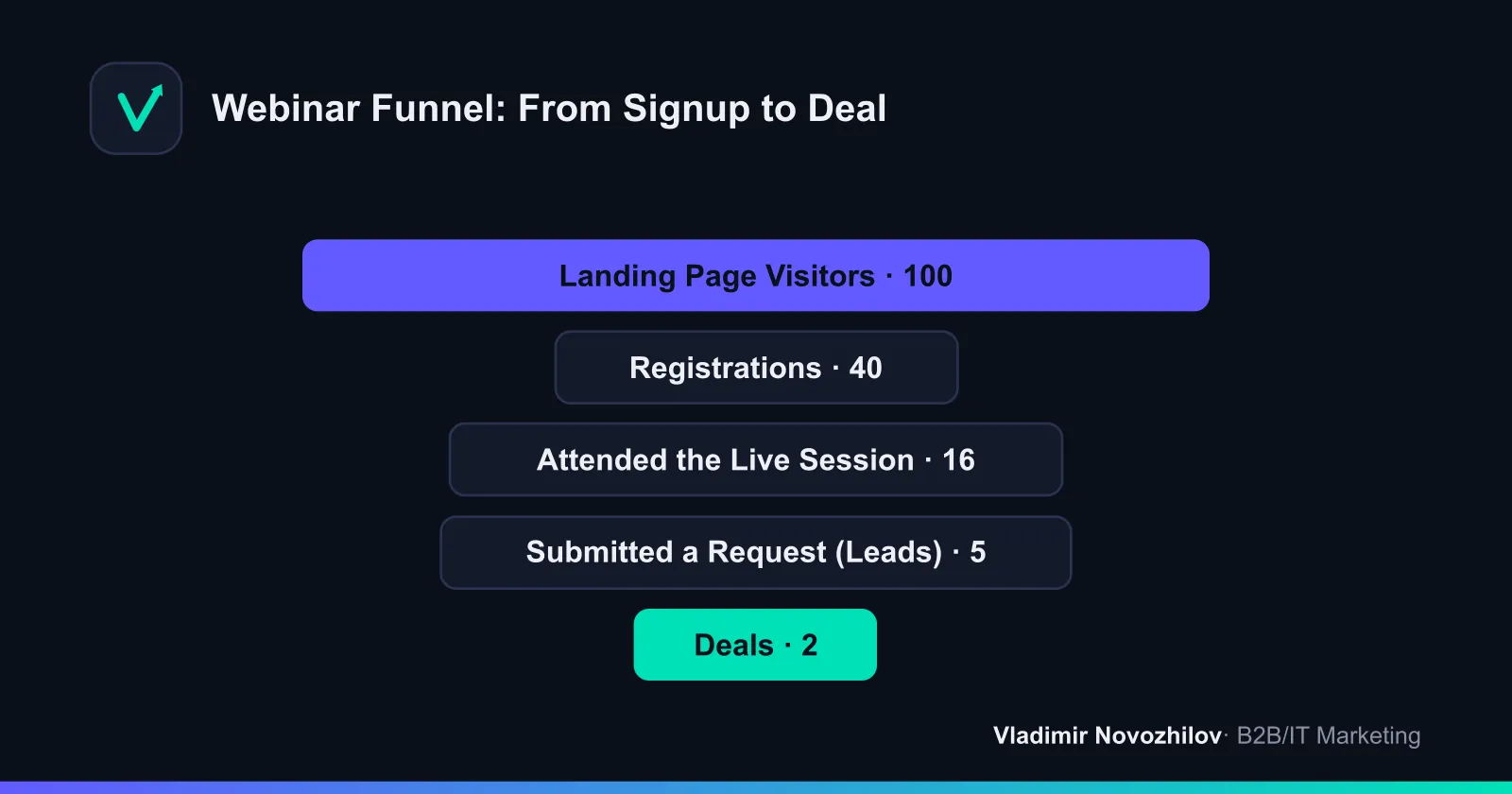
Key idea: the webinar sales funnel doesn’t start with the live session — it starts with the landing page — and it doesn’t end with the final slide either; it continues through follow-up emails and calls.
Types of lead-generation webinars
Different formats work for different goals. Choose based on how warm the audience is and what you’re selling.
| Webinar type | Goal | Audience | What converts |
|---|---|---|---|
| Educational | Attract cold leads, showcase expertise | Broad, top of funnel | Value + soft offer at the end |
| Expert (trend analysis) | Positioning, reach decision-makers | Mid-funnel, executives | Invitation to a consultation |
| Product (demo) | Nurture warm leads toward a deal | Narrow, brand-aware | Demonstration and special offer |
| Sales webinar | Direct product sale | Warm, loyal | Limited-time offer, deadline |
For B2B customer acquisition, the “educational → product” combo tends to work best: the first builds the base, the second closes the deal. A sales webinar aimed directly at a cold audience almost always underperforms.
How to choose a topic and offer that attract targeted leads
The topic accounts for 50% of the result. It needs to hit a sharp pain point for the segment and promise a concrete outcome — not just “discuss the market.”
Formula for a strong topic: pain point + result + specificity. For example, not “Marketing in 2025,” but “How to Cut B2B Lead Cost by 30% Without Increasing Budget.”
The offer is what you present at the end. A good offer for a lead webinar:
- Follows logically from the topic (you promised to lower CPL — you offer a funnel audit).
- Has tangible value and an easy first step (a free assessment, a checklist, a trial period).
- Is limited by time or quantity — this boosts webinar-to-lead conversion.
Stages of preparing a sales webinar: goal, audience, script
Step-by-step preparation looks like this:
- Goal and metric. Determine how many leads you want and at what CPL. This drives your budget.
- Audience and their journey. Map out the Customer Journey Map and decision-maker persona: their objections, context, what they’re looking for.
- Topic and offer (see above).
- Script. Break the session into timed blocks (template below).
- Webinar landing page with a registration form.
- Promotion and nurture emails.
- Technical rehearsal.
Webinar script template (60–75 minutes)
| Block | Time | Task |
|---|---|---|
| Greeting and promise | 0–5 min | State what the viewer will take away from the session |
| Problem framing | 5–15 min | Sharpen the pain point, show the cost of inaction |
| Core content | 15–45 min | Deliver real value, 2–3 techniques |
| Case study / proof | 45–55 min | Show a result-based example |
| Sales block / offer | 55–65 min | The offer + deadline + call to action |
| Q&A | 65–75 min | Address objections, repeat the offer |
Choosing a webinar platform: tool comparison
Competitors’ search results don’t include a single comparison — let’s fill that gap. For lead generation, what matters is a built-in landing page, automated email sequences, and contact export.
| Platform | Registration form | Auto-emails | Lead export / CRM | When to choose |
|---|---|---|---|---|
| MTS Link | Yes | Yes | Yes, integrations | Marketing webinars for a Russia-based audience |
| Webinar.ru | Yes | Yes | Yes | Regular lead webinars |
| GetCourse | Yes | Powerful automated funnel | Built-in CRM | Info products, long funnels |
| Zoom | Basic (Webinar) | Limited | Via third-party services | Small expert sessions |
Takeaway: if the goal is to systematically collect leads, a specialized platform pays for itself through built-in analytics and automation. Zoom works fine to start, but you’ll need to build the landing page and email sequence manually.
How to promote a webinar: channels and registration funnels
Webinar promotion is a mini-funnel of its own. The task is to drive traffic to the landing page and get registrants to actually show up.
Effective lead-generation channels for building an audience:
- Your own base — email newsletters and messenger outreach for the webinar (the cheapest channel).
- Targeted and contextual advertising driving traffic to the landing page.
- Partner sessions and seeding in niche communities.
- Content marketing — announcements on the blog and social media.
- Retargeting those who visited the landing page but didn’t register.
To boost attendance, build an email sequence: confirmation → reminder one day before → reminder one hour before → “we’re starting now.”
Reminder email template (1 hour before)
Subject: Starting in an hour — your link inside
“[Name], the webinar ‘[Topic]’ starts in 60 minutes. You’ll learn [result in one line]. Join early via the link so you don’t miss the case study breakdown and Q&A: [link]. There will be a recording, but the offer is valid only for those attending live.”
Webinar structure that converts viewers into leads
Webinar-to-lead conversion drops when the sales block feels abrupt. The right structure guides the viewer toward the offer logically: value and trust first, then proof, and only then the pitch. Keep the promise you made in the opening minutes — people should feel they’ve already received value for free. That way the offer feels like a continuation of help rather than a hard sell.
What boosts conversion: live chat interaction, polls, a deadline on the offer, and a direct call to action with a single clear link.
Post-webinar lead follow-up: segmentation and nurturing
Most deals close not during the live session but in the days that follow. Post-webinar lead follow-up starts immediately and is built on segmentation.
| Segment | Trait | Action |
|---|---|---|
| Hot | Submitted a request during the session | Call the same day |
| Warm | Watched fully but didn’t submit a request | Follow-up email with the offer + call within 1–2 days |
| No-shows | Registered but didn’t attend | Recording + a 2–3 email sequence |
| Early dropouts | Left within the first third | Separate content-based nurturing |
Each segment gets its own email sequence. Don’t write off no-shows: they can be up to 60% of your base, and some will convert from the recording.
Automating lead generation through webinars: CRM integration
To avoid losing leads, set up automatic contact transfer from the platform to the CRM with segment tags. This way, sales reps can see who attended the session and who submitted a request, while the automated funnel sends emails and creates call tasks on its own.
Minimal automation setup: webinar platform → CRM → segment distribution → email sequence and tasks for sales reps → retargeting for non-buyers. This setup turns a one-off session into an ongoing lead-generation channel, where the webinar recording keeps working in the automated funnel for months.
Metrics and formulas: webinar conversion, CPL, and ROI
Without numbers, a webinar is just a show, not a channel. Track lead-generation metrics at every step of the funnel.
| Metric | Formula | Benchmark |
|---|---|---|
| Registration conversion | Registrations / landing page visitors × 100% | 25–45% |
| Attendance rate | Viewers / registrations × 100% | 30–45% |
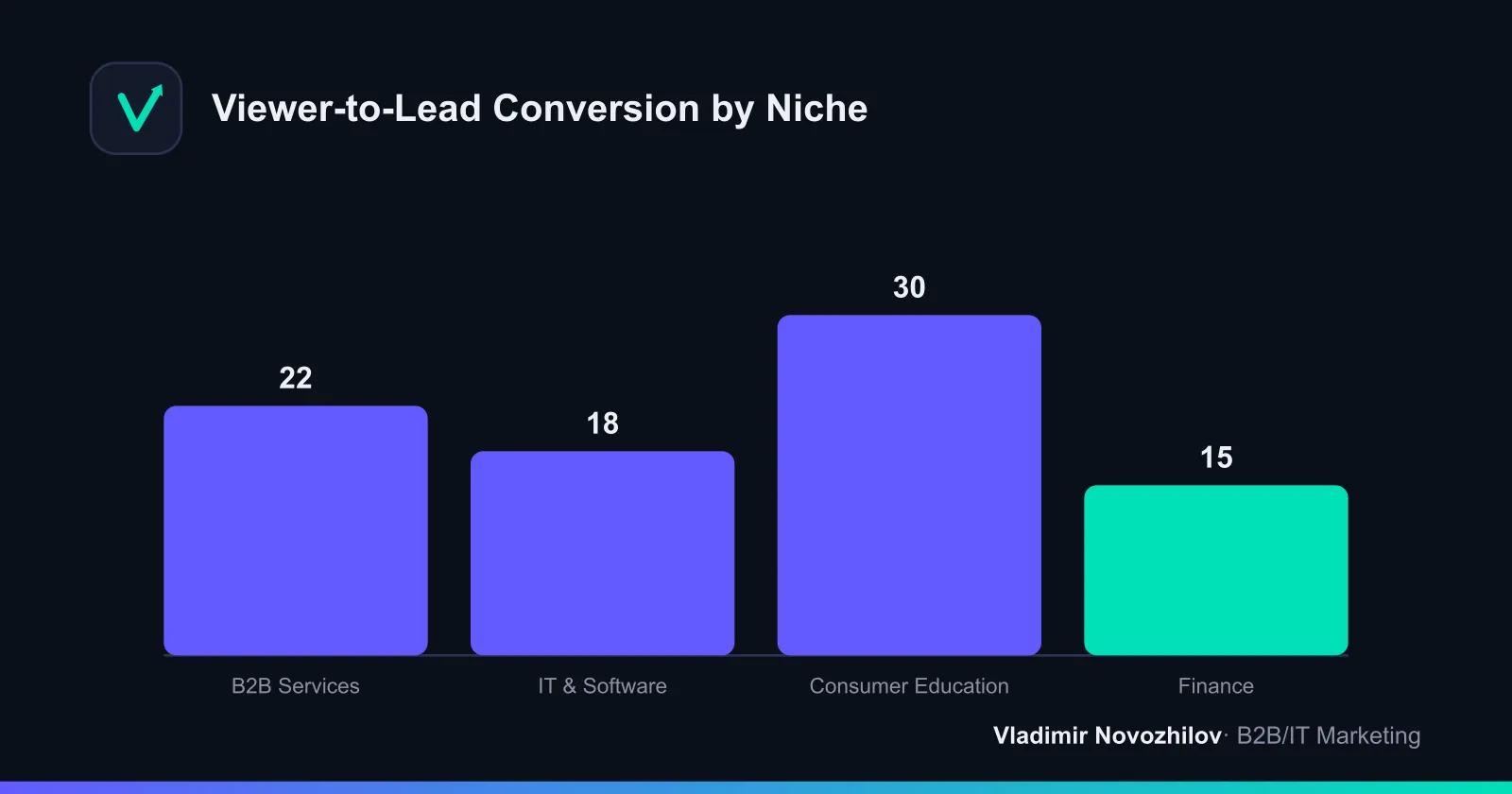
| Lead conversion | Requests / viewers × 100% | 15–30% |
| CPL | Budget / number of leads | Compare with other channels |
| ROI | (Revenue − costs) / costs × 100% | > 100% |
Calculation example
Promotion budget: 100,000 rubles. Results: 1,000 landing page visitors, 350 registrations, 140 viewers, 28 leads, 5 deals at 40,000 rubles each.
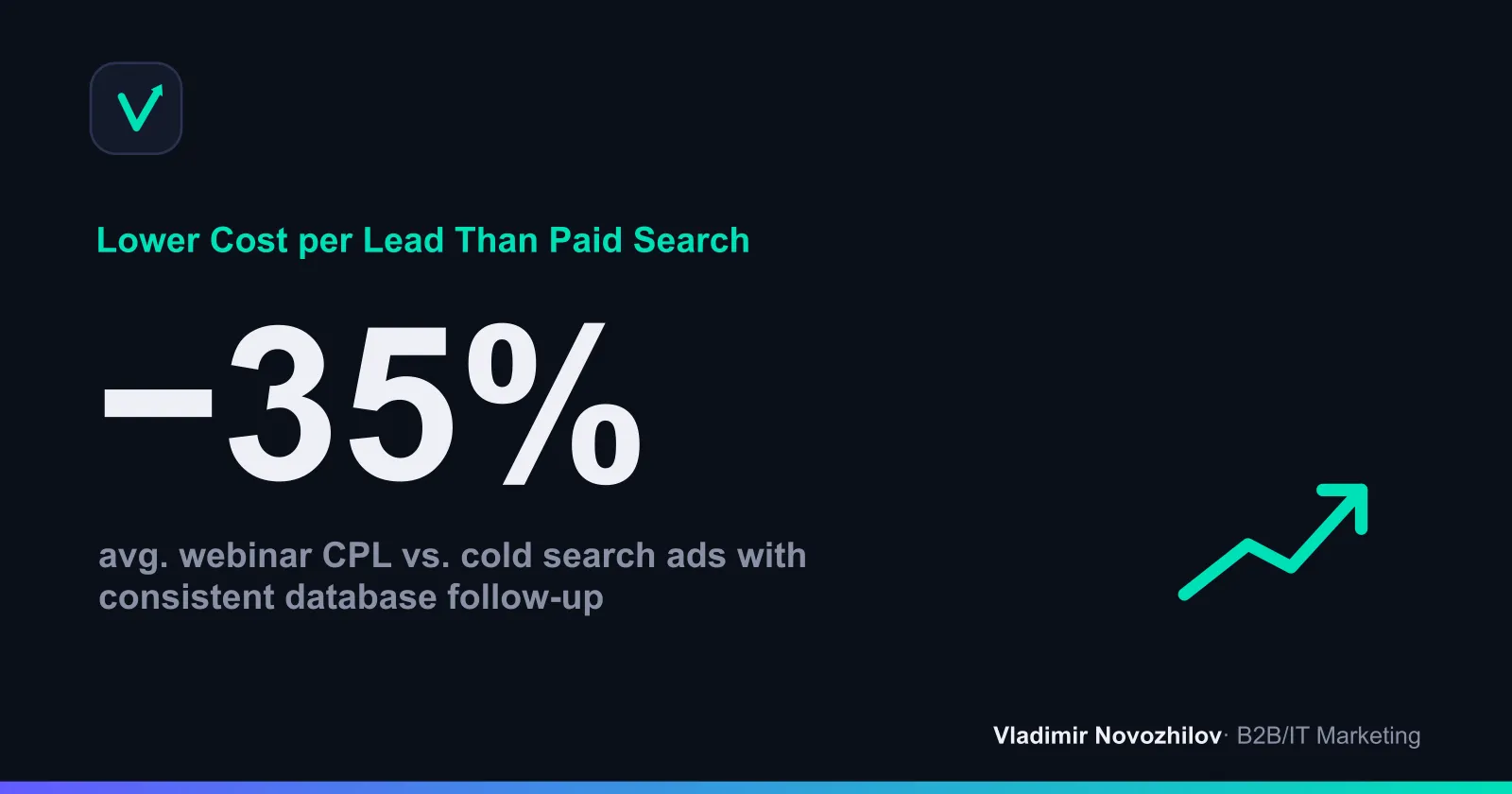
- CPL = 100,000 / 28 = 3,571 rubles per lead.
- Revenue = 5 × 40,000 = 200,000 rubles.
- ROI = (200,000 − 100,000) / 100,000 × 100% = 100%.
Common mistakes when using webinars for customer acquisition
- A vague topic without a specific outcome — leads to low registration.
- Selling from minute one — viewers leave before receiving any value.
- No nurture emails — attendance drops by half.
- A weak webinar landing page — traffic comes in, but registrations don’t.
- No post-webinar lead follow-up — requests go cold within a day.
- Not tracking metrics — impossible to tell if the channel is paying off.
- Ignoring no-shows — a large chunk of the base is lost.
Case studies: webinar examples with conversion numbers
B2B services (consulting). Educational webinar “How to Build a Sales Department,” 220 registrations, 96 viewers, 21 leads (22% lead conversion), 4 contracts signed. CPL was around 2,800 rubles, with quarterly ROI exceeding 300% thanks to the high deal value.
IT product. Product demo for a warm base, 140 registrations, 68 viewers, 12 leads (18%), resulting in 6 trial signups and 3 subscription sales. The recording drove much of the additional impact — 5 more requests came in from the follow-up email sequence over the next two weeks.
B2C education. Free session with a strong offer, 900 registrations, 320 viewers, 96 leads (30%). The high conversion rate was thanks to a simple product and a discount deadline.
Takeaway from these cases: B2B generates fewer leads but at higher cost and ROI; B2C delivers higher volume and conversion but lower deal value.
Checklist for preparing a sales webinar
Content and offer
- Topic is framed as pain point + result
- Timed script is ready
- Offer is logical and time-limited
- There’s a proof case study
Technical
- Platform chosen with registration form and lead export
- Audio and screen-share rehearsal completed
- Backup internet connection tested
Promotion
- Webinar landing page published
- Ads and seeding campaigns launched
- Email sequence set up (confirmation + 3 reminders)
After the session
- Leads transferred to CRM with segment tags
- Recording sent to no-shows
- Follow-up sequence and sales rep tasks configured
- Conversion rates, CPL, and ROI calculated
Key takeaways
A lead-generation webinar works as a system, not a one-off event. Success comes from a precise topic and offer, well-executed multi-channel webinar promotion, a conversion-focused session structure, and disciplined post-webinar lead follow-up through CRM. Track the webinar sales funnel at every step — from registration conversion to ROI — and lead generation through webinars will become one of the most predictable channels for B2B customer acquisition.
FAQ
- How many leads can you realistically get from one webinar?
- It depends on audience size and offer quality. With 300 registrations, typical attendance of 30–45% yields 90–135 viewers, and a webinar-to-lead conversion rate of 15–30% translates into 15–40 qualified leads per session. In niche B2B, the numbers are smaller in volume but higher in quality and average deal size.
- Which platform is best suited for a lead-generation webinar?
- For marketing purposes, choose specialized platforms with a built-in registration form, automated email sequences, and lead export: MTS Link, Webinar.ru, or GetCourse. Zoom works well for small expert sessions, but for lead collection it lacks a built-in landing page and analytics — you'll need to build those separately.
- How do you promote a webinar if you don't have a large subscriber base?
- Combine paid and partner channels: targeted and contextual ads driving traffic to the webinar landing page, seeding in niche Telegram channels and communities, and joint sessions with partners who have the relevant audience. Even without your own base, you can gather 100–300 registrations through partnerships and advertising.
- What should you do with leads who registered but didn't attend the webinar?
- That can be up to 60% of your base, and you can't afford to lose them. Within 24 hours, send them an email with the recording and the same offer, follow up with a 2–3 email sequence, and pass their contacts to the CRM tagged as "no-show." Some will watch the recording and submit a request — conversion for these leads is usually 30–50% lower than for live viewers, but they cost nothing extra.
- Do you need a paid webinar for lead generation, or does a free one work better?
- For B2B customer acquisition, a free webinar attracts more registrations and widens the top of the funnel. A paid webinar (a symbolic 500–1,500 rubles) filters out casual sign-ups and improves attendance and lead quality. The optimal approach: free for cold audiences, paid or closed-door for nurturing warm segments.
- How do you measure the effectiveness of a webinar as a lead-generation channel?
- Track four metrics: registration conversion (landing page visitors → registrations), attendance rate (registrations → viewers), webinar-to-lead conversion (viewers → requests), and final CPL with ROI. CPL = budget / number of leads; ROI = (revenue from deals − costs) / costs × 100%. Compare these figures against other lead-generation channels.