Customer Pain Points: How to Identify Target Audience Needs

TL;DR
A customer pain point is a specific discomfort or unresolved problem that blocks a person from reaching a goal and pushes them toward a purchase. This article explains how pain points differ from needs, fears, and objections, covers the main types of customer pain points, and provides 8 identification methods along with a prioritization template.
A product doesn’t sell because it’s “good” — it sells because it removes a specific pain point. That’s why working with customer pain points isn’t abstract empathy; it’s an applied marketing and sales tool. In this article, we’ll break down what customer pain points and needs are, how a pain point differs from a need, a fear, and an objection, what types of customer pain points exist, and — most importantly — how to systematically identify customer pain points, with methods, tables, and ready-to-use templates you can apply this week.
What customer pain points and needs are
A customer pain point is a specific discomfort, unresolved problem, or obstacle that prevents a person from reaching a goal that matters to them. It’s the pain point that triggers the search for a solution and ultimately leads to a purchase. In B2B and services, pain points are almost always measurable: lost leads, missed deadlines, overpayment, penalties, team frustration.
A customer need is the desired state or outcome a person wants to achieve. Target audience needs answer the question “what do I want”: to pay less, work faster, feel more confident. A pain point answers the question “what’s stopping me from getting that right now.”
The simplest way to keep this straight: a need is the goal, a pain point is the gap between the current and desired state, and the product is the bridge across that gap. The classic Maslow’s pyramid and the JTBD (Jobs to be Done) framework describe needs; pain points show exactly where a person gets “stuck” on the way to the job they’re “hiring” the product to do.
Pain point, need, fear, and objection: what’s the difference
These four concepts are often confused, which causes marketing to miss the mark. Let’s break down the differences in a comparison table — handy to keep on hand when developing an offer.
| Category | What it is | Customer’s question | Example (delivery for an online store) |
|---|---|---|---|
| Need | Desired goal or outcome | ”What do I want?” | Deliver orders fast and cheaply |
| Pain point | Discomfort on the way to the goal | ”What’s stopping me?” | Couriers miss deadlines, returns are increasing |
| Fear | Anxiety about the consequences of a choice | ”What if it gets worse?" | "If I switch contractors, everything might fall apart” |
| Objection | Rational reason not to buy right now | ”Why not now?" | "Too expensive,” “no time to implement” |
An important nuance: an objection almost always masks a customer’s pain point or fear. Behind “too expensive” is often the fear of overpaying and not getting results; behind “we need to think about it” is the fear of taking responsibility for the decision. That’s why you shouldn’t work with the wording of the objection itself, but with the pain point underneath it.
Types of customer pain points
To make sure nothing gets missed, it’s useful to break target audience pain points down by type. Below is a working classification of customer pain point types with example statements.
| Type of pain point | Essence | Example customer statement |
|---|---|---|
| Financial | Overpaying, hidden costs, financial loss | ”I’m paying for something I don’t use” |
| Functional | The product or process doesn’t solve the task | ”Reports export fine, but there’s no way to reconcile them” |
| Time-related | The task takes too long | ”Contract approval takes two weeks” |
| Emotional | Stress, uncertainty, frustration | ”I’m constantly afraid I’ll miss something” |
| Social | Fear of judgment, loss of status | ”I’m embarrassed to show our site to partners” |
A single person rarely experiences only one type of pain point. For example, a sales department head experiences a functional pain point (the CRM is inconvenient), a time-related one (reps waste hours on manual data entry), and a social one (embarrassed in front of the owner over a missed plan) — all at once. A strong offer hits several layers simultaneously.
Why businesses need to understand target audience pain points and needs
Understanding customer pain points in marketing has a direct impact on revenue. Here’s what it delivers.
- Higher conversion. Landing pages and ads built on real pain points, rather than made-up “benefits,” convert 2-3x better. People recognize their own situation and believe they’re understood.
- Lower customer churn. If you know which pain point is driving people away, you can address it in the product and retain revenue.
- Better product and service. Development priorities get built around what actually blocks the customer, not around the team’s own preferences.
- Sharper sales scripts. A rep who names the pain point before the customer does is perceived as an expert, not a salesperson.
- Budget savings. Advertising stops targeting everyone indiscriminately and focuses on people whose pain is acute and who are ready to pay.
How to identify customer pain points: 8 proven methods
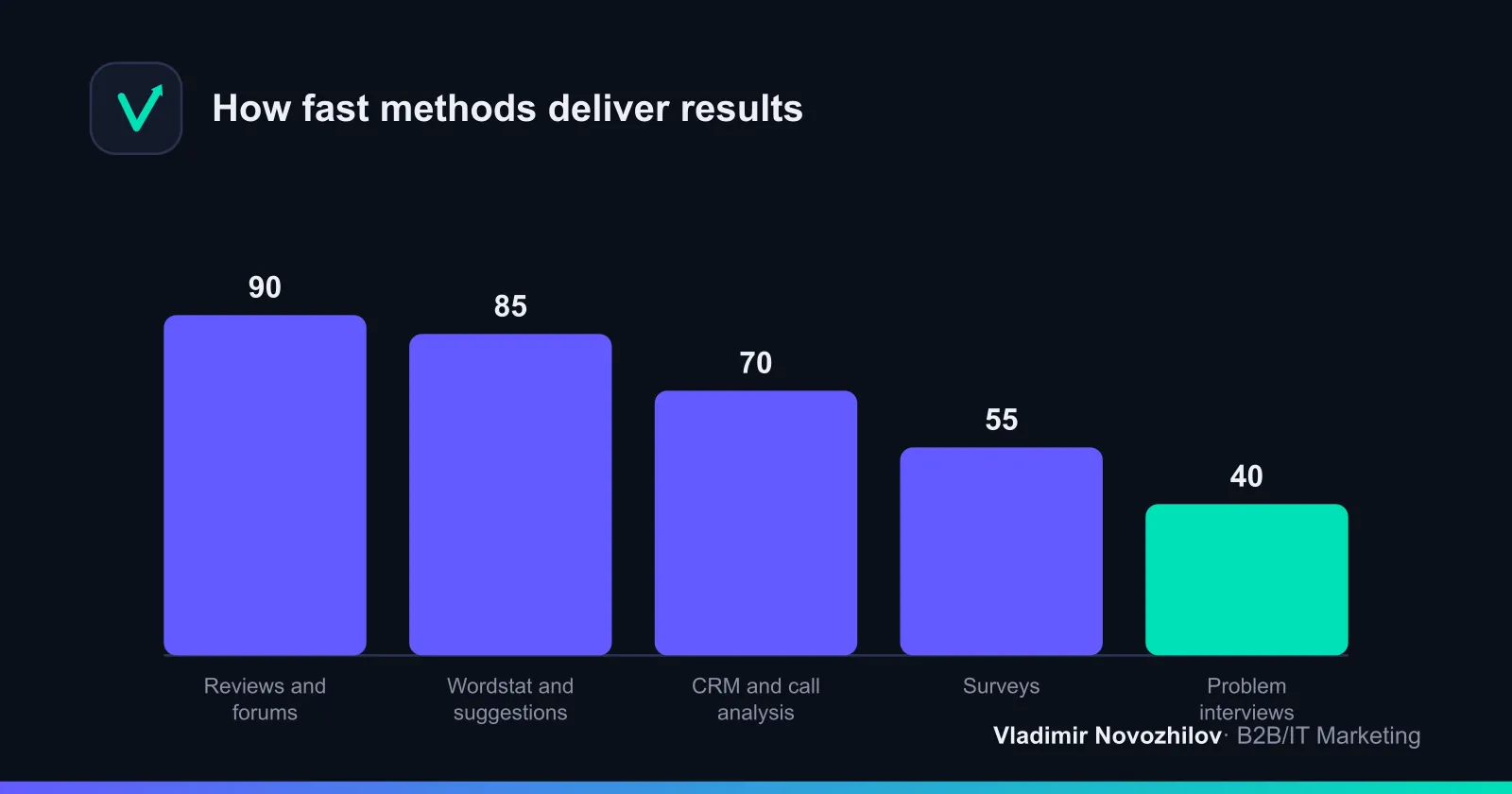
Below are pain-point identification methods, sorted from the fastest and cheapest to the deepest. The optimal strategy is to combine them: first gather hypotheses through free methods, then validate them in conversations with real people.
1. Analyzing search queries and suggestions
Wordstat and search suggestions reveal customer pain points in their own words. Queries like “how to fix,” “why isn’t it working,” “alternative to…,” “reviews of…” are direct signals of discomfort. Gather the semantics around your topic and write down the problem phrasing — this is the foundation for content and headlines.
2. Studying reviews, forums, and social media
Analyzing customer reviews is the most underrated source. Read reviews about you and your competitors on marketplaces, maps, and industry platforms. Pay attention to emotional phrases and to what gets praised versus criticized. Forums, niche chats, and social media comments surface pain points in a natural setting, without survey-induced bias.
3. Surveys and questionnaires
Surveys work well for validating hypotheses on a larger sample. Instead of asking “do you like the product,” ask “what was the hardest part of solving task X.” Open-ended questions yield phrasing, closed-ended ones yield statistics for prioritization. Keep the survey short: 5-7 questions.
4. Interviews and focus groups
A deep interview reveals context and emotions that don’t show up in numbers. One hour of conversation with five to seven representatives of the target audience often yields more insight than a hundred questionnaires. Below we’ll cover how to run such an interview correctly.
5. Analyzing CRM, calls, and reasons for lost deals
CRM is a warehouse of undiscovered pain points. Listen to call recordings, read chat logs — but most importantly, systematize the reasons deals are lost. If 40% of deals fall through at the “too expensive” stage and another 20% at “too slow to implement,” you’re holding two major pain points and customer fears in your hands. This is exactly the gap between pain points and funnel data that competitors rarely tap into.
6. Studying competitors and their communications
Look at which pain points competitors emphasize in ads and on landing pages, and what customers write about them in reviews. Competitors’ failures are your growth opportunities: whatever they get regularly criticized for is an unmet market pain point.
7. Talking to sales and support teams
Reps and support agents hear live pain-point phrasing every day. Make it a habit to collect 3-5 frequently repeated customer phrases from them once a week. This is a free, continuous stream of data.
8. Observing and analyzing behavior
Click maps, session recordings, and the points where people abandon a form or cart reveal functional and time-related pain points that people won’t put into words. Behavior is more honest than statements.
How to conduct a proper problem interview without leading questions
The biggest interview mistake is asking about the future and hypotheticals. People are bad at predicting their own behavior but remember past experience well. That’s why needs discovery is built around real stories.
Step-by-step problem interview algorithm:
- Define the goal. One objective per interview, e.g., “understand how companies choose a logistics contractor.”
- Start with context. “Tell me how this process currently works for you.”
- Dig into the most recent real case. “Think back to the last time you ran into this problem. What happened?”
- Ask about consequences. “What did it lead to? How much time and money did it cost?”
- Clarify emotions. “How did you feel at that moment?”
- Hold pauses and don’t prompt. Don’t praise the product, don’t finish the person’s sentences for them.
- Record verbatim. The customer’s own quotes are more valuable than your paraphrasing — you’ll need them for copy later.
Forbidden questions: “Would you buy this?”, “Do you like the idea?”, “Speed matters to you, right?” — all of these prompt polite agreement and produce unreliable data.
How to organize and prioritize a list of customer pain points
The collected pain points need to be consolidated into a single table. Here’s a working template you can replicate in any spreadsheet tool.
| Pain point (in customer’s words) | Type | Audience segment | Frequency (1-5) | Severity (1-5) | Willingness to pay (1-5) | Total |
|---|---|---|---|---|---|---|
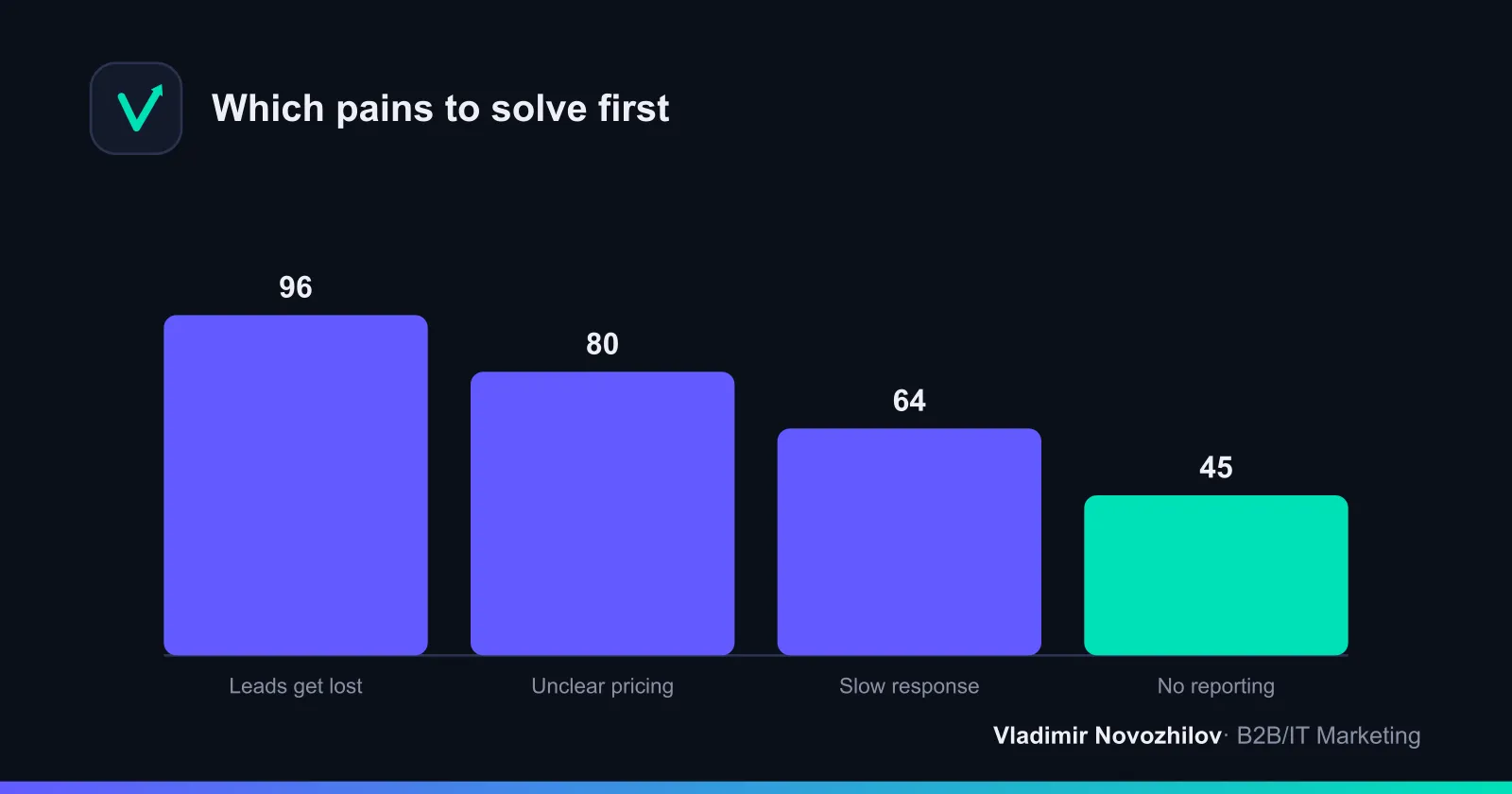
| ”Leads get lost between departments” | Functional | Wholesale | 5 | 5 | 4 | 100 |
| ”Unclear what the final price consists of” | Financial | All | 4 | 4 | 5 | 80 |
| ”Long wait for a rep’s response” | Time-related | Retail | 4 | 4 | 4 | 64 |
| ”No transparent reporting” | Functional | Large accounts | 3 | 3 | 5 | 45 |
The total score is calculated with a simple formula: Frequency × Severity × Willingness to Pay. The higher the result, the sooner that pain point should be addressed in the product, on the landing page, and in advertising. This is essentially a static “prioritization calculator”: calculate the score for each row and sort in descending order.
Add one more filter to your prioritization — how closely the pain point relates to your product. Even a severe, frequent pain point is useless if you can’t solve it. The ideal zone is the overlap between “hurts a lot” and “we know how to fix this.”
How to address a customer pain point: from insight to content and sales
Identifying a pain point is only half the job. Next, you need to show that you solve it. Let’s look at how to address a customer pain point using specific “pain point → solution → result” examples.
- Pain point: “Leads get lost between departments.” Solution: a single intake point and a response SLA. Offer wording: “No lead ever gets lost: we log and respond within 15 minutes.”
- Pain point: “Unclear what the final price consists of.” Solution: a transparent estimate before the project starts. Wording: “A fixed price in the contract — no add-on charges mid-project.”
- Pain point: “I’m afraid a new contractor will miss deadlines” (fear). Solution: a pilot phase with penalties for delays. Wording: “We’ll start with a test phase, and deadlines will be locked into the contract.”
The same pain point gets packaged differently across channels:
- Landing pages and offers — the pain point in the hero headline, the solution in the subheadline.
- Content strategy — articles and posts that answer target audience pain points in their own words (the very phrasing pulled from reviews and Wordstat).
- Sales scripts — the rep names the pain point before the customer does and immediately offers a path to a solution.
- Handling fears and objections — behind every objection, look for the underlying pain point and neutralize it with a guarantee, a case study, or social proof.
Common mistakes when working with target audience pain points
- Generalizing without segmentation. Different segments have different pain points. An “average pain point” doesn’t actually hurt anyone.
- Made-up pain points. Phrasing invented in the marketer’s head rather than pulled from the customer’s mouth. Always rely on data.
- Ignoring hidden fears. Customers rarely voice fears directly — you have to extract them through objections.
- One-off effort. Pain points shift along with the market. Analyzing customer reviews and CRM data should be an ongoing process, not an annual one.
- Collecting without acting. A list of pain points sitting in a spreadsheet with no impact on the product or communications is worthless.
Tools and templates: empathy map, buyer persona, JTBD
To systematize customer pain points and needs, use three proven tools.
- Empathy map — captures what the customer thinks, feels, sees, hears, as well as their pain points and desires. Helps avoid reducing a person to a dry set of characteristics.
- Buyer persona — a composite image of a segment with its goals, context, and pain points. Keeps the team aligned on who exactly the product is being built for.
- JTBD (Jobs to be Done) — a framework centered on “what job the customer is hiring the product to do.” Shifts the focus from features to outcomes and exposes the true pain points.
Below is a summary table of tools and data sources for identifying pain points.
| Tool / source | What it provides | Speed | Cost |
|---|---|---|---|
| Wordstat, search suggestions | Pain points in searchers’ own words, demand volume | High | Free |
| Reviews, forums, social media | Authentic phrasing, emotions | High | Free |
| CRM, calls, lost deals | Pain points at funnel stages | Medium | Low |
| Surveys | Statistics to validate hypotheses | Medium | Low |
| Problem interviews | Context, hidden pain points | Low | Medium |
| Empathy map, JTBD | Data systematization | — | Free |
Checklist: how to identify customer pain points in 7 days
- Day 1. Gather semantics in Wordstat, write down problem-related queries.
- Day 2. Review 50 reviews about you and competitors, record the phrasing.
- Day 3. Read forums and chats, add pain points to a shared spreadsheet.
- Day 4. Pull reasons for lost deals from CRM and listen to 10 calls.
- Day 5. Conduct 3-5 problem interviews using the algorithm above.
- Day 6. Consolidate everything into a table, sort by type, calculate priority scores.
- Day 7. Pick the top 3 pain points and update your offer, content, and sales scripts.
This kind of sprint produces a ready-made pain-point map without a budget for a major study. After that, it’s enough to refresh it once a quarter.
Key takeaways
Customer pain points are what block a person from reaching a goal, while needs are the goal itself. Don’t confuse a pain point with a need, a fear, or an objection: behind almost every objection lies an unresolved pain point or customer fear. Identify pain points using a combination of methods — from Wordstat and reviews to CRM and problem interviews — prioritize them by frequency, severity, and willingness to pay, and then address them in your product, content, and sales using the customer’s own words. That’s what turns working with target audience pain points from theory into higher conversion and lower churn.
FAQ
- How does a customer pain point differ from a need and a fear?
- A need is a desired state ("I want to pay less for logistics"). A pain point is the specific discomfort standing in the way of that state ("leads get lost and customers switch to competitors"). Fear is anxiety about the consequences of a choice ("what if the new contractor misses deadlines"). A need explains what a person wants; a pain point shows what's blocking them; fear holds them back from buying.
- What types of customer pain points exist in marketing?
- There are typically five types of customer pain points: financial (overpaying, hidden costs), functional (the product doesn't solve the task), time-related (the process takes too long), emotional (stress, uncertainty), and social (fear of judgment, loss of status). A single customer often experiences several types of pain simultaneously.
- How can you quickly identify target audience pain points without a research budget?
- Gather free data: analyze reviews about you and competitors, study questions on forums and social media, check search suggestions and Wordstat, and review CRM conversations and reasons for lost deals. In 2-3 days you can collect 30-50 real pain-point statements in the customer's own words.
- How do you conduct a customer interview without getting unreliable answers?
- Ask about past experience, not the future or hypotheticals. Instead of "would you buy this?", ask "tell me how you last solved this task." Don't suggest answers, don't praise the product, and hold your pauses. The goal is facts and emotions from real experience, not polite approval.
- How do you determine which pain point matters most for prioritization?
- Rate each pain point by frequency (how many people encounter it), severity (how much it hurts), willingness to pay for a solution, and closeness to your product. Multiply the scores — address the pain points with the highest totals first in your product, landing page, and advertising. That way resources go where the return is greatest.