Content Formats: Types, Kinds, and How to Choose One


TL;DR
Content formats are ways of presenting material — text, video, audio, graphics, and interactive. Content types describe purpose (sales, educational, engaging), while a channel is the distribution platform. To choose a format, move from goal to audience, platform, and resources, then check results against KPIs.
When a marketer asks “what content should we create,” that question actually hides several decisions at once: what exactly to say to the audience, what form to package it in, and where to publish it. Content formats answer the “what form” question: text, video, audio, graphics, or interactive. Let’s break down content types and formats systematically — how they differ from types and channels, what varieties exist, and how to choose a format for a specific task, audience, and platform.
What content, type, format, and channel are — and how they differ
Confusion between these concepts is the main reason content strategies stall. Let’s fix the definitions.
- Content type (kind) is its purpose and function. Informational, educational, sales-driven, engaging, reputational, viral, user-generated. Answers the question “why.”
- Content format is the way material is presented. Article, post, video, podcast, infographic, quiz, newsletter. Answers the question “in what form.”
- Channel is the distribution platform: website, social media, email, messengers, video platforms. Answers the question “where.”
The same content type can be implemented through different formats and live on different channels. Example: the goal of “demonstrating expertise” (type) can be packaged as a case study (format) and published on a website, social media, and in a newsletter (channels). That’s exactly why the correct planning sequence is: goal first, then format, then channel.
Content types by purpose
Content marketing types are typically classified by purpose. Below is a working list of content types that covers most business tasks.
- Informational — answers audience questions, explains, addresses objections. News, reviews, breakdowns, FAQs, SEO content targeting search queries.
- Educational — teaches how to use a product or solve a problem. Guides, instructions, checklists, webinars, screencasts.
- Sales content — directly drives purchases. Landing pages, product cards, commercial proposals, offer emails with a CTA.
- Engaging content — prompts a reaction: a comment, a share, participation. Polls, quizzes, contests, provocative questions.
- Reputational — builds trust. Reviews, case studies, awards, media mentions, expert commentary.
- Viral content — designed for organic spread through emotion or usefulness. Memes, challenges, unexpected formats.
- User-generated content (UGC) — material created by customers themselves: reviews, photos, unboxings, mentions.
In B2B and services, the core is usually informational, educational, and reputational content, with sales content joining closer to deal closure. In e-commerce and media, the share of engaging and viral content is higher.
Content formats: text, graphic, video, audio, interactive
Now let’s look at forms of presentation. Content marketing formats are conveniently grouped by mode of perception.
Text content
Text content remains the foundation: it’s indexed by search engines, easy to repurpose, and cheap to produce.
- Articles and long-reads — cover a topic in depth, support SEO content and expertise.
- Posts — short messages for social media and messengers.
- Case studies — a “problem → solution → result” story with numbers; the best sales and reputational format for B2B.
- Email newsletters — nurture the base, retain customers, drive repeat sales.
- Checklists and lead magnets — exchange value for contact information, fill the sales funnel.
- White papers and e-books — heavyweight expert content for complex niches.
Video content
Video content delivers maximum reach and engagement but requires more resources.
- Long-form videos — reviews, tutorials, interviews.
- Shorts, reels, clips — short vertical videos that platform algorithms promote most aggressively.
- Stories — fast content with a “here and now” feel.
- Livestreams and webinars — direct contact with the audience, a strong nurturing tool.
Audio content
Audio content is consumed in the background — while driving, walking, or working out.
- Podcasts — expert conversations and monologues that build a loyal audience and authority.
- Audio versions of articles — extend access to the same material.
- Voice messages in messengers — an intimate format for a warm audience.
Graphic formats
- Infographics — compress data and processes into a visual scheme, easy to share.
- Carousels — step-by-step presentation on social media.
- Photos, illustrations, presentations — strengthen any other format.
Interactive and multimedia content
Interactive content engages users in action rather than passive consumption.
- Quizzes and tests — entertain, segment, and collect leads.
- Calculators — compute benefit, cost, or payback right on the page.
- Interactive landing pages and virtual tours — hold attention through interaction.
Multimedia content combines several formats in one: a long-read with video, an infographic, and an embedded quiz.
User-generated content (UGC): why it’s trusted more
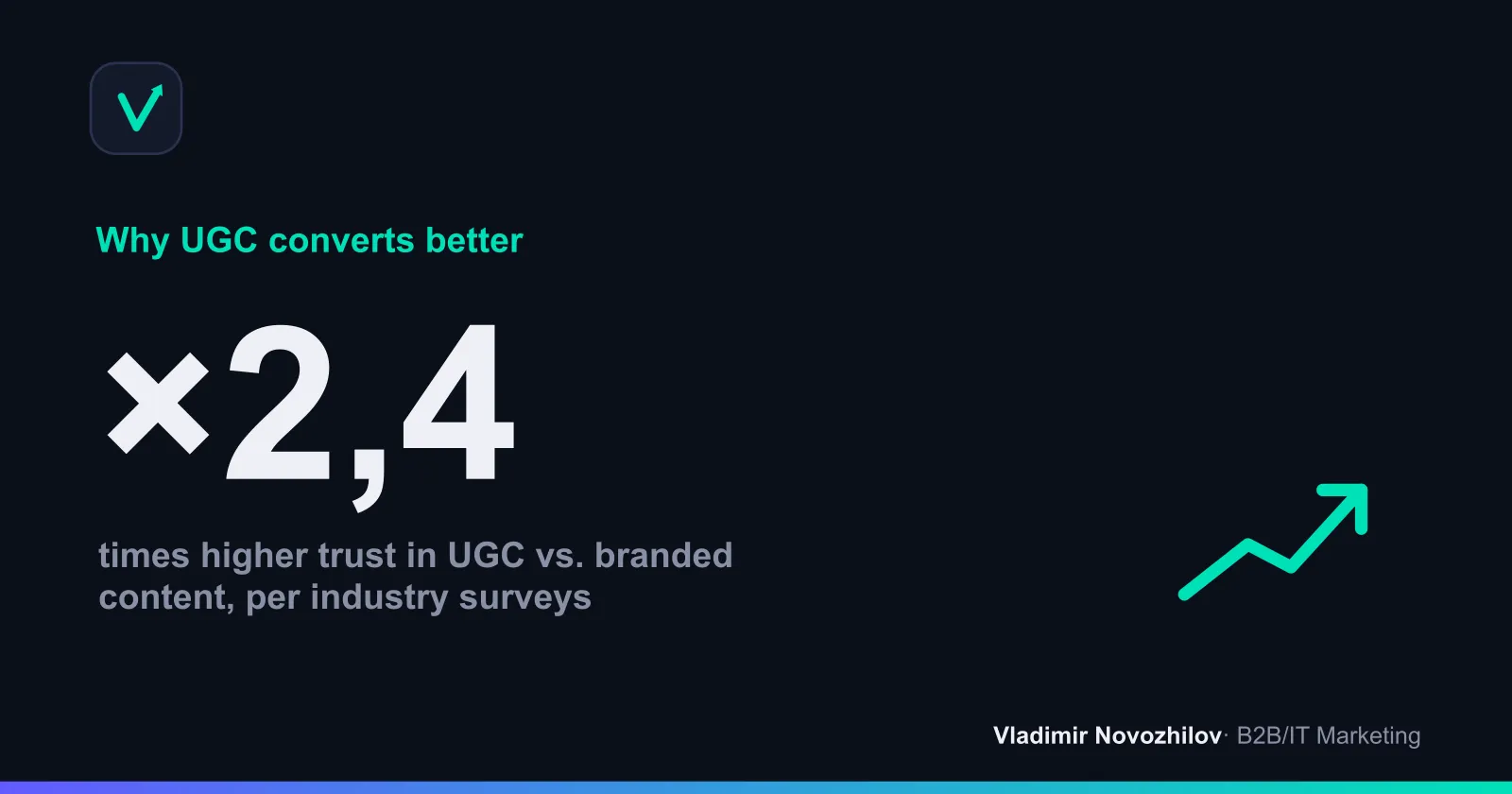
User-generated content is reviews, photos, videos, and mentions created by customers themselves. Its power lies in the fact that people trust other people more than they trust a brand. Industry surveys show trust in UGC noticeably exceeds trust in ad materials, and placing customer reviews and photos on a product page increases conversion.
How to use UGC systematically:
- Motivate customers to share their experience — contests, a discount for a photo review, a branded hashtag.
- Collect UGC in one place and get permission to publish it.
- Embed it in conversion points: product cards, landing pages, emails.
- Respond to mentions — this encourages more user-generated content.
UGC solves two tasks at once: it’s engaging (it sparks audience activity) and reputational (it removes objections through social proof).
How to choose a content format: a step-by-step algorithm
Instead of guessing “what content to create,” use the chain goal → audience → platform → resources → KPI. It works more reliably than intuition.
- Define the goal. Reach, nurturing, sales, retention, or reputation. The content type depends on the goal.
- Study your target audience. Where they spend time, which format they consume, what language they speak. B2B audiences value proof and time savings; mass audiences value emotion and simplicity.
- Choose the platform. The format must fit the channel: vertical video for social media, a long-read for a website, an email for the inbox.
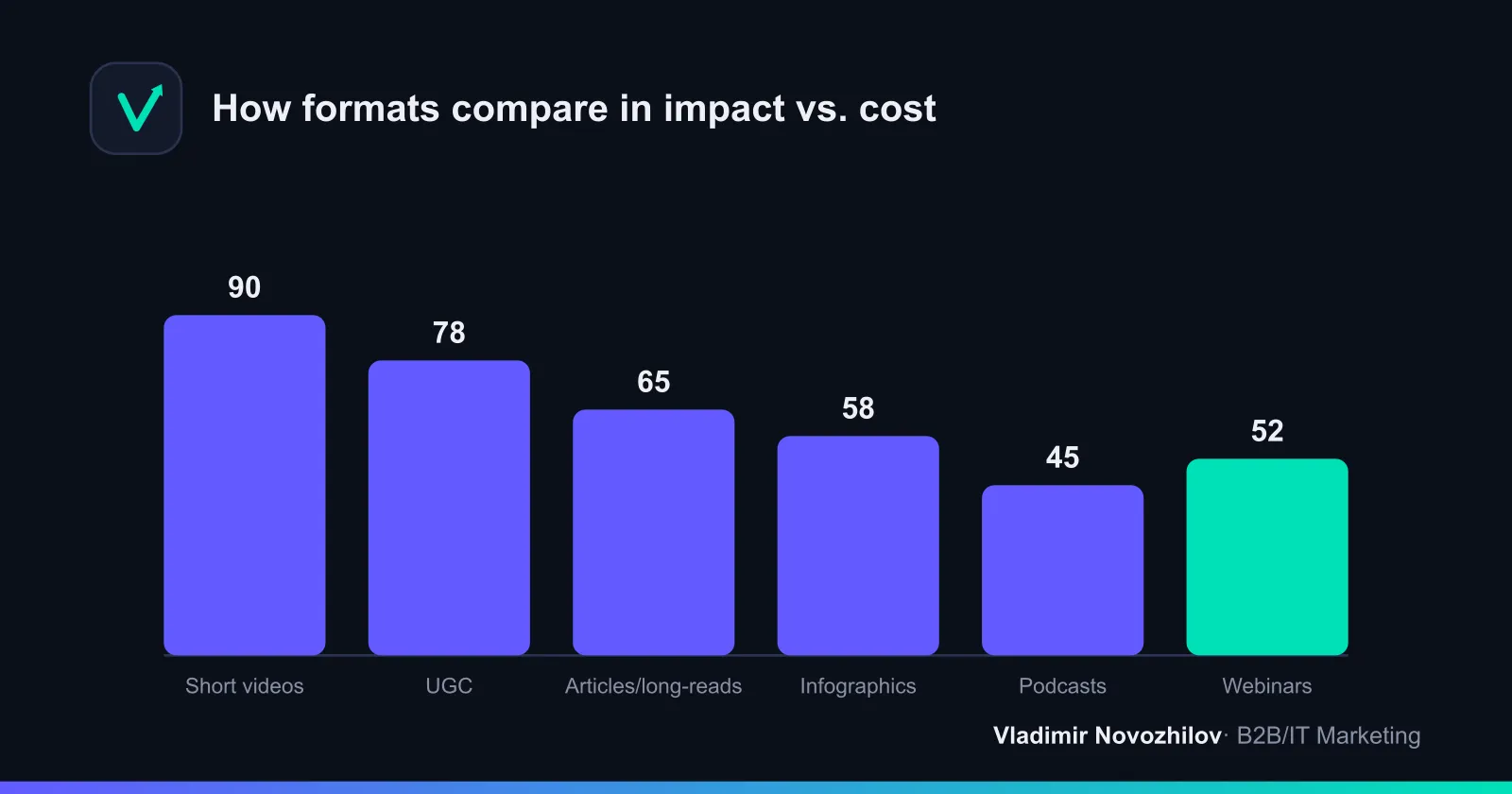
- Assess resources. Video production and webinars are more expensive than articles and posts. Realistically estimate time, budget, and team skills.
- Set the KPI. Decide in advance which metric will measure the format’s success.
Since a live calculator can’t be embedded in an article, here’s its static equivalent — a format priority formula:
Priority = (Goal fit + Audience accessibility on the channel) − Production cost
Rate each parameter on a scale of 1–5 and add them up. Sample calculation for a B2B company with a “lead nurturing” goal:
| Format | Goal fit | Audience accessibility | Cost | Total |
|---|---|---|---|---|
| Case study article | 5 | 4 | 2 | 7 |
| Webinar | 5 | 3 | 4 | 4 |
| Short video | 3 | 5 | 3 | 5 |
| Email sequence | 4 | 5 | 1 | 8 |
In this example, it’s more cost-effective to start with an email sequence and case studies, adding webinars once more resources are available.
Comparison table of content formats by purpose and channel
This table combines format, type, channel, resource intensity, and metric in one place — something usually missing from overview articles.
| Format | Main purpose | Best channels | Resources | Key KPI |
|---|---|---|---|---|
| Article/long-read | Inform, SEO | Website, blog | Medium | Traffic, completion rate |
| Post | Engage | Social media, messengers | Low | Engagement rate |
| Case study | Sell, build trust | Website, email, social media | Medium | Leads, conversion |
| Short video | Reach | Social media, video platforms | Medium | Reach, views |
| Webinar | Nurturing | Website, email | High | Registrations, leads |
| Podcast | Loyalty, expertise | Audio platforms | Medium | Listens, subscriptions |
| Infographic | Explain | Social media, website | Medium | Shares, saves |
| Quiz/calculator | Engage, generate leads | Website, landing page | High | Leads, time on page |
| Email newsletter | Retain, sell | Low | Open rate, CTR | |
| UGC | Trust, conversion | Social media, product cards | Low | Conversion, trust |
Content distribution channels
Content distribution channels determine whether material actually reaches the audience. The same format behaves differently on different platforms.
- Website and blog — the base for SEO content, long-reads, case studies, and lead magnets; you own this traffic.
- Social media — reach and engagement through posts, video, stories, and UGC.
- Video platforms — long-form videos and tutorials, evergreen traffic.
- Email — a direct channel to a warm audience for nurturing and repeat sales.
- Messengers — intimate communication, high open rates.
The rule is simple: don’t drag the same format into every channel without adapting it. Instead, repurpose it — repackage the core material to fit the specifics of each platform.
Repurposing: how to get the most out of one piece of material
Content repurposing is repackaging one piece of material into several formats and channels. It’s cheaper than creating from scratch every time and increases the return on invested effort.
Template for reusing one webinar:
- Webinar recording → a summary article on the website.
- Article → a series of posts and carousels on social media.
- Key highlights → short vertical videos.
- Audio track → a podcast episode.
- Key data → an infographic.
- Conclusions → a newsletter email with a CTA.
One source — six pieces of content for different channels and funnel stages.
How to evaluate the effectiveness of a chosen format: metrics and KPIs
Effectiveness is measured by funnel stage, not by likes in general.
- Reach: impressions, reach, unique visitors, completion rate.
- Engagement: engagement rate, comments, saves, shares, time on page.
- Conversion: CTR, lead conversion rate, cost per lead, ROI.
Compare formats by cost per target action. A post with a high engagement rate but zero leads loses to a modest-reach case study article that actually brings in customers. Keep a unified dashboard to see which format is paying off.
Common mistakes when choosing a content format
- Format for format’s sake. Launching a podcast because it’s “trendy,” with no connection to the goal or audience.
- Ignoring the platform. Publishing horizontal video on a vertical-format channel and losing reach.
- Spreading efforts across all formats at once. Quality drops, consistency collapses.
- No KPI. Without a metric, it’s impossible to know whether the format works.
- No CTA. Even useful content doesn’t drive action if you don’t ask for it.
- Neglecting UGC. The brand talks only about itself, losing the most trusted source — the customer’s voice.
Checklist for choosing a content format for a task
- Goal defined (reach / nurturing / sales / retention / reputation).
- Content type identified for this goal.
- Target audience and its format preferences studied.
- Distribution channels chosen.
- Format adapted for each channel.
- Resources assessed: time, budget, skills.
- Repurposing of the core material planned.
- CTA and next step for the reader written in.
- KPI and measurement method assigned.
- Format added to the overall content plan.
Key takeaways
Content types and formats are different axes of the same system. Type is responsible for the goal, format for the mode of presentation, and channel for the platform. Don’t try to cover everything at once: start with 2–3 formats that precisely fit your goal, audience, and resources, track KPIs, and scale through repurposing. Then your content strategy stops being a collection of disconnected publications and becomes a manageable flow that works for the business.
FAQ
- How does content format differ from content type or kind?
- Format is the way material is presented (article, video, podcast, infographic, quiz). Type or kind of content is its purpose (informational, educational, sales-driven, engaging, reputational). Channel is the platform where content is published (website, social media, email, video platforms). The same goal can be delivered through different formats and distributed across different channels: for example, a case study can exist as a website article, a social media carousel, and a video.
- What's the most effective content format for social media?
- There's no universal leader, but short vertical videos (shorts, reels, clips) and stories deliver the highest reach and engagement in 2025 because platform algorithms prioritize them. For trust and sales, user-generated content (UGC) and case studies work well. It's best to combine several formats: video for reach, posts and carousels for engagement, UGC for trust.
- How do you choose a content format for a B2B company?
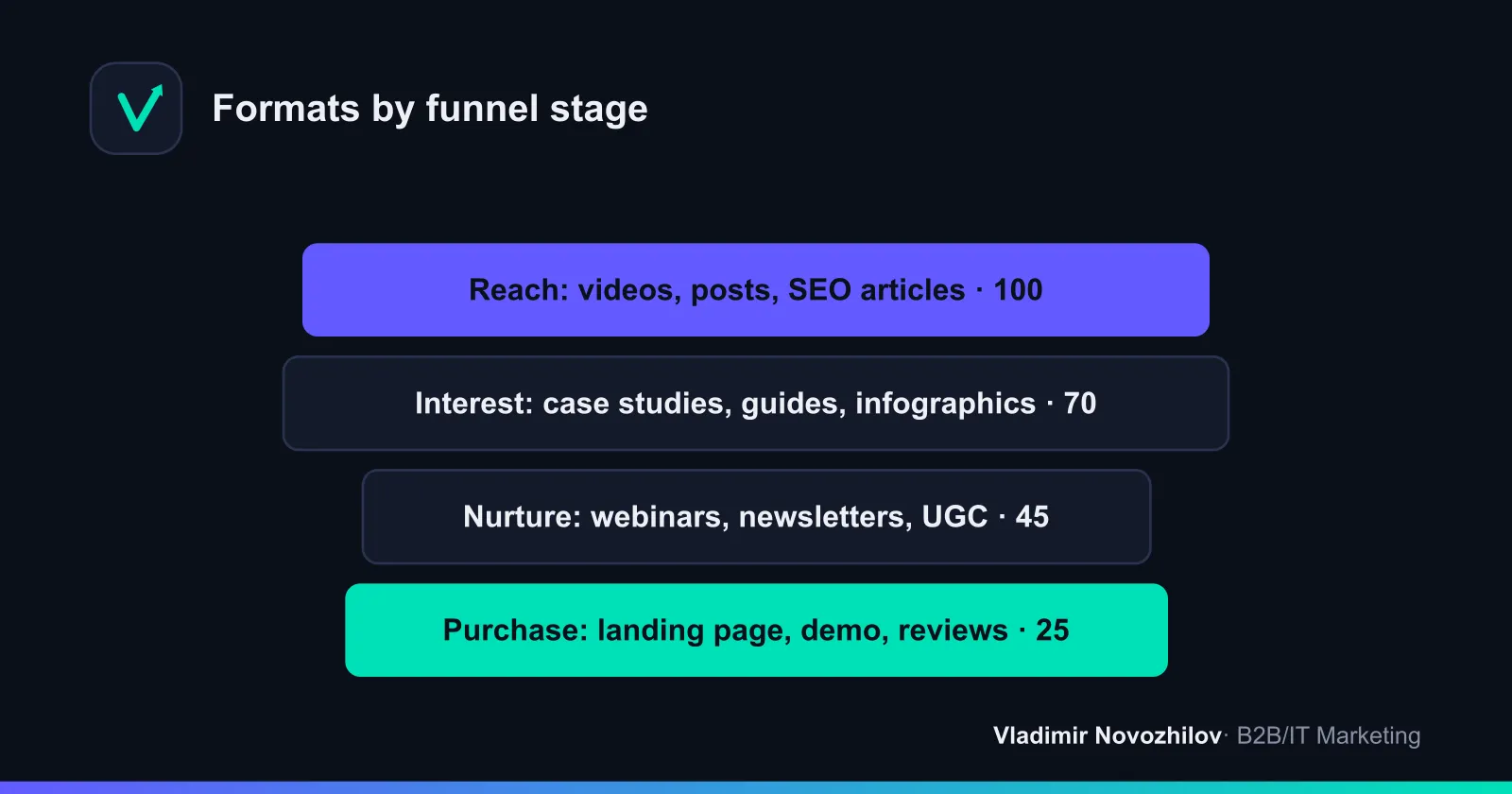
- In B2B, multiple people are involved in the decision and the sales cycle is long, so the focus is on expert and educational content: analytical articles, case studies with numbers, webinars, white papers, checklists, and newsletters. Entertainment formats are used sparingly for brand awareness. Base your choice on the funnel stage: reach — articles and video, nurturing — webinars and case studies, closing — demos and sales landing pages.
- Do you need to use all content formats at once?
- No. Spreading resources across every format at once almost always lowers quality. Start with 2–3 formats that match your goal, perform well on your chosen channels, and fit your resources. Once you've established consistency and quality, add new formats through repurposing — repackaging material you've already created.
- How do you measure the effectiveness of a specific content format?
- Attach KPIs to each format based on the funnel stage. For reach formats, track impressions, reach, and completion rate; for engagement formats — engagement rate, comments, saves; for sales formats — CTR, conversion rate, cost per lead and per inquiry. Compare formats by cost per target action, not by abstract likes.