Expert Content: How to Create It for B2B


TL;DR
Expert content is built on a specialist's real experience and data, solving the reader's problem while proving the business's expertise. Unlike SEO copy, it delivers informational gain — new numbers, cases, and insights. This article covers a step-by-step algorithm, formats, metrics, and common mistakes for B2B and services.
Expert content is material built on a specialist’s real experience and data that solves a specific reader problem — not just satisfies a search query. While ordinary text rehashes what’s already online, expert content adds something new: original figures, cases, observations, and conclusions. Below is what this means, how it differs from SEO copywriting and advertising, and how to create expert content step by step, with a focus on B2B, IT, and services.
What expert content and thought leadership are
Expertise in content rests on three pillars: practical experience, verified qualifications, and data reliability. That’s exactly what search engines describe with the E-E-A-T formula — experience, expertise, authoritativeness, and trust. A piece becomes expert content not because it’s full of jargon, but because there’s a real person behind it who has actually done what they’re writing about.
Thought leadership is the next level. It’s not a single article but a systemic position: a company or specialist formulates a view on the industry, sets the agenda, and is the first to answer new market questions. Thought leadership is built from a steady stream of expert content and directly shapes the expert’s personal brand and the business’s reputation.
Here’s a simple test: if your piece could have been written without a single day of real experience in the field, it’s not expert content. If it requires an actual project, mistake, number, or client story, you’re on the right track.
How expert content differs from SEO copywriting and advertising copy
The difference is visible in the goal, the source of information, and what the reader gets. SEO copy is optimized for the algorithm, advertising copy is optimized for a fast response, and expert content is optimized for trust and problem-solving. Here’s a comparison of the three approaches.
| Criterion | Expert content | SEO copywriting | Advertising (sales) copy |
|---|---|---|---|
| Main goal | Trust, reputation, demand | Rankings and traffic | Fast conversion |
| Source | Author’s experience, own data | SERP and keyword analysis | Offer and product benefits |
| Informational gain | High (new figures, cases) | Low (rehashed) | None |
| Author | Named SME with a bio | Often anonymous | Copywriter/marketer |
| Effect horizon | Months, cumulative | Medium | Short |
| Role in the funnel | Warming up, differentiation | Traffic capture | Closing the deal |
These formats don’t compete — they complement each other. But it’s expert content specifically that delivers informational gain — added value competitors don’t have — which is why it retains audiences better and gets cited.
Expert content in B2B: specifics of the long sales cycle
Expert content in B2B works differently than in retail. Here, the decision is made not by one person but by a buying committee of 3–7 roles, and the sales cycle stretches over months. Content needs to support that journey: first demonstrate understanding of the problem, then provide a methodology, and finally back it up with case studies and research.
In B2B and IT, the reader isn’t looking for entertainment — they’re solving an expensive problem. That’s why calculations, architecture breakdowns, checklists, and figures from real projects are especially valuable here. One strong piece of content can generate leads for years, because it gets forwarded inside client companies as an argument in favor of choosing you.
Types and formats of expert content
Types of expert content differ by platform, while formats differ by presentation. Let’s break down the main formats that work in B2B and services:
- Case studies — a breakdown of a project with a problem, actions, and a measurable result. The most persuasive format for a long sales cycle.
- Research and original data — client surveys, industry benchmarks, analysis of your own database. Delivers maximum informational gain.
- Practical guides and checklists — step-by-step “how to do it yourself” instructions.
- Analysis and opinion pieces — an authored take on trends, myth-busting, forecasts. The foundation of thought leadership.
- Webinars, podcasts, and video — a live format where an expert answers questions.
- Expert newsletters — regular authored content for your subscriber base that nurtures and retains them.
The same expertise should be repackaged: a case study can spawn a social media post, a talk, a newsletter piece, and a media quote. That’s the foundation of sustainable content marketing.
How to create expert content: a step-by-step algorithm
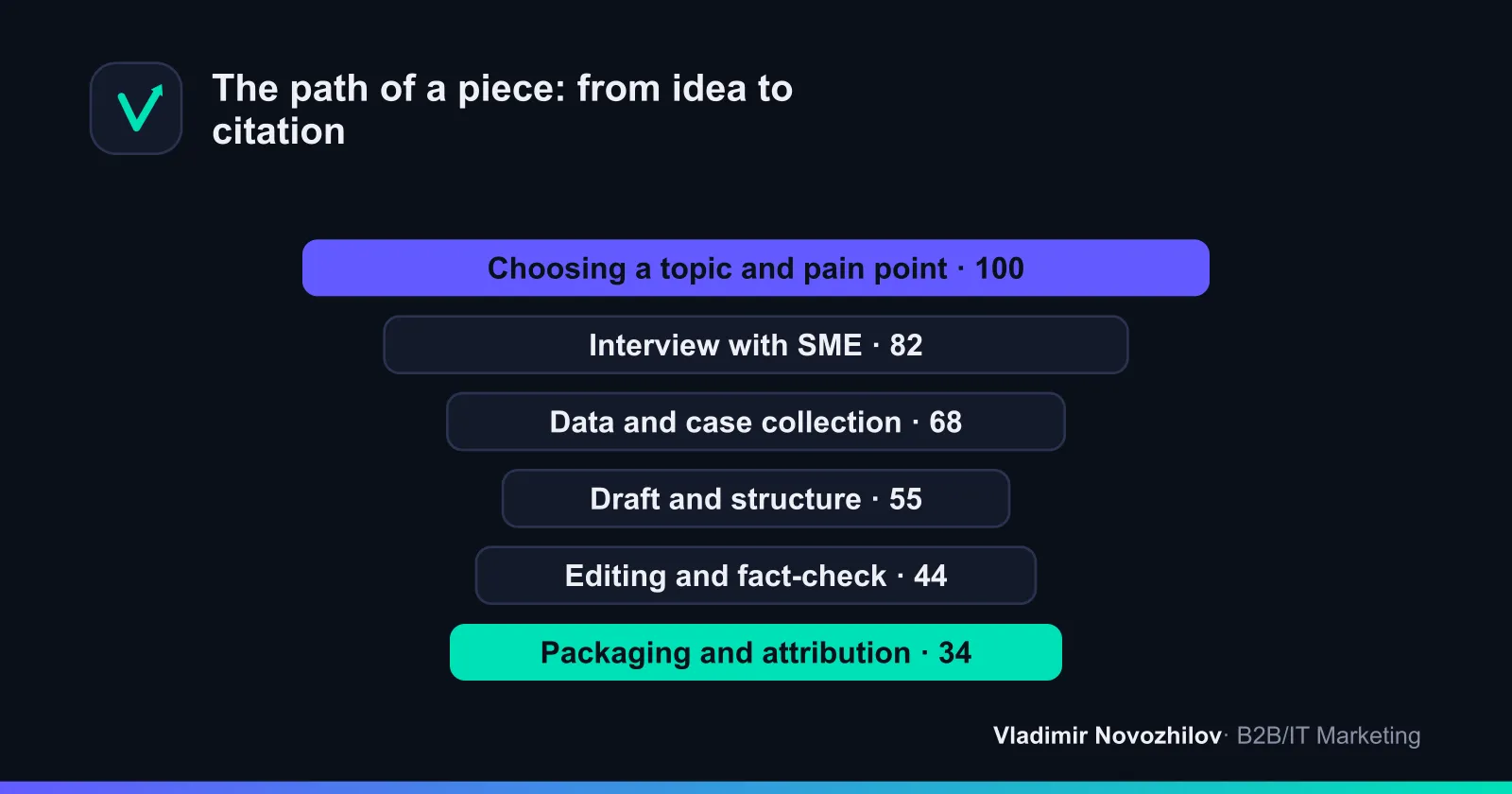
Here’s a working seven-step algorithm for creating expert content systematically rather than by inspiration.
- Choose a topic from the client’s pain point. Start from real questions raised on calls and in correspondence, not from keyword search volume.
- Interview an SME. A 40–60-minute conversation with a specialist yields more than a day of reading other people’s articles.
- Gather data and cases. Project figures, screenshots, before/after comparisons, results. This is your informational gain.
- Build the structure. Start with a direct answer to the question, then arguments, then details. This makes the material accessible to both people and AI.
- Write a draft and fact-check it. Verify every figure and claim with the expert.
- Package and attribute it. Add the author’s bio, links to their profiles, tables, and diagrams — strengthen the Author Entity.
- Distribute it. Social media, newsletters, industry platforms, Digital PR. Without distribution, even strong material goes unnoticed.
A structure template for an expert article or case study
Use this template as a ready-made framework — copy it and fill it in for your own material:
| Block | What to write |
|---|---|
| Headline | Problem + result/promise |
| Summary | A direct answer in 2–3 sentences |
| Context | Who the client is, what the task was |
| Problem | What was in the way, why it was costly |
| Solution | What was done, what methodology was used |
| Data | Before/after figures, timelines, budgets |
| Takeaways | What the reader can apply from this |
| About the author | Experience, role, proof of qualifications |
Team roles: SME, editor, content writer
Expert content is almost never created by one person alone. A healthy model is a combination of roles:
- SME (subject matter expert) — the holder of the expertise. Provides facts, cases, and verifies accuracy. Doesn’t have to write.
- SME editor — the person who extracts knowledge through interviews, structures it, and turns a conversation into text. This is the key role: the “SME + editor” pairing solves the problem of “the expert is busy and doesn’t write.”
- Content writer — polishes the text for readability and maintains the style.
- Distributor / PR specialist — responsible for reach, Digital PR, and mentions.
In small businesses these roles overlap: often the owner acts as both the SME and the face of the brand, while an editor helps package the material.
How to find topics and ideas for expert content
The best topics aren’t found in keyword tools — they’re found in day-to-day work. Sources of ideas:
- questions clients ask during sales calls and support requests;
- objections that cause deals to fall through;
- project mistakes and failures — they make for strong breakdowns;
- internal data and statistics competitors don’t have;
- debates in industry chats and at conferences.
Keep a shared bank of questions: every recurring client question is a ready-made topic for an expert article.
Metrics and evaluating the effectiveness of expert content
Judging expert content by views alone is a mistake. Build your evaluation system on three levels.
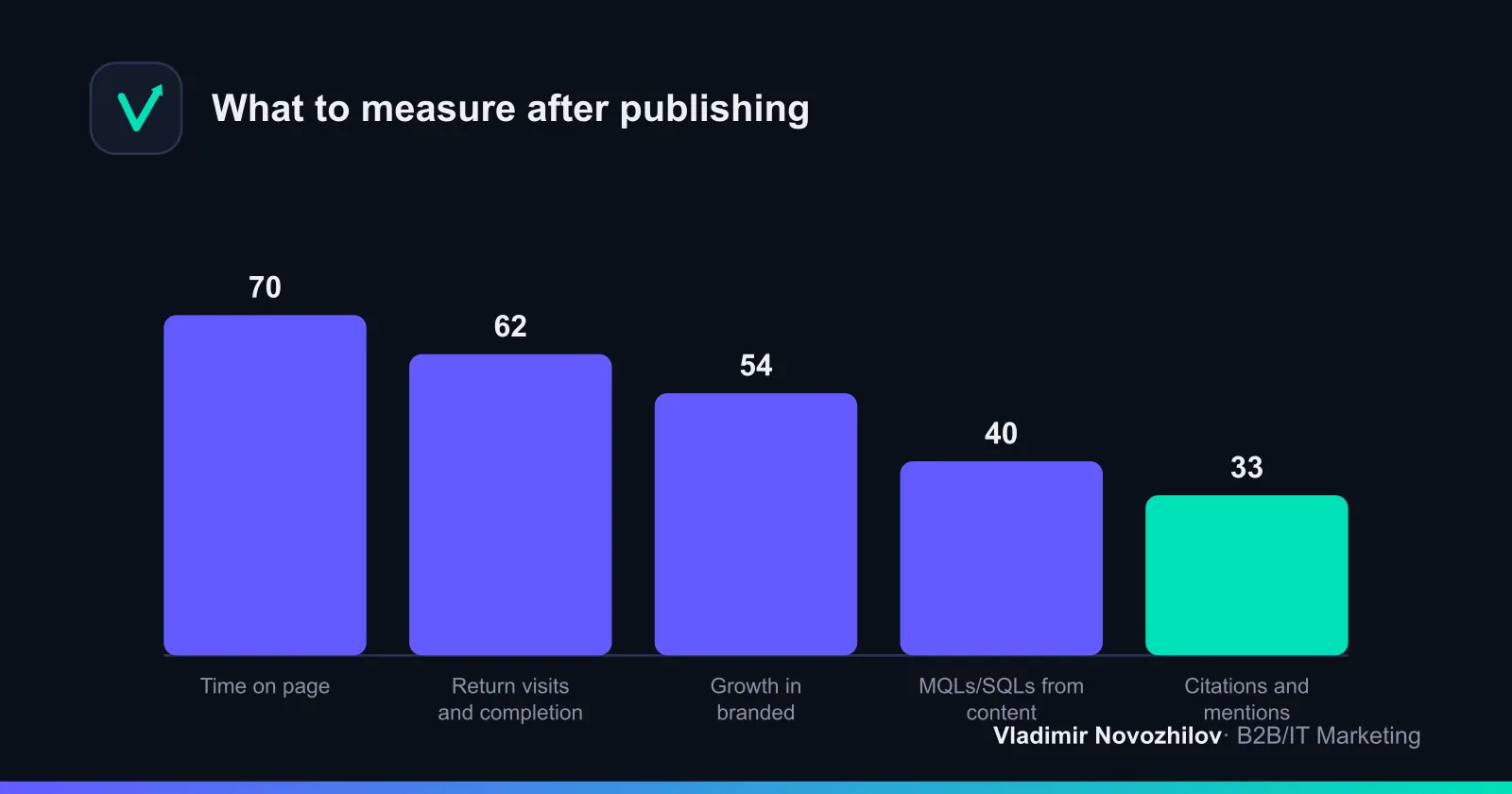
- Engagement: time on page, scroll depth, completion rate, return visits. These are behavioral factors that also matter for ranking (algorithms like NavBoost account for clicks and retention).
- Demand: growth in branded and informational search queries, direct traffic, newsletter subscriptions.
- Revenue: share of MQLs/SQLs originating from content, assisted conversions, pipeline impact, media mentions, and citations in AI-generated answers.
An example of a simple content contribution calculation
A calculator can be replaced with a formula. Pipeline contribution = (leads from content × conversion to deal × average deal size). Example: an article generated 120 leads over six months, of which 8% converted into deals, with an average deal size of 300,000 RUB. Contribution = 120 × 0.08 × 300,000 = 2.88 million RUB. Compare this against production costs to get the material’s ROI.
Expert content and GEO: becoming a source for AI search
GEO (generative engine optimization) is optimization for AI assistant answers. To get cited, you need clear informational gain and precise author attribution.

Practical rules for GEO:
- provide unique data — your own figures, surveys, cases, and research;
- open sections with a direct, structured answer, then elaborate;
- use tables and lists — models can parse them easily;
- strengthen the Author Entity: bio, experience, links to the expert’s profiles;
- invest in Digital PR — mentions on authoritative sites boost algorithmic trust.
Essentially, quality expert content and good GEO are the same thing: both people and AI need reliability, specificity, and a named author.
Common mistakes when creating expert content
Failed attempts are more common than good examples. Here are typical pitfalls:
- “Expert” text without an expert. A writer rehashed three other articles — zero informational gain. Readers sense it and leave.
- Fluff instead of numbers. “We improved efficiency” without figures isn’t convincing. Always provide a measurable result.
- Anonymity. Material with no author or bio loses out on E-E-A-T and AI citability.
- No distribution. Published and forgotten. Without social media, newsletters, and Digital PR, strong material goes unnoticed.
- Selling instead of helping. When every paragraph boils down to “buy from us,” trust collapses.
- One-off bursts. A single post per quarter doesn’t build thought leadership — you need a consistent rhythm.
Examples and cases of expert content across industries
To make this concrete, here’s what it looks like in different niches:
- B2B / IT integrator. A breakdown of a client’s infrastructure migration with real timelines, budget, and pitfalls. This kind of case study gets forwarded inside client companies as an argument when choosing a contractor.
- Professional services (consulting, law). An annual market study based on your own database — for example, average timelines and costs for typical tasks. That’s pure informational gain and a Digital PR opportunity.
- E-commerce. An expert blog where a specialist explains how to choose a complex product without overpaying. Helps justify pricing, differentiate from competitors, and grow organic traffic.
- Business services. A regular authored newsletter that breaks down one client mistake per issue — an inexpensive format that consistently nurtures the subscriber base.
The common denominator across all these examples is real experience, specific numbers, and a named expert behind the material.
Publication readiness checklist
Run your article through this list before publishing:
- The material contains at least one fact/figure competitors don’t have
- The author is credited with a bio and proof of qualifications
- The first paragraph gives a direct answer to the query
- There’s a table, diagram, or checklist
- Every claim has been fact-checked with the SME
- There’s no filler or pushy selling
- Headings address real audience questions
- A distribution plan is ready (social media, newsletter, PR)
- An FAQ with direct, clear answers has been added
If all boxes are checked, the material is ready to work for both people and GEO.
Key takeaways
Expert content is a specialist’s experience and data packaged to solve the reader’s problem and prove the business’s qualifications. It differs from SEO copywriting through informational gain, and from advertising through value delivered without pressure. In B2B, it supports the long sales cycle, and through thought leadership it builds the expert’s personal brand and market demand. Work with an SME-and-editor pairing, measure engagement, demand, and revenue, strengthen your Author Entity and Digital PR — and your materials will start bringing in clients and getting cited by AI search.
FAQ
- How does expert content differ from regular SEO copy?
- SEO copywriting is written for a search query and keywords, aiming to rank at the top. Expert content solves a real reader problem and relies on the author's practical experience: original numbers, cases, and conclusions not found in open sources. It delivers informational gain and confirms expertise, so it builds trust and drives sales, not just traffic.
- How do you find an expert inside a company if there's no public thought leader?
- Look for an SME (subject matter expert) — someone who solves client problems daily: a project lead, senior engineer, or account manager. They don't need to be able to write. The editor's job is to interview them, extract cases and numbers, and then package the material. This is how authored content emerges even without a ready-made personal brand.
- How long does it take for expert content to produce results?
- The first behavioral signals (completion rates, return visits, mentions) appear within 1–2 months. Growth in organic and branded search traffic typically shows up over a 4–6 month horizon. In B2B with a long sales cycle, it's more accurate to assess impact on leads and revenue over 6–12 months, since purchase decisions mature slowly.
- What metrics show that expert content is working?
- Look at three levels: engagement (time on page, scroll depth, return visits), demand (growth in branded and informational queries, direct traffic), and revenue (MQLs/SQLs from content, assisted conversions, media mentions, and citations in AI-generated answers). For B2B, the key indicator is pipeline impact, not one-off views.
- Does a small business or a service company need expert content?
- Yes, if the product requires trust and explanation — services, consulting, complex goods. Expertise in content helps justify pricing and differentiate from competitors. A small business doesn't need a large team: one SME and a regular publishing rhythm are enough. If the product is simple and bought impulsively, it's better to prioritize other channels.
- How does expert content affect visibility in AI search engines (GEO)?
- AI assistants cite sources with clear informational gain: unique data, precise definitions, and structured answers. GEO is reinforced by author attribution (Author Entity), Digital PR, and mentions on authoritative sites. Tables, specific figures, and FAQs increase the chance of being included in a generative answer.