Buyer Persona: How to Create a Buyer Persona + Template

TL;DR
A buyer persona is a composite portrait of your ideal customer, built on real data: demographics, psychographics, goals, and pain points. This guide covers what a buyer persona is, how it differs from ICP, how to build one step by step, plus a ready-to-use template, examples, and a tool comparison.
If an ad “works for everyone,” it works for no one. A buyer persona is a tool that turns a vague “target audience” into a specific person with a name, goals, and objections. In this guide, we’ll cover what a buyer persona is, why you need one, how it differs from ICP, and — most importantly — how to create a buyer persona yourself: with a methodology, a ready-made template, an example, and a comparison of tools.
What is a buyer persona: definition and essence
A buyer persona is a generalized, semi-fictional representation of your ideal customer, built on real data: demographics, psychographics, goals, pain points, and decision-making patterns. It’s not a made-up character created just for show, but a working document that answers the question: who actually buys your product, and why.
In practice you’ll see various synonyms: customer portrait, customer avatar, customer persona, ideal buyer image. The meaning is the same — you’re describing not an abstract segment, but a specific person, as if talking about a good acquaintance: their name, where they work, what worries them before a purchase, and what makes them say “yes.”
The key difference between a solid persona and a “portrait pulled out of thin air” is a foundation of research. A weak persona is built on a marketer’s guesses (“our customer is a successful man aged 30–45”). A strong persona relies on customer interviews, CRM data, and web analytics. Data is what turns a persona from a slide in a presentation into a decision-making tool.
Why give a persona a name and a face
The human brain works better with specifics. When a copywriter writes for “Irina, Head of Procurement, 42, who’s afraid of missing delivery deadlines,” they phrase things differently than when writing for a “B2B audience.” A name, photo, and quote make the persona tangible — the team starts making decisions on her behalf.
Why you need a buyer persona: business goals and objectives
A buyer persona isn’t a marketing decoration — it’s a way to align the entire company around the customer. Here’s what it delivers in practice:
- Precise positioning and messaging. You craft offers in the language of customer pain points, not product features.
- Budget savings. Targeting and media planning become more accurate, so you stop paying for impressions to an irrelevant audience.
- Higher conversion rates. Landing pages and emails written for a specific persona convert better than generic ones.
- Stronger sales. The sales team knows objections, decision criteria, and the counterpart’s role in the deal in advance.
- Better product development. Feature prioritization is driven by real needs, not stakeholder wish lists.
- A shared language across departments. Marketing, sales, and product stop arguing about “who our customer is.”
Without a persona, companies often fall into a trap: marketing generates leads that sales considers “junk” because the two teams have different ideas of the ideal customer. A customer portrait removes this conflict.
Buyer persona vs. target audience: don’t confuse the two
A common question is how a buyer persona differs from a “target audience.” A target audience is a broad market segment (for example, “IT department heads at companies with 100–500 employees”). A persona is one specific representative of that segment, with a name, motivation, and story. The audience answers “who could potentially buy,” while the persona answers “how does a specific buyer think and decide.”
Another related concept is audience segmentation. Segmentation divides the market into groups by attributes, while a persona fills each meaningful group with “human” content. These are levels of detail within the same process, not competing approaches.
Buyer persona vs. ICP vs. customer profile: what’s the difference
The most common confusion is between a buyer persona, ICP (Ideal Customer Profile), and customer profile. Let’s break down the differences in a comparison table.
| Criteria | Buyer Persona | ICP (Ideal Customer Profile) | Customer Profile |
|---|---|---|---|
| Subject described | The decision-maker (a person) | The client company | An existing customer (fact-based) |
| Key question | How do we persuade and reach them? | Who is worth selling to in the first place? | Who already buys from us? |
| Main fields | Demographics, psychographics, pain points, buyer’s journey | Industry, size, revenue, tech stack, geography | Purchase history, LTV, status, plan |
| Level | Individual | Organizational | Transactional |
| Where it’s used | Content, advertising, sales scripts | Lead qualification, ABM | CRM, retention, upsell |
| Data type | Qualitative (interviews) | Firmographic | Behavioral, system-derived |
A short formula to remember: ICP tells you which door to knock on, the buyer persona tells you what to say once it opens, and the customer profile tells you who you already work with. In B2B, all three are used together: first define the ICP, then describe personas by role within it, and feed both pictures with real CRM data via the customer profile.
Types of buyer personas: positive, negative, and B2B roles
Personas serve different purposes. Let’s look at the main types.
Positive persona
This is your target customer — the one you want to attract. Most personas people talk about are of this type: they describe people who bring value to the company.
Negative persona (anti-persona)
A negative persona is a portrait of someone you do NOT want as a customer. These are people who are expensive to serve, churn quickly, generate a lot of support load with little revenue, or simply don’t fit your product. Examples of an anti-persona:
- A student looking for a free solution who will never buy a paid plan.
- A micro-business with no budget that eats up sales team time without ever closing.
- A specialist who researches the topic themselves but has no influence over the purchase.
Why do you need a negative persona? It helps filter out irrelevant leads, saves targeting budget, and prevents wasted sales effort. The anti-persona is an underrated but very practical filtering tool.
B2B buyer persona: roles in the buying committee
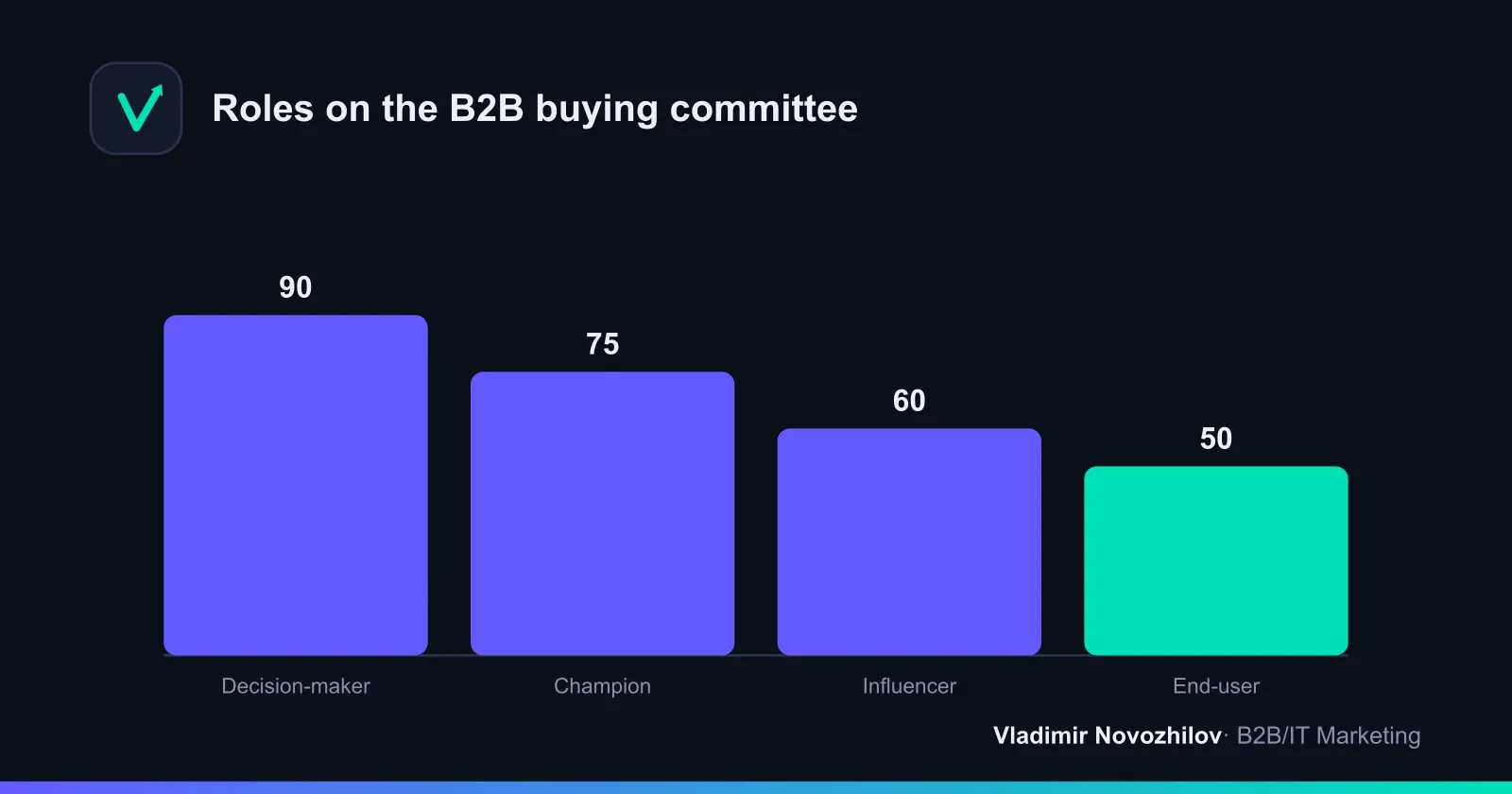
In B2B, purchasing decisions are rarely made by one person. That’s why B2B buyer personas are often built around roles in the buying committee rather than around individuals:
- Decision-maker — the person who approves the budget and gives the final sign-off. They care about risk, ROI, and strategic fit.
- Champion — the internal advocate who promotes your solution within the company. They want to look like the hero who solved the problem.
- Influencer — the expert who shapes the choice (e.g., a technical architect). They evaluate based on quality and compatibility criteria.
- End-user — the person who actually uses the product. They care about ease of use and how the product makes their daily work easier.
A single deal may involve all four roles, and each requires its own message. Ignoring even one risks derailing the deal at the final stage.
What a buyer persona consists of: demographics, psychographics, pain points, goals
For a persona to become a working document, it needs several essential blocks. Here’s a structure you can use as the basis for your buyer persona template.
Demographic profile
Basic characteristics: age, gender, location, income level, education, job title. In B2B, demographics are supplemented with firmographics: company size, industry, area of responsibility. The demographic profile answers the question “who is this person, formally speaking.”
Psychographics
Psychographics are the values, motives, attitudes, fears, and lifestyle that drive a person’s behavior from within. Psychographics is what separates a deep persona from a shallow set of numbers. This includes what the person fears, what they aspire to, how they want to be perceived by colleagues, and which sources they trust.
Goals and pain points
Goals are what a person wants to achieve. Pain points are what stands in their way. Your product should address a specific pain point. For example, a logistics director’s goal might be “cut costs by 15%,” while their pain point is “no visibility into routes.”
Buyer’s journey
The buyer’s journey is the sequence of stages a person goes through, from recognizing a problem to making a purchase and beyond. Typically these stages are awareness, consideration, and decision. For a persona, it’s important to capture how the person searches for information, what content they consume at each stage, and what raises doubts.
Information sources and objections
Where the persona gets their information (industry media, Telegram channels, colleagues, conferences), who they trust, and what objections arise before purchase. This block directly feeds the media plan and sales scripts.
How to create a buyer persona: step-by-step methodology
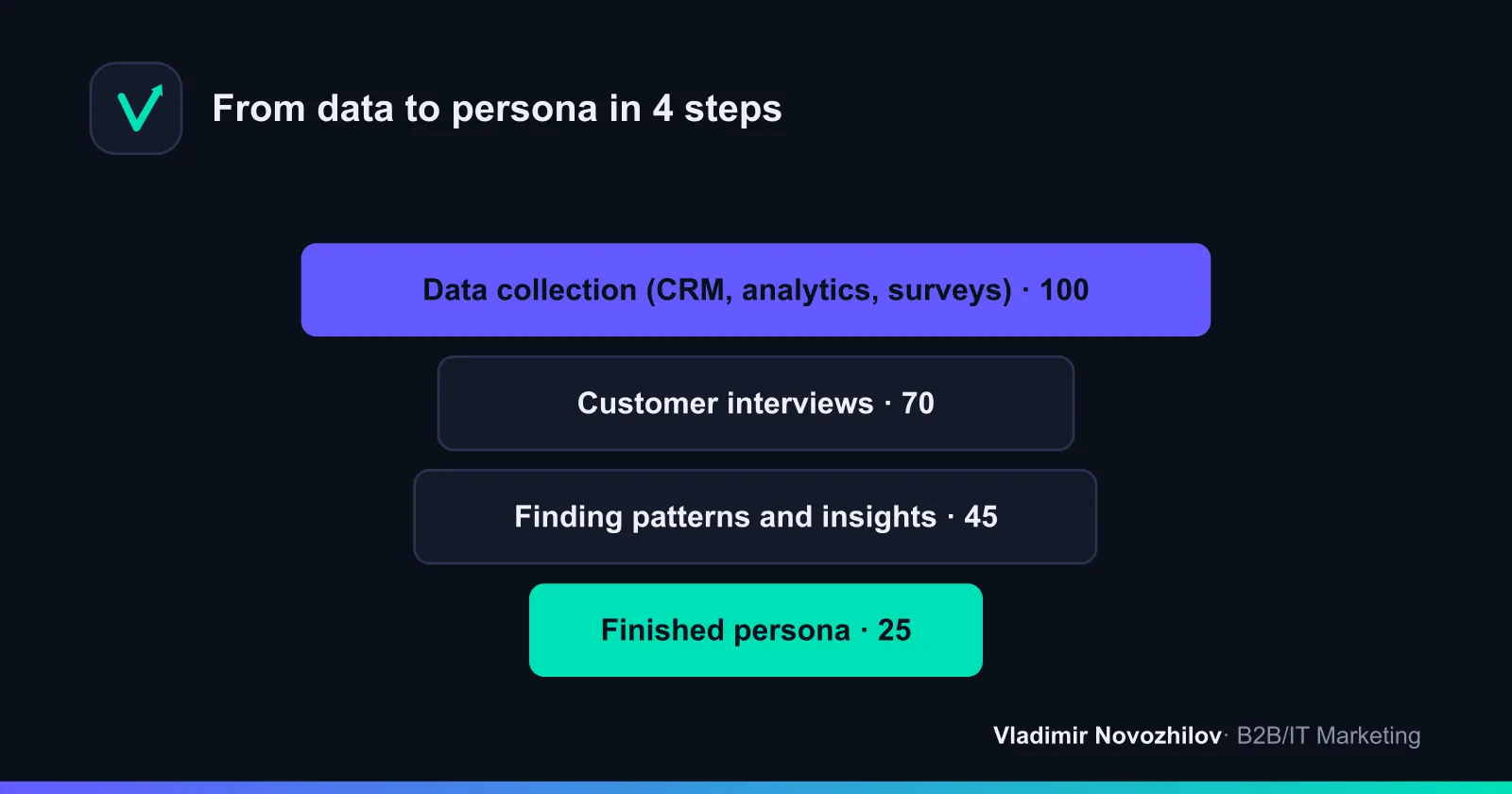
Now for the main part — how to build a buyer persona that reflects reality rather than fantasy. The methodology has six steps.
Step 1. Define the purchase decision
Start with the specific decision you’re building the persona around: “choosing a CRM system,” “ordering an implementation service,” “purchasing equipment.” A persona is always tied to a purchase context, not to an abstract “customer in general.”
Step 2. Outline the target market and hypotheses
Formulate preliminary segments and hypotheses: who these people are, what roles and pain points they might have. This is a draft you’ll validate with data. At this stage it helps to reference your ICP to understand the boundaries.
Step 3. Find and invite real buyers for interviews
Customer interviews are the heart of the methodology. Invite people who recently made a purchase decision — both those who bought from you and those who chose a competitor or decided not to buy at all. Those who didn’t buy provide insights just as valuable as those who did.
Step 4. Conduct and record the interviews
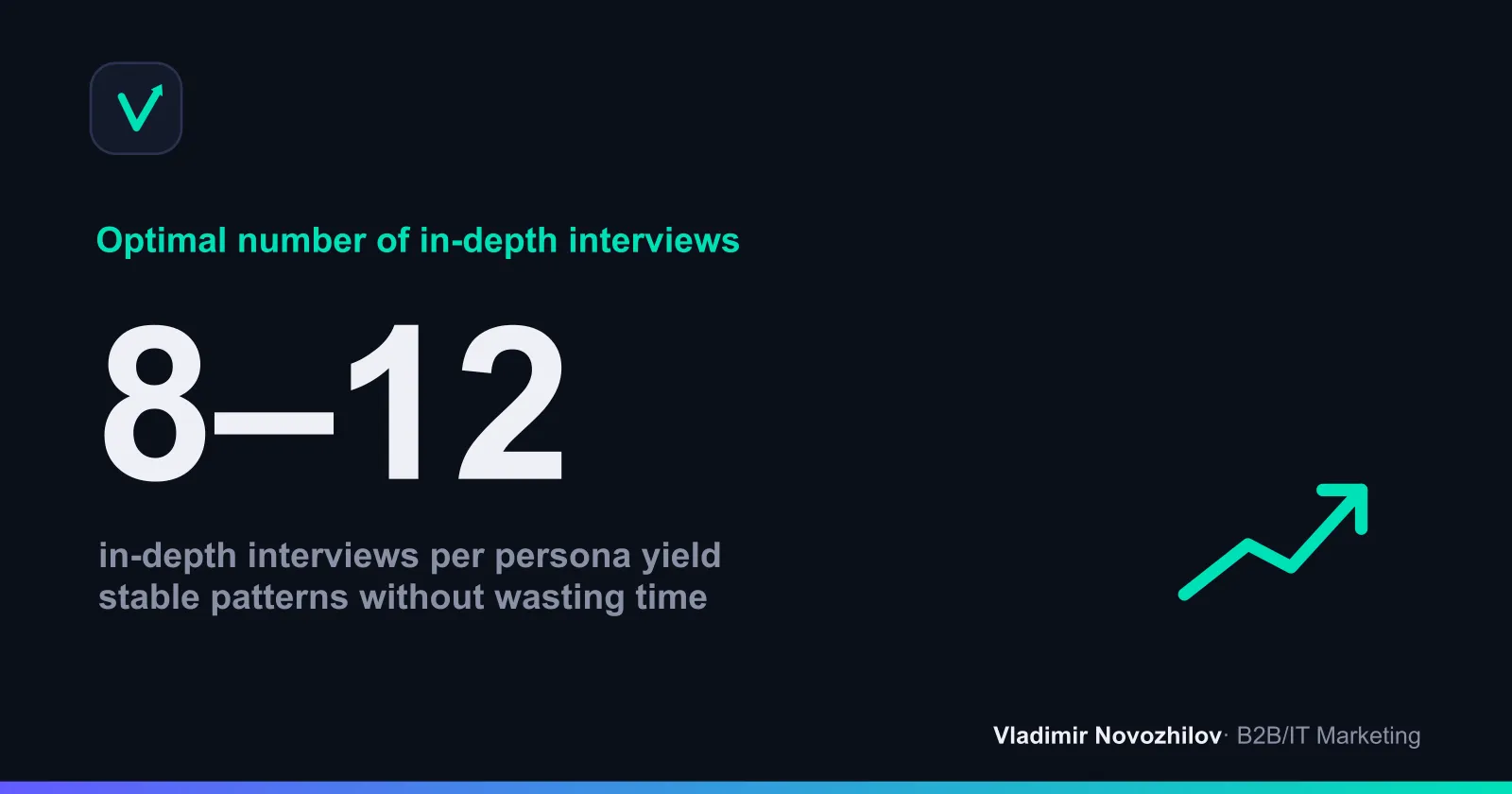
How many interviews do you need? The sweet spot is 8–12 in-depth interviews per persona — enough for patterns to start repeating. Ask open-ended questions about how the person made their decision, what they compared, what they feared, and what triggered the search. Record everything — you’ll need verbatim quotes.
Step 5. Find patterns and insights
Analyze the transcripts and look for recurring themes, decision criteria, and objections. These patterns are where “buying insights” come from — an understanding of what really drives the purchase. Supplement qualitative data with quantitative data from CRM and analytics.
Step 6. Assemble the persona and add quotes
Organize the insights into your template structure: give the persona a name, photo, and job title, and articulate their goals, pain points, and buyer’s journey. Add real quotes from the interviews — they make the persona feel alive and credible to the team.
Where to get data for a persona: analytics, surveys, interviews, social media
To make the customer portrait credible, combine several data sources:
- CRM — deal history, average check size, cycle length, reasons for lost deals. The most honest source of who buys and how.
- Web analytics — demographics, devices, on-site behavior, entry and exit points.
- In-depth interviews — qualitative data about motivation that numbers alone can’t show.
- Surveys — a quick way to validate hypotheses on a larger sample.
- Sales team — real objections and questions salespeople hear every day.
- Social media and communities — the audience’s language, discussed problems, opinion leaders.
- Support team — recurring issues and complaints that become the persona’s pain points.
The rule is simple: the more independent sources confirm an insight, the more reliable it is for the persona. One comment from an interview is a hypothesis; three sources form a pattern.
Buyer persona example: case study breakdown
Let’s walk through a realistic B2B example: a company that sells a warehouse management automation system for mid-sized businesses.
Irina, Head of Logistics
- Demographic profile: 41 years old, lives in a large city, holds a higher education degree, works at a company with 200 employees and annual revenue of 1.2 billion rubles.
- Role in the purchase: Champion — she initiates the project and pitches it to the CFO (the decision-maker).
- Goals: Cut inventory-related costs by 15%, eliminate stock mismatches, and get real-time visibility into inventory levels.
- Pain points: Manual tracking in Excel, warehouse staff errors, missed shipments, and pressure from management for numbers she doesn’t have.
- Psychographics: Values reliability over “trendiness,” fears implementing a system that “breaks down” and damages her reputation. Wants to be seen by leadership as the person who brought order to the process.
- Buyer’s journey: Googles “warehouse automation,” reads case studies, asks in industry chat groups, requests 3 demos, compares based on implementation cost and payback period.
- Objections: “What if the staff can’t learn it?”, “How long will implementation take?”, “What about support?”
- Interview quote: “I don’t need the fanciest system. I need to be able to show my director a report in a month and have him stop asking questions.”
This portrait immediately shows which messages will resonate: emphasize speed of implementation, reliability, payback case studies, and support. Meanwhile, product features the company is proud of but that don’t matter to Irina fade into the background.
Buyer persona template: ready-to-use structure
Here’s a ready-made buyer persona template you can copy into a spreadsheet or document and fill in for each persona. This is the checklist of fields most guides leave out.
| Template block | What to fill in |
|---|---|
| Name and photo | A working name + photo for visualization |
| Job title and buying role | Their formal title; decision-maker / champion / influencer / end-user |
| Demographics | Age, location, income, education |
| Firmographics (for B2B) | Industry, company size, revenue |
| Goals | 2–3 key goals related to the product |
| Pain points | 3–5 pain points your product addresses |
| Psychographics | Values, fears, motives, self-perception |
| Buyer’s journey | How they search, compare, and decide |
| Information sources | Channels, media, communities, experts |
| Objections | What stops them from saying “yes” |
| Purchase triggers | What kicks off the search for a solution |
| Quote | A verbatim phrase from the interview |
| Our message | The offer and arguments tailored to this persona |
A readiness checklist for a persona: all blocks are filled in, every insight is backed by at least two sources, there’s at least one real quote, and the description fits on a single screen. If a persona runs three pages long, no one will read it.
Common mistakes when creating personas
Almost no competing article covers this section, yet mistakes are exactly what kills the value of personas most often. Here are the main ones:
- Persona out of thin air. The most common mistake is inventing a customer avatar without a single interview. Such a document reflects the team’s biases, not the market.
- Too many personas. Ten personas are impossible to keep in mind. Start with 2–4 and merge similar ones with matching motivations.
- Excess useless demographics. A persona’s favorite color and zodiac sign don’t influence purchase decisions. Keep only what actually changes decisions.
- Missing pain points and objections. A persona without pain points turns into a résumé. Pain points and objections are what make it functional.
- The “shelf” persona. You built a presentation and then forgot about it. A persona should live in briefs, scripts, and requirement documents.
- Ignoring B2B roles. You described the end-user but forgot the decision-maker — and the deal stalls at budget approval.
- Outdated persona. The market changes, but a three-year-old document keeps misleading the team.
- Confusing persona with ICP. When the team mixes up the individual and company levels, strategy loses focus.
How to use a buyer persona in marketing and sales
Creating a persona is only half the job. Its value shows up when it’s used every day.
In marketing:
- Write headlines and offers around a specific persona’s pain points, not “everyone.”
- Build a content plan by buyer’s journey stage for each persona.
- Set up targeting and media plans around the channels each persona trusts.
- Personalize email sequences around each persona’s goals and objections.
In sales:
- Qualify leads: if someone doesn’t match any persona (or matches a negative one), save your time.
- Prepare scripts and objection responses in advance for each role.
- In B2B, work the deal across multiple personas at once: the champion helps from inside, the decision-maker approves the budget.
In product:
- Prioritize features based on whose pain point they solve.
- Test hypotheses grounded in each persona’s goals.
Integrating with CRM strengthens the effect: tag deals by persona, and over time you’ll see which personas bring the highest LTV and conversion — and which ones are just a headache.
Tools and AI generators for building personas: comparison
You can build a persona in a plain spreadsheet, but dedicated tools speed up the process and make the result presentable. Let’s compare popular options.
| Tool | Format | Strengths | Best for |
|---|---|---|---|
| HubSpot Make My Persona | Step-by-step wizard + AI | Quick start, PDF export, free | Beginners, small businesses |
| Semrush template | Field-based template | Detailed field structure, ties to data | Practicing marketers |
| Hootsuite template | Ready-made template | Simplicity, social media focus | Social media and content teams |
| Xtensio | Builder/editor | Polished design, collaborative editing | Agencies, presentations |
| Google Docs / spreadsheet | Manual document | Full control, free | Those who value flexibility |
| LLMs (ChatGPT and similar) | AI-generated draft | Speed, hypothesis generation | Quick prototyping |
A note on AI. Can you create a buyer persona using AI? Yes — language models quickly assemble a draft and organize your thinking. But keep the main limitation in mind: AI works with averaged data from its training, not with your actual customers. That’s why an AI-generated persona is a hypothesis that must be validated with interviews and CRM data. Use AI to accelerate the first draft, not as a source of truth.
How to measure buyer persona effectiveness
A persona isn’t an end in itself — it’s a means of improving performance. How do you know it’s working? Track metrics before and after implementation:
- Landing page and email conversion — copy written for a persona should convert better than generic copy.
- Lead quality (MQL→SQL) — the share of leads sales considers on-target.
- Customer acquisition cost (CAC) — precise targeting lowers the cost per customer.
- Deal cycle length — understanding B2B roles speeds up approvals.
- Campaign ROI — compare returns before and after introducing personas.
- LTV by persona — which persona delivers more value long-term.
A simple way to prove a persona’s value is an A/B test: run one campaign targeting a “generic audience” and another with messaging tailored to a specific persona, then compare conversion and ROI. The difference in numbers will convince skeptics better than any presentation.
In short: what you need to know about buyer personas
A buyer persona is a data-driven portrait of your ideal customer that helps you position more precisely, save budget, and boost conversion. Start with 2–4 personas, build them on 8–12 interviews, don’t confuse them with ICP, add a negative persona to filter leads, and update the document every 6–12 months. And most importantly — don’t leave the persona on a shelf: it should live in every brief, email, and customer conversation.
FAQ: common questions about buyer personas
Where can I download a free buyer persona template?
You don’t necessarily need to download anything: take the structure from the “Buyer persona template” section above and copy it into a spreadsheet or document. Free templates are also offered by HubSpot, Semrush, and Hootsuite, and the Xtensio builder helps you design a persona visually. The key is filling the fields with data, not guesses.
How does psychographics differ from demographics in a persona?
The demographic profile describes formal traits — age, gender, income, job title. Psychographics reveals internal motives — values, fears, aspirations, and decision-making style. Demographics answer “who is this,” while psychographics answer “why do they buy.” A strong persona always includes both blocks.
Do I need a B2B buyer persona if I have few customers?
Yes, especially in B2B, where deals are large and multi-step. Even with a small number of clients, it’s important to understand the roles in the purchase: decision-maker, champion, influencer, and end-user. Role-based personas help you manage the deal systematically and avoid losing it at the budget approval stage.
Why do you need a negative persona?
A negative persona describes someone you do NOT want to attract: people who can’t pay, churn quickly, or are resource-intensive to serve. It helps filter out irrelevant leads at the targeting and qualification stage, saving budget and sales time. It’s a simple but underrated focusing tool.
FAQ
- What is a buyer persona in simple terms?
- A buyer persona is a composite portrait of your typical customer, based on real data and interviews. It describes who this person is, what their goals, pain points, and buying criteria are, and how they make purchasing decisions. A persona helps the whole team speak the same language about the audience.
- How many buyer personas should a company create?
- Most businesses need just 2–4 buyer personas to start. Focus not on quantity but on meaningful differences in behavior and motivation between segments. If two segments buy for the same reasons, merge them. In B2B, add personas by role in the buying committee rather than by industry.
- What's the difference between a buyer persona and an ICP?
- An ICP (Ideal Customer Profile) describes the type of company that's profitable to target: industry, size, revenue, tech stack. A buyer persona describes a specific person within that company: their role, goals, and pain points. ICP answers "who should we sell to," while a persona answers "how do we reach and convince them."
- How often should you update a buyer persona?
- Review personas every 6–12 months, and also after product changes, entering a new market, or a noticeable shift in conversion rates. A persona is a living document: if CRM data and fresh interviews no longer match the description, it's time to update the customer portrait.
- Can you create a buyer persona using AI?
- Yes, AI generators and language models can help draft a persona and structure data in minutes. But AI works with averaged assumptions, so you should always validate the result with real interviews and CRM data. Use AI as an accelerator, not a replacement for research.