Customer Profile Without Guesswork: Algorithm, Template, B2C/B2B

TL;DR
You need more than “women 25–45”: build a concrete buyer image — demographics, psychographics, JTBD and purchase journey. This article explains the difference from TA and persona, gives a step‑by‑step algorithm, a ready template, B2C and B2B examples, and validation metrics (CVR, CPA, LTV, NPS).
Shooting at the broad target “women 25–45 with average income” is a road to nowhere. You need a concrete image of a typical buyer within one segment: who they are, how they live, what jobs (JTBD) they solve, what they fear and how they make decisions. In other words, a “living” person with real data, not an anonymized TA. Below we explain the difference from TA and persona, the profile components, a step‑by‑step algorithm, a ready template, B2C and B2B examples, and metrics to check correctness.
In 15 years in marketing and sales (B2B, IT, services) I’ve seen the same pattern: positioning failures often start with not knowing exactly who we sell to. A customer profile is the cheapest way to close that blind spot and align marketing, sales and product.
How a customer profile differs from TA and a persona
Let’s separate three similar terms with different levels of detail.
- Target audience (TA) — a broad group sharing common attributes who potentially need your product. It’s statistics: gender, age, geography, income.
- Customer profile — a detailed image of one typical representative of a segment: motives, jobs, objections and purchase scenario.
- Customer persona — the same profile but “humanized”: a name, photo, short story. Essentially persona and profile are synonyms; the difference is presentation.
The connection: TA shows “who in principle buys”, segmentation splits it into homogeneous groups, and the profile is the specific person from the group you think of when writing a headline or preparing a sales script.
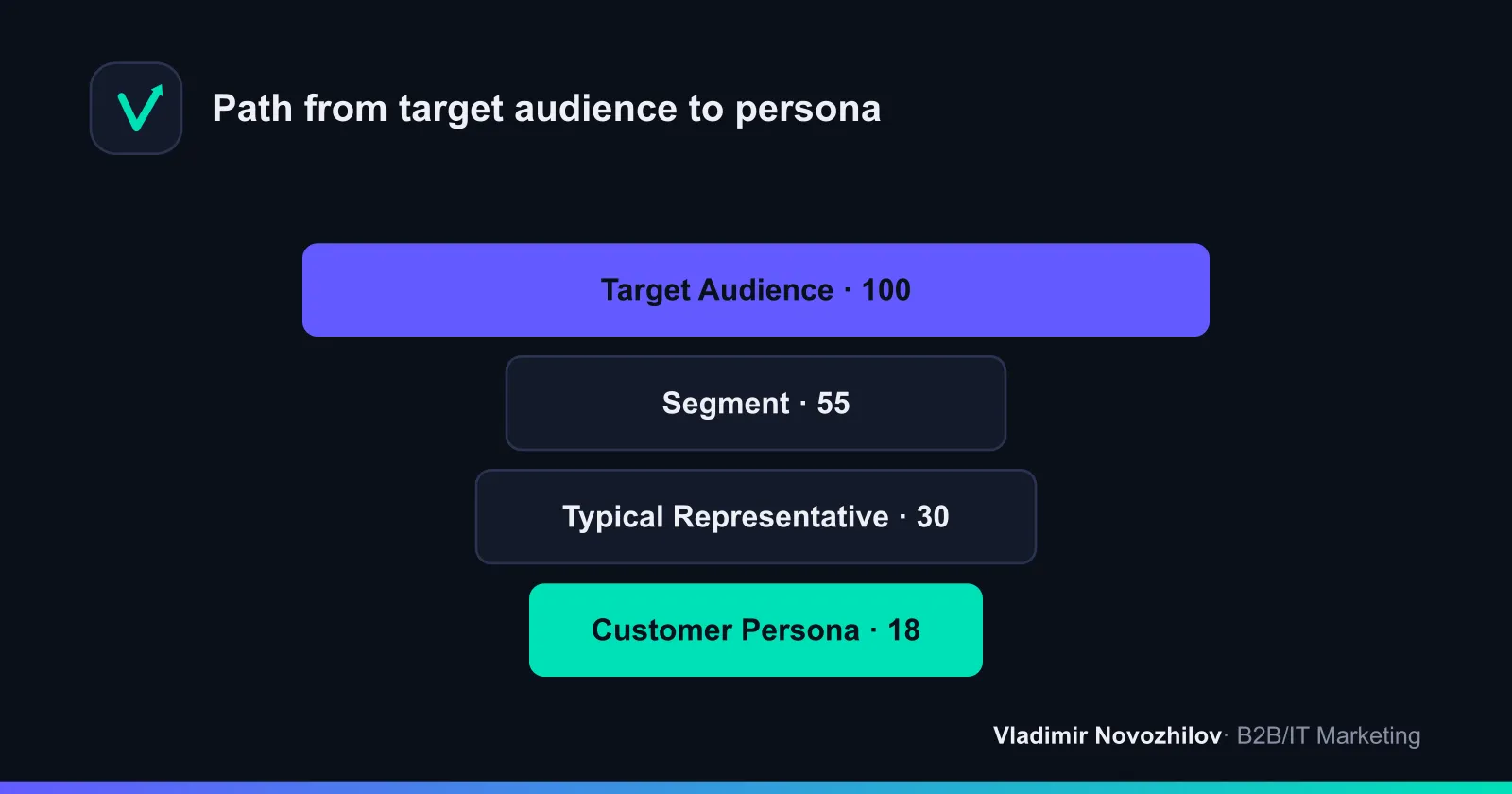
Table: TA, profile and persona — briefly
| Criterion | Target audience | Customer profile | Customer persona |
|---|---|---|---|
| Level of detail | Group, statistics | Typical segment representative | Character with name and story |
| Example | “Small service businesses” | “Owner of an 8-person studio, looking to fill staff schedules” | “Marina, 34, barbershop owner, afraid of empty chairs” |
| Answers the question | Who are our buyers overall | How a concrete customer thinks and decides | How this customer looks and sounds |
| Where applied | Media planning, reach | Offers, copy, product, scripts | Team briefs, empathy building |
| Basis | Demographics, market size | CRM data + interviews + psychographics | Profile + storytelling |
The takeaway: TA helps estimate scale, a profile helps make precise marketing, sales and product decisions. In English sources, customer profile corresponds to “customer profile”, ICP means Ideal Customer Profile, and the humanized version is a buyer persona.
Why a business needs a customer profile
A profile is not a checkbox document but a working tool that saves budget and increases conversion.
- Precise messaging. Knowing tasks and pains lets you craft an offer that hits motivation, not “everyone at once.”
- Cheaper acquisition. Narrow targeting by profile attributes reduces CPA and raises CVR — you pay less for irrelevant clicks.
- Higher AOV and LTV. Understanding motives enables relevant upsells and better retention.
- Faster sales. Scripts preempt objections and selection criteria — the sales cycle shortens.
- Better product. Development prioritizes features for real tasks, not “we think it should be.”
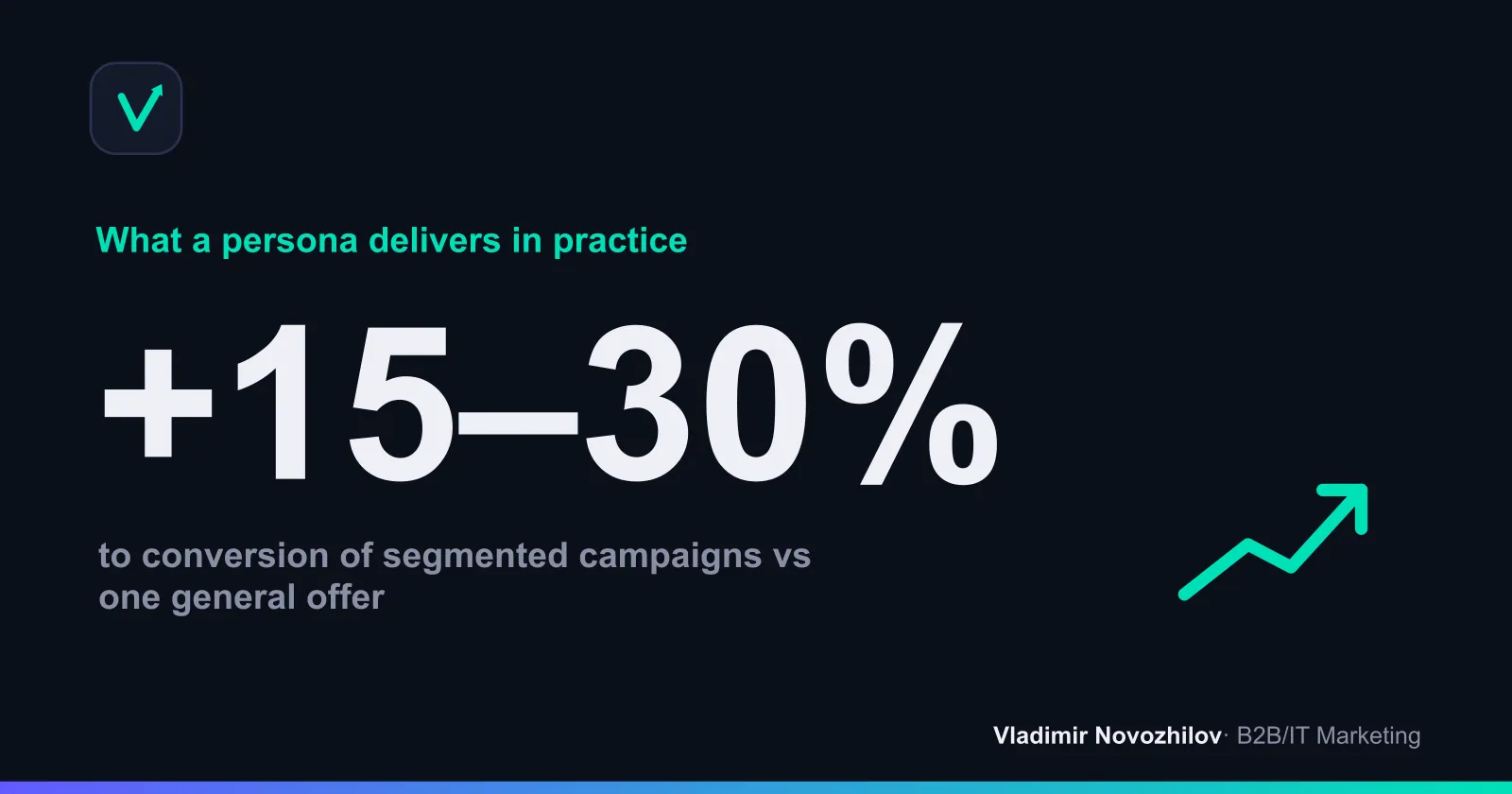
From my experience, even a rough profile assembled in a couple of days from CRM and five interviews increases segmented campaign conversion by 15–30% versus a universal offer. It’s not magic — you simply stop speaking to everyone the same way.
Types of profiles: target, ideal, negative and B2B
Decide the objective before composing. Several practical types exist.
- Target customer profile. The basic image of a typical buyer in a priority segment.
- Ideal customer (ICP). Delivers max revenue with minimal cost: buys quickly, pays on time, stays long. Marketing and sales prioritize ICP.
- Negative profile. Who NOT to sell to: low LTV, many objections, high support load, fast churn. Saves budget as well as positive profiles.
- B2B customer profile. Instead of one person — the buying committee; instead of demographics — firmographics (industry, company size, revenue). We’ll cover this further.
Most companies do well with: 2–4 positive profiles, one ICP and one negative profile. That’s enough to maintain focus.
What a profile consists of: demographics, psychographics, JTBD and customer journey
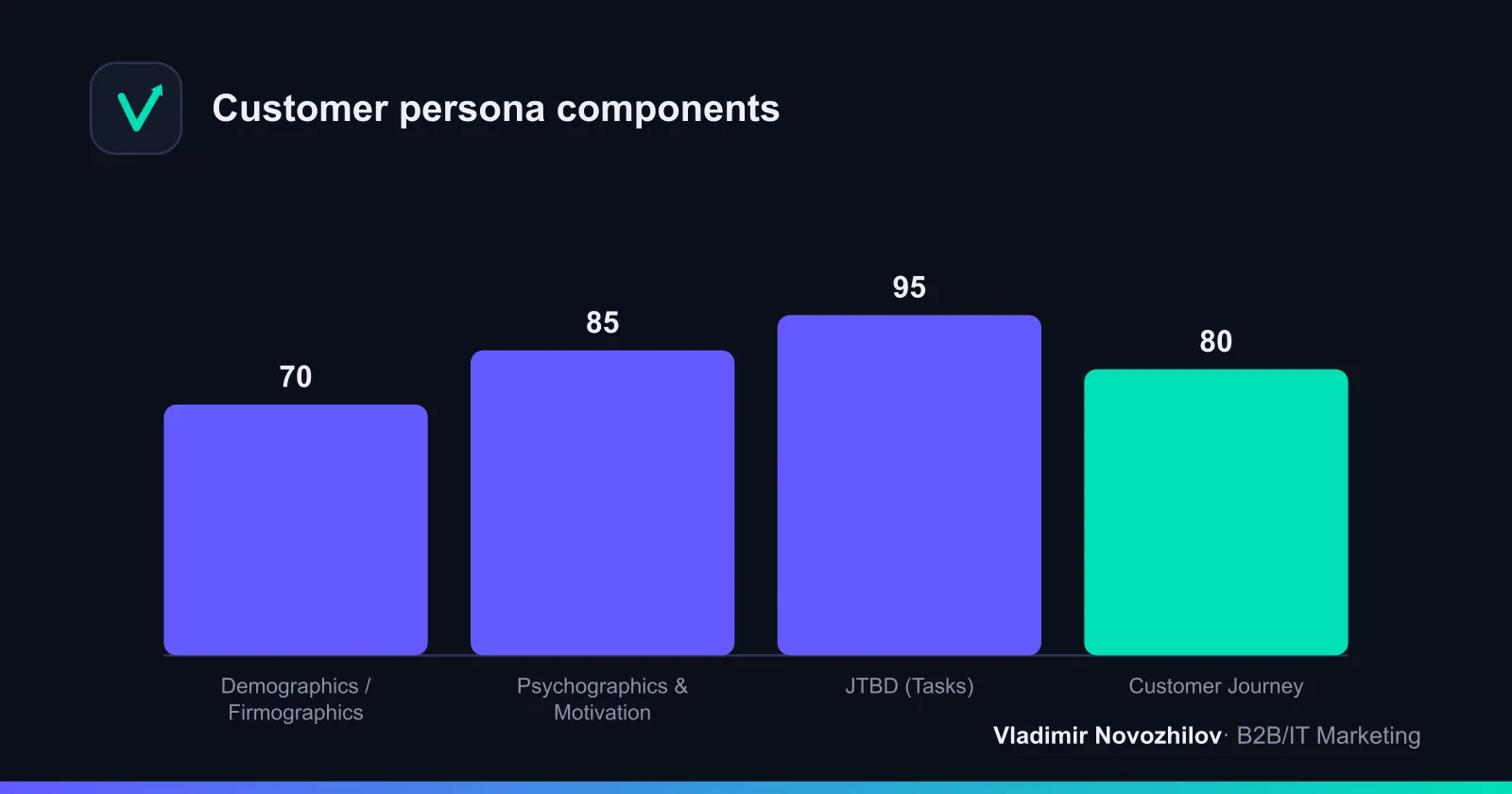
A strong profile has four blocks. The first two answer “who is the customer”, the second two — “why and how they buy”. That second pair usually delivers the most value.
1. Demographics and firmographics
Basic client characteristics: for B2C — gender, age, marital status, income, city, profession. For B2B — firmographics: industry, company size, revenue, region, and the decision maker’s role and title. The foundation matters, but you can’t build the whole profile on it.
2. Customer psychographics
Values, lifestyle, beliefs, fears and motives. This answers “what matters to this person and what do they fear?” For a salon owner it’s not “CRM” but peace of mind and no idle staff time. Psychographics turn dry facts into reasons why they buy the way they do.
3. JTBD (Jobs To Be Done)
JTBD describes the “job” the customer “hires” the product to do. Formula: “When [situation], I want to [action], so that [outcome].” Example: “When appointments are canceled, I want to quickly fill the slot so I don’t lose revenue.” The approach helps shift focus from demographics to the task.
4. Customer Journey
Customer Journey Map (CJM) — stages the buyer passes through: problem awareness, solution search, comparison, purchase, use, repurchase. For the profile note: where they look for information, what doubts arise at each step and what pushes them to decide. This shows where to activate marketing and sales.
Add pains, needs, objections, selection criteria, favorite channels and purchase triggers to these four blocks. Together they form a full customer profile.
How to build a customer profile: step‑by‑step algorithm
Below is a practical four‑step algorithm with checklists. It works for both B2C and B2B — only the data sources differ.
Step 1. Collect customer data (CRM, analytics, surveys, CustDev)
A profile is built on data, not guesses. You need two types of sources.
Quantitative (what happens):
- CRM export: who buys, for how much, how often, with what LTV;
- web analytics (Metrica, GA): demographics, devices, on‑site behavior;
- search query stats (Wordstat): what people search for;
- ad account and email platform data.
Qualitative (why it happens):
- CustDev — in‑depth interviews with 5–10 customers per segment;
- surveys and questionnaires of current buyers;
- analysis of reviews, comments and support tickets;
- conversations with sales — they hear live objections.
Step 1 checklist: exported CRM data ✓, reviewed web analytics ✓, gathered 15–20 reviews ✓, conducted 5+ interviews ✓, talked with sales ✓.
If you have no customers yet, rely on competitor buyers, industry communities and public research, and test hypotheses with first deals.
Step 2. Segment the audience
Segmentation divides TA into groups that decide differently. Segment by meaningful attributes: JTBD, behavior, value (LTV/order size), not just gender and age. Quality check is simple: the same offer fits people inside the segment.
In B2B segment by firmographics and decision‑maker role; in B2C by usage scenario and motivation. Identify 3–6 segments and rank them by revenue and potential.
Step 2 checklist: identified 3–6 segments ✓, each has a clear job ✓, ranked by revenue ✓, chose 1–2 priorities ✓.
Step 3. Select a typical segment representative
Within a priority segment find the median customer — not the biggest or smallest, just typical. Prefer a real person from your database: the profile will be credible. Give a name and, if desired, a photo — that becomes a persona which boosts team empathy.
Step 3 checklist: selected a real typical customer ✓, verified they represent the segment ✓, assigned a name and role ✓.
Step 4. Document the profile and validate it
Fill the template (below) for all blocks: demographics/firmographics, psychographics, JTBD, purchase journey, pains, objections, channels. Use verbatim pain statements from interviews — critical for copy and scripts.
Then validate: run ads or a mailing to the segment and compare metrics with a control. If conversion is higher and lead cost lower — the profile works. If not — refine hypotheses and return to step 2.
Step 4 checklist: filled every block ✓, used customer quotes ✓, ran a test ✓, checked metrics ✓, updated the profile ✓.
Ready customer profile template
Below is a template you can copy into Google Docs, Excel or Notion and fill for each segment.
| Block | Field | What to write |
|---|---|---|
| Identification | Name / role | Persona and position (for B2B — decision maker) |
| Demographics / firmographics | Age, city, income / industry, size, revenue | Basic client characteristics |
| Psychographics | Values, fears, lifestyle | Client psychographics and motivation |
| JTBD | “When…, I want…, so that…” | Main job the product solves |
| Pains | Top‑3 problems | Verbatim from interviews |
| Objections | What stops them from buying | “Too expensive”, “I don’t trust it”, “No time” |
| Selection criteria | How they compare offers | Price, lead time, guarantees, case studies |
| Customer Journey | Stages and touchpoints | Where they look, what they read, what decides them |
| Channels | Where to find them | Search, social, email, offline |
| Triggers | What pushes to buy | Event, deadline, promotion |
| Metrics | LTV, AOV, sales cycle | For segment prioritization |
A document filled with these fields is a working profile. Keep it available to marketing, sales and product.
Customer profile examples: B2C and B2B
Theory sticks better with examples. Below are one B2C and one detailed B2B profile.
Example customer profile (B2C, services)
Marina, 34 — owner of a 4‑chair barbershop, Kazan.
- Demographics: married, two children, business income unstable, basic marketing knowledge.
- Psychographics: values control and predictability, fears idle chairs and “empty” slots, tired of chaotic scheduling.
- JTBD: “When appointments are canceled, I want to quickly fill the slot so I don’t lose daily revenue.”
- Pains: empty chairs, staff turnover, few repeat visits.
- Objections: “hard to implement”, “expensive for a small salon.”
- Customer journey: looks for solutions in Telegram channels for beauty business and on YouTube, compares via colleagues’ reviews, decides after a free trial.
- Channels: Instagram*, Telegram, word of mouth.
- Trigger: sharp revenue drop in the off‑season.
Example customer profile (B2B)
Wholesale building materials company, decision maker — commercial director.
- Firmographics: industry — wholesale of finishing materials; staff 50–150; revenue 300–800M ₽/year; region — Volga Federal District.
- Buying committee: initiator — procurement manager; decision maker — commercial director; influencers — CFO and logistics; blocker — accounting over payment terms.
- JTBD: “When we lose margin due to supply disruptions, we want a reliable supplier with deferred payment to maintain sales plans.”
- Pains: missed deadlines, out‑of‑stock items, inflexible payment terms.
- Selection criteria: in‑stock availability, deferred payment, shipping speed, cases from similar clients.
- Objections: “we already have a trusted supplier”, “quality risks.”
- Sales cycle: 1–3 months; decision is made by a group, not one person.
- Channels: industry exhibitions, commercial search queries, referrals, price‑list email mailings.
Note: in B2B the profile describes roles and the entire decision group, not a single buyer. This is the key B2C difference.
*The social network is owned by Meta, recognized as extremist in the Russian Federation.
How to use the customer profile in marketing, sales and product
A profile is useless if it sits in a folder. Here’s how teams apply it.
- Marketing: offers and headlines targeted to segment pains, targeting by profile attributes, channel selection from the customer journey, content topics for journey stages.
- Sales: scripts with pre‑handled objections, lead qualification by ICP fit, prioritization of high‑LTV deals.
- Product: feature prioritization based on JTBD, not on “wishes”; interface copy in the client’s language.
- CRM & automation: profiles form the basis for tags and segments in CRM. Set auto‑marking of leads by firmographics and behavior — then mailings and scoring work by segments without manual sorting. This turns the profile from a document into automation rules.
Important nuance: the base profile is one, but format and emphasis change by channel. Search relies on intent, social on psychographics and pains, email on the journey stage.
How many profiles does a business need
Rule of thumb — one profile per meaningful revenue segment that decides differently. Small businesses usually need 2–4, mid‑size 3–6. More than 7–8 is hard to maintain: profiles duplicate and focus blurs.
Start with the donor segment — the one generating most revenue and LTV — and add as you grow. Keep ICP and a negative profile separate: the first concentrates effort, the second filters out poor matches.
Common mistakes when composing a customer profile
The most costly errors I’ve seen:
- Profile from thin air. Built in a meeting without data and interviews. Result — pretty but useless document. Fix with CustDev and CRM export.
- Only demographics. “Women 25–45, average income” is not a profile. Without psychographics and JTBD you don’t know what to offer.
- Too many personas. 12 profiles nobody uses. Better 3 working ones than 12 dead ones.
- No pains and quotes. You write in your words, not the customer’s. Capture verbatim phrases from interviews.
- Ignoring B2B specifics. Described one person where a committee decides. The message won’t reach the real decision maker.
- Built and forgotten. Market and clients change, but the profile remains last year’s. Update every 6–12 months and after product changes.
- No validation. No metric checks — you won’t know if it works.
How to measure profile effectiveness: metrics and validation
A profile is considered working if the segment it describes yields better business metrics than the average audience. Validate by launching a campaign or mailing to the profile segment and comparing with a control group.
Table of profile validation metrics
| Metric | What it shows | Good signal |
|---|---|---|
| CVR (conversion) | Share of target actions | Higher than general audience |
| CPA (acquisition cost) | Cost per lead/customer | Lower than unsegmented campaigns |
| AOV (average order value) | Purchase amount | Increases with a relevant offer |
| LTV (lifetime value) | Revenue per customer over time | Higher for ICP segment |
| NPS | Willingness to recommend | Higher for the “own” customer |
Also check qualitatively: 3–5 new interviews should confirm that pains and wording match the documented ones. If metrics for the segment improve and clients “recognize themselves” in the description — the profile is assembled correctly. If not — return to step 2 and refine segmentation and hypotheses.
Key takeaways
A profile describes a concrete buyer from a segment: demographics, psychographics, JTBD and purchase journey. It’s deeper than TA, and a persona is the humanized version of the same. The process is simple: collect data (CRM, analytics, CustDev), segment, pick a typical representative, fill the template and validate by metrics (CVR, CPA, LTV, NPS). Keep 2–6 working profiles, update them every 6–12 months and use them in marketing, sales, product and CRM — then a customer profile ceases to be a file and becomes a growth tool.
FAQ
- What is the main difference between a customer profile and a target audience?
- Target audience (TA) is a broad group defined by basic attributes. A customer profile is a detailed image of a single typical member of a segment: their motives, jobs-to-be-done, objections and purchase journey. TA helps assess scale; the profile enables precise decisions in marketing, sales and product.
- How many profiles should you keep and where to start?
- Typically 2–4 for small businesses and 3–6 for mid‑size. Start with the revenue/LTV donor segment. Add an ICP (ideal customer) and one negative profile — they focus efforts and filter out unprofitable deals.
- What if you don't have any customers yet?
- Use competitors' data and community insights, read reviews, run CustDev with potential buyers. Form hypotheses and validate them with initial deals and test campaigns, then refine segmentation and profiles.
- How often should profiles be updated?
- Every 6–12 months or when the product, market or channels change noticeably. Regularly add interview quotes and feedback from sales and support so the document stays relevant and actionable.
- How do you know a profile is 'assembled correctly'?
- Launch a campaign based on the profile and compare with a control using CVR and CPA. Also check AOV, LTV and NPS. If metrics improve and interviewees recognize themselves in the description, the profile works. If not — revisit segmentation and hypotheses.
- How does a B2B profile differ from B2C and what is an ICP?
- B2B describes firmographics and the buying committee (roles and influence), not just one person. ICP is the ideal customer with the best economics: high revenue and LTV, short sales cycle, low support burden. ICP guides marketing and sales priorities.