Ideal Customer Profile in B2B: how to build ICP — guide & template

TL;DR
An ICP describes the type of company that gets the most value from your product while delivering the highest profit to you with minimal CAC and churn. Unlike a buyer persona (a portrait of the decision maker), ICP focuses on the company itself: firmographics, technographics and unit economics. This article provides a step-by-step algorithm, two filled examples and an open template without email-gate.
Simply about the Ideal Customer Profile (ICP)
An ideal customer for your product can be a company to which you deliver the maximum value, and which in turn gives you the maximum profit with minimal CAC and churn. The profile of such a customer (ICP, Ideal Customer Profile) records the characteristics of these companies. It is not a dream or “everyone who pays”, but an aggregate portrait of those who buy quickly, stay for a long time and recommend you to others.
In B2B the profile describes the organization itself: industry, size, revenue, geography, technology stack and deal economics. It answers the question “which companies should we go after at all” — even before you decide who to talk to inside them.
A well-crafted ICP is a filter. It saves sales time (you don’t waste effort on non-targets), focuses marketing (you write for those who truly have the pain) and signals to product which features matter to the best customers.
The difference between ICP, buyer persona and target audience
These three concepts are often confused. The formula is simple: ICP — about the company, buyer persona — about the person, target audience — about the broad market.
| Parameter | Target audience (TA) | ICP | Buyer persona |
|---|---|---|---|
| Object | Market/segment | Company | Person (decision maker/influencer) |
| Level of detail | General | Medium | High |
| Example | “B2B companies in Russia” | “IT companies 50–200 employees, revenue 300–800 mln ₽, stack on 1С” | “CFO, 40 years old, fears cash gaps, decides in 2 weeks” |
| Answers the question | Who is broadly interested | Which companies to approach | Who and how to speak with internally |
| Where used | Strategy, reach | Scoring, ABM, targeting | Messaging, scripts, content |
In practice ICP and persona work together: first you select companies by ICP, then within each you identify the buying committee (DMU) and develop personas for each role — from the initiator to the final decision maker (Factors.ai, PandaDoc).
Why you need it: sales, marketing and product
ICP is not a checkbox document but a working tool that affects three functions at once.
- Sales. Less time spent on non-target leads, higher conversion and shorter deal cycle. You get an objective qualification criterion instead of “like/dislike”.
- Marketing. More accurate targeting and messaging, lower CAC, relevant content. ICP is the foundation for ABM (account-based marketing).
- Product. Understanding which Jobs-to-be-Done to prioritize and for whom to build the roadmap.
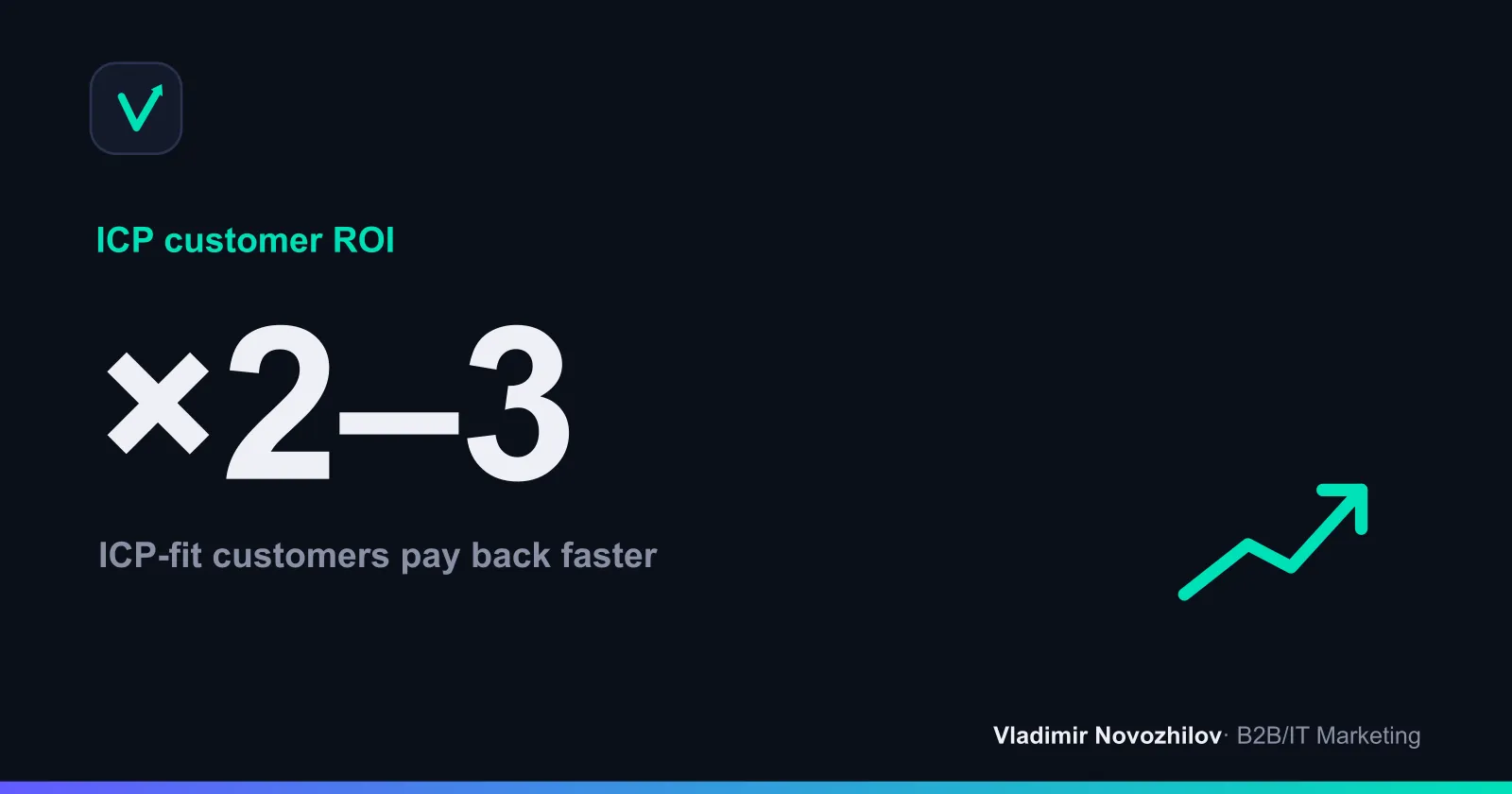
The main economic effect is focus. Customers within the ICP typically have higher LTV, lower churn and expand contracts more often.
ICP criteria in B2B: firmographics, technographics and unit economics
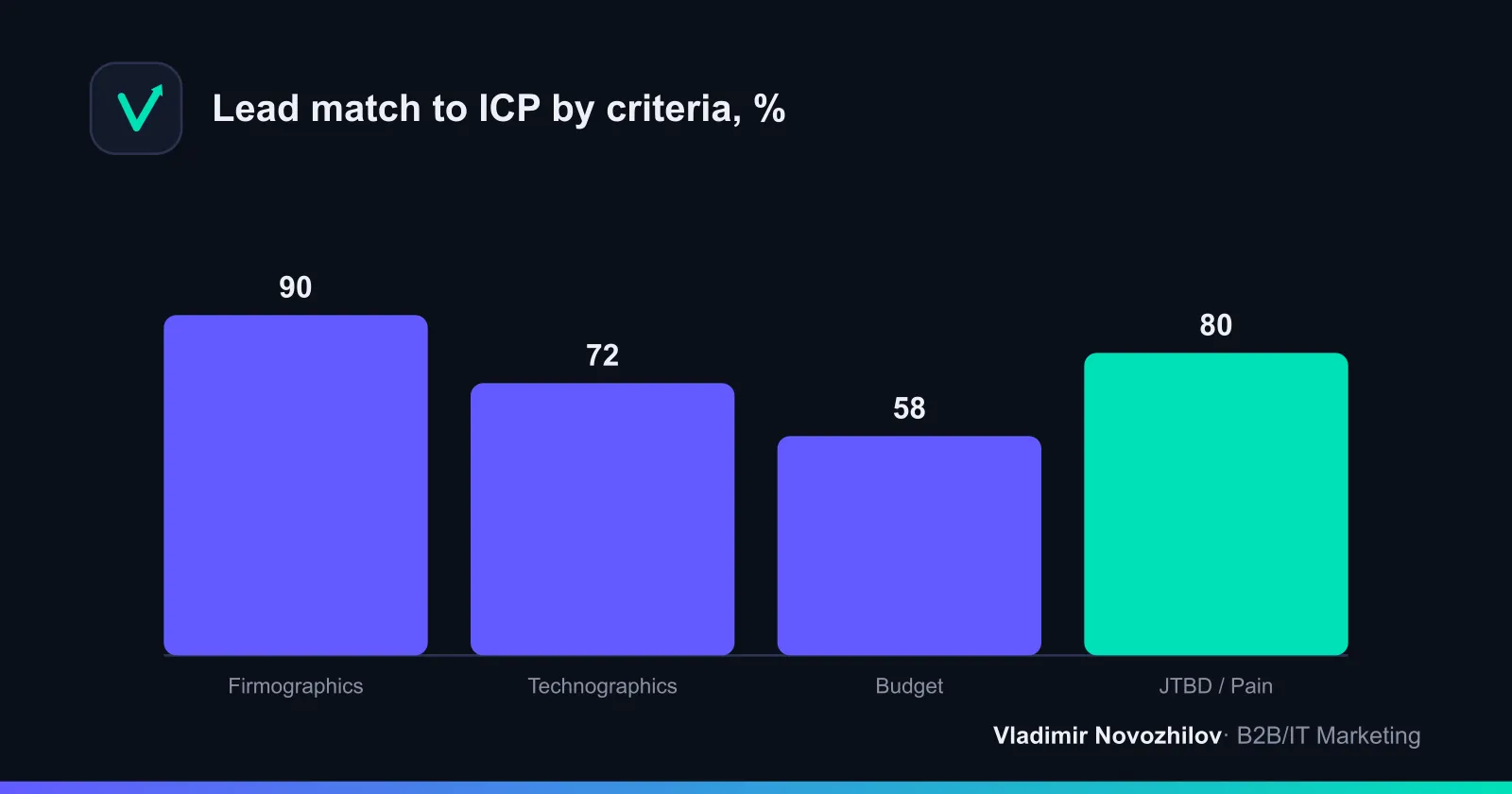
A strong B2B profile is built on three groups of criteria. Many stop at the first level, but the decisive factor is the combination of all three.
Firmographics
The “demographics” of companies: industry, headcount, annual revenue, geography, business type (product/services), stage of development. This is the basic selection layer: who it even makes sense to work with.
Technographics
The company’s technological environment: which systems are already used (CRM, ERP, analytics), which integrations are critical, level of digital maturity. For SaaS/IT this is a key criterion: if your product lives alongside 1С or requires an API, companies without the necessary stack are not your ICP.
Unit economics
The most underrated block. The ideal client is also economically viable. Look at:
- Average contract value — what size contract the company can sustain.
- LTV (lifetime value) — how much revenue they generate over time.
- CAC (customer acquisition cost) — how much it costs to acquire them; a healthy benchmark is LTV/CAC ≥ 3.
- Deal cycle length — faster closes = cheaper acquisition.
- Retention / churn — how long they stay; critical for SaaS.
- Profitability — how much remains after servicing costs.
If a segment provides a large check but needs a six-month implementation and churns after 3 months — it’s not an ICP, however “big” it may seem.
Step-by-step ICP creation algorithm in 6 steps
- Analyze current customers. Export deals from CRM for the last 6–12 months. Rank by LTV, speed of close, retention and profitability. Identify the top 10–20% — these are candidates for “ideal”.
- Conduct 5–10 in-depth interviews with the best customers. The goal is to understand purchase triggers, pain, selection criteria, who participated in the decision and why they chose you.
- Find common patterns. What unites the best customers by firmographics, technographics and economics? Look for repeating patterns, not single successes.
- Describe triggers and Jobs-to-be-Done. In what situation does the company develop the need? Which “job” are they hiring your product to do?
- Set measurable criteria and anti-patterns. Not “medium and large”, but “50–300 employees, revenue 300 mln — 1 bln ₽”. Be sure to describe who is NOT your customer.
- Document, name and implement. Put the profile into a template, give it a name, add fields to CRM and turn criteria into lead scoring.
Filled ICP examples for B2B SaaS and B2B services
Theory without numbers is useless. Here are two completed profiles.
Example 1. Warehouse management SaaS
| Criterion | Value |
|---|---|
| Industry | E-commerce, wholesale trade, distribution |
| Size | 50–300 employees |
| Revenue | 300 mln — 1.5 bln ₽/year |
| Geography | Russia, major cities |
| Technographics | 1С, marketplace integrations, needs API |
| Trigger | Growth in order volume, errors in manual accounting |
| JTBD | “Reduce picking errors and speed up shipment” |
| Average contract | 90,000 ₽/month |
| LTV | ~2.7 mln ₽ |
| CAC | up to 300,000 ₽ (LTV/CAC ≈ 9) |
| Deal cycle length | 30–45 days |
| Churn | < 3% per month |
| Anti-patterns | < 20 employees, no proprietary warehouse, no 1С |
Example 2. B2B services agency (analytics implementation)
| Criterion | Value |
|---|---|
| Industry | Fintech, SaaS, retail |
| Size | 100–500 employees |
| Revenue | from 500 mln ₽/year |
| Technographics | Has data stack (BI, DWH), dedicated analyst |
| Trigger | Data exists but decisions are made “by eye” |
| JTBD | “Build transparent reporting for the board” |
| Average contract | 1.2 mln ₽ per project |
| Deal cycle length | 45–90 days |
| Profitability | > 40% |
| DMU | CDO/CFO (decision), analyst (influence), CEO (budget) |
| Anti-patterns | No digitized data, one-off “cheap” requests |
Template and ICP checklist: fields to fill
Below is an open template you can copy into a spreadsheet and fill out (no email-gate).
Block 1. Firmographics
- Industry / vertical
- Number of employees
- Annual revenue
- Geography
- Stage / business type
Block 2. Technographics
- Key systems (CRM, ERP, BI)
- Required integrations
- Level of digital maturity
Block 3. Pain and triggers
- Trigger situation
- Jobs-to-be-Done
- Cost of inaction
Block 4. Buying committee (DMU)
- Initiator
- Influencers
- Economic decision maker
- Blockers
Block 5. Unit economics
- Average contract
- LTV and CAC (target LTV/CAC ≥ 3)
- Deal cycle length
- Retention / churn
- Profitability
Block 6. Anti-patterns — who we DO NOT take and why.
How to use ICP: lead scoring, ABM, messaging and CRM
ICP brings value only when embedded into processes.
- Lead scoring. Assign weights to each criterion and score incoming requests. Leads with high match — prioritized for sales.
- ABM. Build a list of companies that precisely fit the ICP and work them addressably — from targeting to personalized offers.
- Messaging. Craft messages around triggers and JTBD from the profile, not around features.
- CRM. Add ICP fields as mandatory during qualification — this makes the profile a living tool, not a “dead” document.
Typical mistakes when creating an ICP
- Too broad a profile. “Medium and large business” is not an ICP but an excuse. You need measurable boundaries.
- Ignoring unit economics. Attractive firmographics without LTV, churn and deal length are misleading.
- Mixing with B2C logic. In B2B the committee decides, not one person — ignoring the DMU is dangerous.
- Building ICP on wishes, not data. Rely on real best deals from CRM.
- No anti-patterns. Without a clear “who we don’t take” sales will again try to pursue everyone.
- Set and forget. ICP without CRM implementation and scoring does not work.
How often to update ICP
Review the ICP every 6–12 months, and for fast-growing SaaS — quarterly. An ad-hoc review is needed when launching a new product, entering a new segment or market, a noticeable change in LTV/CAC, or rising churn. ICP is a living hypothesis: a segment that was profitable a year ago may become unprofitable today, and the profile must reflect that.
Start small: export the top 10 customers, find commonalities, fill the template above and implement one scoring criterion in CRM this week. Then refine the profile based on data — and it will pay off every quarter.
FAQ
- Чем ICP отличается от buyer persona и целевой аудитории?
- ICP описывает саму компанию (фирмографику, технографику и экономику сделки). Buyer persona — конкретного человека внутри этой компании (ЛПР/влияющий) и его мотивацию. Целевая аудитория — широкий рынок/сегмент для охватных задач.
- Можно ли иметь несколько ICP одновременно?
- Да, но ограничьте число профилей 1–3 на продукт/рынок. На каждый — отдельные критерии и антипризнаки, свой месседжинг и приоритизация. Смешение профилей размывает таргетинг и ухудшает конверсию.
- Что делать, если клиентов пока мало и данных недостаточно?
- Начните с гипотезы на основе 3–5 лучших сделок и интервью. Дополните открытыми источниками и конкурентным анализом. Внедрите простой скоринг и быстро валидируйте на выходящем и ABM — уточняйте профиль по мере накопления данных.
- Как внедрить ICP в CRM и работу продаж?
- Добавьте поля ICP в карточку лида/аккаунта и сделайте их обязательными при квалификации. Настройте скоринг по весам критериев и пороги передачи в продажи. Обновите скрипты и плейбуки под триггеры и JTBD из ICP.
- Как часто пересматривать ICP и какие поводы для апдейта?
- Планово — раз в 6–12 месяцев (для быстрорастущих SaaS — ежеквартально). Внепланово — при новом продукте/сегменте, смене LTV/CAC, росте оттока или заметных изменениях цикла сделки и маржинальности.