How to Segment an Audience: Criteria, Methods, and Examples


TL;DR
Talking to the entire market as if it were one person means losing money and attention. This article covers segmentation criteria and methods (Kotler, 5W, Hunt, JTBD, RFM, LTV), a step‑by‑step checklist, a persona template, and practical B2B and B2C examples to make targeting measurable and profitable.
Talking to the market as if it were a single person means missing the motivations of specific groups. Once you split the audience into clear segments with similar needs and behaviors, messages become more precise, targeting gets cheaper, and product decisions gain focus. Below are criteria, a comparison of methods (Kotler, 5W, Hunt, JTBD, RFM, LTV), a step‑by‑step checklist, a persona template, and examples for B2B and B2C.
Why segment the audience and what it gives the business
A segment is a group of people or companies with a common set of attributes and similar responses to marketing. Segmentation turns a vague “our target audience” into a set of concrete groups, each of which can receive its own message.
Why it matters for business:
- Higher conversion. A personalized offer addressing the segment’s pain and context works better than a one‑size‑fits‑all message.
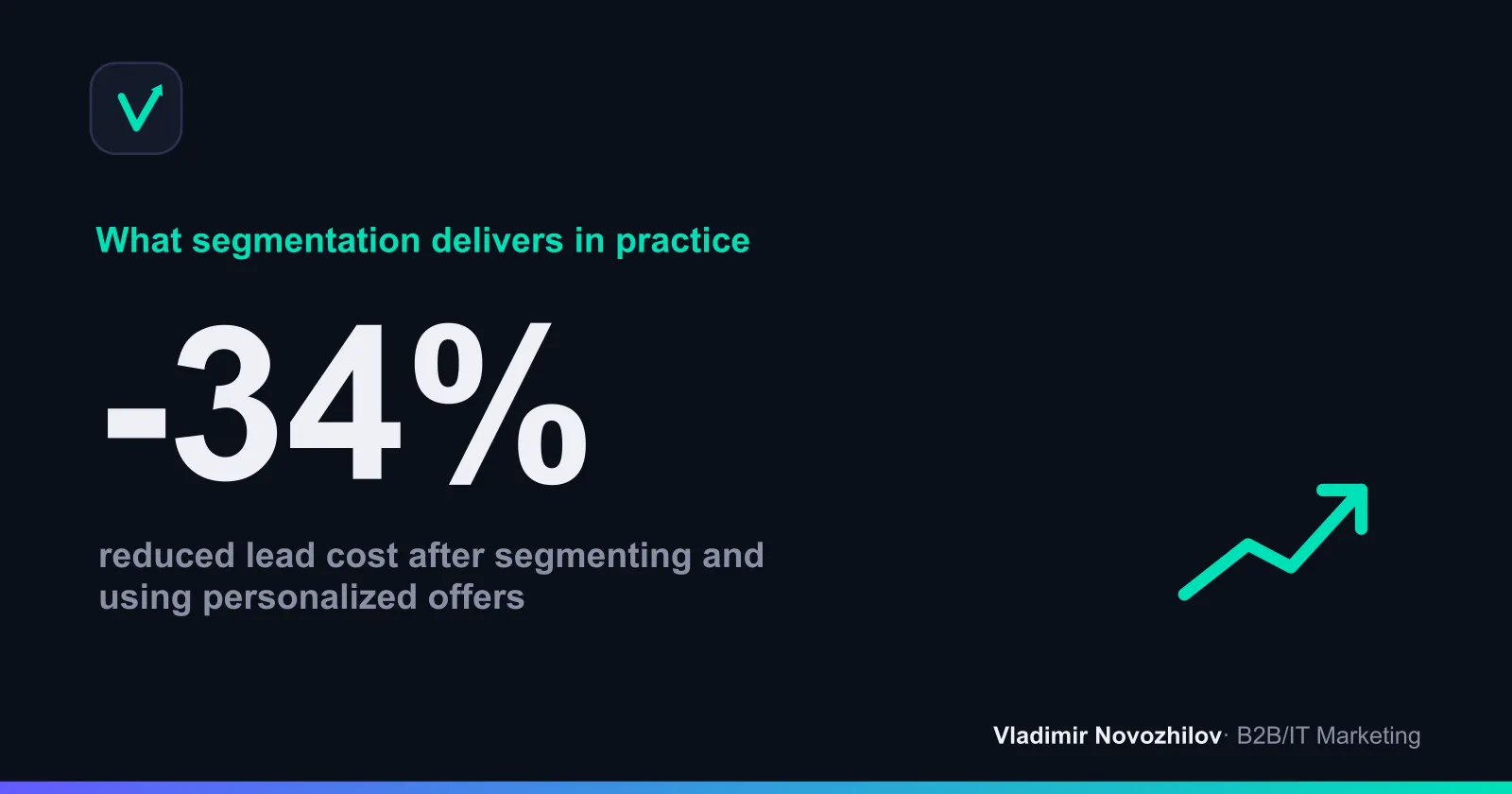
- Lower acquisition cost. More precise targeting reduces CPC and CPL.
- Clearer product direction. You know who and what to improve first.
- Sales priorities. Resources flow to the most profitable groups.
Segmentation vs defining the target audience: what’s the difference
These are two distinct steps. Defining the target audience answers “who can be our customer in principle” — it sets the market boundaries. Segmentation goes further and, within those boundaries, выделяет groups with different motives and behaviors.
Example: for an online English school the base TA is “adults 25–45 who want to speak fluently.” Inside it are segments: “preparing to relocate,” “need language for work,” “learning for travel.” The product may be the same, but messages and channels differ.
Criteria: by what attributes to divide the audience
Criteria are the bases by which you group people. Classically, five attribute groups are distinguished.
- Demographic. Gender, age, marital status, education, profession. The basic and most accessible layer of data.
- Geographic. Country, region, city, climate, population density. Especially important for offline services and logistics.
- Socio‑economic. Income, position, purchasing power — determine the price tier.
- Behavioral. Purchase frequency and volume, loyalty, readiness stage, response to discounts, contact channels. Often the strongest predictor.
- Psychographic. Values, lifestyle, interests, motives, fears. Explain the “why,” not just the “who.”
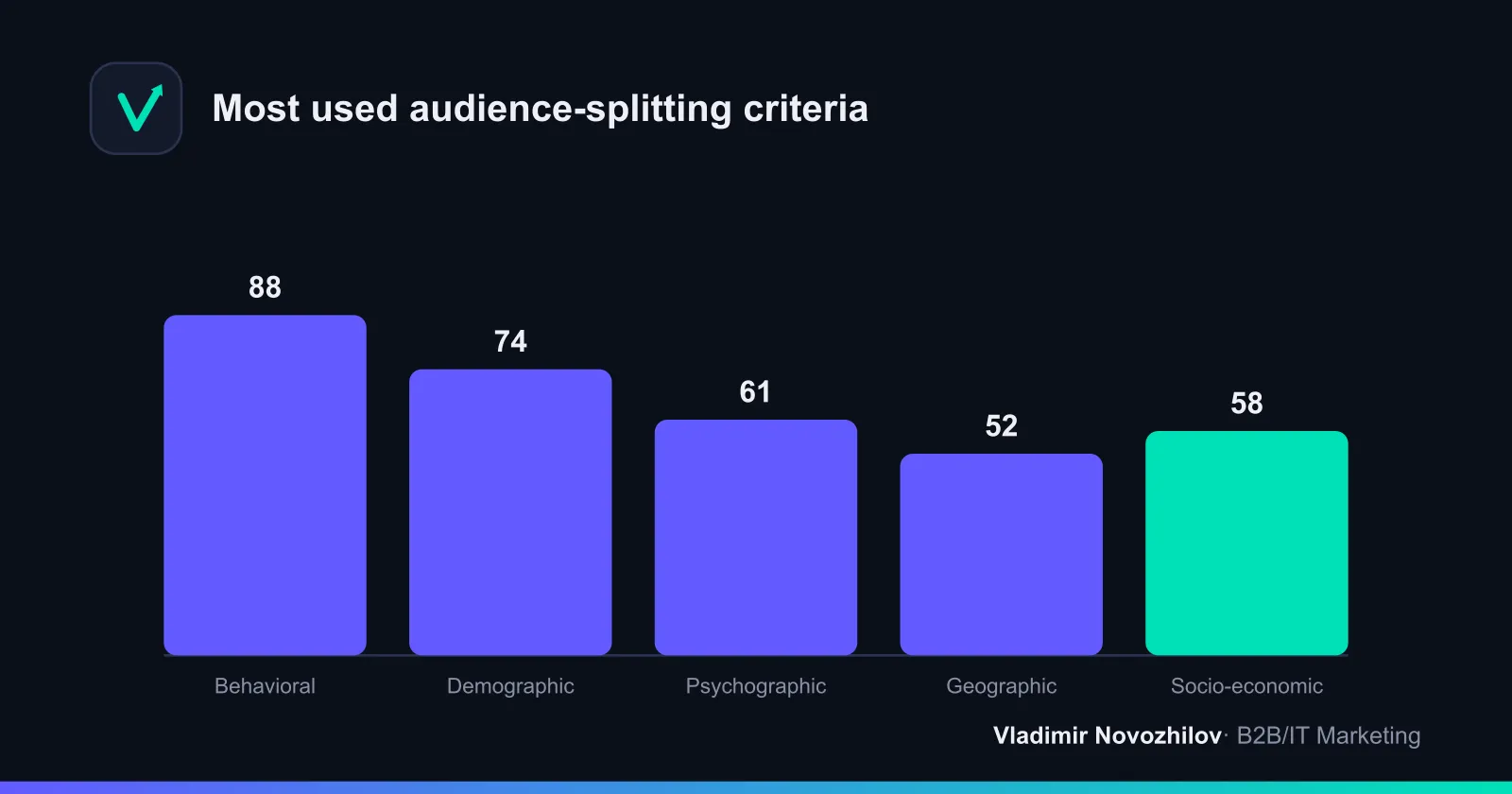
Table: criteria by attribute types
| Тип признаков | Что учитываем | Где брать данные | Для чего сильны |
|---|---|---|---|
| Демографические | Пол, возраст, профессия | Опросы, аналитика, CRM | Базовый таргетинг |
| Географические | Регион, город, климат | Веб-аналитика, доставка | Локальные офферы |
| Соц.-экономические | Доход, должность | Анкеты, косвенные данные | Ценообразование |
| Поведенческие | Покупки, активность | CRM, веб-аналитика | Прогноз спроса |
| Психографические | Ценности, мотивы | Интервью, JTBD | Смыслы и креатив |
Segmentation methods: overview and comparison
Methods are ready frameworks that help systematically break the audience into groups. We’ll review six practical approaches and summarize them in one table.
Kotler method
A classic model: the audience is divided immediately by four attribute groups — geographic, demographic, psychographic, and behavioral. A universal base that’s convenient when starting segmentation from scratch.
Sherrington’s 5W methodology
Five questions, each a separate slice: What (what we sell), Who (who buys), Why (why), When (when), Where (where). Intersections of answers create clear segments. A good quick start for small businesses — fast and low‑cost.
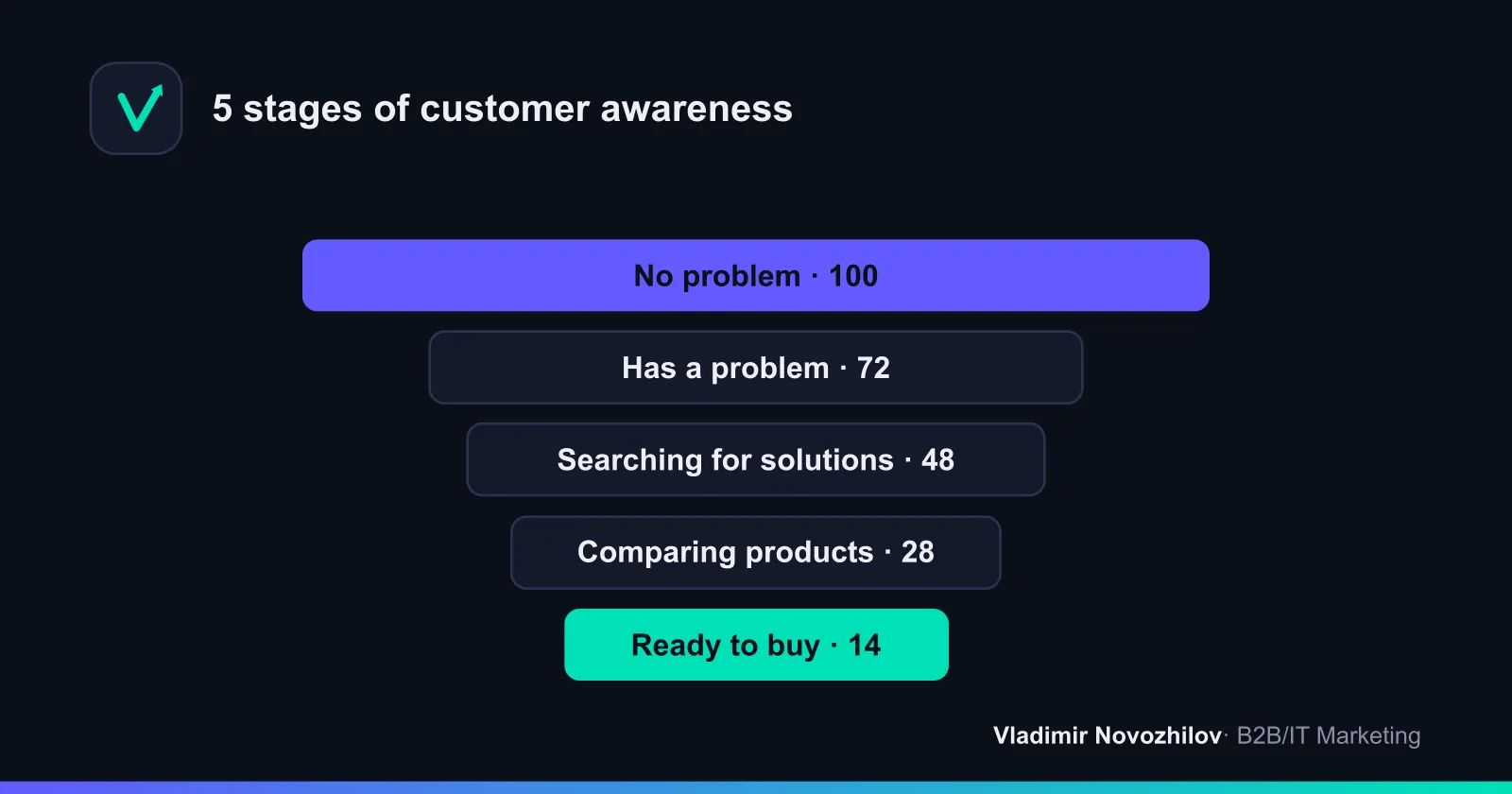
Hunt’s awareness ladder
Divides the audience by problem awareness and readiness to buy: from “no problem” to “ready to buy.” Each rung requires its own content and offer: cold audiences need warming, hot ones need a direct proposal.
JTBD (Jobs To Be Done)
JTBD segments not people but the “jobs” the customer hires the product to do. Formula: “when [situation], I want to [action], so that [outcome].” The method uncovers true motives and complements psychographics well.
RFM and ABCDX analysis
RFM analysis splits the current base by three parameters: Recency, Frequency, Monetary. This finds loyal, dormant, and churning customers. ABCDX analysis ranks segments by profitability and implementation difficulty — from ideal “A” to hopeless “X.”
LTV assessment method
LTV (lifetime value) shows how much profit a segment brings over the whole relationship. Simple formula: LTV = average ticket × number of purchases per year × customer lifespan. Segments with high LTV get budget priority.
Methods comparison: table
| Метод | Что делит | Данные | Когда применять |
|---|---|---|---|
| Котлер | Рынок по 4 группам признаков | Аналитика, опросы | Базовая структура с нуля |
| Методика 5W | Аудиторию по 5 вопросам | Гипотезы, опросы | Быстрый старт, малый бизнес |
| Лестница Ханта | По готовности к покупке | Поведение, запросы | Планирование контента и рекламы |
| JTBD | По «работам» и мотивам | Глубинные интервью | Продукт и смыслы |
| RFM-анализ | Текущую базу по покупкам | CRM | Удержание, реактивация |
| LTV | Сегменты по прибыльности | CRM, финансы | Распределение бюджета |
B2B: how to segment and what to consider
B2B segmentation is built around the company and the buying committee, not a single person. Key parameters:
- Firmographics: industry, company size, revenue, number of employees, region.
- Roles in the deal: decision maker, user, economic buyer, expert‑influencer.
- Maturity and need: whether they have an in‑house team, tech stack, budget cycle.
There are fewer deals in B2B but each is more expensive and decided collectively, so segments describe both the company and roles within it. RFM and LTV in B2B are calculated by invoices and contracts.
B2C: how the approach differs
In B2C the basis is demographic, geographic, behavioral, and psychographic attributes of the individual buyer. Purchase cycles are shorter and decisions are often emotional and personal. Here 5W, Hunt’s ladder, and RFM on order history work especially well. B2B and B2C converge on one point: in both cases a segment must be measurable, reachable through advertising, and sufficiently large.
How to run segmentation: step‑by‑step checklist
- Collect data. CRM, web analytics, surveys, interviews, ad platforms.
- Choose segmentation criteria according to the task — from demographic to psychographic.
- Apply a method (5W for start, RFM for the base, JTBD for motives).
- Identify 3–7 segments and describe each.
- Evaluate segments by volume, accessibility and profitability (ABCDX, LTV).
- Formulate an offer and channel for each priority segment.
- Run a test and compare conversion by segment.
- Review segmentation every 6–12 months.
Segment persona: template and example
A persona is a description of a typical representative of the segment: who they are, what drives them, how and why they buy. Use the template table.
| Поле портрета | Пример заполнения (онлайн-курсы по Excel) |
|---|---|
| Название сегмента | «Специалист на рост» |
| Демографические признаки | Женщина/мужчина, 26–35 лет, аналитик |
| Географические признаки | Города-миллионники, удалёнка |
| Поведенческие признаки | Ищет курсы вечером, сравнивает 3–4 школы |
| Психографические признаки | Ценит карьеру, боится отстать от коллег |
| JTBD | «Когда завал в отчётах, хочу освоить формулы, чтобы успевать и претендовать на повышение» |
| Ступень Ханта | Сравнивает продукты |
| Оффер | Практикум с разбором рабочих задач за 4 недели |
Create this template for each priority segment — it immediately suggests the message and channel.
Tools and data sources
- CRM — deal history, RFM, LTV, roles in B2B.
- Web analytics — sources, behavior, on‑site action segments.
- Surveys and quizzes — quick data on motives and barriers.
- In‑depth interviews — material for JTBD and psychographics.
- Ad platforms — ready audience slices for targeting.
This set is enough to describe segments and validate hypotheses without expensive research.
Common mistakes
- Too many tiny segments. Dozens of groups you can’t reach with advertising.
- Segments by eye. Splitting without CRM or web analytics data.
- Only demographic attributes. Age and gender don’t explain purchase motives.
- Segmentation for its own sake. Groups exist but there are no distinct offers for them.
- One‑off work. Segmentation isn’t updated and becomes stale.
- Ignoring profitability. Resources go to a large but unprofitable segment.
Examples for different niches
Dentistry (B2C, services). Using Hunt’s ladder they separated “acute pain — urgent need” from “planning an implant.” The first group gets immediate appointments and a phone number in the ad; the second gets warming content and payment plan options. CPL for the hot segment dropped noticeably.
IT integrator (B2B). Segmented by industry and company size: separate offers for retail and manufacturing, and separate ones for enterprise and SMB. This reduced sales cycle through relevant case studies in first touch.
Online cosmetics store (B2C). RFM analysis identified “dormant” buyers and VIPs. Dormant received reactivation emails with discounts; VIPs got early access to new products. Repeat purchases increased without growing the ad budget.
How often to review segmentation
The basic rhythm is every 6–12 months, plus when launching a product, changing markets, or when demand shifts sharply. Behavioral segments in CRM (RFM) should be updated more frequently — monthly or quarterly — because recency and frequency change dynamically. Regular review keeps the audience relevant and marketing precise.
FAQ
- How is segmentation different from defining a target audience?
- Defining a target audience outlines who can potentially be a customer. Segmentation splits that pool into groups with different motives and behaviors so you can deliver targeted offers and choose channels for each group.
- How many segments should you start with?
- 3–7 meaningful groups are enough. That allows testing different messages and channels without spreading the budget thin. Too many tiny segments complicate targeting and creative work without clear benefit.
- What data is needed for segmentation?
- Sources: CRM (purchases, LTV, RFM), web analytics (traffic sources and behavior), surveys and quizzes (motives and barriers), in‑depth interviews (JTBD, psychographics), ad platforms (ready audience slices for targeting).
- Which methods should you choose initially?
- For structure — Kotler or 5W; for content and funnel — Hunt’s ladder; for meanings and product — JTBD; for base and retention — RFM; for budget prioritization — LTV and ABCDX.
- How often should segmentation be updated?
- Basically — every 6–12 months, and ad hoc when the product or market conditions change. Behavioral segments from RFM should be recalculated more often: monthly or quarterly.
- What if segments are too small or don't map to channels?
- Aggregate by similar motives and behavior, check measurability and channel availability, evaluate capacity and profitability (ABCDX, LTV). Combine or drop segments that aren’t viable.