Customer Persona: How to Build One, With Examples and a Template


TL;DR
A customer persona is a composite image of a typical buyer from one segment, covering demographics, psychographics, jobs to be done (JTBD), and the buying journey. Unlike a target audience, it describes a specific person rather than a group. Below is a step-by-step process, a template, B2C and B2B examples, and the metrics used to validate a persona.
A customer persona is a composite yet concrete image of a typical buyer from a single segment: their demographics, psychographics, jobs to be done (JTBD), pain points, and decision-making scenario. Simply put, it’s a “living” person backed by real data, not an abstract “target audience aged 25–45.” Below, we’ll cover how a persona differs from a target audience and an avatar, what it consists of, a step-by-step process, a ready-to-use template, B2C and B2B examples, and the metrics used to check whether a persona was built correctly.
I’ve spent 15 years working with marketing and sales in B2B, IT, and services, and almost every positioning failure I’ve analyzed started with one thing: the team didn’t understand exactly who they were selling to. A customer persona is the cheapest tool that removes that blind spot.
What a customer persona is and how it differs from a target audience
To avoid confusing terms, let’s separate three concepts that are often used interchangeably, even though they represent different levels of detail.
- Target audience (TA) — a broad group of people with common traits who could potentially need your product. It’s statistics: gender, age, geography, income.
- Customer persona — a detailed image of one typical representative of a segment: with motivations, jobs to be done, objections, and a purchase scenario.
- Customer avatar — the same entity as a persona, but “humanized”: with a name, photo, and a short backstory. Essentially, customer avatar and buyer persona are synonyms — the difference is just in presentation.
To make the relationship clearer: target audience is “who buys in principle,” audience segmentation splits it into homogeneous groups, and a persona is the specific person within a group you picture when writing ad copy or a sales script.
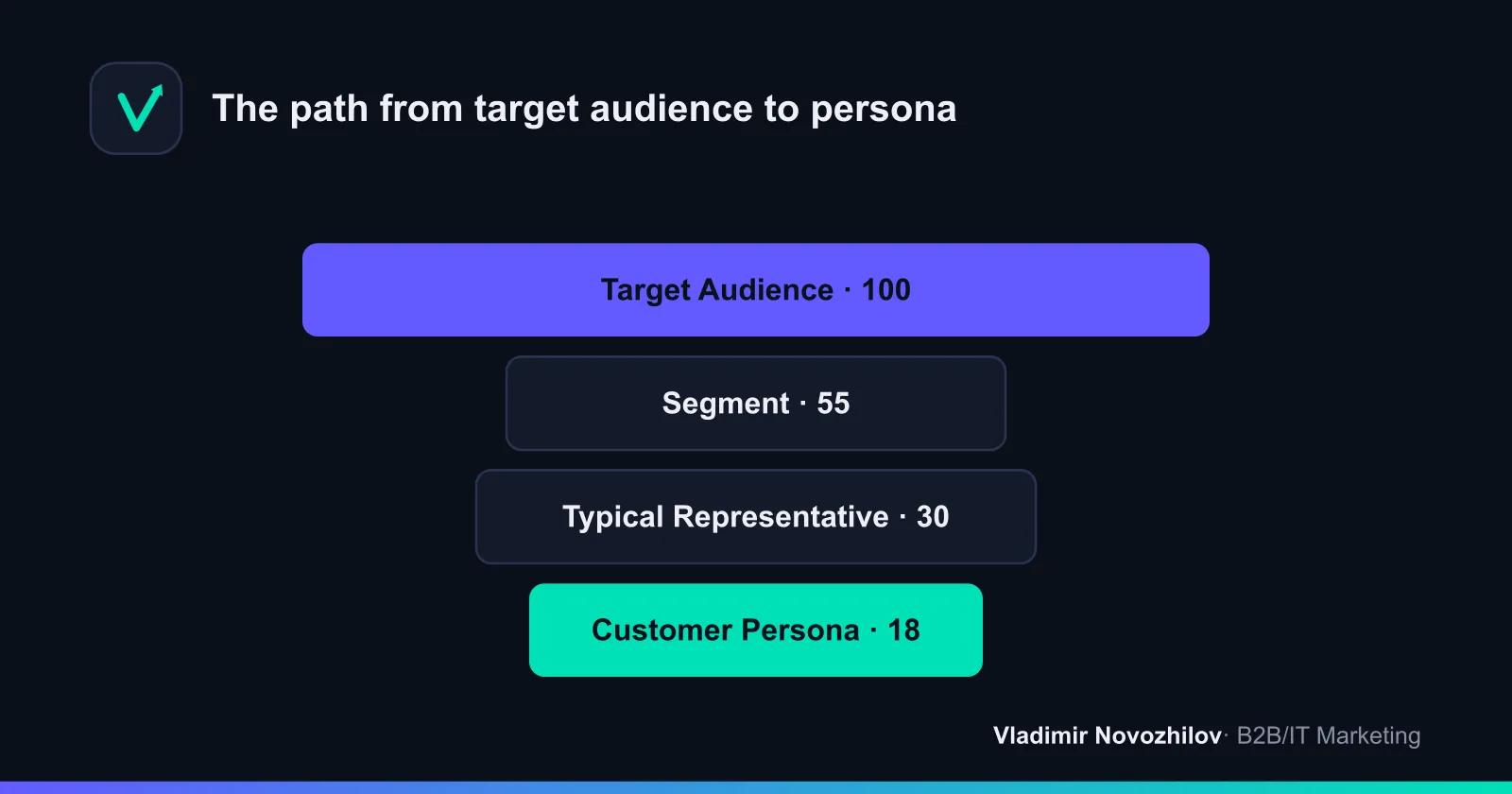
Table: Target audience vs. customer persona vs. avatar
| Criterion | Target audience | Customer persona | Customer avatar |
|---|---|---|---|
| Level of detail | Group, statistics | Typical segment representative | Character with a name and backstory |
| Example | ”Small service businesses" | "Studio owner with 8 employees looking to keep stylists booked" | "Marina, 34, barbershop owner, afraid of empty chairs” |
| Answers the question | Who are our buyers in general | How does a specific customer think and decide | What does this customer look and sound like |
| Where it’s used | Media planning, reach | Offers, copy, product, scripts | Team briefs, customer empathy |
| Basis | Demographics, market size | CRM data + interviews + psychographics | Persona + storytelling |
The takeaway is simple: target audience is for assessing scale, while a customer persona drives specific decisions in marketing, sales, and product. The term “customer profile” in English-language literature refers to exactly this persona; for the ideal customer, ICP (Ideal Customer Profile) is used, and for the “humanized” version — buyer persona.
Why a business needs a customer persona
A customer persona isn’t paperwork for its own sake — it’s a working tool that saves budget and boosts conversion. Here’s what it delivers in practice.
- A precise message. Once you know the buyer’s pain points and jobs to be done, your offer hits the target instead of “everyone at once.”
- Cheaper acquisition. Targeting ads at a specific segment lowers CPA and raises CVR — you’re not paying for irrelevant clicks.
- Higher average order value and LTV. Understanding motivation lets you offer relevant upsells and retain customers longer.
- Faster sales. The sales team already knows objections and selection criteria, so the deal cycle shortens.
- Better product. The development team prioritizes features based on real jobs to be done, not guesswork.
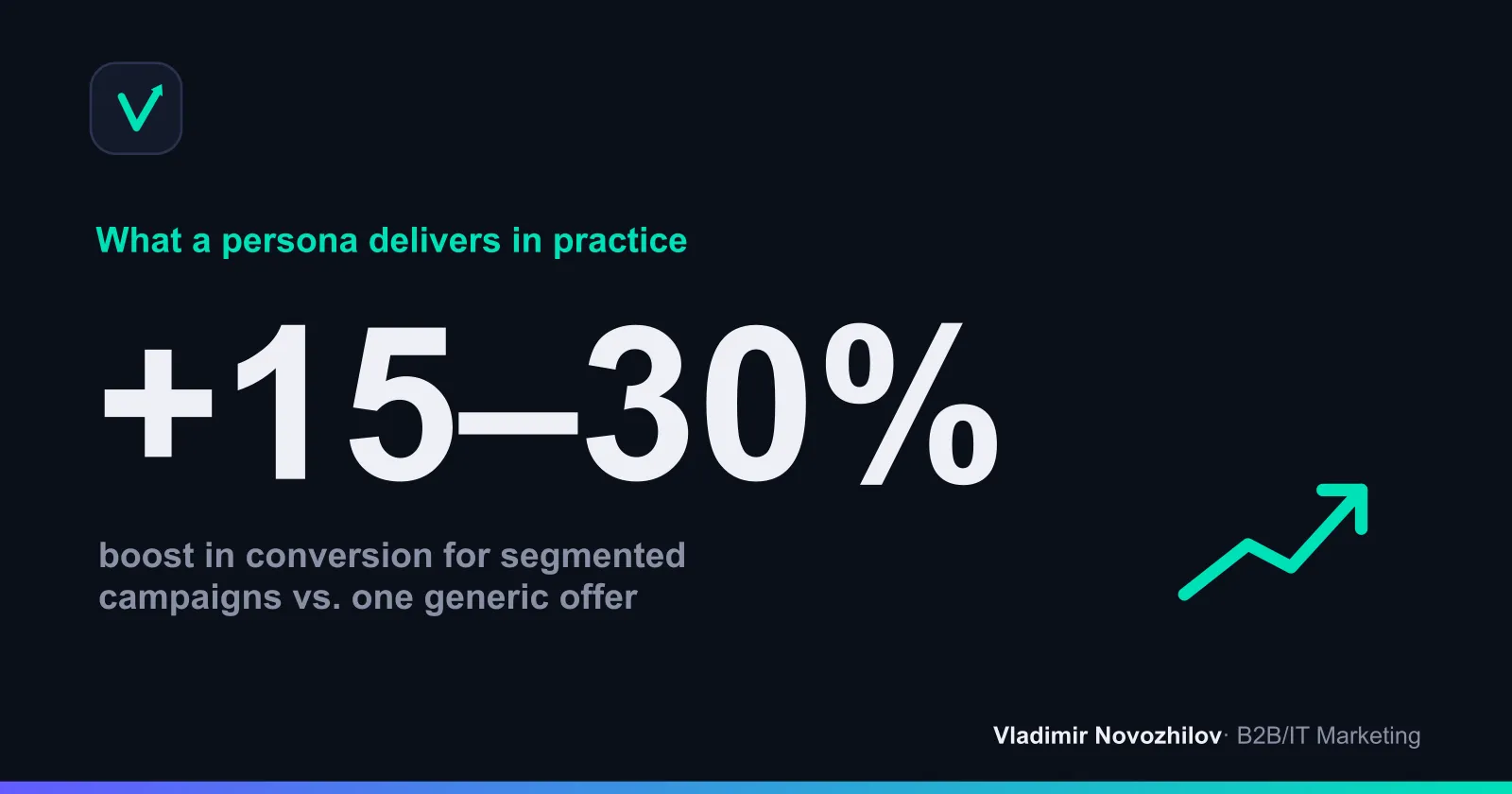
In my experience, even a rough persona built in a couple of days from CRM data and five interviews boosts conversion of segmented campaigns by 15–30% compared to a single “universal” offer. That’s not magic — it’s simply the result of stopping talking to everyone the same way.
Types of personas: target, ideal, negative, B2B
Before building a persona, decide which type you actually need. There are several.
- Target customer persona. The primary working image of a typical buyer from a priority segment.
- Ideal customer (ICP). The one who brings maximum revenue with minimum cost and hassle: buys quickly, pays on time, stays long-term. Sales and marketing prioritize this one first.
- Negative persona. The image of who you should NOT sell to: a customer with low LTV, lots of objections, high support burden, and a tendency to churn quickly. A negative persona saves budget just as effectively as a positive one.
- B2B customer persona. A separate type where, instead of one person, there’s a buying committee, and instead of demographics, there’s firmographics (industry, company size, revenue). We’ll cover it in more detail below.
Most businesses maintain a combination: 2–4 positive target personas, one ICP, and one negative persona. That’s enough to keep resources focused.
What a customer persona consists of: demographics, psychographics, JTBD, customer journey
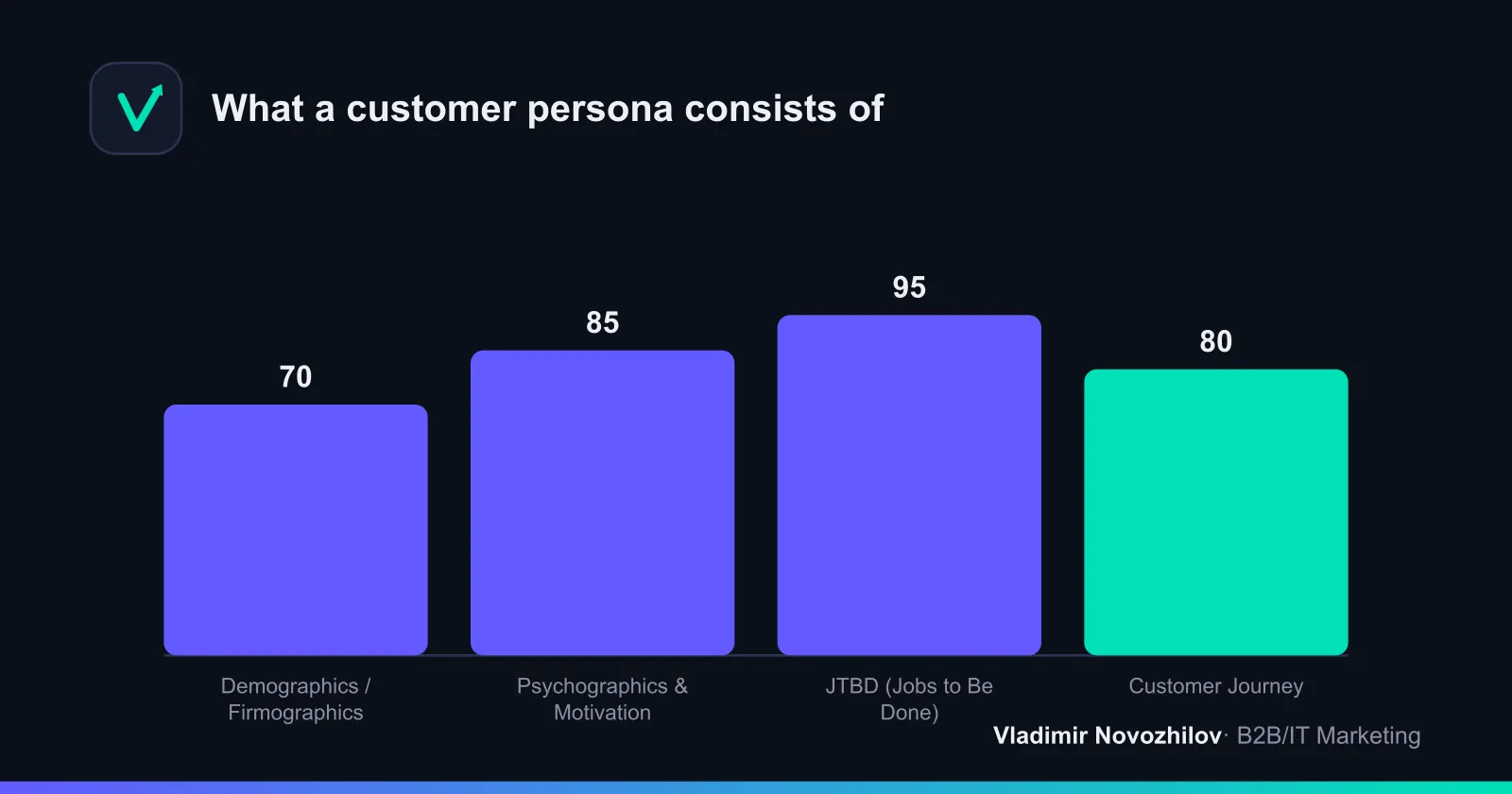
A strong persona is built from four core blocks. The first two describe who the customer is; the other two describe why and how they buy. It’s the latter two blocks that get skipped most often — which is a mistake, since they deliver the bulk of the value.
1. Demographics and firmographics
Basic characteristics of the customer: for B2C — gender, age, marital status, income, city, profession. For B2B — firmographics: industry, company size, revenue, region, the decision-maker’s role and title. This is the foundation, but you can’t build a persona on it alone.
2. Customer psychographics
Customer psychographics covers values, lifestyle, beliefs, fears, and motivations. Here you answer the question “what matters to this person and what are they afraid of.” For example, a salon owner doesn’t care about “CRM” per se — they care about peace of mind and not having idle stylist chairs. Psychographics turns dry demographics into an understanding of buyer motivation.
3. JTBD (Jobs To Be Done)
JTBD is a concept that describes a product through the “job” the customer hires it to do. The formula is simple: “When [situation], I want to [action], so that [outcome].” For example: “When my bookings get canceled, I want to quickly fill the gap so I don’t lose daily revenue.” JTBD eliminates the main mistake — focusing on demographics instead of the actual job to be done.
4. Customer Journey (the path to purchase)
A Customer Journey Map (CJM) describes the stages a buyer goes through: recognizing the problem, researching solutions, comparing options, purchasing, using the product, and repeat purchase. For a persona, it’s important to record where the customer looks for information, what doubts arise at each stage, and what pushes them toward a decision. The customer journey shows exactly where marketing and sales should step in.
On top of these four blocks, add pain points and needs, objections, selection criteria, preferred channels, and purchase triggers. Together, they form a complete customer profile.
How to build a customer persona: a step-by-step process
Now to the main question — how to build a customer persona yourself. Below is a four-step process with a checklist for each step. It works the same way for both B2C and B2B; only the data sources differ.
Step 1. Gather customer data (CRM, analytics, surveys, CustDev)
A persona is built on data, not imagination. Use two types of sources.
Quantitative (what’s happening):
- CRM export: who’s buying, how much, how often, with what LTV;
- web analytics (Yandex Metrica, GA): demographics, devices, on-site behavior;
- search query statistics (Wordstat) — what people are actually searching for;
- ad account and email platform data.
Qualitative (why it’s happening):
- CustDev — in-depth interviews with 5–10 customers per segment;
- surveys and questionnaires for existing buyers;
- analysis of reviews, comments, and support tickets;
- conversations with the sales team — they hear real objections firsthand.
Step 1 checklist: pulled CRM data ✓, reviewed web analytics ✓, collected 15–20 reviews ✓, ran 5+ interviews ✓, talked to sales ✓.
If you don’t have customers yet, build the persona from competitors’ customers, niche communities, and external research, then validate hypotheses with your first deals.
Step 2. Segment the audience
Audience segmentation is dividing the target audience into homogeneous groups that make purchase decisions differently. Segment by meaningful traits — job to be done (JTBD), behavior, value (LTV/order size) — not just gender and age. A good sanity check for a segment: one offer works for everyone inside it.
For B2B, segment by firmographics and decision-maker role; for B2C, by usage scenario and motivation. Identify 3–6 segments and rank them by revenue and potential.
Step 2 checklist: identified 3–6 segments ✓, each has a clear job to be done ✓, ranked by revenue ✓, chosen 1–2 priority segments ✓.
Step 3. Pick a typical representative of the segment
Within the priority segment, find the “median” customer — not the largest or the smallest, but the typical one. It’s best to base this on a real person from your database, so the persona stays credible. Give them a name and, if you like, a photo — this is essentially the customer avatar that helps the team empathize with the buyer.
Step 3 checklist: picked a real, typical customer ✓, confirmed they represent the segment ✓, gave them a name and role ✓.
Step 4. Document the persona and validate it
Fill in the template (below) across all blocks: demographics/firmographics, psychographics, JTBD, buying journey, pain points, objections, channels. Take pain-point wording verbatim from the interviews — this matters a lot for copy.
Then validate it: launch a campaign or email segment based on the persona and compare the metrics to a control group. If conversion is higher and lead cost is lower, the persona works. If not, refine your hypotheses.
Step 4 checklist: filled in all blocks ✓, used customer quotes ✓, ran a test ✓, checked the metrics ✓, updated the persona ✓.
A ready-to-use customer persona template
Here’s a customer persona template you can copy into Google Docs, Excel, or Notion and fill in for each segment. It’s a static equivalent of an online builder — just copy the fields.
| Block | Field | What to fill in |
|---|---|---|
| Identification | Name / role | Avatar name and title (for B2B — the decision-maker) |
| Demographics / firmographics | Age, city, income / industry, size, revenue | Basic customer characteristics |
| Psychographics | Values, fears, lifestyle | Customer psychographics and motivation |
| JTBD | ”When…, I want…, so that…” | The main job the product does |
| Pain points | Top 3 problems | Verbatim from interviews |
| Objections | What holds them back from buying | ”Too expensive,” “I won’t believe it,” “No time” |
| Selection criteria | What they compare | Price, timing, guarantees, case studies |
| Customer journey | Stages and touchpoints | Where they search, what they read, what they decide |
| Channels | Where to find them | Search, social media, email, offline |
| Triggers | What pushes them to buy | An event, deadline, promotion |
| Metrics | LTV, order size, deal cycle | For segment prioritization |
A document filled in with these fields is a working customer persona template. Keep it shared across marketing, sales, and product teams.
Customer persona examples: B2C and B2B
Theory sinks in better with concrete examples. Below is a B2C customer persona example and a detailed B2B customer persona.
Customer persona example (B2C, services)
Marina, 34 — owner of a 4-chair barbershop, Kazan.
- Demographics: married, two kids, unstable business income, has basic marketing knowledge.
- Psychographics: values control and predictability, afraid of idle chairs and “empty slots,” tired of scheduling chaos.
- JTBD: “When my bookings get canceled, I want to quickly fill the slot so I don’t lose daily revenue.”
- Pain points: idle chairs, stylist turnover, no repeat visits.
- Objections: “too complicated to implement,” “too expensive for a small salon.”
- Customer journey: looks for solutions in Telegram channels for beauty businesses and on YouTube, compares based on peer reviews, decides after a free trial.
- Channels: Instagram*, Telegram, word of mouth.
- Trigger: a sharp revenue drop during the off-season.
B2B customer persona example
Wholesale building materials company, decision-maker — Commercial Director.
- Firmographics: industry — wholesale trade of finishing materials; staff of 50–150; revenue of RUB 300–800 million/year; region — Volga Federal District.
- Buying committee: initiator — procurement specialist; decision-maker — Commercial Director; influencers — CFO and logistics manager; “blocker” — accounting, over payment terms.
- JTBD: “When we lose margin due to delivery failures, we want a reliable supplier with deferred payment so we can hit our sales plan.”
- Pain points: missed deadlines, stockouts, inflexible payment terms.
- Selection criteria: stock availability, payment deferral, shipping speed, case studies from similar clients.
- Objections: “we already have a trusted supplier,” “quality risks.”
- Deal cycle: 1–3 months; the decision is made by a group, not one person.
- Channels: industry trade shows, search for commercial queries, referrals, email newsletters with price lists.
Note: in B2B, the persona describes roles and the entire decision-making group, not a single buyer. This is a key difference between a B2B customer persona and a B2C one.
*This social network belongs to Meta, which has been designated as an extremist organization in Russia.
How to use a customer persona in marketing, sales, and product
A persona is useless if it just sits in a folder. Here’s how different teams put it to work.
- Marketing: offers and headlines built around the segment’s pain points, targeting based on persona traits, channel selection based on the customer journey, content topics matched to buying-journey stages.
- Sales: scripts with pre-handled objections, lead qualification against ICP fit, prioritizing deals with high LTV.
- Product: prioritizing features based on JTBD instead of random “wish lists,” interface copy written in the customer’s own language.
- CRM and automation: the persona becomes the basis for tags and segments in your CRM. Set up automatic lead tagging based on firmographics and behavior, and both email campaigns and lead scoring will run by segment without manual sorting. This is what integrating a persona with CRM looks like — it turns from a document into an automation rule.
One important nuance: the base persona stays the same, but the format and emphasis change by channel. In search, intent matters most; on social media, it’s psychographics and pain points; in email, it’s the customer journey stage.
How many personas a business needs
As a rule of thumb, build one persona per meaningful segment that generates revenue and makes decisions differently. Small businesses usually need 2–4 personas; mid-sized ones, 3–6. More than 7–8 becomes hard to manage — they start overlapping and diluting focus.
Start with your “donor” segment — the one delivering the most revenue and LTV — and add personas as you grow. Keep the ICP (ideal customer) and the negative persona separate: one focuses your efforts, the other filters out unprofitable prospects.
Common mistakes when building a customer persona
Here are the costliest mistakes I’ve seen on projects.
- Persona built from thin air. The team came up with an image during a meeting, without data or interviews. The result: a beautiful document that doesn’t work. Fix it with CustDev and CRM data.
- Demographics only. “Women 25–45, average income” isn’t a persona — it’s a wrapper. Without psychographics and JTBD, it’s unclear what to offer.
- Too many personas. 12 personas that nobody actually uses. Three working personas beat 12 dead ones.
- Persona without pain points or quotes. Copy ends up written “in your own words” instead of the customer’s language. Always capture verbatim wording from interviews.
- Ignoring B2B specifics. Describing one person where a committee actually decides. Result: the message never reaches the real decision-maker.
- Built once and forgotten. The market and the customer change, but the persona has been sitting there since last year. Update it every 6–12 months and after major product changes.
- No validation. The persona was never checked against metrics, so it’s unclear whether it actually works.
How to measure persona effectiveness: metrics and validation
A persona is considered effective if the segment it describes performs better on key business metrics than the average audience. Validate it like this: launch a campaign or email segment based on the persona and compare it to a control group.
Persona validation metrics table
| Metric | What it shows | Good signal |
|---|---|---|
| CVR (conversion rate) | Share of target actions | Higher than the general audience |
| CPA (cost per acquisition) | Cost per lead/customer | Lower than unsegmented campaigns |
| AOV (average order value) | Purchase amount | Grows with a relevant offer |
| LTV (lifetime value) | Total revenue per customer over time | Higher for the ICP segment |
| NPS | Willingness to recommend | Higher among “your” customers |
Also validate the persona qualitatively: 3–5 new interviews should confirm that pain points and wording match what you recorded. If segment metrics improve and customers “recognize themselves” in the description, the persona was built correctly. If not, go back to step 2 and refine your segmentation and hypotheses.
Key takeaways
A customer persona is a specific image of a typical buyer from one segment, complete with demographics, customer psychographics, JTBD, and the buying journey. It differs from a target audience in its level of detail, while a customer avatar is its “humanized” version. To build a persona: gather data (CRM, analytics, CustDev), run audience segmentation, pick a typical representative, fill in the template, and validate it with metrics (CVR, CPA, LTV, NPS). Maintain 2–6 working personas, keep them updated, and use them across marketing, sales, product, and CRM — that’s how a customer profile turns from a document into a growth tool.
FAQ
- How is a customer persona different from a target audience?
- A target audience is a broad group of people sharing common traits (for example, "women aged 25–40 interested in healthy eating"). A customer persona is a detailed image of one typical representative of that segment, complete with a name, motivations, jobs to be done (JTBD), pain points, and a purchase scenario. Target audience answers the question "who are these people in general," while a persona answers "how does a specific buyer think and act." Customer avatar is a synonym for persona — it's usually the term used for the "humanized" version with a photo and backstory.
- How many customer personas does a business need?
- As a rule of thumb, build one persona per meaningful segment that generates revenue and makes purchase decisions differently. In practice, 2–4 personas are enough for a small business, and 3–6 for a mid-sized one. More than 7–8 personas becomes hard to maintain — they start overlapping. Start with the segment that drives the most revenue and LTV, then add personas as you grow and gather more data.
- How do you build a customer persona if the company doesn't have customers yet?
- Rely on hypotheses and external data: study competitors' customers, reviews and comments in their channels, niche communities, search query statistics (Wordstat), and public market research. Run 5–8 in-depth interviews (CustDev) with people from your assumed segment. Document the hypothetical persona, mark it clearly as unvalidated, and refine it based on your first real deals.
- What data must a B2B customer persona include?
- A B2B customer persona should include firmographics (industry, company size, revenue, region), the decision-maker's role and the buying committee's composition, the business problem and KPIs used to evaluate the solution, budget and deal cycle, selection criteria, and objections. B2B purchases are almost always made by a group, so the persona should describe roles rather than a single person: the initiator, the decision-maker, influencers, and "blockers."
- How do you verify that a customer persona was built correctly?
- A correct persona is measurable. Launch a campaign or an email segment based on it and compare the metrics against a control group: CVR (conversion rate), CPA (cost per acquisition), AOV (average order value), LTV, and NPS. If the segment described by the persona shows higher conversion and lower lead cost, the persona works. Additionally, validate the hypotheses through 3–5 interviews — the real wording of customers' pain points should match what you recorded.
- Can you use one customer persona across all advertising channels?
- The base persona stays the same, but it's adapted for each channel: the message format, offer, and triggers change. In search, intent and specific queries matter; on social media, psychographics and pain points drive engagement; in email, it's the scenario and stage of the buying journey. The underlying image of the customer is one and the same — only the emphasis and creatives differ by channel.