Tone of Voice: How to Define Your Brand Voice — A Guide


TL;DR
Tone of voice (ToV) is a brand's consistent way of speaking to its audience: the words, intonation, and emotions that stay recognizable across every channel. To define your brand voice, describe your audience and values, set tone scales (formality, humor, respectfulness, enthusiasm), and test them on real copy. Below is a step-by-step framework, examples, and an implementation checklist.
What is tone of voice, in plain terms
Tone of voice (ToV) is a brand’s consistent way of communicating with its audience: word choice, intonation, rhythm, and emotions that stay recognizable across every channel. It’s not a logo or a color palette — it’s how a company talks, whether in a newsletter, a social post, an error notification, or a support reply.
If visual style is about how a brand looks, tone of voice is about how it sounds. Voice is part of positioning: it’s the manner of speech that lets a customer tell a “strict bank” apart from a “bold startup” in a split second, even before seeing the name.
Tone of voice, brand voice, and tone of speech: what’s the difference
These three terms are constantly confused. Let’s draw clear lines — it matters for understanding exactly what you’re describing.
- Brand voice — the brand’s consistent character and “personality” in writing. Rarely changes.
- Tone of voice — the shade of that voice in a specific situation. One voice, many tones.
- Tone of speech — how the brand sounds in spoken form: voice assistants, TTS, radio ads, answering machines.
Mini glossary:
| Term | What it describes | Does it change |
|---|---|---|
| Brand voice | The brand’s character, who we are | Almost never |
| Tone of voice | The tone in a specific context | Yes, situationally |
| Tone of speech | Spoken delivery, voice, pace | Yes, by channel |
Why a brand needs a voice: how ToV affects perception and conversion
A consistent communication style solves four problems: it makes a company recognizable, builds trust, speeds up the team’s work, and directly affects the conversion of emails and website copy. When ten writers each write “their own way,” the brand blurs. With a tone guide in place, texts read as if written by one person.

This is especially visible in B2B and services: a complex product is easier to sell when the brand voice eases anxiety and speaks the customer’s language instead of drowning them in jargon.
The 4 dimensions of tone: formality, humor, respect, enthusiasm
A handy working model is the four dimensions of tone from NN/G researchers. Any message can be scored on four scales:
- Formality — formal vs. informal (from businesslike to casual).
- Humor — from serious to playful.
- Respectfulness — from deferential to irreverent.
- Enthusiasm — from restrained to exuberant.
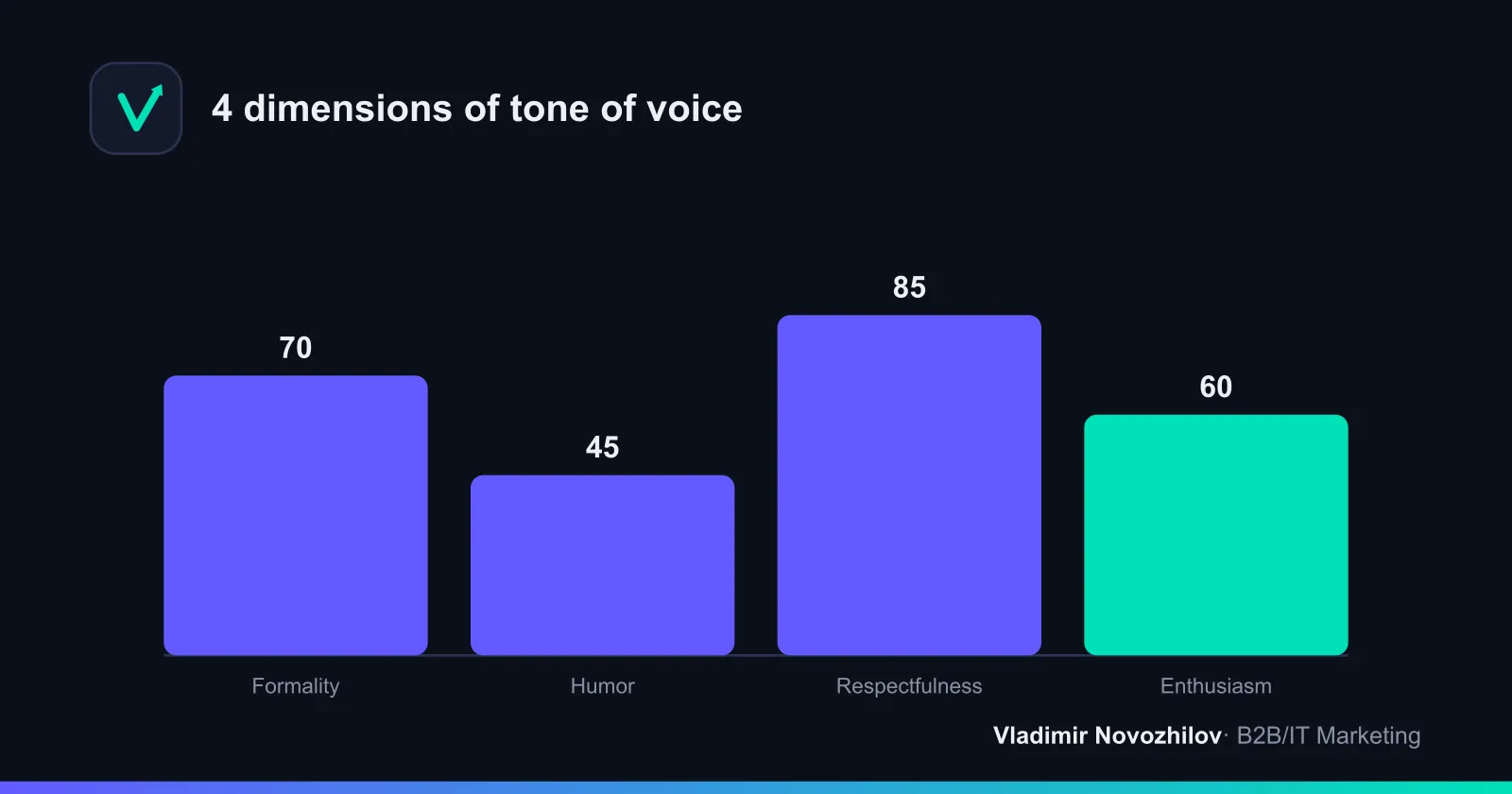
These scales are more useful than fixed labels because they define a range rather than a single point: in support, you shift toward a calmer tone; in an announcement, toward enthusiasm.
Types of tone of voice, with examples
Besides scales, there are familiar tone of voice types — voice characters. Here are common types with short sample phrasings:
| Tone type | Character | Example phrase |
|---|---|---|
| Formal | Businesslike, reserved | ”Thank you for reaching out. Your request has been received.” |
| Friendly | Warm, casual | ”Done! We’re already on it.” |
| Expert | Confident, specific | ”Let’s break it down step by step so you can decide quickly.” |
| Playful | Humorous, light | ”An error? It happens. Already fixing it — hang tight.” |
| Inspiring | Emotional | ”You’re almost there — just one step left.” |
How to define a brand’s tone of voice: a step-by-step framework
Below is a practical guide in five steps. This is the core of “how to define tone of voice” and “how to build a tone of voice” from scratch.
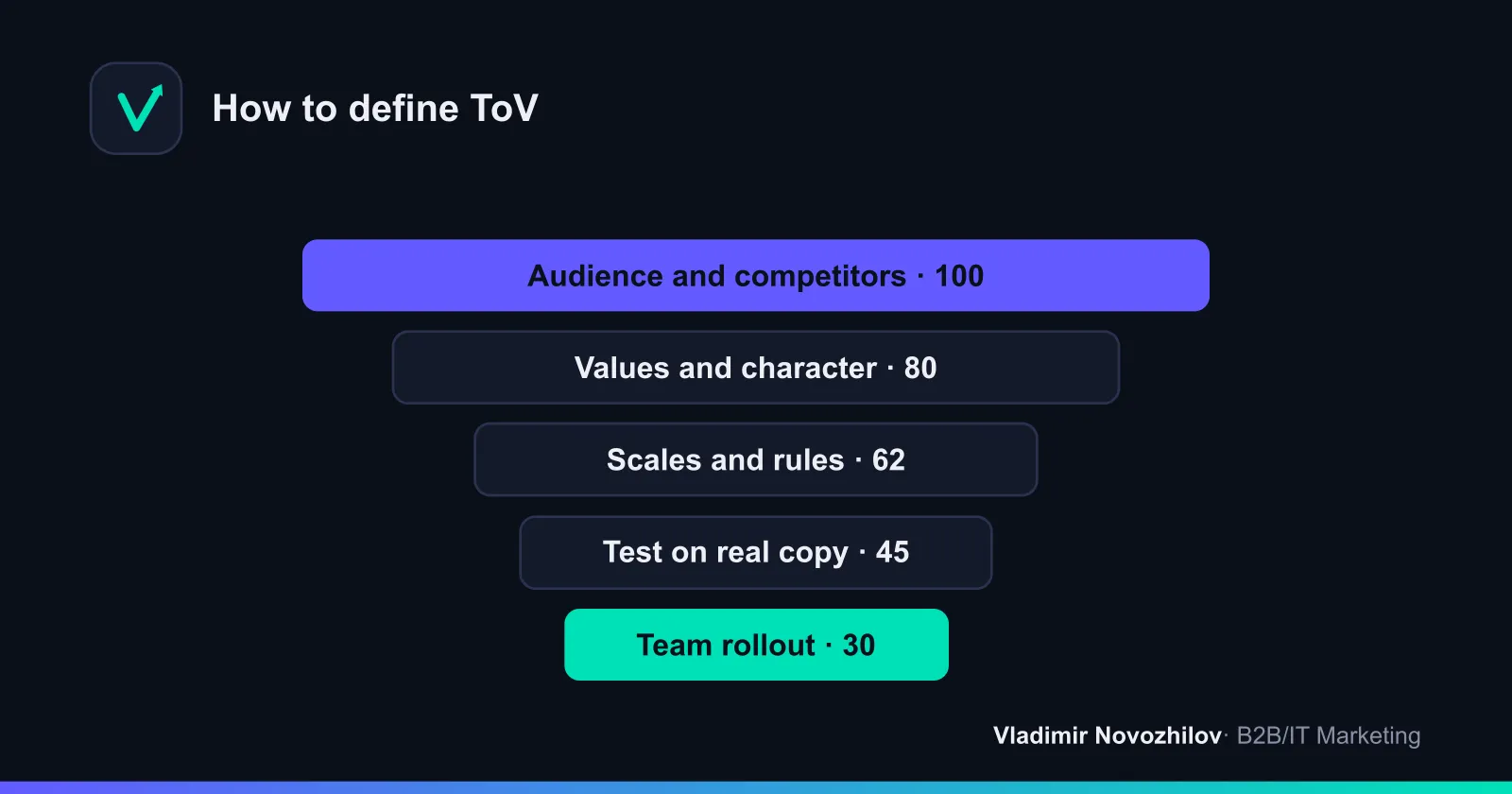
Step 1. Analyze the audience and competitors
Describe who you’re talking to: the customer’s language, pain points, level of expertise, where they read you. Then listen to 3–5 competitors — how they sound — to find an open tonal niche instead of blending into the market.
Step 2. Define values and brand character
Pick 3–5 values and describe the brand as a person: “if the brand were a conversation partner, what would they be like?” This is the foundation of brand voice, from which the company’s tone of voice grows.
Step 3. Set the scales and tone rules
Define a position on each of the four scales and write “say / don’t say” rules: which words to use, which are off-limits, how you address customers (formal or casual), how you talk about errors and pricing. This is the core of the brand’s style guide.
Step 4. Test on real copy
Rewrite 5–7 real fragments in the new tone: a greeting, an email, an error notice, a social post. If it sounds natural and recognizable, you’ve found the tone.
Before/after examples:
| Before | After (friendly-expert) |
|---|---|
| “An error has occurred. Please try again." | "Something went sideways — try again, we’re already looking into it." |
| "Payment was not processed." | "Your payment didn’t go through. A different card usually fixes it." |
| "We are notifying you of order receipt." | "Your order’s with us — we’re packing it up and will keep you posted.” |
A brand book template for tone of voice
A skeleton for a voice & tone guide you can put together in a day:
- Who our audience is (1 paragraph).
- Brand character (3–5 adjectives).
- Values (3–5 points).
- The four tone scales with markers.
- “Say / don’t say” rules.
- Before/after examples by channel.
- Signature words and words to avoid.
Examples of great tone of voice: brand breakdowns
- Yandex — simple, calm, “human” tone in interfaces: helpful without being preachy.
- Tinkoff — confident and friendly, casual, with a light touch of humor.
- Aviasales — bold and ironic, leaning into colloquial speech.
- Mailchimp — a benchmark for a friendly yet professional voice in English-language markets.
- IKEA — warm, caring, plain language instead of corporate-speak.
These are vivid tone of voice examples: different characters, but each one is recognizable from the very first line.
Common mistakes when implementing ToV
- A voice built “for the deck,” not for real copy.
- Copying someone else’s tone without tying it to your own values.
- One tone for every situation, with no channel adaptation.
- Rules without examples — the team doesn’t know how to apply them.
- No ToV owner — the style drifts within six months.
How to roll out tone of voice across a team: guide and checklist
A checklist for tone of voice in marketing and team rollout:
- The tone guide is documented and accessible to all writers.
- A workshop with before/after examples has been run.
- There’s a bank of good and bad phrasing examples.
- A pre-publication checklist is in place.
- Someone is responsible for the brand voice.
- Regular content audits are scheduled.
- Metrics are defined: audience reaction, tone of inquiries, newsletter conversion.
A mini self-assessment for finding your tone
Answer five questions and mark your position on the scales:
- Do we address the customer formally or casually?
- Is humor appropriate in our error messages?
- Do we explain like an expert or like an equal friend?
- How emotional are our announcements?
- What would we absolutely never say?
The combined answers give you a rough tone profile — refine it further on real copy.
Table: comparing tone-of-voice typologies
| Approach | What it offers | Format | Who it’s useful for | |---|---|---| | Cambridge / dictionaries | A linguistic definition | A term | For basic understanding | | Grammarly | Tone in writing: formal/friendly | Email examples | Copywriters | | NN/G | 4 dimensions of tone | Scales | UX and product copy | | Marketing guides | 10–16 tone types | A catalog of characters | Branding and social media |
Bottom line: dictionaries explain “what it is,” Grammarly and NN/G provide assessment tools, and marketing catalogs offer ready-made characters. For a brand, it’s best to combine them: use NN/G’s scales as a measuring tool and one or two tone types as a character reference.
FAQ
- How is tone of voice different from brand voice?
- Brand voice is the brand's consistent character — its "personality" in writing, which rarely changes. Tone of voice is the shade of that voice in a specific situation: warm in a congratulation message, calm and supportive in an error notice. There's one voice but many tones. Put simply: brand voice answers "who we are," while tone of voice answers "how we sound right now."
- How do I define my company's tone of voice from scratch?
- Follow five steps: study your audience and competitors, define 3–5 values and your brand's character, set tone scales (for example, formal vs. informal, level of humor), write down "say / don't say" rules, and test them on real emails, posts, and notifications. Capture the result in a voice & tone guide — a short section of your brand book.
- Can tone of voice change across different communication channels?
- Yes, and that's normal. The brand voice stays consistent while the tone adapts to context: lighter and more human on social media, stricter in contracts and legal notices, calmer and more caring in support. The key is to preserve a recognizable character rather than turning into a different brand channel by channel.
- Does a small business or sole proprietor need a tone of voice?
- Yes. Even a single specialist has a way of communicating, and it's better to make it deliberate. A small business only needs a one-page tone guide: 3–4 values, two or three tone scales, and a couple of before/after examples. This saves time when hiring copywriters and contractors and makes communication consistent.
- How do you check that employees follow the brand's tone of voice?
- Introduce a short pre-publication checklist, run periodic spot audits of copy, and collect examples of good and bad phrasing in a shared bank. Track metrics: audience reaction, the tone of support inquiries, and email/newsletter conversion. If texts from different authors sound consistently recognizable, the brand's style guide is working.