Video Marketing in 2026: Formats, Strategy, and Metrics

TL;DR
Systematic video work drives reach, leads, and revenue. This guide covers formats (short/vertical clips, explainers, webinars, shoppable video), distribution platforms, analytics and ROI calculations. It also provides briefs, scripts and checklists to launch video marketing in 30–180 days.
Video for business: how and why it works
Systematic video content solves applied business tasks — from awareness to leads and sales. Instead of “one video for the checklist” use hypotheses, clear metrics (VTR, CTR, watch time, CPA/CAC) and continuous iterations. In 2026 video is the most visual way to demonstrate complex B2B/IT products, build trust through cases and speed up decision making.
Why it works:
- Video communicates value faster: in 30–60 seconds you can visually break down a problem and show a solution with a real example.
- Platform algorithms (YouTube, TikTok, Instagram Reels, VK, Odnoklassniki) amplify content with high retention and engagement.
- The chain “short vertical teasers → webinar with Q&A” gently warms and converts without aggressive selling.
When video is appropriate: goals and KPIs (reach, engagement, leads, sales)
Start with the goal — then the format and metrics. Without KPIs video quickly becomes an expense.
- Awareness/reach: CPM, VTR, share of 25/50/75% completions, frequency.
- Engagement: watch time/average view duration, ER, clicks on CTA (CTR).
- Leads/sales: CPC/CPA, CAC, landing conversion, revenue/ROMI, LTV.
- Lead quality: qualification (MQL/SQL), deal velocity, win rate.
Funnel benchmarks for cold audiences:
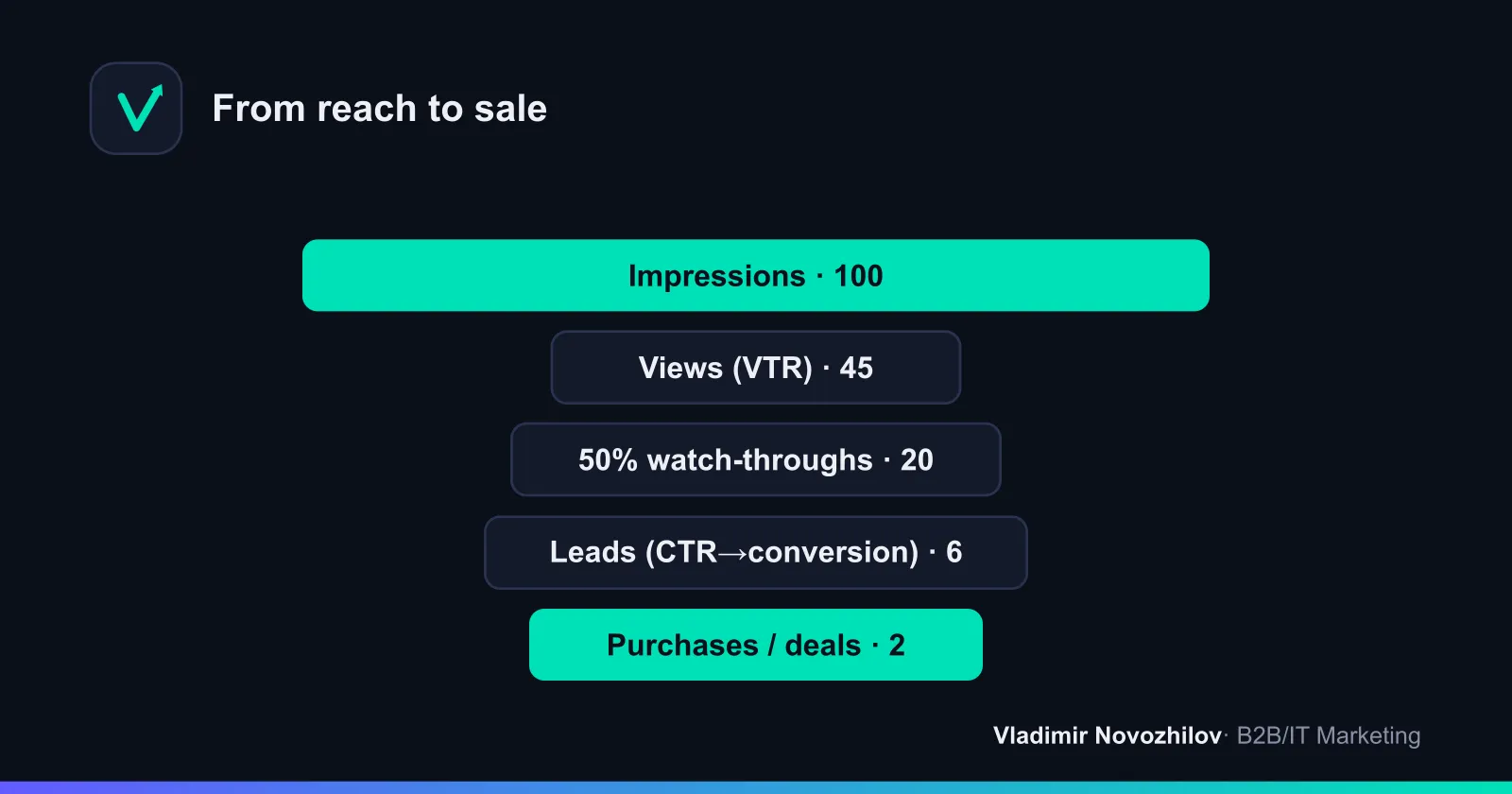
- VTR 30–45% (views to impressions), CTR 0.5–1.5% for native content and 0.8–2.5% for performance ads.
- Watch time: 6–12 seconds for short clips, 30–90 seconds for overview videos, 12–30 minutes per user for a webinar.
- Click-to-lead conversion: 5–12% for warm audiences, 2–6% for cold. After that — CAC and ROMI per chosen attribution model.
Formats and where to use them (shorts, long, live, shoppable)
Top-of-funnel — short vertical clips; consideration and conversion — explainer, webinar, testimonial.
- Short videos (15–30s): teasers, value offers, UGC compilations, webinar cuts. Channels: TikTok, Reels, VK Clips, Shorts.
- Vertical videos (9:16): a must for mobile reach and quick creative tests.
- Long explainers (60–120s) and demos (up to 3 min): show product/cases, close objections.
- Webinars (30–90 min): deep expertise, Q&A, a B2B lead magnet. Afterwards slice into 10–20 shorts.
- Live streams/AMA: live interaction, demos, answering questions.
- Testimonial/case: 60–180s, before/after, client results.
- Shoppable video: player with product cards and CTAs to site/landing or inside platform ecosystems.
Table: what to use where
| Format | Funnel stage | Length | Video platforms | Key metrics |
|---|---|---|---|---|
| Short videos | Reach/engagement | 15–30s | TikTok, Reels, VK Clips, Shorts | VTR, CTR, CPM |
| Vertical videos | Reach | 6–20s | TikTok, Reels, VK Clips, Shorts | VTR, watch time |
| Explainer/Demo | Consideration | 60–180s | YouTube, site, VK, email | Watch time, CTR, conversion |
| Testimonial/Case | Consideration/conversion | 60–180s | YouTube, site, VK, LinkedIn | CTR, inquiries, CPA |
| Webinars | Leads/conversion | 30–90 min | YouTube, VK, site | Registration, attendance, leads |
| Live streams | Engagement | 20–60 min | TikTok, VK, YouTube | Peak viewers, comments |
| Shoppable video | Conversion | 20–90s | Site, product card | CTR to product, conversion, AOV |
Video marketing in B2B: differences from B2C and practical examples
B2B deals have longer cycles, more stakeholders, and trust is critical. Webinars, explainers, demos and testimonials work best.
Tactics that work:
- A Q&A series with an expert: 10–15 short vertical clips for reach, then an explainer.
- Demo focused on before/after: concrete metrics (reduced TTV, conversion uplift by X%).
- Webinar with a case study + Q&A; then slice the webinar into shorts and email the recording.
- Client testimonial: numbers, process, ROI — reduces risk in late stages.
Platforms and distribution channels: YouTube, TikTok, Instagram, VK, site, email
Choose channels by goal and budget. In Russia/CIS account for restrictions on Meta platforms.
- YouTube: long videos, search SEO, webinars, Shorts for teasers. Strong search presence and long tail.
- TikTok: fast hypothesis tests, short vertical videos, viral reach. Great for top-of-funnel.
- Instagram (Reels): visual contact and warming, useful for branding; consider regional ad limitations.
- VK: multi-format — feed, clips, streams, targeting by interests/signals. Easy integration with communities and site.
- Odnoklassniki: mass reach 35+, promo activities, thematic groups.
- Site and email: publish webinars, shoppable videos on product pages, nurture sequences. Core for attribution and conversions.
Distribution tip: plan platform-specific versions in advance (aspect ratio, length, subtitles, CTA).
How to create video: from brief to release (brief template, script, shot list)
A strong brief saves 30–50% of production budget and speeds up shooting.
Brief template (abridged):
- Goal and KPIs: reach, leads, sales (numbers). ROMI triggers and deadlines.
- Audience: segments, pains, barriers, insights.
- Message: 1 core thesis + 2–3 proofs.
- Call-to-Action: where to send people (form, chat, call), legal requirements.
- Video content formats: short/vertical, explainer/demo, webinars, testimonial.
- Platforms: YouTube, TikTok, VK, Instagram Reels, Odnoklassniki, site/email.
- References and tone of voice: mandatory and forbidden elements.
- Resources: team, budget, timeline; production mode (in‑house/outsourced).
Process: idea → video script → storyboards → shot list → shoot → edit → localization → platform versions → release → analytics → iterations.
Script and shot list examples: 30s, 60s and webinar
- 30s (teaser, vertical):
- 0–3s: “Pain/offer” (onscreen text + hook).
- 3–12s: Show solution (b‑roll/screencast, 1–2 proofs).
- 12–25s: Mini case/social proof (figure, logo).
- 25–30s: CTA (“demo”, “apply”, “subscribe”). Subtitles — mandatory.
- Shot list: wide → medium → close‑up on product/action; 6–8 shots.
- 60s (explainer):
- 0–5s: Audience problem.
- 5–20s: How the solution works (3 steps, graphics/screencast).
- 20–40s: Cases/benefits with numbers.
- 40–55s: Close objections (security, integrations, support).
- 55–60s: CTA.
- Shot list: 10–14 shots, 1–2 locations, 1 screen infographic.
- Webinar (45 min):
- 0–2 min: announce agenda and benefit.
- 2–25 min: content blocks (3–4 sections with demo/case slides).
- 25–40 min: case with numbers and Q&A.
- 40–45 min: offer and CTA. Add chapter markers and timestamps.
Production savings and AI usage: tools and workflows
AI speeds the path “from raw footage to publish” by 30–60%.
- Opus Clip, Munch, Vizard — webinar-to-shorts clipping, auto‑subtitles, reframing for vertical video.
- Speech‑to‑text: transcribe interviews → draft script → timestamps.
- AI assistant for editor: b‑roll selection, noise reduction, color.
- Localization: auto‑translate subtitles, synthetic voiceover dubbing, terminology handling.
Workflow “1 long → 20 shorts”:
- Shoot a 45–60 min webinar/interview.
- Auto clip the webinar (10–20 clips of 15–30s) + subtitles.
- Select top 5 by signal metrics (hook rate, retention at 3–5s).
- A/B test creatives on TikTok/VK/Shorts.
- Adapt winners for site/email/landing pages.
Analytics setup and metrics: which KPIs to calculate and how to track them
Record UTMs and viewing events, link them to CRM and compare results across platforms.
- Events: video_start, video_25, video_50, video_complete, click_to_CTA, form_submit.
- Attribution: UTM for source/medium/campaign/content, post‑click and post‑view. For long cycles use a mixed model (for example, linear + special weighting for webinars).
- Platform metrics: VTR / View‑through rate, CTR, watch time, CPM/CPC/CPA. Business metrics: CAC, LTV, ROI/ROMI.
- Integration: site analytics + CRM (creating a lead from video sessions, tag “video_assisted”).
Summary benchmarks by platform (RF/CIS, average):
| Platform | Ideal length | VTR | CTR | CPM (₽) | Avg watch time | Notes |
|---|---|---|---|---|---|---|
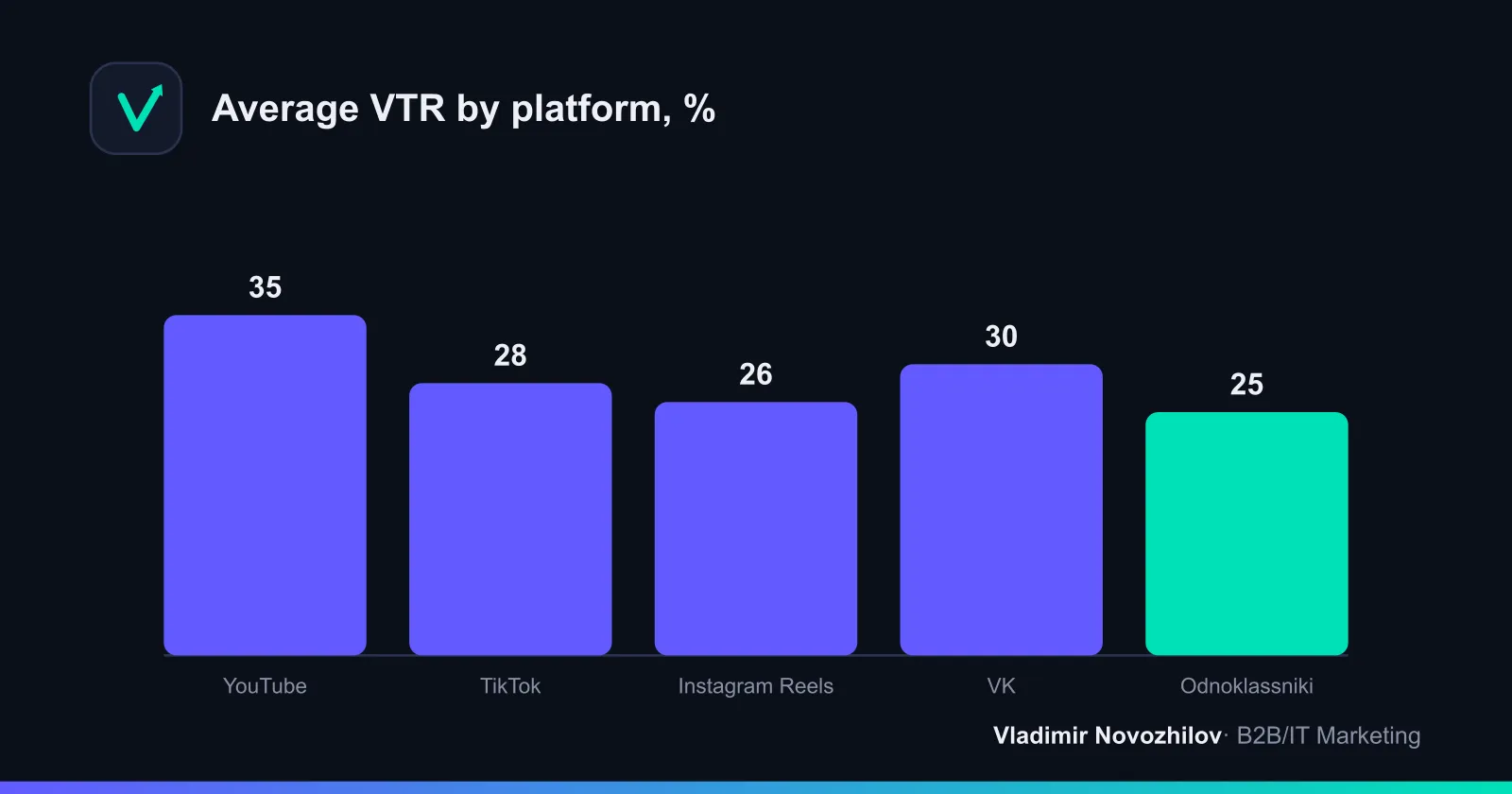
| YouTube | 60–180s | 30–45% | 0.7–1.5% | 150–400 | 20–60s | SEO, long tail, Shorts for teasers |
| TikTok | 6–20s | 25–35% | 0.8–2.5% | 100–250 | 6–12s | Strong reach, fast tests |
| Instagram Reels | 6–20s | 22–30% | 0.6–1.8% | 150–300 | 6–10s | Mind regional ad constraints |
| VK | 10–30s | 26–35% | 0.7–2.0% | 80–200 | 8–15s | Easy integration with communities |
| Odnoklassniki | 10–30s | 20–28% | 0.5–1.2% | 50–150 | 8–12s | Audience 35+, promo mechanics |
Note: benchmarks are a starting point; decisions require tests and normalization by creative/segment.
Examples and cases with numbers: budget, result, lessons
Case 1. B2B webinar → leads (IT service)
- Format: webinars + webinar cut into 14 clips.
- Budget: 90k ₽ (prep, platform, editing). Ads: 180k ₽ (VK + YouTube Discovery).
- Result: 1,240 registrations (CPA 217 ₽), avg attendance 31 min, 186 MQL, 54 SQL, 12 deals (CAC 22.5k ₽). ROMI +140% in 90 days (gross revenue minus ads and production).
- Lessons: 70% of leads came from remarketing to the recording; 20s clips with a specific offer performed best.
Case 2. Shoppable video on site (e‑com category 35+)
- Format: 12 short videos 20–45s with product cards.
- Budget: production 160k ₽, media 120k ₽ (Yandex.Direct + VK).
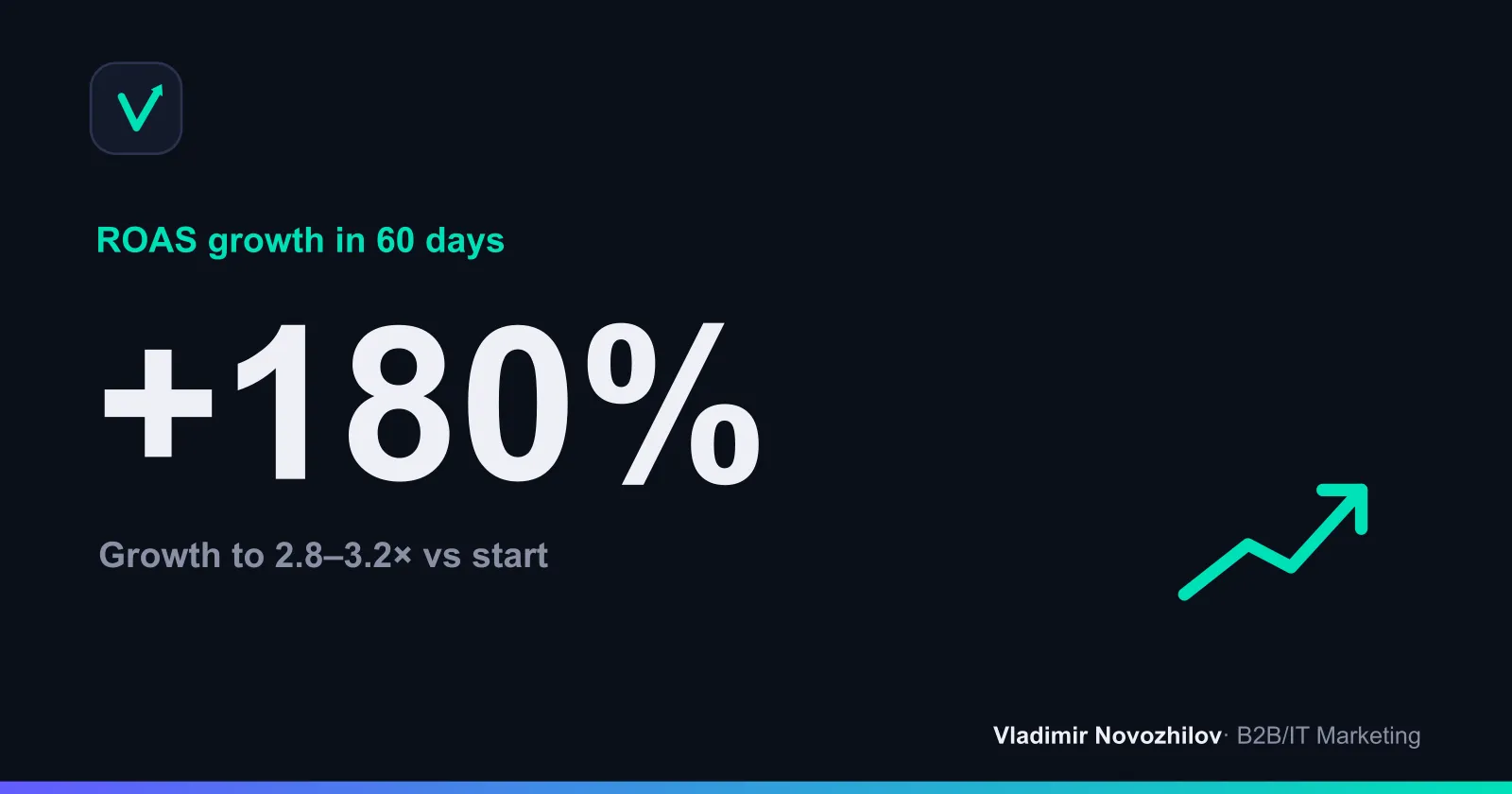
- Result: CTR to product card 2.1%, conversion 3.8%, incremental revenue +1.2M ₽, ROMI +180% in 60 days.
- Lessons: subtitles and putting the offer in the first 3 seconds increased VTR by 22%.
Case 3. Explainer + performance (B2B equipment)
- Format: 75s explainer + 8 short vertical teasers.
- Budget: 290k ₽ production, 350k ₽ media (YouTube In‑feed, VK clips).
- Result: VTR 38% (explainer), CTR 1.4%, 320 leads (CPA 2,000 ₽), 7 deals avg ticket 480k ₽, CAC 91k ₽, LTV 2.1M ₽ (upsells). ROMI +260% in 6 months.
- Lessons: best teaser was a before/after cut highlighting savings with a number.
Checklists and templates (brief, shoot plan, budget, A/B test)
Launch checklist (idea to release):
- Goal, KPI and budget; creative hypotheses.
- Brief approved: audience, messages, offer, legal requirements.
- Video script, storyboard, shot list.
- Version plan for platforms (9:16, 1:1, 16:9; lengths; subtitles; CTA).
- Prepare channels for video: channels, playlists, landing pages, pixels/UTM.
- Pilot and A/B test 3–5 creatives.
- Analytics events and CRM linkage configured.
Shoot plan template (excerpt):
- Locations/time/responsibles.
- Scenes/shots: ID, duration, props, sound.
- Graphics/subtitles: styles, key titles.
Budget template (high level):
- Preprod: writer, director, storyboard.
- Production: crew, studio/location, gear, actors/voice.
- Post: edit, graphics, color, sound, subtitles, localization.
- Distribution: media buy, analytics tools.
A/B creative checklist:
- 3–5 hook variations (first 3 sec).
- 2–3 offer and CTA phrasings.
- Ratios 9:16 vs 1:1 vs 16:9.
- Subtitle test: auto vs manual, contrast.
- Different thumbnails (YouTube/VK) — 2–3 variants.
ROI calculator / sample profitability calculation
Calculate ROMI and CAC accounting for LTV. Formula: ROMI = (Revenue − Costs) / Costs.
Example (B2B webinar):
| Metric | Value | Formula |
|---|---|---|
| Impressions | 320,000 | — |
| Views | 128,000 | VTR 40% |
| Clicks | 1,920 | CTR 1.5% |
| Registrations | 384 | Conversion 20% |
| Leads (MQL) | 120 | 31% joined live |
| Deals | 10 | Conversion 8.3% |
| Gross revenue | 5,000,000 ₽ | 10×500,000 ₽ |
| Costs (production+media) | 400,000 ₽ | 120k+280k |
| ROMI | 1,150% | (5,000,000−400,000)/400,000 |
| CAC | 40,000 ₽ | 400,000/10 |
| LTV (estimate) | 1,200,000 ₽ | ticket × retention/upsells |
Conclusion: if ROMI > 0% and CAC < LTV/3 — scale while monitoring lead quality and retention.
Common mistakes and how to avoid them
- No alignment of goals and formats: “shot a pretty video” but no CTA or UTM.
- One video for all platforms: no adaptation of aspect ratios, lengths or subtitles.
- Ignoring the first 3 seconds: a weak hook kills VTR and CTR.
- No analytics: missing viewing events and attribution to deals.
- Overinvesting in production early: expensive graphics before testing hypotheses.
- Missing legal and regional checks (medical/financial ad restrictions, music/footage rights).
Step‑by‑step implementation plan (30/90/180 days)
30 days — start and hypotheses
- Team: product owner/marketer, writer/editor, editor. Outsource operator on demand.
- Output: brief, content plan, 5–8 short vertical videos, 1 rough explainer, basic analytics (UTM, viewing events, CRM tags).
90 days — scale and funnel
- Team: + motion designer/sound, webinar host.
- Output: 1 webinar/month + cuts (10–15 clips), 2–3 testimonials, site/email releases, remarketing. A/B test creatives, optimize for VTR/CTR.
180 days — systematize and ROMI
- Team: producer/editor, production lead or reliable vendor.
- Output: quarterly content line, 2‑week short‑cycle tests, ROMI report, UGC/clip library, localization for regions (language/dialect, CTA channel), legal guides.
Roles and budgets (in‑house vs agency)
- In‑house MVP: writer/editor, editor, SMM/distribution. Budget from 120–250k ₽/mo + media buy.
- Agency/production: faster for complex tasks, higher per‑video fees but predictable timelines/quality. Explainer cost 150–400k ₽, series of shorts 50–150k ₽ for 8–12 pieces.
- Hybrid: creative and clipping in‑house; complex shoots outsourced. Balance price and speed.
Legal and GEO:
- Account for restrictions on advertising medical, fintech and other categories; include correct disclaimers.
- Local platforms (VK, Odnoklassniki, Yandex services) and tools (Yandex.Direct) provide predictable buys.
Frequently asked questions
-
How many videos to launch at the start and when to expect results? Answer: Start with 5–8 short vertical clips and one rough explainer. Initial conclusions on VTR/CTR appear in 1–2 weeks; leads and deals follow after adding remarketing and a landing page; stable ROMI in 60–90 days.
-
How to choose between short and long formats? Answer: Short (6–30s) formats deliver reach and fast hypothesis tests; long (60–180s and webinars) close objections and move people to apply. Effective chain: shorts → explainer/demo → webinar/case.
-
Which KPIs to calculate first? Answer: For the top of funnel — VTR, watch time, CTR and CPM/CPC; for conversion — CPA/CAC, lead qualification (MQL/SQL), deal velocity and ROMI. Tag all views and clicks with UTM and events.
-
How to optimize production without losing quality? Answer: Start with a strong brief and a pilot. Use AI for clipping, subtitles, reframing and localization — it reduces postproduction by 30–60%. Postpone expensive graphics until hypotheses are validated.
-
How to connect video with CRM and sales? Answer: Set events video_start/25/50/complete, click_to_CTA, form_submit and UTM. Integrate web analytics with CRM, mark records “video_assisted” and use mixed attribution (post‑click + post‑view) for long cycles.
FAQ
- How many videos to release at the start and when to expect first results?
- Start with 5–8 short vertical clips and one rough explainer. Initial conclusions on VTR/CTR appear in 1–2 weeks. Leads and deals arrive after enabling remarketing and a landing page; stable ROMI emerges in 60–90 days.
- How to decide which formats are needed: short or long?
- Short (6–30s) videos are for reach and fast hypothesis tests. Long formats (60–180s) and webinars close objections and drive applications. A proven chain: shorts → explainer/demo → webinar/case.
- Which metrics to track first?
- For the top of funnel — VTR, watch time, CTR and CPM/CPC. For conversion — CPA/CAC, share of MQL/SQL, deal velocity and ROMI. Tag all views and clicks with UTM and events.
- How to optimize production without dropping quality?
- Create a strong brief and a pilot. Use AI for clipping, subtitles, framing and localization — it cuts postproduction by 30–60%. Add complex graphics only after hypotheses are validated.
- How to link video views to CRM and revenue?
- Set up events video_start/25/50/complete, click_to_CTA, form_submit and UTM. Integrate web analytics with CRM, tag records as “video_assisted” and apply mixed attribution (post‑click + post‑view) for long cycles.