Building B2B Content: Strategy and Funnel


TL;DR
In B2B, content is a system of materials that guides multiple decision makers through a long sales cycle and hands qualified prospects to sales. This article explains the ToFu/MoFu/BoFu model, ties formats to stages, presents the 60/30/10 rule, shows content‑to‑lead and content‑to‑MQL metrics, and covers how to connect content to CRM and common mistakes.
How B2B content works and how it differs from B2C
To attract target companies and shepherd several decision makers toward a purchase, B2B needs a managed stream of content. This is not “one‑off articles to tick a box”: materials are built into a funnel where each piece solves a concrete buyer problem and hands prepared leads to sales.
Key differences from B2C:
- Long sales cycle — from a few weeks to a year: content must hold attention for months.
- Group decision‑making. The buyer is a purchasing committee of 2–7 decision makers: user, finance, security, executive. Each role needs tailored content.
- Rational motivation. Decisions are justified with ROI, risks and infrastructure compatibility, not emotion.
- High deal value and CAC — so tie content to LTV: content should reduce acquisition cost and speed up payback.
ICP and buyer persona: the foundation of the strategy
Any B2B marketing strategy starts not with “what” but with “for whom.”
- ICP (ideal customer profile) — description of companies where you deliver the most value: industry, size, revenue, tech stack, purchase triggers. ICP filters out non‑target traffic.
- Buyer persona — profiles of roles inside the ICP: their goals, KPIs, pains and objections. In B2B you typically need 2–4 personas (e.g., “product lead”, “CFO”, “IT architect”).
Practical tip: for each persona list 10–15 real questions they ask at different stages. That becomes a ready bank of topics for the content plan. If you run ABM (account‑based marketing), personalize content for specific target accounts.
The B2B funnel model: ToFu, MoFu, BoFu
The funnel is split into three stages; each has its own objective and metric. This structure is a convenient template:
| Stage | Goal | Formats | Key metric |
|---|---|---|---|
| ToFu (awareness) | Attract the target audience, highlight the problem | Articles, SEO guides, LinkedIn posts, industry overviews, podcasts | Reach, traffic, new subscribers |
| MoFu (consideration) | Warm up, prove expertise, collect contacts | Whitepaper, webinars, lead magnets, checklists, email nurturing | Content‑to‑lead, MQL |
| BoFu (decision) | Remove objections, help choose you | Case studies, comparisons, ROI calculators, demos, competitor battles | SQL, win conversion |
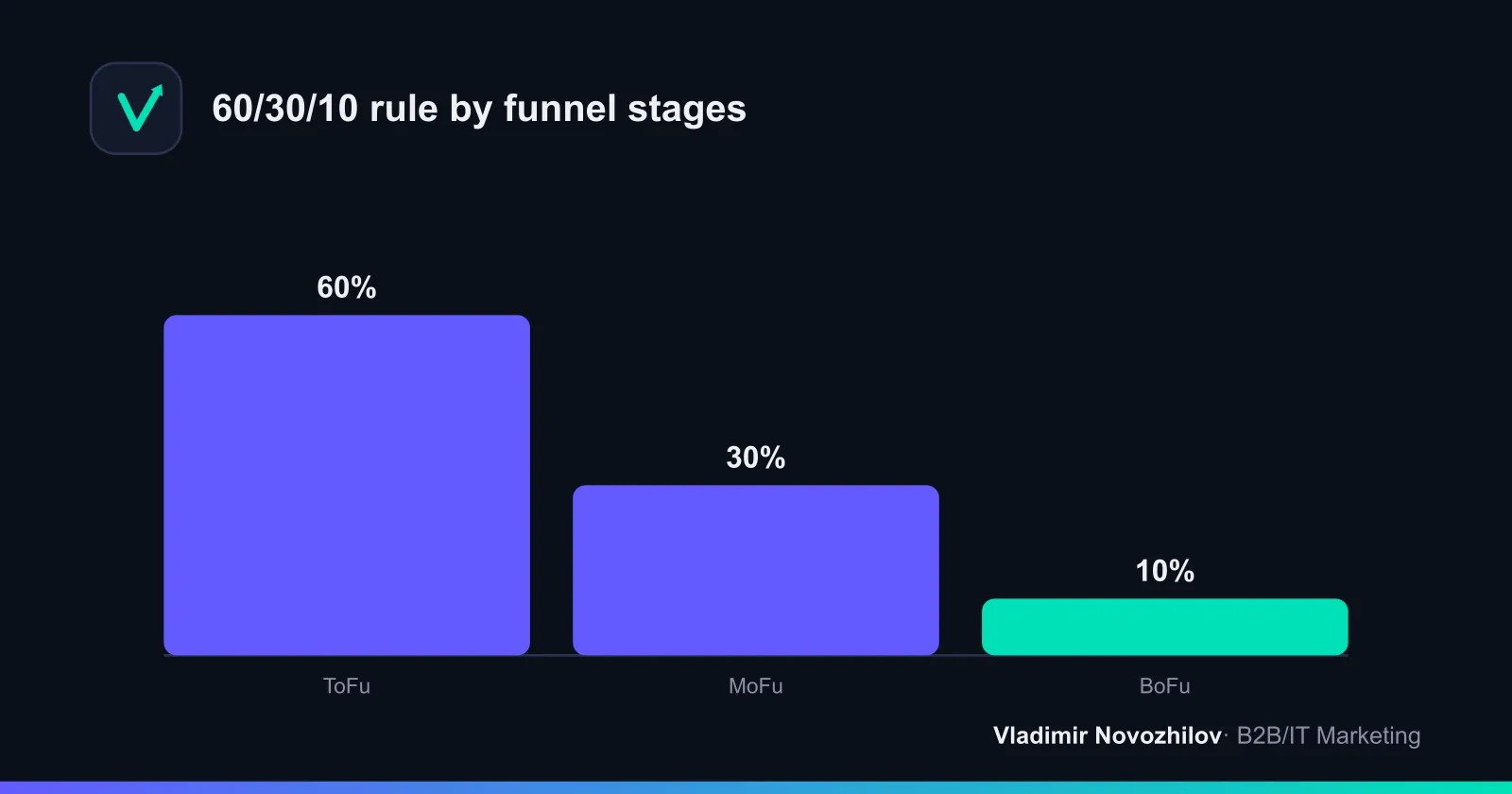
Allocate effort using the 60/30/10 rule: roughly 60% ToFu (reach), 30% MoFu (nurture), 10% BoFu (sales). BoFu content produces the fastest revenue impact, so create it first even if the volume is small.
Formats for each funnel stage
- ToFu: expert articles, SEO content for informational queries, trend overviews, LinkedIn posts and carousels, guest posts in vc.ru and industry media. The task is to get into the ICP’s field of view.
- MoFu: whitepapers and long guides, webinars, templates and calculators as lead magnets, email nurturing sequences. Here the reader trades contact details for value and becomes a lead.
- BoFu: case studies with numbers, “us vs competitor” comparisons, ROI substantiations, demo recordings, objection responses. This content directly impacts demand generation and deal closing.
For SaaS content marketing, interactive formats are especially effective: test drives, sandboxes, product tours and ROI calculators.
Distribution of B2B content: where and how to place it
The “publish and forget” rule doesn’t work. Distribution should take at least as much time as production.
- LinkedIn — the main B2B platform: posts by experts and executives typically reach further than the corporate page.
- vc.ru and industry media — for ToFu reach and reputation.
- SEO blog — the foundation that generates traffic for years.
- Email nurturing — sequences that chase the lead through funnel stages.
- Partner and co‑marketing content — joint webinars and studies broaden audience via partners.
Repurpose each asset into 5–7 formats: from a webinar you can get an article, clip highlights, a post, a checklist and an email.
How to connect content to sales: sales enablement and CRM
Content in B2B lives beyond marketing. Sales enablement are materials used by sales: battle cards (competitor comparison cards), industry‑specific case studies, presentations, objection responses. A rep sends these directly in correspondence and shortens the sales cycle.
To make content measurable, set up lead handoff to the CRM: record which asset generated the lead, tag MQL and SQL statuses, track which content appears most often in won deals. This connects marketing to revenue and justifies the budget.
Metrics and KPIs in B2B content marketing
Abandon vanity metrics as an end in themselves. Work with the conversion funnel:
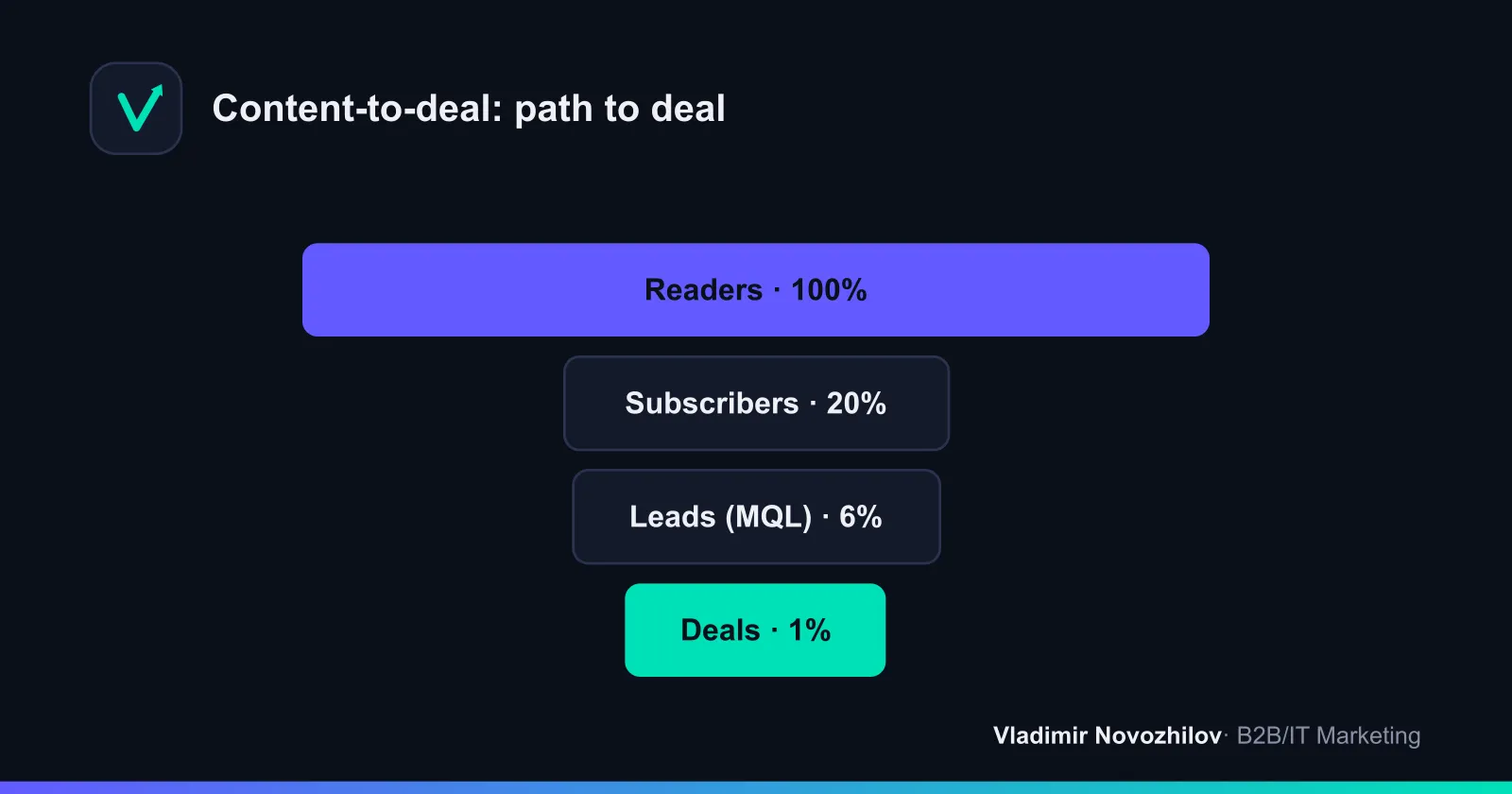
- Content‑to‑lead conversion = leads / readers. Benchmark for B2B — 1–3% on cold traffic, up to 10–20% on MoFu landing pages with a lead magnet.
- Content‑to‑MQL / content‑to‑SQL — how many contacts reached qualification.
- Influence on deals — whether content participated in won deals (influenced revenue).
- Content ROI = (revenue attributed to content − costs) / costs.
- CAC and LTV — content should reduce CAC and increase LTV via retention.
How to build a content plan for a B2B company
- Fix ICP and personas, collect the question bank.
- Map topics to ToFu/MoFu/BoFu in 60/30/10 proportion.
- Define the editorial policy: tone of voice, structure, expertise and fact requirements.
- Create a quarterly content plan with publishing cadence. A realistic rhythm for a 1–2 person team: 4–6 articles per month, 1 webinar per month, 2–3 LinkedIn posts per week, 1 newsletter per week.
- Build the distribution and repackaging cycle for each asset.
- Reconcile metrics monthly and reallocate effort.
Common mistakes in B2B content marketing
- Copying a B2C funnel without accounting for multiple decision makers and a long cycle.
- Only ToFu content — lots of traffic, zero leads because there is no MoFu/BoFu.
- Hard selling in every asset instead of providing value and expertise.
- Ignoring distribution — “we published on the blog and wait.”
- No link to sales — leads don’t reach CRM, attribution isn’t tracked.
- Evaluating by views instead of MQL/SQL and revenue.
- No editorial policy — inconsistent quality and voice.
- Expecting results in a month — organic B2B takes 6–9 months.
Mini case studies: how funnels look in IT and SaaS
SaaS product (SMB segment). ToFu — SEO articles for user tasks; MoFu — templates and webinars in exchange for email; BoFu — product tours and an ROI calculator. Short cycle, emphasis on self‑service and automated nurturing.
IT services (Enterprise). Long cycle, ABM. ToFu — industry research and speaking engagements; MoFu — whitepapers and closed roundtables; BoFu — account‑specific case studies and battle cards for sales. Content is targeted and deep.
The difference is telling: the larger and more expensive the client, the smaller the volume of content and the higher its personalization and depth.
FAQ on B2B content marketing
Чем B2B‑контент‑маркетинг отличается от B2C?
В B2B длинный цикл сделки, групповое решение нескольких ЛПР и рациональная мотивация. Контент строится как система прогрева ролей на месяцы, с упором на экспертность, кейсы и доказательства ROI, а не на импульсную эмоциональную продажу.
Как выстроить контент‑воронку под длинный цикл сделки?
Разделите контент на ToFu (охват), MoFu (прогрев и сбор контактов) и BoFu (снятие возражений и продажа), распределив усилия по правилу 60/30/10. Свяжите каждый этап с метрикой и настройте email‑нёртуринг, который ведёт лида от первой статьи до кейса и демо в течение всего цикла.
Какие форматы контента лучше всего работают в B2B?
На охват — экспертные статьи и LinkedIn; на прогрев — whitepaper, вебинары и лид‑магниты; на продажу — кейс‑стади, сравнения и ROI‑калькуляторы. В SaaS хорошо работают интерактивные форматы: продуктовые туры и калькуляторы окупаемости.
Как измерять эффективность контента и понять, что он влияет на продажи?
Смотрите на content‑to‑lead, content‑to‑MQL/SQL, участие контента в выигранных сделках и ROI. Параллельно отслеживайте влияние на CAC и LTV — они должны улучшаться по мере зрелости контента.
Как связать контент с продажами и CRM, чтобы не терять лидов?
Подготовьте sales enablement‑пакет (кейсы, battle cards, презентации) и передавайте лидов в CRM с метками источников. Фиксируйте MQL/SQL и анализируйте, какие материалы чаще встречаются в выигранных сделках — так маркетинг напрямую связывается с выручкой.
FAQ
- Чем B2B‑контент‑маркетинг отличается от B2C?
- В B2B длинный цикл сделки, групповое решение нескольких ЛПР и рациональная мотивация. Контент строится как система, которая месяцами прогревает роли, опираясь на экспертность, кейсы и доказательства ROI, а не на импульсную эмоциональную продажу.
- Как выстроить контент‑воронку под длинный цикл сделки?
- Разделите контент на ToFu (охват), MoFu (прогрев и сбор контактов) и BoFu (снятие возражений и выбор), распределив усилия по правилу 60/30/10. Свяжите этапы с метриками и настройте email‑нёртуринг, который ведёт лида от первой статьи до кейса и демо на всём пути.
- Какие форматы лучше всего работают в B2B?
- На охват — экспертные статьи и LinkedIn; на прогрев — whitepaper, вебинары и лид‑магниты; на продажу — кейс‑стади, сравнения и ROI‑калькуляторы. В SaaS особенно эффективны интерактивные форматы: продуктовые туры, песочницы и калькуляторы окупаемости.
- Как понять, что контент влияет на продажи?
- Смотрите на content‑to‑lead, content‑to‑MQL/SQL, участие контента в выигранных сделках и ROI. Параллельно отслеживайте влияние на CAC и LTV — по мере зрелости контента CAC должен снижаться, а LTV расти.
- Как связать контент с продажами и CRM, чтобы не терять лидов?
- Соберите sales enablement‑пакет (кейсы, battle cards, презентации) и передавайте лидов в CRM с метками источников. Фиксируйте MQL/SQL и анализируйте, какие материалы чаще встречаются в выигранных сделках — так маркетинг напрямую связывается с выручкой.