How to Set Brand Voice and Tone: A Practical Guide


TL;DR
Brand voice is a stable way a company communicates: choice of words, intonation and emotions that are recognizable across channels. To set it up, describe your audience and values, define four tone scales (formality, humor, respectfulness, enthusiasm) and test them on real texts. Below is a practical algorithm, examples and an implementation checklist.
Simpler: about a brand’s tone of communication
A brand has its own voice — a stable manner of communication: word choice, intonation, rhythm and emotions that are recognizable across channels. In professional contexts this is called tone of voice (ToV).
This is not a logo or colors, but how the company speaks — in a newsletter, post, error notification or support reply.
If the visual style is responsible for how the brand looks, the voice is responsible for how it sounds. Manner of speech is part of positioning: a customer can tell a “corporate bank” from a “bold startup” in a second just by the way it talks, even without seeing the name.
How to distinguish tone of voice, brand voice and tone of speech
These three terms are often confused. Let’s separate them clearly — it makes it easier to know what you’re actually describing.
- Brand voice — the brand’s consistent character and “personality” in text. It changes rarely.
- Tone of voice — the shade of that voice in a specific situation. One voice, many tones.
- Tone of speech — how the brand sounds in spoken delivery: voice assistants, TTS, radio, IVR.
Mini‑glossary:
| Term | What it describes | Does it change |
|---|---|---|
| Brand voice | Brand character, who we are | Almost never |
| Tone of voice | Tone in a specific context | Yes, by situation |
| Tone of speech | Oral delivery, voice, pace | Yes, by channel |
Why a brand needs a voice: how tone affects perception and conversion
A unified communication style solves four tasks: increases recognition, builds trust, speeds up the team’s work and directly impacts conversions in emails and pages. When ten authors write “their own way,” the brand blurs. When there’s a tone guide — texts sound like one person.

In B2B and services the effect is especially noticeable: a complex product is easier to sell if the voice reduces anxiety and speaks the customer’s language instead of bureaucratic jargon.
Four tone dimensions: formality, humor, respectfulness, enthusiasm
A practical NN/G model suggests evaluating any text across four scales:
- Formality — from businesslike to friendly.
- Humor — from serious to ironic.
- Respectfulness — from reverent to cheeky.
- Enthusiasm — from restrained to exuberant.
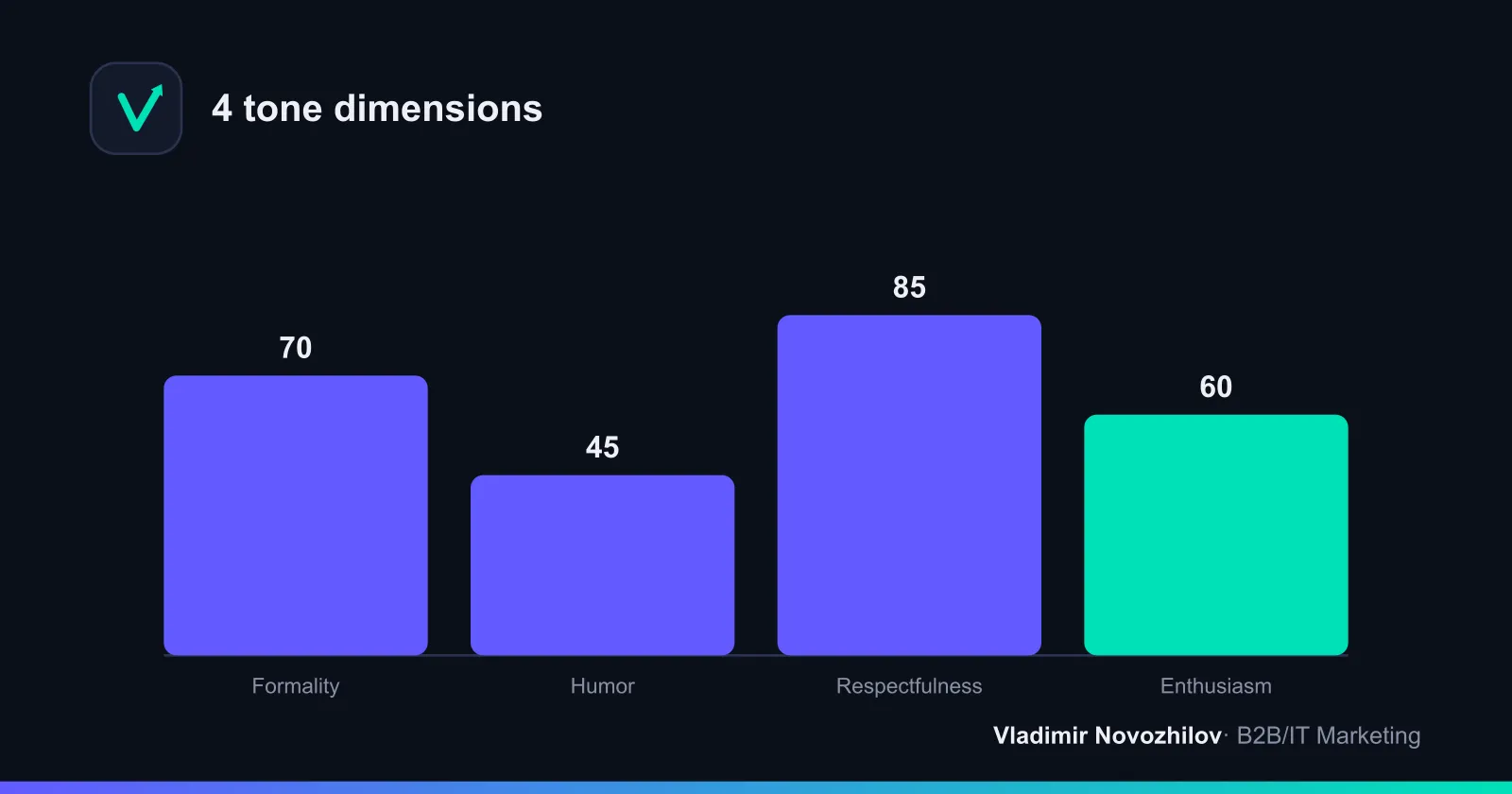
Think of the scales as ranges rather than single points. In support you shift toward a calmer tone; in announcements — toward enthusiasm.
Tone types with examples
Besides the scales, there are familiar archetypes — voice characters. Here are common variants with short phrase examples:
| Tone type | Character | Example phrase |
|---|---|---|
| Formal | Businesslike, restrained | “Благодарим за обращение. Заявка принята в работу.” |
| Friendly | Warm, on “ты” | “Готово! Мы уже занялись твоим вопросом.” |
| Expert | Confident, specific | “Разберём по шагам, чтобы вы приняли решение быстро.” |
| Playful | Humorous, light | “Ошибка? Бывает. Уже чиним — держитесь.” |
| Inspirational | Emotional | “Вы у цели — остался один шаг.” |
(Note: keep original example phrases intact as product/phrasing artifacts.)
How to determine a brand’s tone: a step‑by‑step algorithm
Below is a practical algorithm: from analysis to testing on real texts.
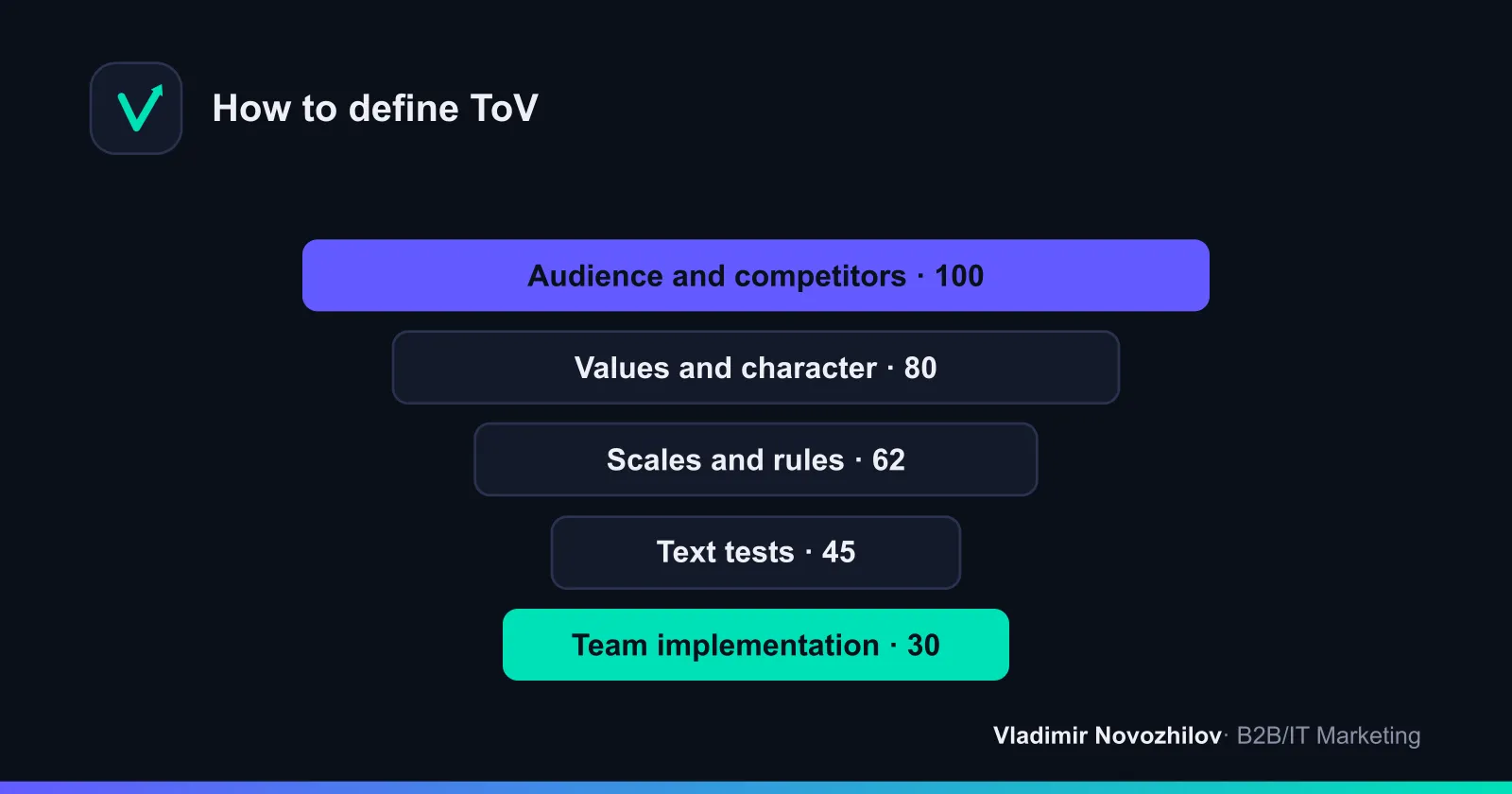
Step 1. Audience and competitor analysis
Describe who you speak to: the customer’s language, their pains, level of expertise, where they read you. Then listen to 3–5 competitors — how they sound, so you can find an unoccupied niche and avoid blending into the market.
Step 2. Articulate values and brand character
Choose 3–5 values and describe the brand as a person: “if the brand were a conversational partner, what would it be like?”. This is the foundation of brand voice, from which the communication tone grows.
Step 3. Set the scales and tone rules
Mark positions on the four scales and write “say / don’t say” rules: which words to use, which are forbidden, how to address people (“ты” or “вы”), how to write about errors and prices. This is the core of the brand’s editorial policy.
Step 4. Test on real texts
Rewrite 5–7 real fragments in the new tone: a greeting, an email, an error notification, a post. If it sounds natural and recognizable — the tone is found.
Before/after examples:
| Before | After (friendly‑expert) |
|---|---|
| «Произошла ошибка. Повторите попытку.» | «Что-то пошло не так — попробуйте ещё раз, мы уже смотрим.» |
| «Оплата не была осуществлена.» | «Платёж не прошёл. Обычно помогает другая карта.» |
| «Уведомляем о поступлении заказа.» | «Ваш заказ у нас — собираем и держим в курсе.» |
Template for a voice & tone brandbook
A voice & tone skeleton you can assemble in a day:
- Who our audience is (1 paragraph).
- Brand character (3–5 adjectives).
- Values (3–5 items).
- The four tone scales with marks.
- “Say / don’t say” rules.
- Before/after examples by channel.
- Marker words and stop‑words.
Examples of effective tone: brand breakdowns
- Яндекс — simple, calm, a “human” tone in interfaces: helpful without lecturing.
- Тинькофф — confident and friendly, on “ты”, with light humor.
- Aviasales — bold and ironic, leaning on colloquial speech.
- Mailchimp — a benchmark of friendly yet professional voice in English‑language segment.
- IKEA — warm, caring, simple language instead of bureaucratic phrasing.
Different characters — each recognizable from the first line.
Common mistakes when implementing ToV
- A voice meant for presentation, not real texts.
- Copying someone else’s tone without linking it to your values.
- One tone for all situations — no channel adaptation.
- Rules without examples: the team doesn’t know how to apply them.
- No owner of the ToV — the style disperses after six months.
How to roll out tone of voice in the team: guide and checklist
Checklist for rolling out to marketing and product:
- Tone guide is documented and accessible to all writers.
- Workshop held with before/after examples.
- A bank of good and bad formulations exists.
- A pre‑publication checklist is introduced.
- A person responsible for the brand voice is assigned.
- Regular text audits are configured.
- Metrics are defined: audience reaction, tone of incoming requests, email conversion.
Mini questionnaire to self‑define the tone
Answer five questions and mark positions on the scales:
- Do we address the customer as “ты” or “вы”?
- Is humor appropriate in our error messages?
- Do we explain as an expert or as an equal friend?
- How emotional are our announcements?
- What would we never say?
The sum of answers gives a rough tone profile — then refine it on real texts.
Table: comparison of tone typologies
| Approach | What it offers | Format | Useful for |
|---|---|---|---|
| Cambridge / dictionaries | Linguistic definition | Term | For basic understanding |
| Grammarly | Tone in writing: formal/friendly | Example emails | For copywriters |
| NN/G | 4 tone dimensions | Scales | For UX and product texts |
| Marketing guides | 10–16 tone types | Catalog of characters | For branding and SMM |
Conclusion: dictionaries explain “what it is,” Grammarly and NN/G provide assessment tools, and marketing catalogs offer ready‑made characters. For a brand it’s useful to combine: take NN/G scales as measures and one or two tone types as character references.
FAQ
- What is the difference between brand voice, tone of voice and tone of speech?
- Brand voice is the brand’s consistent character in writing. Tone of voice is the shade of that voice in a specific situation and channel. Tone of speech is the oral delivery: voice, pace and performance for assistants, TTS, and answering machines.
- Can one tone be used for all channels?
- The base is one (brand voice), but the tone adapts. Use the four NN/G scales: in support shift toward calmness and respectfulness, in announcements move toward enthusiasm and, if appropriate, light humor.
- How to quickly lock down a tone of voice when time is limited?
- Create a mini‑guide: who the audience is, 3–5 character adjectives, values, marks on the four scales, rules "say/don't say", before/after examples, marker words and stop‑words. That’s enough for the team to start writing consistently.
- What common mistakes most often hinder implementation?
- A guide made for presentation rather than real texts; copying someone else’s tone; one tone for all situations; rules without examples; no owner, leading to the style dispersing within six months.
- How do I know the chosen tone works?
- Monitor metrics: audience reactions, tone of incoming support requests, conversion of emails. Conduct regular text audits: they should sound like one person, without being diluted by different authors.