Expert Content in B2B: How to Create and Measure Impact

TL;DR
Expert materials rely on direct experience and verifiable data, help solve practical problems and confirm a company's qualifications. Unlike SEO rewrites, they deliver informational gain—new numbers, cases and conclusions. This article gives a step‑by‑step algorithm, working formats, metrics, common mistakes, and practical guidance on GEO and thought leadership for B2B, IT and services.
The foundation of a strong expert text is direct experience and verifiable data. Such material helps the reader understand a task and make a decision, not just satisfy a formal query. Ordinary articles retell search results; expert pieces add what isn’t yet available online: numbers, cases, observations and conclusions.
Below: how this approach differs from SEO copywriting and advertising, how to organize production step by step and what to watch for in B2B, IT and services: the algorithm, formats, metrics and common mistakes.
What builds expertise and why lead opinions
Expertise rests on three pillars: practical experience, proven qualifications and reliable data. Search engines describe this with the formula E‑E‑A‑T — experience, expertise, authority and trust. A piece becomes expert not because of the number of terms, but because a person who actually did what they write about stands behind it.
Thought leadership is the next level. It’s not a one‑off column, but a position: a company or specialist regularly articulates a view on the industry, sets the agenda and is first to answer new market questions. Opinion leadership grows from a flow of expert content and directly impacts the author’s personal brand and the business’s reputation.
A simple test: if the text can be written without working a day in the topic — it’s not expert material. If you can’t assemble it without a real project, mistakes, numbers or a client story — you’re on the right track.
How it differs from SEO rewrites and ads
Differences are in the goal, the information source and the outcome for the reader. SEO copywriting adapts to algorithms, advertising targets quick responses, while expert content targets trust and problem solving. Comparison of the three approaches — below.
| Критерий | Экспертный контент | SEO-копирайтинг | Рекламный (продающий) текст |
|---|---|---|---|
| Главная цель | Доверие, репутация, спрос | Позиции и трафик | Быстрая конверсия |
| Источник | Опыт автора, свои данные | Анализ выдачи и ключей | Оффер и выгоды продукта |
| Информационный gain | Высокий (новые цифры, кейсы) | Низкий (пересказ) | Отсутствует |
| Автор | Named SME с биографией | Часто анонимный | Копирайтер/маркетолог |
| Горизонт эффекта | Месяцы, накопительный | Средний | Короткий |
| Роль в воронке | Прогрев, отстройка | Захват трафика | Закрытие сделки |
These formats don’t compete but complement each other. Expert publications uniquely provide informational gain — added value competitors lack. That’s why they retain audiences better and get cited more often.
B2B reality: long cycles and multiple decision makers
In b2b content works differently than in retail. The decision is not made by one person but by a procurement committee of 3–7 roles, and the deal cycle stretches for months. Content must accompany that journey: first show understanding of the problem, then provide methodology, and closer to the end — proof in the form of cases and research.
In B2B and IT the reader is not looking for entertainment but a solution to an expensive problem. Calculations, architecture breakdowns, checklists and figures from real projects are especially valued here. One strong piece can generate leads for years: it is forwarded within client companies as an argument for a vendor choice.
Working formats and material types
Types depend on the platform; formats depend on the delivery. Below are formats that consistently work in B2B and services:
- Case study — a project breakdown with the task, actions and measurable result. The most persuasive format for long deal cycles.
- Research and proprietary data — customer surveys, industry benchmarks, analytics of your own base. Provide the maximum informational gain.
- Practical guides and checklists — step‑by‑step instructions “how to do it yourself.”
- Analyses and opinions — an author’s take on trends, myth‑busting, forecasts. The basis of thought leadership.
- Webinars, podcasts and video — live formats where an expert answers questions.
- Expert newsletters — regular emails to your base that nurture and retain.
The same expertise should be repackaged: a case spawns a social post, a talk, a newsletter item and a quote for media. That’s how sustainable content marketing is built.
Step‑by‑step process: how to do this systematically
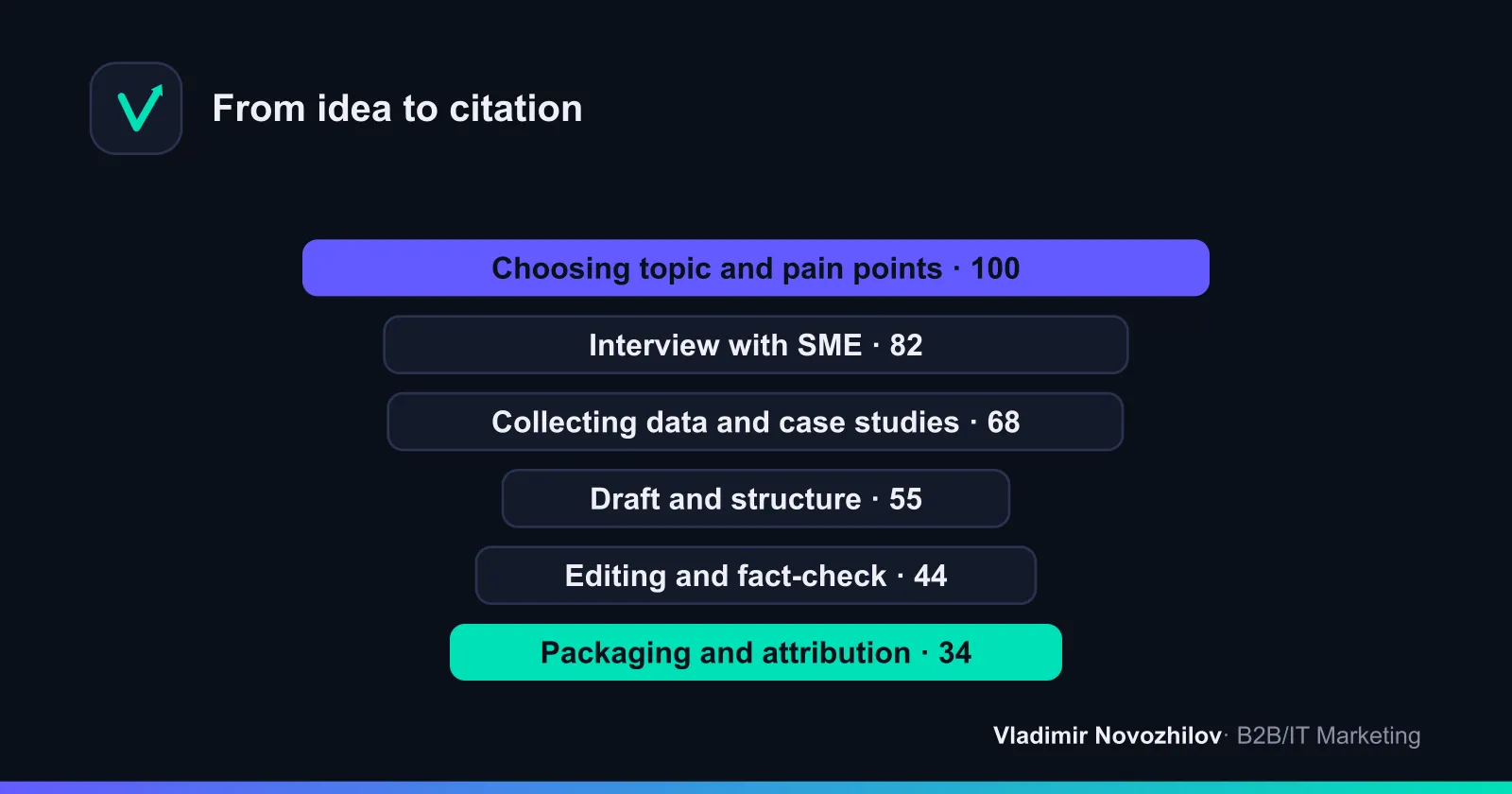
Here is a practical seven‑step algorithm — how to produce materials by process, not inspiration.
- Choose a topic from the client’s pain. Start from real questions on calls and in messages, not search volume.
- Interview the SME. 40–60 minutes with a specialist yields more than a day of reading other articles.
- Collect data and cases. Project figures, screenshots, before/after results. This is your informational gain.
- Build the structure. Start with a direct answer, then arguments and details. This format suits both people and AI.
- Write a draft and fact‑check. Verify every number and claim with the expert.
- Package and attribute. Add the author’s bio, experience, tables and diagrams — strengthen the Author Entity.
- Distribute. Social media, newsletter, industry platforms, Digital PR. Without distribution even a strong piece won’t be found.
Template structure for an article or case
Use this boilerplate as a ready template — copy and fill for your material:
| Блок | Что написать |
|---|---|
| Заголовок | Проблема + результат/обещание |
| Коротко | Прямой ответ в 2–3 предложениях |
| Контекст | Кто клиент, какая была задача |
| Проблема | Что мешало, почему это дорого |
| Решение | Что сделали, какая методология |
| Данные | Цифры до/после, сроки, бюджеты |
| Выводы | Что из этого может забрать читатель |
| Об авторе | Опыт, роль, подтверждение квалификации |
Who is responsible: SME, editor, writer
Expert content is rarely produced by one person. A healthy model is a combination of roles:
- SME (subject matter expert) — the knowledge holder. Provides facts, cases and verifies accuracy. Not obliged to write.
- SME‑editor — extracts knowledge via interview, structures it and turns the conversation into text. Key role: the “SME + editor” combo solves the problem of a busy expert who doesn’t write.
- Content author / writer — brings the text to readability and maintains style.
- Distributor / PR specialist — responsible for reach, Digital PR and mentions.
In small businesses roles are often combined: the owner can be both SME and brand face, while an editor helps package the material.
Where to get topics and triggers
The best topics come from daily work, not keyword tools. Sources:
- questions from sales and support;
- objections that derail deals;
- mistakes and failed projects — they make strong breakdowns;
- internal data and statistics competitors don’t have;
- debates in industry chats and conferences.
Maintain a single question bank: every repeated client question is a ready topic for an article.
How to measure effectiveness
Evaluating expert materials by pageviews is a mistake. Build a system on three levels.
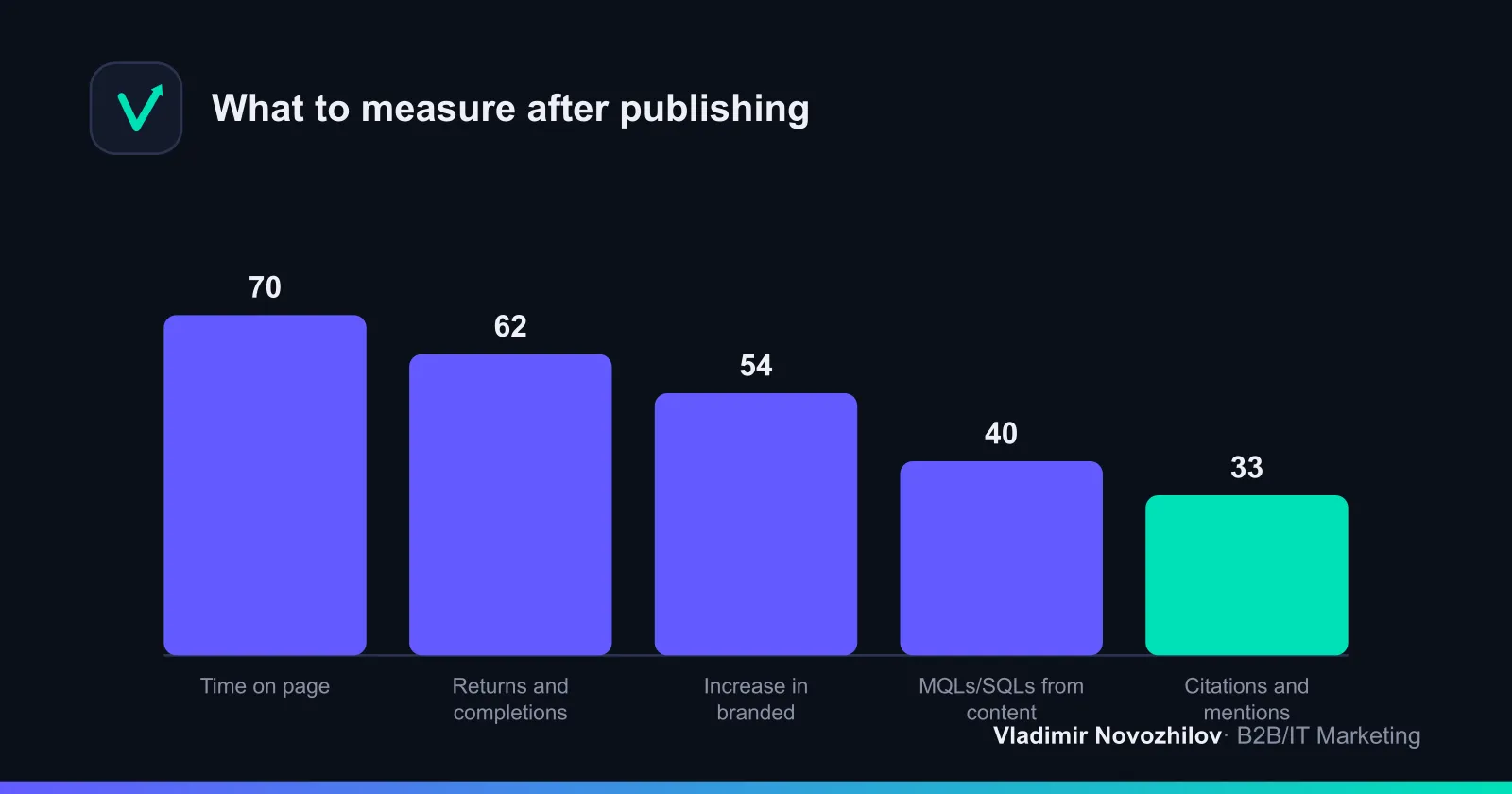
- Engagement: time on page, scroll depth, completions, returns. These behavioral signals matter for ranking (algorithms like NavBoost consider clicks and retention).
- Demand: growth in branded and informational queries, direct visits, newsletter signups.
- Money: share of MQL/SQL originating from content, assisted conversions, impact on pipeline, citations in media and AI answers.
Example simple contribution calculation
A calculator can be replaced with a formula. Contribution to pipeline = (leads from content × conversion to deal × average check). Example: an article brought 120 leads over six months, 8% converted to deals, average check 300 000 ₽. Contribution = 120 × 0.08 × 300 000 = 2.88 mln ₽. Compare to the creation costs to get ROI of the piece.
GEO and AI search: how to become a source
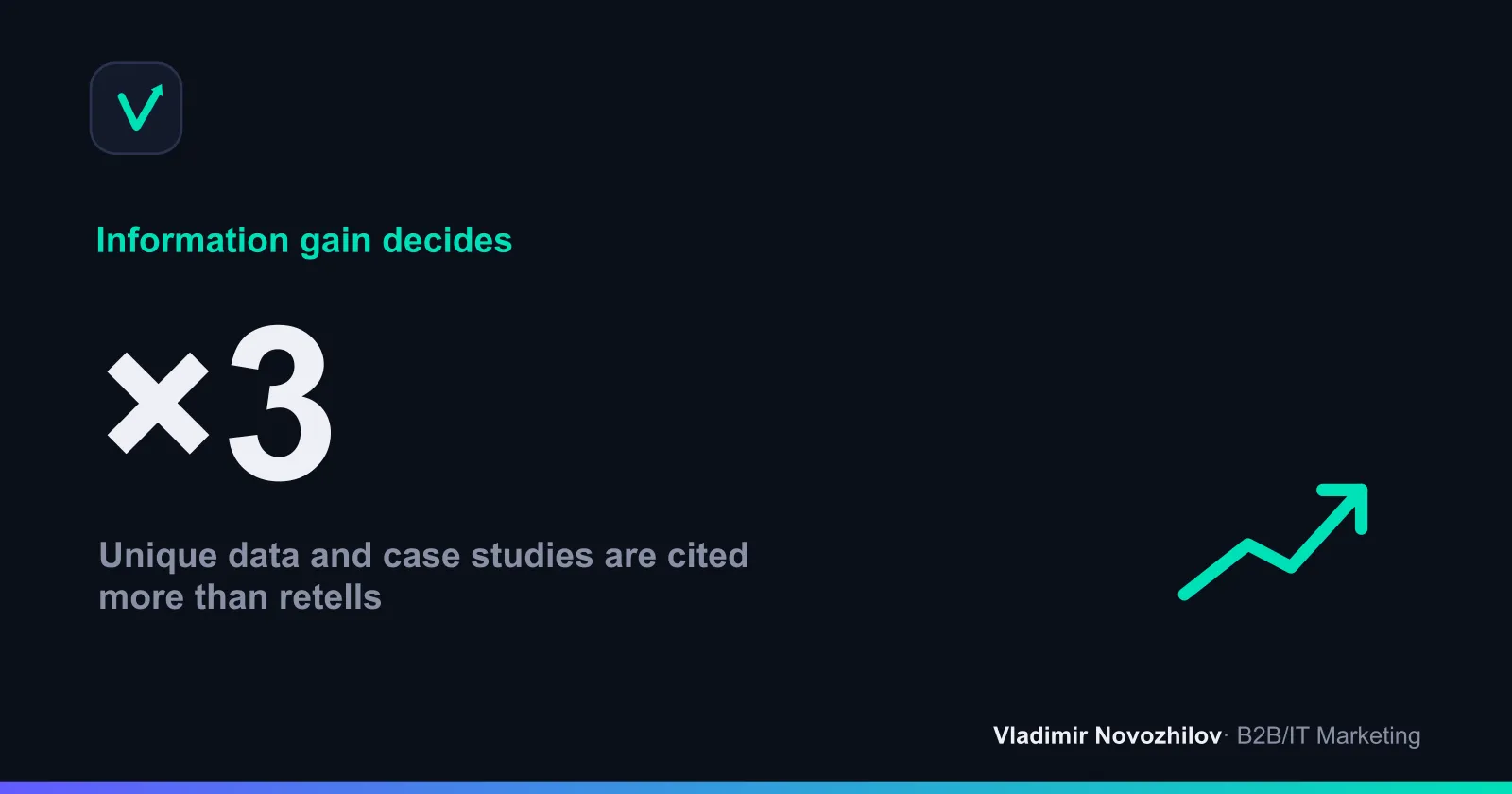
GEO promotion (generative search optimization) is optimization for AI assistant answers. To be cited you need a clear informational gain and explicit author attribution.
Practical rules for GEO:
- provide unique data — your numbers, surveys, cases and research;
- start sections with a direct structured answer, then expand;
- use tables and lists — models parse them easily;
- strengthen Author Entity: bio, experience, expert profiles;
- do Digital PR — mentions on authoritative sites increase algorithmic trust.
In short, high‑quality expert content and smart GEO follow the same requirements: credibility, specificity and a named author — this is what both people and AI expect.
Typical mistakes
Anti‑cases appear more often than successes. Here’s what breaks effectiveness:
- “Expert” text without an expert. A writer rehashes three other articles — informational gain is zero. The reader notices and leaves.
- Fluff instead of numbers. “We improved efficiency” without figures doesn’t convince. Always provide measurable results.
- Anonymity. Content without an author and bio loses in E‑E‑A‑T and AI citability.
- No distribution. Published and forgotten. Without social, newsletter and Digital PR, a strong piece won’t be found.
- Selling instead of serving. When every paragraph boils down to “buy from us,” trust collapses.
- One‑off spikes. One post a quarter doesn’t build thought leadership — you need a rhythm.
How it works across industries
To be concrete, here’s how the approach looks in various niches:
- B2B / IT integrator. A migration case study with real timelines, budget and pitfalls. Such a case is forwarded within client companies as an argument when choosing a vendor.
- Professional services (consulting, legal). An annual market study based on your own base — e.g., average timelines and costs by task. That’s pure informational gain and a Digital PR hook.
- E‑commerce. An expert blog where a specialist explains how to choose a complex product and not overpay. Helps justify price, differentiate from competitors and grow organic traffic.
- Business services. A regular authored newsletter dissecting one client mistake per issue — a low‑cost format that steadily warms the base.
Common denominator — real experience, concrete numbers and a named expert behind the piece.
Pre‑publication checklist
Run your article through this list before release:
- The piece contains at least one fact/figure competitors don’t have
- Author is listed with a bio and qualification proof
- First paragraph gives a direct answer to the query
- There is a table, diagram or checklist
- Every claim has been fact‑checked by the SME
- No fluff or pushy selling
- Headlines cover real audience questions
- Distribution plan prepared (social, newsletter, PR)
- FAQ with direct formulations added
If all boxes are checked — the material is ready to work for both people and GEO.
Key takeaways
Expert materials rely on the specialist’s experience and data, packaged to solve the reader’s task and confirm the business’s qualifications. They differ from SEO copywriting by providing informational gain, and from advertising by offering help without pressure. In B2B they accompany long deal cycles and, through thought leadership, shape demand and personal brands. Work in an “SME + editor” tandem, measure engagement, demand and money, strengthen Author Entity and Digital PR — and materials will start driving clients and appearing in AI search answers.
FAQ
- When should I expect results from expert content in B2B?
- This is a long game: first noticeable effects appear after months. Materials accumulate trust, build reputation and demand, and strong case studies can generate leads for years.
- Who should write: the expert or a copywriter?
- The expert provides facts, numbers and cases; the editor extracts the knowledge via interview and builds the structure; the writer brings it to readable form. The optimal combo is 'SME + editor'.
- What data makes a text truly expert?
- Your own figures and observations: before/after metrics, screenshots, project timelines and budgets, results of analyses on your database. That's the informational gain.
- How to measure content contribution to sales?
- Look at three levels: engagement, demand and money. For pipeline use the formula: leads × conversion to deal × average check. Compare to costs to get ROI.
- What's more important at the start: keywords or client questions?
- In B2B start from real questions from calls and emails. SEO keywords help with reach, but material that solves a specific LPR problem wins.
- How to get into AI answers and boost GEO?
- Provide unique data, start sections with a direct answer, use tables and lists, strengthen Author Entity (bio, experience) and do Digital PR.