Content Strategy: What It Is, Examples, and How to Build One

TL;DR
A content strategy is a long-term plan for creating and distributing content that ties business goals, audience, and channels together. Unlike a content plan (a publishing schedule) or content marketing (the ongoing process), strategy answers the questions of why, for whom, and about what. Below is a step-by-step 8-stage guide, comparison tables, examples, and a ready-to-use checklist.
A content strategy is a long-term plan for creating, publishing, and distributing content that ties a company’s business goals, target audience needs, and chosen channels together. Put simply, it answers three questions: why we create content, for whom, and about what. Everything else — formats, topics, schedules — is derivative. In this article, we’ll cover what a content strategy is, how it differs from a content plan and content marketing, and most importantly, how to build a content strategy step by step, with examples, tables, and a ready-made checklist.
I’ve worked in marketing for B2B, IT, and services for over 15 years, and I keep seeing the same mistake: companies start “running a blog” or “launching a Telegram channel” without a strategy — and abandon it six months later because they don’t understand why they’re doing it. Strategy removes the chaos and turns content into a manageable asset.
What a content strategy is and why business needs it
To give a precise definition, a content strategy is a system of decisions about what content, for which audience, in which channels, and for what purpose a company creates over a 6–12 month horizon. It’s not a list of posts — it’s the framework within which all tactical decisions are made.
Why business needs a content strategy:
- Clear objectives. Content stops being “just because” and starts working toward specific KPIs: traffic, leads, lower acquisition cost.
- Budget savings. You stop spending money on formats and channels that don’t move the needle.
- Predictability. You get a system that can be scaled and handed off to a team.
- Compounding effect. SEO articles, case studies, and a knowledge base keep working for months and years, reducing dependence on paid advertising.
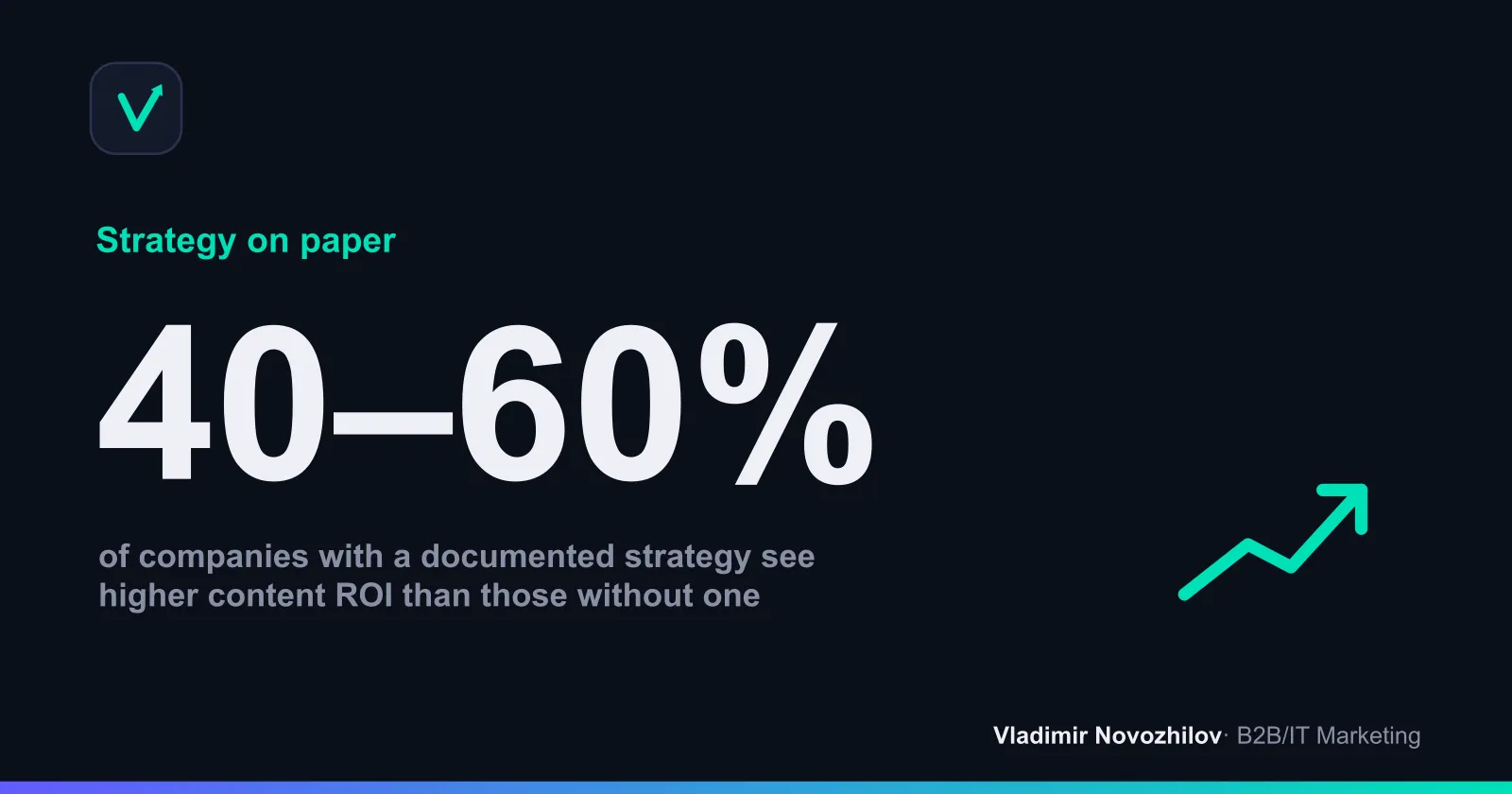
According to industry benchmarks, companies with a documented strategy consistently get more return from their content than those acting on guesswork.
How content strategy differs from a content plan and content marketing
These three terms are constantly confused, even though they operate on different levels. Here’s a short, self-contained breakdown:
- Content marketing is a process and discipline: attracting and retaining an audience through useful content instead of direct advertising.
- Content strategy is a document and a system of decisions within content marketing: goals, audience, topics, channels, metrics.
- Content plan is a tactical calendar: specific publications with dates, formats, and owners.
To settle the question for good, here’s a comparison table.
| Criterion | Content marketing | Content strategy | Content plan |
|---|---|---|---|
| Level | Discipline, approach | Strategic document | Tactical tool |
| Key question | How to attract customers through content | Why, for whom, and about what | What and when to publish |
| Horizon | Ongoing | 6–12 months | 1 month / quarter |
| Contents | All content-related activities | Goals, audience, pillars, channels, KPIs | Topics, formats, dates, authors |
| Owner | Marketing as a whole | Strategist / manager | Editor / content manager |
| Example | ”We grow through a blog and webinars" | "Blog for SEO + LinkedIn for expertise, goal — 40 leads/month" | "March 12 — article on CAC, author Ivanov” |
It’s also worth separating SEO from content marketing: SEO ensures content is found in search (keyword research, optimization), while content marketing ensures that the content found actually solves the reader’s problem and drives a business result. In a good strategy, they work together.
Types of content strategy
There’s no single classification, but in practice it’s useful to group content strategy types by primary goal and funnel type. Here’s the working typology I use.
By goal:
- SEO-focused — centered on organic traffic from search and AI search. The core is articles and a knowledge base built around audience queries.
- Reputation/expertise-focused — aimed at building trust and awareness: case studies, expert columns, speaking engagements.
- Lead-generation — content designed to capture leads: lead magnets, webinars, comparisons, calculators.
- Community strategy — audience retention and engagement, typical for social media and messenger content strategies.
By “funnel depth” (a simplified model used by agencies):
- “Straight to checkout” — a short path with sales-oriented content for products with quick decisions.
- “Understand first” — a complex product that requires educational content.
- “Fall in love with the brand” — an image-building strategy for competitive markets.
- “Stay close” — content for retention and repeat sales.
Most companies combine 2–3 types. For example, a typical content strategy in B2B pairs an SEO blog (traffic) with expert social media content (trust and leads).
Content types: informational, promotional, image-building, entertainment, UGC
For a strategy to be balanced, it’s important to distinguish content types and distribute them across the funnel.
- Informational — educates and answers questions: guides, how-tos, breakdowns. Top and middle of the funnel.
- Promotional — shows the product in action: demos, comparisons, case studies with numbers. Bottom of the funnel.
- Image-building — shapes brand perception: values, culture, expert manifestos.
- Entertainment — boosts reach and engagement, softens the brand’s tone.
- UGC (user-generated content) — reviews and mentions from customers; works as social proof.
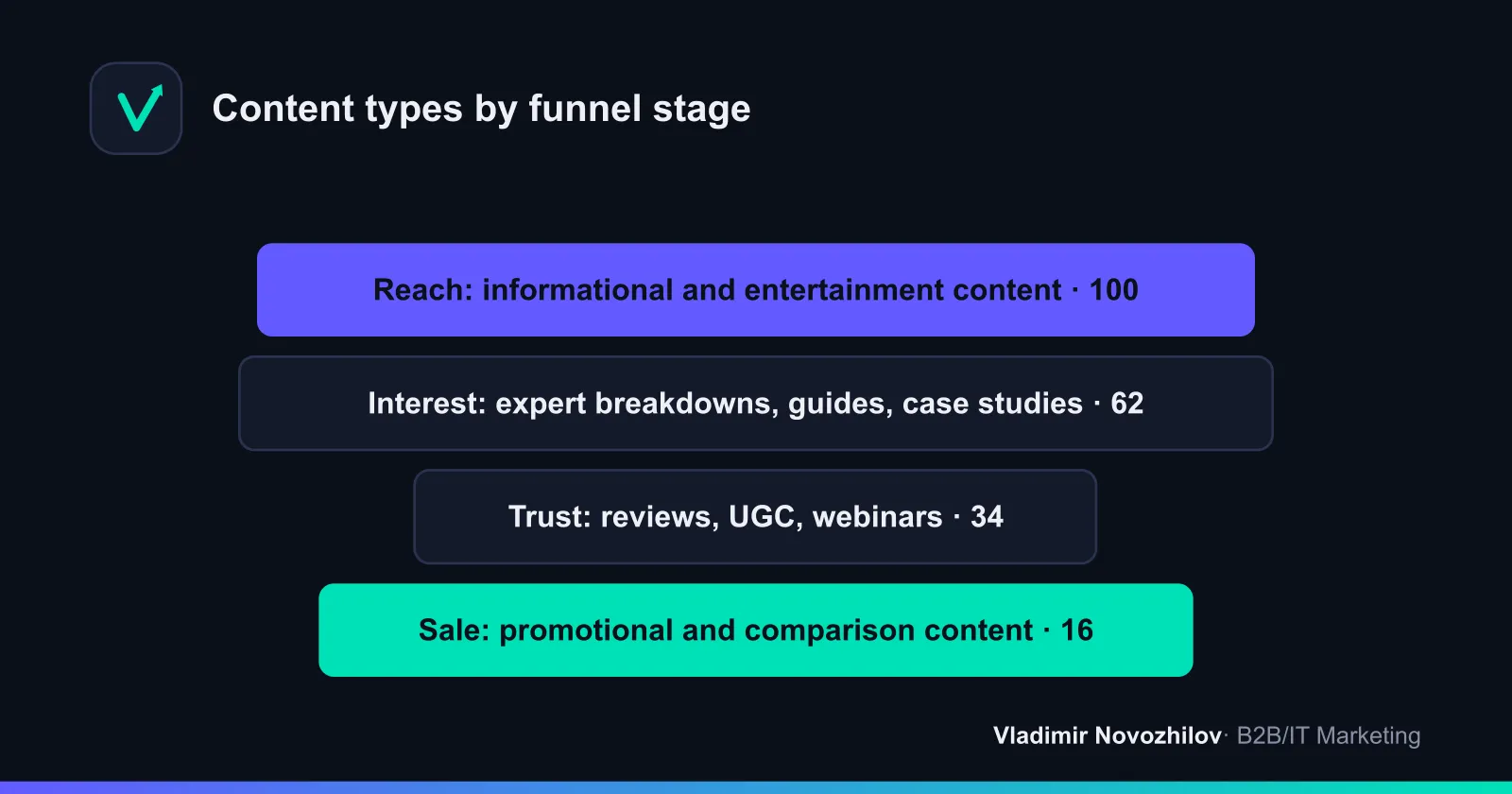
The golden rule of balance is not to overwhelm the audience with sales pitches. A workable ratio for most niches is roughly 60% value, 20% engagement/image, 20% sales.
Content formats: text, video, audio, graphics, interactive
One content type can be packaged into different content formats. The choice depends on the channel and audience habits.
| Format | Examples | Best used for |
|---|---|---|
| Text | Articles, long reads, posts, newsletters | SEO, knowledge base, expertise |
| Video | Reviews, webinars, short clips, video messages | Demonstration, reach, trust |
| Audio | Podcasts, voice messages | Loyal audience, “background” consumption |
| Graphic | Infographics, cards, diagrams | Complex data, social media |
| Interactive | Polls, quizzes, calculators, tests | Engagement, audience data collection |
In B2B, long reads and case studies work well for SEO, cards and breakdowns work well on social media, and webinars work well for leads. In services, short “before/after” videos and customer testimonials perform well.
What a content strategy document consists of
Before moving to the steps, let’s fix the structure of the document. A good content strategy template includes these mandatory blocks:
- Business goals and content goals + KPIs.
- Target audience personas and their pain points.
- Key message and tone of voice (brand voice).
- Content pillars — 3–5 major topics.
- Content distribution channels and their roles.
- Content formats and types.
- Resources: team and content budget.
- Metrics and evaluation cadence.
- Editorial policy and publication rules.
This document serves as a single source of truth for the whole team. Next — how to put it together.
Step-by-step guide: how to build a content strategy
Below is a practical 8-step framework. These are the core stages of a content strategy: from goals to analytics. Each step is self-contained, and you can move through them sequentially.
Step 1. Set goals and KPIs
Always start with a business goal, not “we need a blog.” Connect content to money: growing leads, lowering CAC, speeding up deals, raising LTV. Then translate the goal into measurable KPIs.
Examples of proper SMART goals:
- Grow blog organic traffic from 5,000 to 15,000 visits per month within 9 months.
- Generate 40 qualified leads per month from content by year-end.
- Reduce the share of paid traffic in leads from 80% to 50%.
Assign a metric and a target value to each goal. Without this step, the strategy can’t be evaluated.
Step 2. Analyze the target audience
The second step is defining the content’s target audience. Describe 2–3 key segments: who makes the decision, what their pain points and objections are, how they speak, and where they consume content.
Data sources: interviews with customers and sales, search queries, comments, support chats, analytics. For each segment, it’s useful to compile a mini-persona:
- role and context (e.g., a department head at a mid-sized company);
- tasks and pain points;
- purchase triggers and barriers;
- preferred channels and formats.
This is also where you define tone of voice — how the brand talks to its audience: expert and dry, friendly and simple, bold and casual. A consistent tone of voice makes content recognizable.
Step 3. Analyze competitors
Study what and how competitors and category leaders publish. The goal isn’t to copy but to find gaps you can fill better.
What to analyze:
- topics and formats that drive their traffic and engagement;
- channels where they’re active;
- publishing frequency and quality;
- what queries they rank for (keyword research);
- what they DON’T cover — these are your growth opportunities.
A simple table — “competitor — strong topics — weak spots — our opportunity” — saves weeks of work.
Step 4. Choose distribution channels
Content without distribution doesn’t work. Channels fall into three groups:
- Owned — blog, website, email newsletter, knowledge base. You fully control these.
- Guest/partner — social media, messengers, third-party platforms, media outlets, guest publications.
- Paid — seeding and advertising to amplify your best materials.
Don’t try to cover every channel — pick 2–3 where your audience actually spends time. For a social media content strategy, assign each platform its own role: for example, one channel for expertise and leads, another for reach and awareness. Adapt the same material for each platform rather than posting an identical copy.
Step 5. Build the budget and team
Assess your resources honestly, or the strategy will stay on paper. Determine who will produce content (in-house, freelance, hybrid), and calculate your content budget.
Since an interactive calculator isn’t feasible in an article, here’s a simple formula and a sample calculation:
Monthly budget = (content volume × cost per unit) + distribution + tools.
| Expense item | Example (per month) |
|---|---|
| 4 SEO articles × ₽8,000 | ₽32,000 |
| 12 social media posts × ₽2,000 | ₽24,000 |
| Design and graphics | ₽15,000 |
| Promotion/seeding | ₽20,000 |
| Tools (analytics, services) | ₽9,000 |
| Total | ₽100,000 |
Next, compare the budget against the goal: if the target is 40 leads per month with a ₽100,000 budget, the target content CAC is ₽2,500. Compare it to CAC from other channels and to customer LTV — this shows whether the model pays off.
Step 6. Build a content plan and topic map
Now the strategy turns into tactics. First, define content pillars — 3–5 major topics around which all content is built. Under each pillar, sketch out a cluster of subtopics (keyword research helps here for SEO).
Then build a topic map and a content plan for a month or quarter. Minimum structure for the plan:
| Date | Topic | Content type | Format | Channel | Goal | Owner |
|---|---|---|---|---|---|---|
| 03/03 | How to calculate CAC | Informational | Article | Blog | SEO traffic | Editor |
| 03/07 | Case study: 2x lead growth | Promotional | Cards | Social media | Leads | SMM |
| 03/14 | Customer testimonial | UGC | Video | Social media | Trust | SMM |
This is also where you fix the editorial policy: presentation rules, off-limit topics, quality requirements, deadlines. This is your media plan in practice.
Step 7. Create, optimize, and promote content
Production follows the plan, but with two mandatory add-ons:
- SEO optimization. Every piece targets specific search queries: headlines, structure, comprehensive answers. Account for both traditional search and AI search.
- Distribution. One piece of content, several touchpoints: article → newsletter → post series → short video. This squeezes maximum value out of every content unit.
Before launch, it’s useful to audit existing content: what to update, what to remove, what to repackage. Often the fastest growth comes from improving old materials rather than creating new ones.
Step 8. Evaluate results and effectiveness metrics
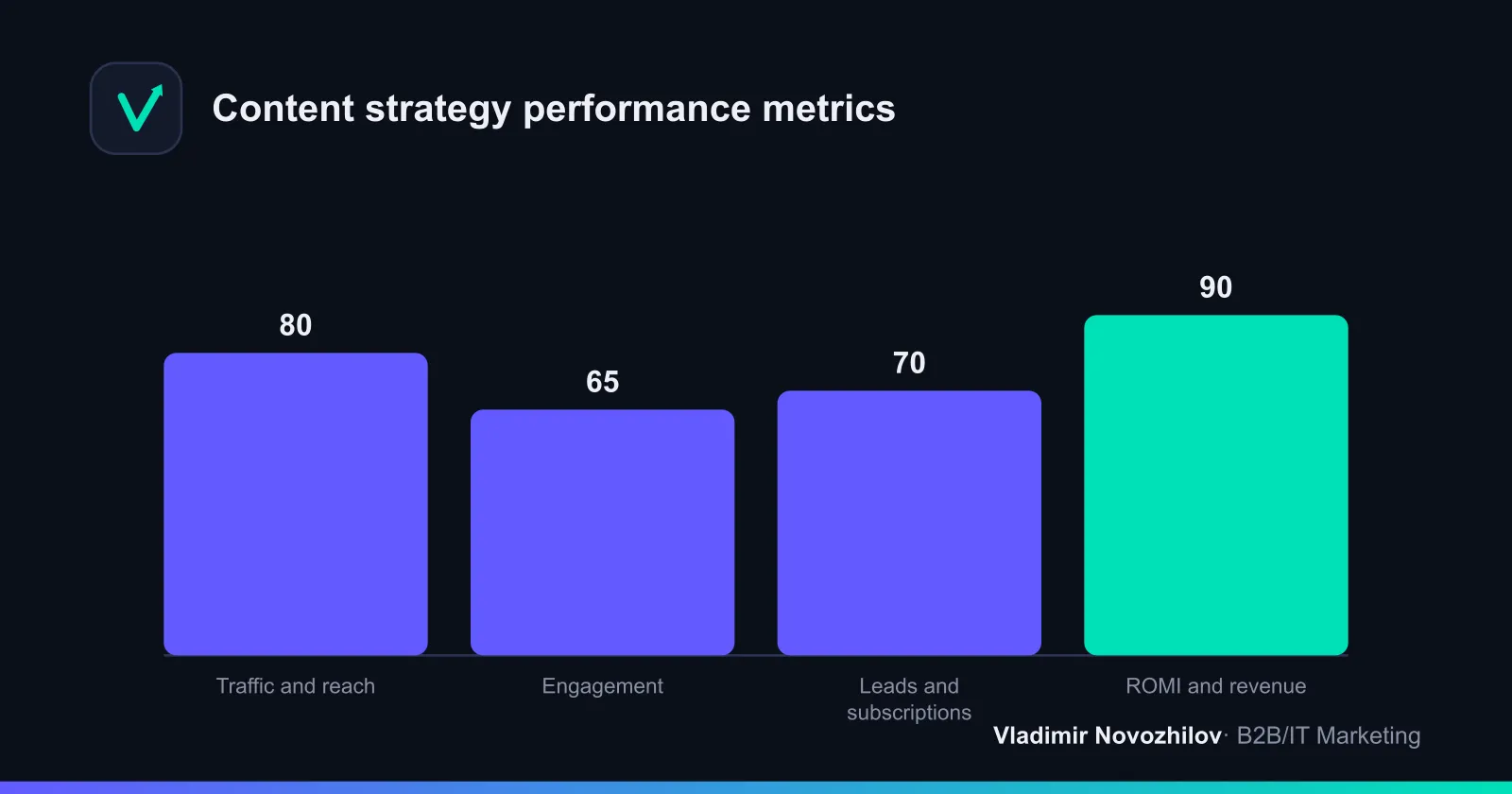
The last stage is analytics. Metrics are grouped by funnel level so you don’t celebrate views that never turn into revenue.
- Top of funnel: reach, traffic, impressions, new users.
- Middle: engagement, completion rate, subscriptions, time on page.
- Bottom: leads, inquiries, sales, ROMI, content’s contribution to revenue.
Connect content to unit economics: calculate organic CAC and compare it to LTV. Review reports monthly, and reassess topics and channels quarterly.
AI search and GEO: adapting your strategy
One gap in most guides is optimization for AI search and generative answers (GEO). Neural networks and AI-generated results are increasingly becoming the first point of contact with a brand.
For your content to be cited in AI answers:
- give a clear definition of the term in the first lines of the section;
- structure the material: lists, tables, explicit step headings;
- answer specific questions with direct statements (FAQ);
- include numbers, criteria, and examples — models tend to cite these;
- cover the topic fully rather than superficially.
Essentially, GEO is a stronger version of the old rule: “create the most useful material for the query.”
Examples of ready-made content strategies
Let’s look at three brief content strategy examples for different niches as a reference point. These are generalized models, not endorsements of specific companies.
Example 1. B2B, IT service. Goal — 50 leads per month from content within a year. Types: SEO + expertise-focused. Channels: blog (articles targeting queries like “how to calculate metrics,” “solution comparison”) and a professional social network (case studies, breakdowns). Pillars: metrics, automation, customer case studies. Success metric — share of organic leads and their CAC. In similar projects, this leads to a 2–3x increase in organic traffic within 6–9 months.
Example 2. Services (agency, consulting). Goal — trust and inbound inquiries. Type: reputation/expertise-focused. Channels: blog + founder’s Telegram channel. Formats: case studies with numbers, short videos, checklists. Key message — “we deliver measurable, transparent results.” Here, content directly shortens the sales cycle: the customer arrives already “warmed up.”
Example 3. E-commerce. Goal — traffic and repeat sales. Types: SEO + community. Channels: blog with product-selection guides, social media with UGC and curated lists, email newsletter for retention. The content mix leans toward value and inspiration, with promotional content used sparingly. Metrics — traffic, cart conversion, LTV.
The overall takeaway from these examples: strategy always starts with the goal and the audience, while channels and formats are derivative.
Common mistakes when building a content strategy
Here are the typical mistakes I see most often:
- Starting with formats instead of goals. “Let’s shoot Reels” without answering “why” is money down the drain.
- A vague audience. “Our customer is everyone” means content resonates with no one.
- Ignoring distribution. Creating content without promoting it wastes half the effort.
- Spreading across every channel. Two channels done excellently beat six done mediocrely.
- No metrics. Without KPIs, you can’t tell whether the strategy is working.
- No tone of voice or editorial policy. Content looks inconsistent and loses recognizability.
- One-off effort. A strategy written once and forgotten needs quarterly revisiting.
- Sales-heavy skew. Constant offers burn out the audience.
Checklist and content strategy template
Below is a content strategy checklist you can move into a table or document and use as a content strategy template. Go through the items — if every one is answered, the document is ready.
Strategic block:
- Business goals and content goals are defined.
- Measurable KPIs are set for each funnel level.
- 2–3 target audience segments and their pain points are described.
- Key message and tone of voice are defined.
- Competitor analysis is done, growth opportunities identified.
Tactical block:
- 3–5 content pillars are chosen.
- Content types and formats are matched to the funnel.
- 2–3 distribution channels and their roles are chosen.
- Content budget is calculated and the team is assembled.
- Topic map and quarterly content plan are compiled.
- Editorial policy is documented.
Operational block:
- Analytics and reporting are set up.
- Evaluation cadence (monthly/quarterly) is defined.
- A content audit and update plan is in place.
- SEO and AI search optimization are accounted for.
This checklist covers all the mandatory strategy blocks. Keep it in front of you when building or revising your strategy.
Key takeaways
A content strategy isn’t a set of posts — it’s a system that ties business goals, audience, and channels together. It differs from a content plan (a schedule) and content marketing (a discipline) in that it answers the questions of why, for whom, and about what. To build one, go through 8 steps: goals and KPIs, audience, competitors, channels, budget and team, content plan, production with optimization and distribution, analytics. Add adaptation for AI search, track funnel-level metrics, and revisit the strategy quarterly — and content will become a predictable asset rather than a line item on your expense sheet.
FAQ
- How is a content strategy different from a content plan?
- A content strategy is a top-level document: it defines goals, target audience, key message, topics (content pillars), and channels for a 6–12 month horizon. A content plan is a tactical calendar of specific publications (topic, format, date, channel, owner), usually for a month. Strategy answers "why and about what," while the plan answers "what and when." The plan always flows from the strategy, not the other way around.
- What time horizon should a content strategy cover?
- The optimal horizon is 6–12 months with quarterly reviews. A shorter period doesn't give SEO and reputational content time to pay off (organic growth in B2B typically takes 3–6 months), while a longer one becomes outdated as the market and algorithms shift. Goals and metrics are set for the year, while the topic map and content plan are updated quarterly based on results.
- How do you know if a content strategy is working?
- Look at metrics across the funnel: reach and traffic (top), engagement and subscriptions/leads (middle), inquiries, sales, and ROMI (bottom). The strategy is working if the share of qualified traffic grows, CAC from organic channels declines, and content's contribution to revenue increases. A rise in views alone, without movement down the funnel, is a signal to revisit topics and offers.
- Does a small business or freelancer need a content strategy?
- Yes, but in a lightweight form. Even a one-page document with a goal, audience persona, 3–4 topics, and a list of channels saves dozens of hours and budget by stopping random publishing. Small businesses are better off focusing on 1–2 channels and one key message rather than spreading efforts thin across everything at once.
- Who should own content strategy — an in-house employee or a contractor?
- Strategy is best built in-house or together with an expert, since it requires deep knowledge of the product, audience, and unit economics. Content production (writing, video, design) can be outsourced. The key rule: the holder of expertise and business goals must always stay on the company's side, otherwise the content loses credibility.