Prompts for Marketers: Templates, Tests, and Compliance 2026

TL;DR
This single guide contains a library of prompts for marketers, an algorithm for creating them, A/B testing methodology, and a compliance checklist. Includes before/after examples, model recommendations for Russian tasks, and a ready prompt‑book in CSV/JSON. Suitable for B2B, IT and services.
Businesslike: prompts for a marketer are not a “magic phrase” but a proper brief for an intelligent executor. AI quality depends on the task setup: who it is (role), what it knows (context), what it must do (task), how to report (format) and what to avoid (constraints). This article contains a practical library of templates for content, SMM, ads, email and analytics; a working algorithm for writing prompts; A/B tests and metrics; model selection for the Russian context; and data security. All examples and recommendations are current as of 2026.
Who this material is for and what it contains
Short on benefits.
- Who: marketers in B2B, IT and services, editors, media planners, performance managers, team leads and CMOs.
- What you’ll get: a library of ready prompt templates, before/after examples for each task category, a validation checklist, A/B testing methodology with KPIs (CTR, CR/CVR, CPA, CAC, LTV), model recommendations (ChatGPT/GPT‑6.x, Claude Sonnet/Opus, YandexGPT, GigaChat), safe prompts without personal data, and a prompt‑book in CSV/JSON.
- When to use: when building a content plan, ads, emails, funnels, JTBD maps, competitor analyses, or reports to leadership.
What a prompt is: structure and quality criteria
Practical definition: a prompt is a formalized brief to a model with role, context, task, response format and constraints.
Structure of a strong prompt (remember this formula):
- Role. “You are a B2B editor / funnel analyst / media planner” — sets style and depth.
- Context. Industry, audience, JTBD (what job the product is hired to do), funnel stage, SEO intent.
- Task. What exactly to produce and why: “generate 10 A/B hypotheses with priorities.”
- Format. Table / bullet points / draft text / SQL / brief with fields.
- Constraints and quality criteria. Tone, length, factuality, “no PD, no links”, “examples from Russia 2024–2026”, “3 alternatives”.
- Data. Source materials: theses, exports, campaign parameters, existing text — better to include as separate blocks.
- Success metric. Which KPI will be used to evaluate the result: CTR, CR, CPA, CPL, NPS, speed of delivery.
Definition of Done (acceptance criteria):
- Match role and brand tone. 9/10 phrases sound like a real expert, no clichés.
- Hit the intent (SEO intent / funnel stage). No vague answers.
- Format as specified: tables, length, CTA, structure.
- Verifiability of facts/figures: no hallucinations, questionable data marked.
- Adaptation to Russian audience and 2026 local realities.
Template matrix (copy as a base):
Role: [who you are + who you write for]
Context: [industry/market], Audience [segment, JTBD], funnel stage [TOFU/MOFU/BOFU], SEO‑intent [info/commercial], product/service [one line]
Task: [what to do + goal]
Format: [output type, fields/headings, length]
Constraints: [tone, no PD, no links, verify facts]
Source data: [paste theses/tables]
Quality criteria: [3–5 items]
Success metric: [KPI and threshold]
How to write a working prompt: step‑by‑step algorithm (with examples)
- Clarify the goal and metric. Example: “Reduce CPA by 15% without volume loss.”
- Gather context. Market, audience segment, JTBD, competitors, current creatives.
- Choose the model role and output format.
- Set constraints and quality criteria.
- Split complex tasks into stages: research → hypotheses → draft → editing.
- Attach source data as a separate block.
- Run a mini‑iteration: request → edit prompt → final version. Save the prompt in the library.
Before/after example for an ad:
Before (lazy prompt):
Write ad text for contextual advertising for CRM implementation services.After (working prompt):
You are a B2B performance editor.
Context: service — CRM implementation for mid‑sized companies (50–250 employees), industries: distribution, service. Audience — heads of sales and operations directors, JTBD: "transparent funnel and predictable forecasts". BOFU.
Task: 5 ad variants for contextual advertising, different mechanics (social proof, specificity, deadline, economic effect, minimized risk).
Format: table [Mechanic | Headline ≤ 30 | Text ≤ 90 | CTA | Key metric for A/B].
Constraints: no fluff or buzzwords, numbers only if verifiable, Russian language.
Quality criteria: clear benefit, concrete triggers, BOFU fit, 1 USP per variant.
Success metric: +10% CTR vs benchmark, preserve CVR.
This kind of setup usually reaches KPIs faster and is easier to validate.
Prompt library by task (content, SMM, ads, email, analytics, performance)
Below — ready templates. For each block I give a before/after example. Copy and adapt to your context. Where relevant — I note recommended model and settings.
Content prompt examples (planning, draft, rework)
- Monthly content plan (B2B, TOFU/MOFU)
Role: content strategist B2B in IT services.
Context: product — IT infrastructure audit; Audience — CIOs/IT directors of mid‑sized enterprises; JTBD: "reduce IT risks and CAPEX". TOFU/MOFU.
Task: 4‑week content plan for blog and LinkedIn/Telegram: 8 articles, 12 posts, 4 short videos.
Format: table [Week | Channel | Topic | Format | Goal | CTA | Metric (CTR/ER/leads)].
Constraints: topics without hype, practical value, examples from RF 2024–2026.
Criteria: cover 3 clusters of search intents, 30% content reuse.
Model: Claude Sonnet or GPT‑6.x, T=0.4.
Before/after:
- Before: “Make a month of post plans.”
- After: clear audience, JTBD, channels, table format and metrics.
- Draft SEO article for informational intent
You are a B2B editor.
Context: article "How to choose a SIEM for mid‑market", informational intent, cluster: security/risk reduction; Audience — InfoSec leads.
Task: outline H2/H3 + draft 1800–2200 words; highlight selection criteria, a comparison table of 5 solutions, a checklist.
Format: Markdown: TOC, H2/H3, table [Criterion | Why it matters | How to check], "In short" block.
Constraints: no promotional inserts, no links, examples for RF.
Criteria: natural term density, readability Flesch‑Kincaid for RU — average/above.
Model: GPT‑6.x or Claude Opus, T=0.3.- Rewriting text into brand voice
Role: brand editor.
Context: tone — businesslike, friendly, no slang; brand voice is concise and factual.
Task: edit the text below into the specified voice; reduce by 15%, increase specificity.
Format: version v1 (rewritten) + v2 (shorter, 500–700 chars) + list of replaced clichés.
Constraints: do not invent facts, keep meaning.
Source:
---
[INSERT TEXT]
---
Model: YandexGPT or GigaChat, T=0.3.- Case study “before — work — result”
Role: case editor.
Context: B2B analytics implementation service.
Task: compose a case study with: Client → Task/JTBD → What was done (3–5 steps) → Result (figures CTR/CR/CPA/LTV) → Business impact.
Format: 900–1200 words, "Before/After" table with 3 metrics.
Constraints: no client name, replace tags with [CLIENT], [SECTOR], amounts as ranges.
Criteria: measurability, honest baseline.- FAQ block for a service page
You are a product marketer.
Context: BI implementation service, audience — operations directors.
Task: 8 Q&A items: timelines, effects, risks, support, integrations.
Format: markdown list; answers 2–4 sentences, no links.
Constraints: plain language, no PD.
Criteria: address 80% of common objections.- 15 headlines + 10 first paragraphs
Role: headline editor.
Context: article about reducing CPA in performance.
Task: 15 H1s with different mechanics (numbers, question, benefit, "against expectations", case), 10 first paragraphs (100–140 words each).
Format: two‑part table.
Constraints: no clickbait.
Criteria: 3 headlines ready for A/B.
Socials and Telegram prompt examples
- Weekly plan for Telegram + VK
Role: SMM editor.
Context: B2B audience, high average check, tone — expert, no memes.
Task: schedule of 7 posts: educational, case, short insight, poll, video, FAQ, offer.
Format: table [Day | Format | Topic | Opening hook | CTA].
Criteria: 3 hooks with different mechanics.
Model: YandexGPT/GigaChat, T=0.5.
Before/after:
- Before: “Generate posts for a week in Telegram.”
- After: clear format, tone and hook mechanics.
- A post that doesn’t feel “robotic”
You are a Telegram SMM editor.
Context: topic — "how we reduced CPA by 22% in 4 weeks", tone — lively, no bureaucratic language.
Task: post 1200–1600 chars, PAS structure (problem‑agitate‑solve), 1 "before/after" table, 1 CTA.
Constraints: numbers are from the block below, no guesses.
Data:
— CTR: 1.2% → 1.35%
— CVR: 3.0% → 3.4%
— CPA: 4300 → 3350- A 5‑post warming series
Role: SMM strategist.
Context: launching a pilot service offer "funnel audit in 72 hours".
Task: 5 posts: pain, mistake, mini‑case, method, offer.
Format: table [Post | Goal | Message | Proof | CTA].
Criteria: at least 1 social proof per post.- Replies to comments/questions
Role: SMM moderator.
Context: frequent question "expensive/long/complex".
Task: 6 ready replies: calm, with numbers, empathetic, humorous, redirect to DM, refusal.
Format: list by tone.
Constraints: no negative language, no promises on timing if no slots.- Visual and cover ideas
You are a creative editor.
Context: topic — "A/B testing mistakes in marketing".
Task: 10 cover concepts (text + visual metaphor), 3 for 9:16 video.
Format: table [Format | Idea | Cover text ≤ 6 words | Why it will work].
Advertising prompt examples (search, targeting, copy)
- 10 concepts for targeting creatives
Role: performance creative.
Context: CRM implementation audit; Audience — ROP/CEO in SMB; goal — lead form.
Task: 10 concepts, each — headline, key visual, offer, social proof, risk‑reverse.
Format: table.
Criteria: 4 concepts low risk, 4 medium, 2 bold.
Model: GPT‑6.x, T=0.7 (creative).- Search ads (3 mechanics)
You are a contextual ads editor.
Context: queries "внедрение crm", "настроить crm под ключ"; region — RF.
Task: 6 headlines (≤ 30) and 6 descriptions (≤ 90) across 3 mechanics: benefit, deadline, proof.
Format: table [Mechanic | Headline | Description | CTA].
Criteria: keywords used naturally, no keyword stuffing.
Model: YandexGPT, T=0.4.- UTM table for a campaign
Role: media planner.
Context: campaign "CRM‑audit", sources — Search/RSYA/VK.
Task: compile UTM parameters and naming for campaigns/ads.
Format: table [Source | Campaign | utm_source | utm_medium | utm_campaign | utm_content | utm_term | Example value].
Constraints: unified naming, no Cyrillic in UTM.- Landing A/B hypotheses
Role: conversion analyst.
Context: landing for CRM implementation, current form CR — 2.9%.
Task: 10 hypotheses with ICE scoring.
Format: table [Hypothesis | Insight/Data | Change | Expected effect | ICE].
Criteria: at least 3 hypotheses about social proof.- 30–45s video script (ads)
You are a performance scriptwriter.
Context: offer — "Funnel audit in 72 hours"; Audience — SMB owners.
Task: 30–45s script using AIDA, voiceover text, shot notes.
Format: table [Seconds | Shot | Text | Subtitles | CTA].
Before/after (ads):
- Before: “Write an ad for RSYA.”
- After: “Role: contextual editor; context: BOFU, segment, mechanics; table format; quality criteria; CTR metric.”
Email and CRM prompt examples
- Welcome sequence of 5 emails
Role: email editor B2B.
Context: lead downloaded a CRM selection guide; segment — mid‑market; goal — demo.
Task: 5 emails: value → case → approach comparison → objections → offer.
Format: for each email — subject (≤ 55), preheader (≤ 80), body (800–1200), CTA.
Criteria: 2 subject variants for A/B.- Re‑engagement of cold contacts
You are a CRM marketer.
Context: base hasn't opened emails for 90+ days.
Task: 3 emails with soft offers and a "choose frequency" option.
Format: subjects, preheaders, 3 CTAs (content/diagnostics/unsubscribe).
Constraints: no pressure.
Metric: +20% Open Rate vs benchmark.- Subjects and preheaders: 10×2
Role: editor.
Context: BOFU email offering demo.
Task: 10 subjects + for each 2 preheaders with different mechanics (deadline/fact/question).
Criteria: avoid "free" in subject; length ≤ 55.- Behavioral segmentation of the base
Role: CRM analyst.
Context: events — open, click, visit, lead.
Task: RFM‑light segmentation scheme + trigger rules.
Format: table [Segment | Rule | Message | KPI].- NPS survey (B2B service)
You are a researcher.
Context: clients 3+ months.
Task: NPS form + 3 open JTBD questions.
Format: email text + form questions.
Before/after (emails):
- Before: “Write a demo offer email.”
- After: a sequence, varied subject mechanics, segmentation and KPI rules.
Analytics and competitor analysis prompt examples
- Competitor analysis by site/content
Role: competitive analyst.
Context: service — CRM implementation, RF market; 3 competitors: [A], [B], [C].
Task: table of positions and content gaps.
Format: [Competitor | USP | Topics | Formats | CTA | Gaps vs us | Article/case ideas].
Constraints: no speculation, only observable site elements.
Model: Claude/ GPT‑6.x.- Audience map: pains/jobs/selection criteria
You are a JTBD researcher.
Context: Audience — heads of sales in SMB.
Task: JTBD table: [Situation | Job | Barriers | Choice criteria | Risks | Triggers].
Format: table + 5 client‑voice paraphrases.- Marketing hypothesis generator
Role: growth strategist.
Context: goal — reduce CAC by 15% in a quarter.
Task: 20 hypotheses across channels (search, social, partnerships, content, email), prioritized by ICE and impact on CAC/LTV.
Format: [Hypothesis | Channel | Impact on CAC | Impact on LTV | ICE | First steps].- Funnel analysis: growth points
You are a funnel analyst.
Context: data: impressions=1 000 000, clicks=12 000, leads=360, meetings=170, deals=68.
Task: find bottlenecks, propose 10 hypotheses and 5 quick experiments.
Format: table [Stage | Current % | Benchmark | GAP | Hypotheses].
Model: YandexGPT/GPT‑6.x.- SQL query for BI (if you work with a DB)
Role: analyst assistant.
Context: tables events (ts, user_id, event), leads (lead_id, user_id, status).
Task: calculate CVR from "registration" → "lead" by week for 8 weeks.
Format: SQL + comments.
Constraints: do not execute, only show example query and checks.
—
Prompt‑book for download: CSV and JSON (paste into your editor)
CSV version (prompt-book.csv):
id,task,goal,role,model,temp,format,constraints,acceptance,metrics
CNT01,Контент‑план,"Заполнить 4 недели контента","Контент‑стратег B2B","Claude Sonnet|GPT‑6.x",0.4,"Таблица [Неделя|Канал|Тема|Цель|CTA|KPI]","Без воды, РФ 2024–2026","3 кластера интентов, 30% репак","ER, CTR, лиды/нед"
SEO02,SEO‑статья,"Инфоинтент, охват","Редактор B2B","GPT‑6.x|Opus",0.3,"Markdown H2/H3 + таблица","Без ссылок, факты проверять","Структура, читабельность","Органический трафик, Time on page"
BRD03,Голос бренда,"Единый тон","Бренд‑редактор","YandexGPT|GigaChat",0.3,"v1/v2 + список замен","Без штампов","‑15% длина, +ясность","Редакт‑оценка"
SMM04,План SMM,"ER + клики","SMM‑редактор","YandexGPT",0.5,"Таблица 7 постов","Без мемов","3 хука/нед","ER, CTR"
ADS05,Объявления поиск,"+10% CTR","Редактор контекста","YandexGPT",0.4,"Таблица вариантов","Естественные ключи","3 механики","CTR, CVR"
ADS06,Креативы таргет,"10 концепций","Креативщик","GPT‑6.x",0.7,"Таблица идей","Без пустых обещаний","4/4/2 по риску","CTR, CPL"
CRM07,Welcome‑цепочка,"Демо","Email‑редактор","Claude|GPT‑6.x",0.4,"5 писем: тема/тело/CTA","Без спама","2 темы A/B","Open, CTR, CR"
CRM08,Реактивация,"Возврат","CRM‑маркетолог","YandexGPT",0.4,"3 письма + частота","Без давления","Опт‑аудитория","Open, CTR"
ANL09,JTBD‑карта,"Гипотезы боли","Исследователь","Claude|GPT‑6.x",0.2,"Таблица JTBD","Без домыслов","5 инсайтов","Кол‑во идей"
ANL10,Воронка,"Поиск узких мест","Аналитик","GPT‑6.x|YandexGPT",0.2,"Таблица этапов","Факты только","Точность расчётов","CVR, CPA"
JSON version (prompt-book.json):
[
  {
    "id": "CNT01",
    "task": "Контент‑план",
    "goal": "Заполнить 4 недели контента",
    "role": "Контент‑стратег B2B",
    "model": ["Claude Sonnet", "GPT‑6.x"],
    "temp": 0.4,
    "format": "Таблица [Неделя|Канал|Тема|Цель|CTA|KPI]",
    "constraints": ["Без воды", "РФ 2024–2026"],
    "acceptance": ["3 кластера интентов", "30% репак"],
    "metrics": ["ER", "CTR", "Лиды/нед"]
  },
  {
    "id": "ADS05",
    "task": "Объявления поиск",
    "goal": "+10% CTR",
    "role": "Редактор контекста",
    "model": ["YandexGPT"],
    "temp": 0.4,
    "format": "Таблица вариантов",
    "constraints": ["Естественные ключи"],
    "acceptance": ["3 механики"],
    "metrics": ["CTR", "CVR"]
  },
  {
    "id": "CRM07",
    "task": "Welcome‑цепочка",
    "goal": "Демо",
    "role": "Email‑редактор",
    "model": ["Claude Sonnet", "GPT‑6.x"],
    "temp": 0.4,
    "format": "5 писем: тема/тело/CTA",
    "constraints": ["Без спама"],
    "acceptance": ["2 темы A/B"],
    "metrics": ["Open Rate", "CTR", "CR к демо"]
  }
]
How to test prompts: A/B, metrics and acceptance criteria
The test goal is to compare the lazy vs working prompt by business metric, not by subjective “like/dislike”.
Typical metrics:
- Content/blog — time on page, depth, share of organic traffic, citation in neural search.
- SMM — ER (likes+comments / reach), CTR from post, referrals.
- Ads — CTR, CVR (click→lead conversion), CPA/CPL.
- Email — Open Rate, CTR, CR to the goal (demo/lead), unsubscribes.
- Sales funnel — stage conversion rates, cycle time, CAC, LTV.
Mini A/B checklist:
- Hypothesis with threshold: “New prompt reduces CPA by 15% at same lead volume.”
- Unit of randomization: ad / creative / email / landing block.
- 95% confidence level, fixed horizon or sequential testing.
- Equal budgets and targeting except for the variable.
- Duration — at least one funnel cycle (often 7–28 days in B2B).
- Stopping rule and decision criterion defined before start.
Example thresholds (table):
| Task | Main KPI | Success threshold | Minimum volume |
|---|---|---|---|
| Search ads | CTR | +10% vs benchmark | ≥ 3 000 clicks |
| Targeted ads | CPA | −15% at same lead volume | ≥ 200 leads |
| Welcome email #1 | Open Rate | +5 p.p. | ≥ 10 000 recipients |
| Telegram post | CTR | +12% | ≥ 50 000 impressions |
| Longread on blog | Time on page | +20% | ≥ 1 500 sessions |
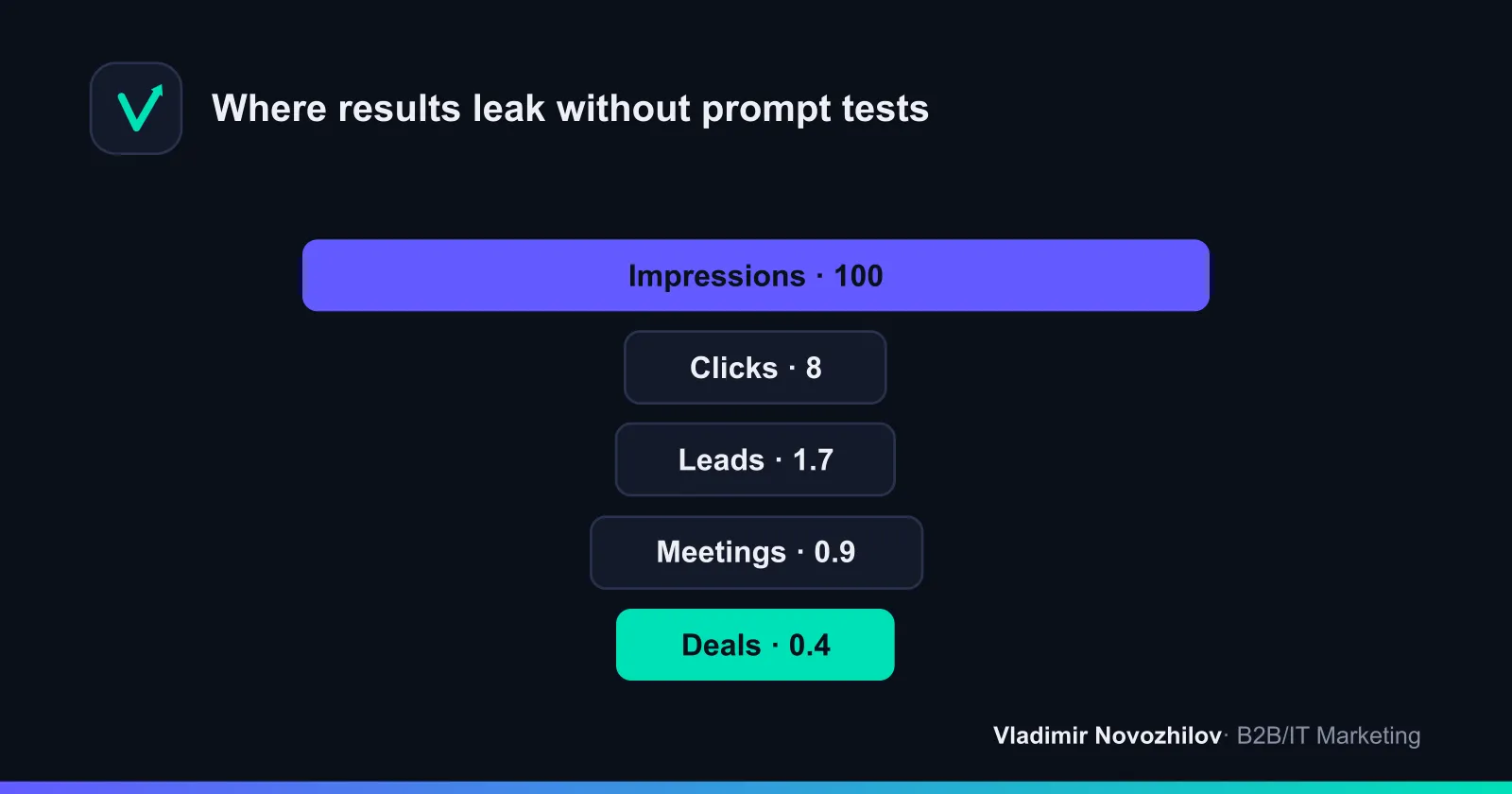
Funnel before prompt optimization:
Common testing mistakes and how to avoid them:
- Peeking and premature stopping. Fix: lock horizon and confidence level.
- Mixing segments. Fix: keep audience and timing identical.
- Evaluating by a proxy metric. Fix: look at CVR/CPA, not only CTR.
- Poor formalization of the “working” prompt. Fix: save exact prompt text, system role and model params.
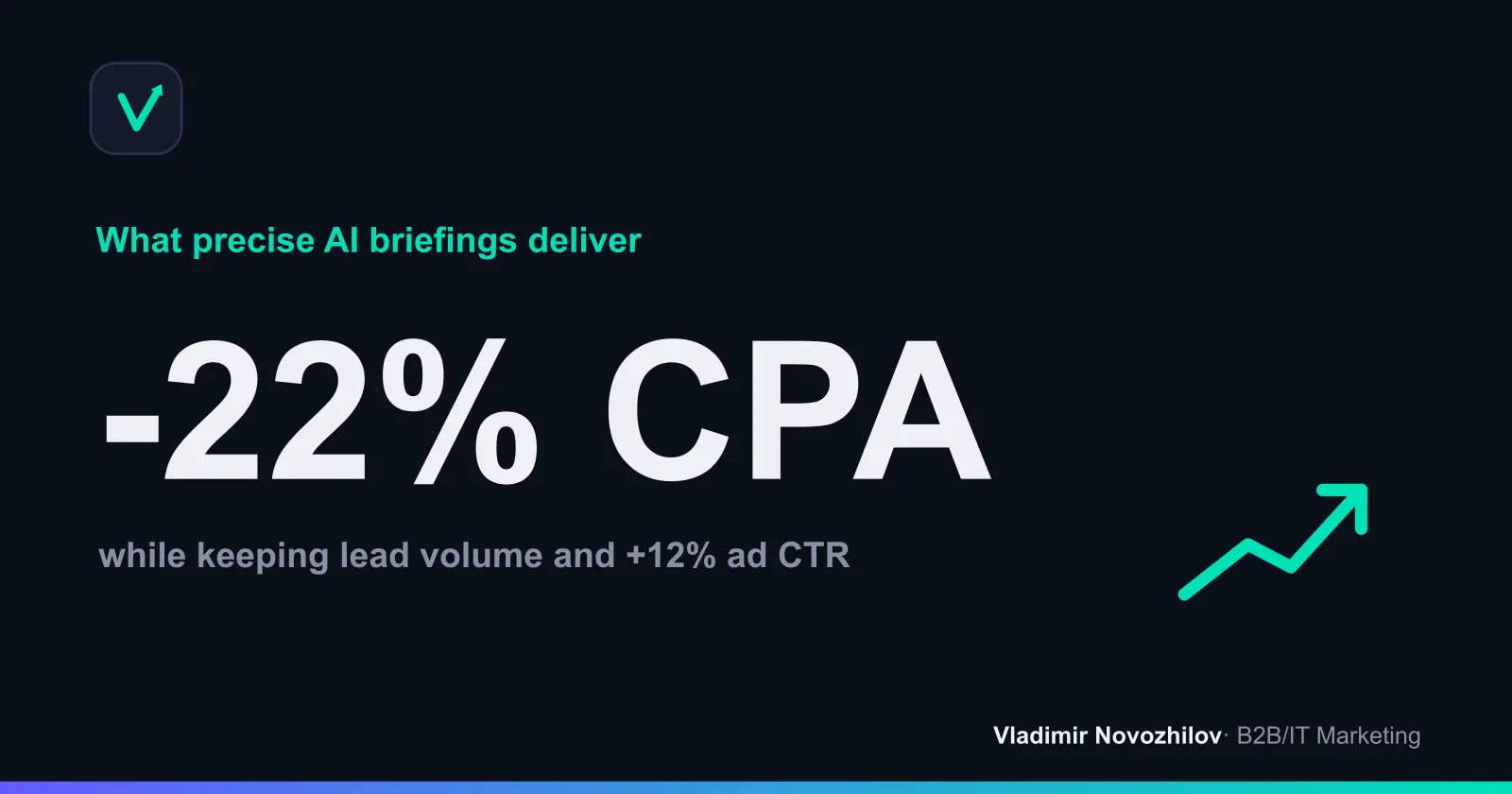
It helps to store before/after in one place. Average observed effect when switching to formalized prompts:
Model selection and settings for the Russian market
Short: choose the model by task, language and compliance needs.
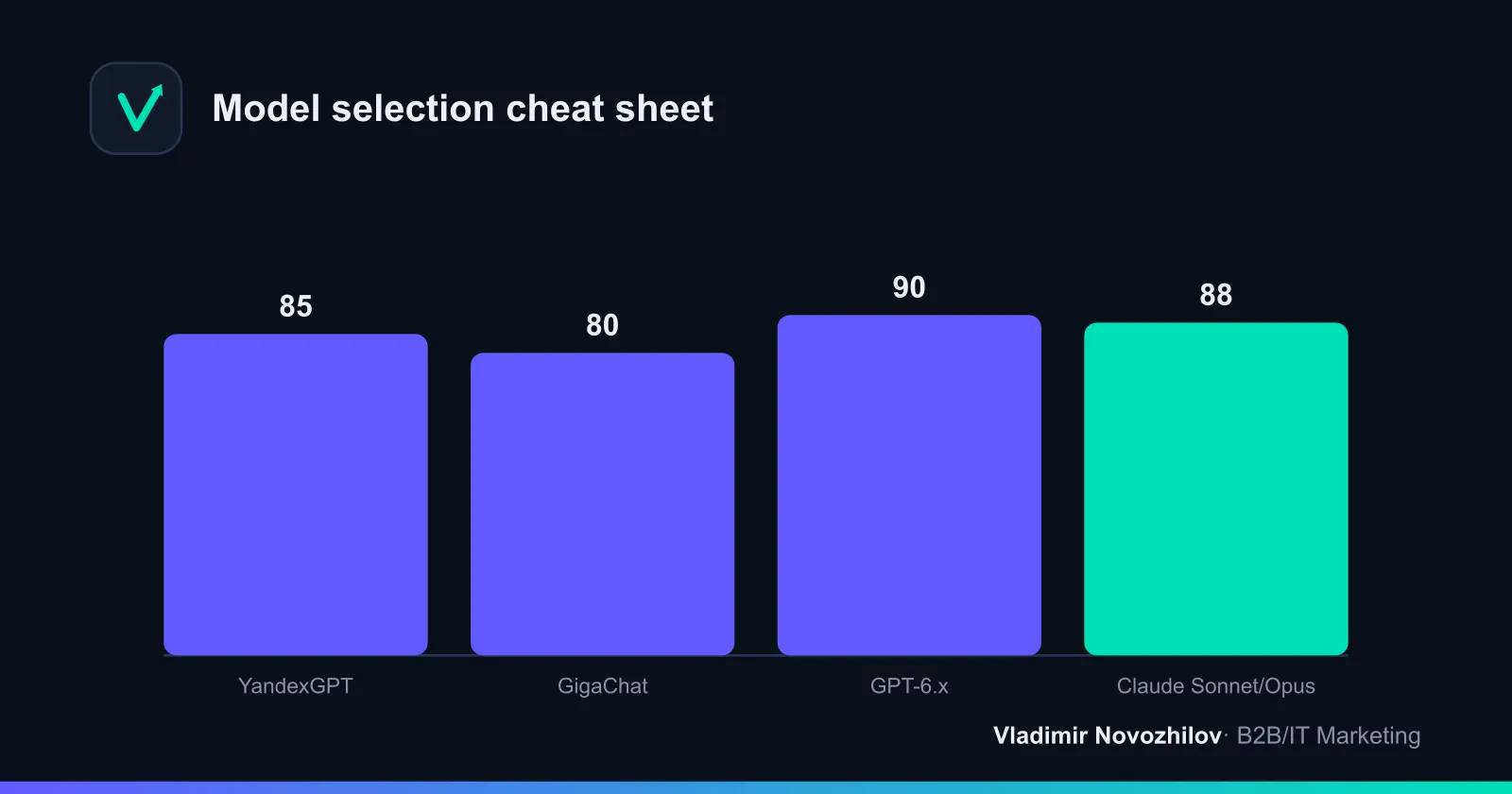
Comparison (as of 2026):
| Task/criterion | YandexGPT | GigaChat | GPT‑6.x | Claude Sonnet/Opus |
|---|---|---|---|---|
| Russian copywriting | Strong, natural tone | Good, sometimes terse | Excellent, but pricier | Excellent, softer style |
| Structural analytics | Good | Good | Very strong | Very strong |
| Compliance/localization | Easier with PD in RF | Easier with PD in RF | Transmission needs review | Transmission needs review |
| Cost/speed | Competitive in RF | Competitive in RF | Depends on pricing | Depends on pricing |
| Where to apply | SMM, copy, local tasks | Email, copy, dialogues | Research, strategy | Research, longform copy |
Default settings:
- Creative: temperature 0.6–0.8, top_p 0.8–0.9.
- Analytics/tables/SQL: temperature 0.1–0.3, strict formatting.
- Editing/styles: temperature 0.2–0.4, forbid “making up” facts.
When a local model or private perimeter is mandatory:
- If you have PD, commercial secrets, contractual limits, government contracts, or internal security policies.
- Solution: YandexGPT/GigaChat in a private contour or on‑prem LLM; or a pre‑saver with entity masking.
Security and compliance: what not to send to public models
By law and corporate policy you must not send the following to public LLMs:
- PD: full names, phone numbers, emails, addresses, job titles, identifiers.
- Commercial secrets: contract amounts, margins, unannounced features/prices.
- Sensitive data: medical, biometric, political views, etc.
Safe prompt pattern (example):
You are a funnel analyst.
Context: [SECTOR]=distribution; [SIZE]=100–200 employees; Audience — ROP/CEO.
Task: generate 10 hypotheses to grow CVR at the "lead → meeting" stage.
Format: table [Hypothesis | Why | How to test | Risk | KPI].
Constraints: do not use PD; numbers replaced with tags [$CPA], [$CR].
Data (obfuscated): CTR=[$CTR], CVR=[$CR], CPA=[$CPA].
How to de‑identify:
- Mask: Ivan Petrov → [CLIENT_A]; 8 530 rub. → [$AMOUNT_A]; Moscow → [CITY_A].
- Aggregate: send summarized tables instead of raw logs.
- Separate secrets: do not send strategic documents to the cloud at all.
Security checklist before running a prompt:
- No PD or commercial secrets in text/data.
- Clear context and goal, fixed model and params.
- Output format regulated, data obfuscated.
- Quality criteria and KPI of the test defined.
Common mistakes and how to avoid them
- No role and context. Fix: start with “You are…”, define audience and JTBD.
- Vague task. Fix: one action per prompt; split complex tasks.
- Empty format. Fix: require a table/structure, specify length and fields.
- Missing constraints. Fix: ban fabrication, set style/tone, “no links”.
- Testing by proxy metrics. Fix: lock KPI, focus on CVR/CPA, CAC/LTV.
- Sending PD to the cloud. Fix: local models, pre‑saver, obfuscation.
Implementation checklist for the leader (CMO): stages, resources, ROI
Stages:
- Diagnosis. Where AI is useful: content, SMM, performance, CRM, analytics.
- Data policy. What can/cannot be sent. Local/private models for PD.
- Prompt library. Create a single repository (like the prompt‑book above) with versioning.
- Pilots. 2–3 directions, fixed KPIs (CTR, CPA, delivery speed).
- Team training. Prompt formula, quality criteria, before/after.
- A/B procedures. Unified counting rules, reporting, test calendar.
- Scaling. Approve working templates as standards.
Resources:
- Process owner (marketing operations), quality editor, data analyst.
- 2–4 hours/week to maintain the library and run retros.
ROI (example):
- Content production saving: −30% time × team rate.
- Ad efficiency growth: −15–25% CPA at same volume.
- Model costs: track budget per 1000 tokens and share of local solutions.
Quick before/after summary by category
Content:
- Before: “Write an article about CRM.”
- After: “Role: B2B editor, informational intent, H2/H3 structure, criteria table, 1800–2200 words, DoD.”
SMM:
- Before: “Create a Telegram post.”
- After: “SMM editor, PAS structure, length, 3 hooks, CTA, ER/CTR metric.”
Ads:
- Before: “Need texts.”
- After: “Contextual editor, 3 mechanics, BOFU, table, KPI CTR/CVR.”
Email:
- Before: “Write an email.”
- After: “5‑email welcome sequence, A/B subjects, preheaders, CTA, Open/CTR/CR.”
Analytics:
- Before: “Review competitors.”
- After: “Table of positions, gaps, ICE ideas, links to observed elements.”
Frequently asked questions (FAQ)
— duplicated in the structured FAQ block at the page bottom; here is a short version.
- What to include in a prompt? Role, context, task, format, constraints, data, criteria and KPI.
- How to test? A/B on a business metric, 95% confidence, fixed horizon, stopping rule.
- Which models for Russian? Copywriting — YandexGPT/GigaChat; analytics — GPT‑6.x/Claude; PD — local models.
- PD to cloud? Not allowed; mask or use private perimeter.
- Channel adaptation? Keep context, change role/format (Telegram/landing/email).
—
Short reminder: prompts are a manageable process. Fix the formula, test on KPI, follow compliance — and AI will become your “fast second in command”, saving time and lowering CPA without losing quality.
FAQ
- What should I always include in a working prompt for a marketer?
- Minimum: model role, context (market, audience, JTBD), a clear task, response format, constraints/quality criteria, source data and a success metric. Example: "You are a B2B editor. Context: service X, audience — CIOs. Task: draft a longread for informational SEO intent. Format: outline + 1500–1800 word text, CTA. Constraints: no fabricated facts, do not insert links. Criteria: readability, uniqueness, tone fit, 3 USPs."
- How do you test and measure prompt effectiveness?
- Use A/B testing at the outcome level: for posts — CTR/ER, for lead gen — CR and CPA, for emails — Open Rate/CTR, for ads — CTR→CVR→CPA. Keep a 95% confidence level, document the hypothesis in advance, avoid peeking. Minimal duration — a full funnel cycle. Define the decision rule before start (for example, −15% CPA with unchanged lead volume).
- Which models are better for the Russian market and when is a local solution necessary?
- As of 2026: for copywriting and dialogues in Russian — YandexGPT and GigaChat are strong and convenient for compliance. For complex structure/analytics — GPT‑6.x and Claude Sonnet/Opus. If you have personal data/commercial secrets — use local models or a private perimeter, or obfuscate data via a pre‑saver.
- Can I send client/personal data to public LLMs?
- No. Personal data and confidential commercial information must not be uploaded to public cloud LLMs per legislation and internal company policy. Use a local LLM or a pre‑saver with masking: replace names/phones/amounts with tags like [CLIENT], [PHONE], [$AMOUNT].
- How to adapt one prompt for different channels (Telegram, landing page, email)?
- Keep the same context and objective, change the role and format: "You are a Telegram SMM editor…" → short post + 3 hooks; "You are a landing copywriter…" → H1+sub+benefit blocks; "You are an email editor…" → subject+preheader+body+CTA. Specify length, tone and acceptance criteria (for example, no emojis for B2B).