Target Audience Segmentation: Criteria and Methods


TL;DR
Target audience segmentation means dividing the market into customer groups with shared traits and needs. This article covers segmentation criteria (demographic, geographic, behavioral, psychographic), compares methods (Kotler, 5W, Hunt's ladder, JTBD, RFM, LTV), and provides a step-by-step checklist with a segment persona template.
Target audience segmentation is the process of dividing a market into groups of customers who share similar needs, behavior, or characteristics and respond to an offer in similar ways. Without it, marketing speaks to everyone the same way — which means it speaks to no one in particular. A segmented audience lets you address each group’s specific pain points, fine-tune targeting, and spend ad budget with greater return. Below are segmentation criteria, a comparison of methods (Kotler, 5W, Hunt, JTBD, RFM, LTV), a step-by-step checklist, a persona template, and examples for B2B and B2C.
What target audience segmentation is and why business needs it
A segment is a group of people or companies that share a common set of traits and respond to marketing in a similar way. Target audience segmentation turns an abstract “our audience” into a set of concrete groups, each of which can be addressed with its own message.
Why business needs audience segmentation:
- Higher conversion. A personalized offer targeting a segment’s pain point outperforms a generic one.
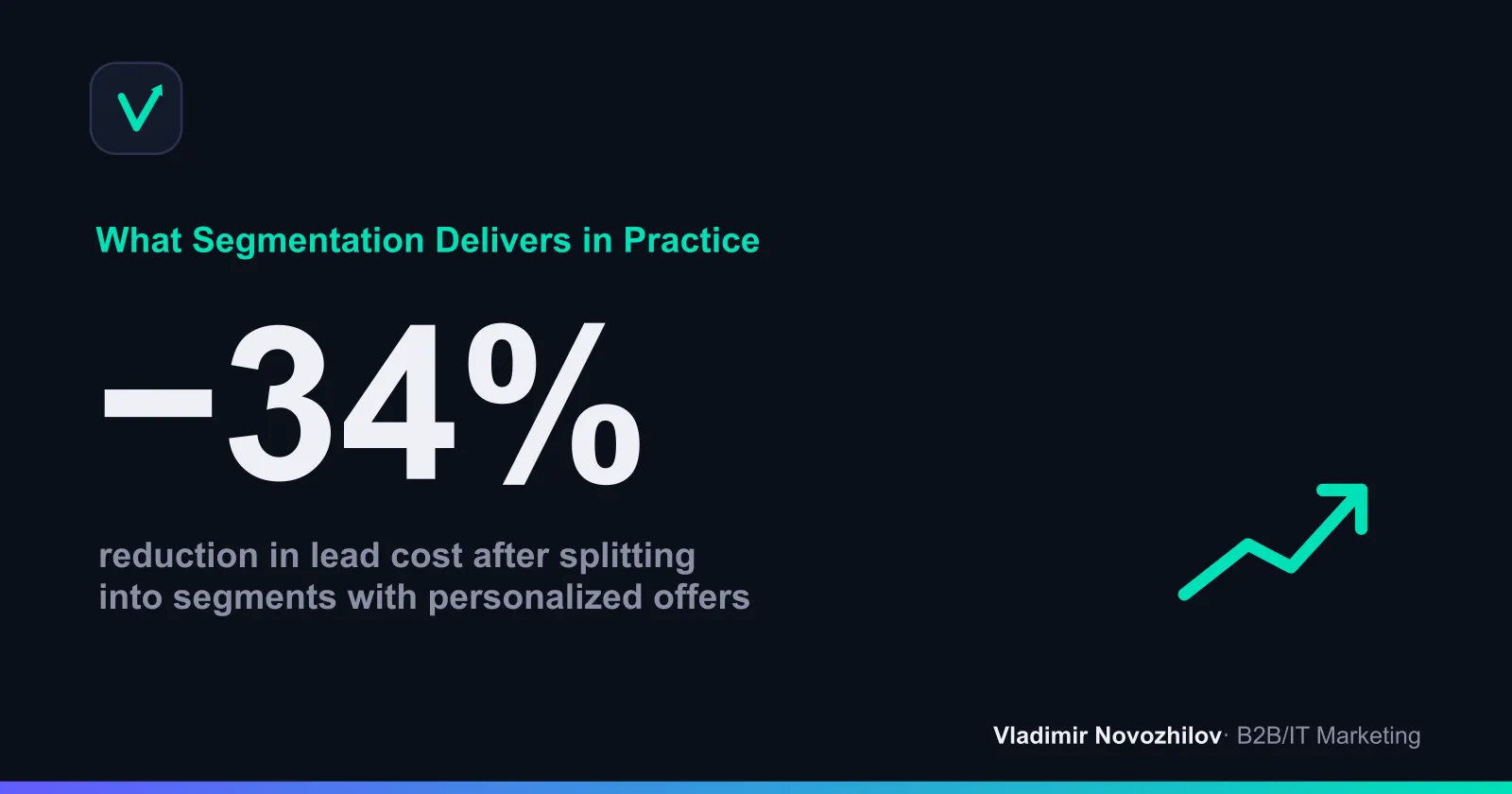
- Cheaper acquisition. Precise targeting lowers the cost per lead and per click.
- Clearer product direction. You can see who and what to improve first.
- Sales prioritization. Resources go to the most profitable target audience segments.
How audience segmentation differs from defining the target audience
These are two different steps. Defining the target audience answers the question “who is our customer in general” — it outlines the boundaries of the market. Customer segmentation goes further: within those boundaries, it identifies distinct groups with different motives and behaviors.
Example: the target audience definition for an online English school is “adults aged 25–45 who want to speak fluently.” Segments within it: “preparing to relocate,” “need English for work,” “learning for travel.” The product is the same, but the messages and channels differ.
Segmentation criteria: which traits to use for dividing an audience
Segmentation criteria are the bases on which you group people. Classically, there are five categories of traits.
- Demographic traits. Gender, age, marital status, education, occupation. The most basic and accessible layer of data.
- Geographic traits. Country, region, city, climate, population density. Geographic segmentation is especially important for offline services and logistics.
- Socioeconomic traits. Income, job title, purchasing power — these define the price segment.
- Behavioral traits. Purchase frequency and volume, loyalty, readiness stage, response to discounts, contact channels. Often the strongest predictor.
- Psychographic traits. Values, lifestyle, interests, motives, fears. These explain “why,” not just “who.”
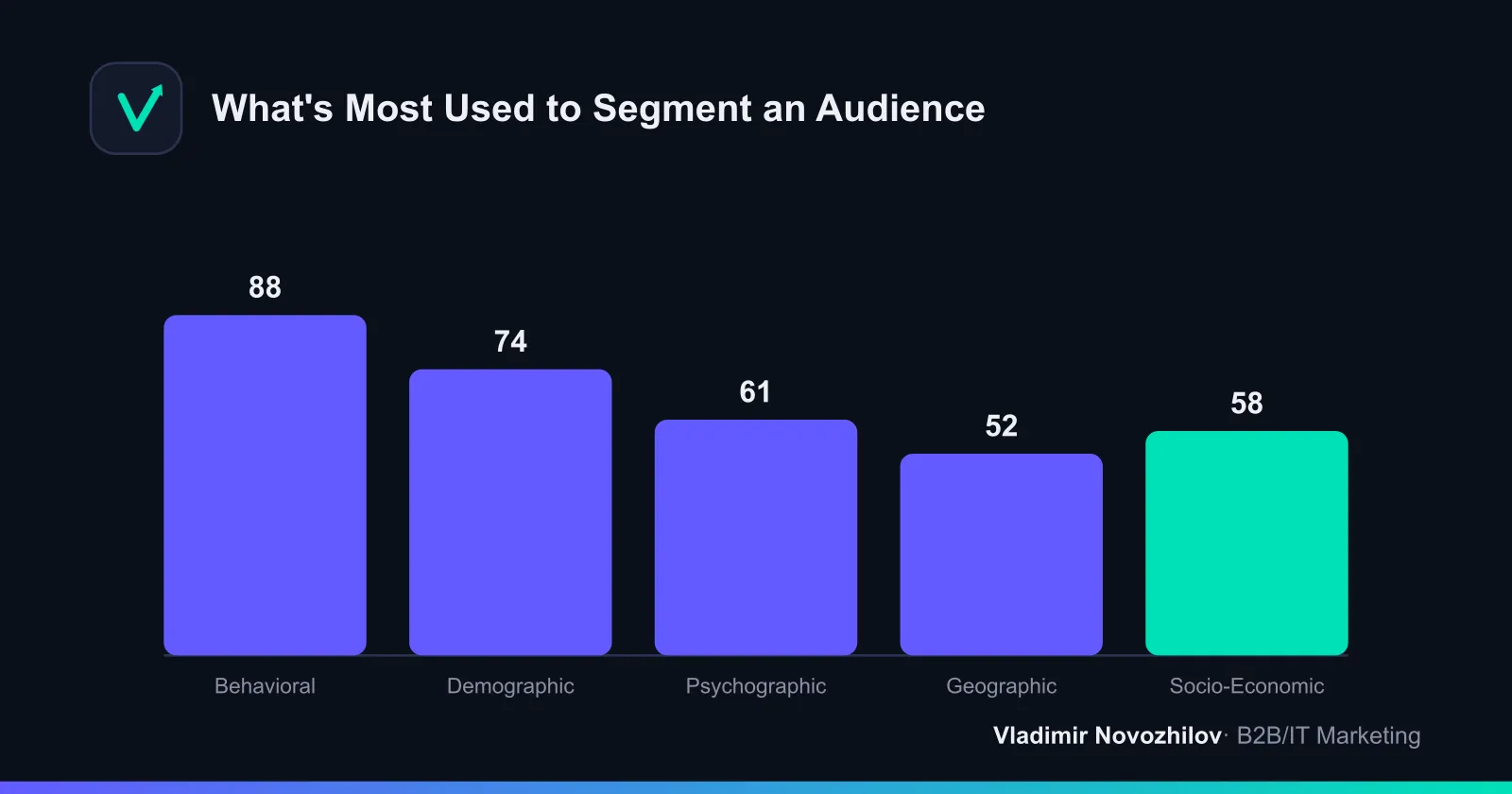
Table of segmentation criteria by trait type
| Trait type | What to consider | Where to get data | Best suited for |
|---|---|---|---|
| Demographic | Gender, age, occupation | Surveys, analytics, CRM | Basic targeting |
| Geographic | Region, city, climate | Web analytics, delivery data | Local offers |
| Socioeconomic | Income, job title | Questionnaires, indirect data | Pricing |
| Behavioral | Purchases, activity | CRM, web analytics | Demand forecasting |
| Psychographic | Values, motives | Interviews, JTBD | Messaging and creative |
Target audience segmentation methods: overview and comparison
Segmentation methods are ready-made frameworks that help you break down an audience into groups systematically. Let’s go through six practical ones and summarize them in a single table.
Kotler’s method
A classic model: the audience is divided at once across four groups of traits — geographic, demographic, psychographic, and behavioral. A universal foundation, worth starting with if you’re structuring market segmentation from scratch.
Sherrington’s 5W method
The 5W method is five questions, each of which shapes a slice of the audience: What (what you’re selling), Who (who buys it), Why (motivation), When (timing), Where (location). At the intersection of the answers, clear segments emerge. The best starting point for small businesses — fast and with no budget required.
Hunt’s awareness ladder
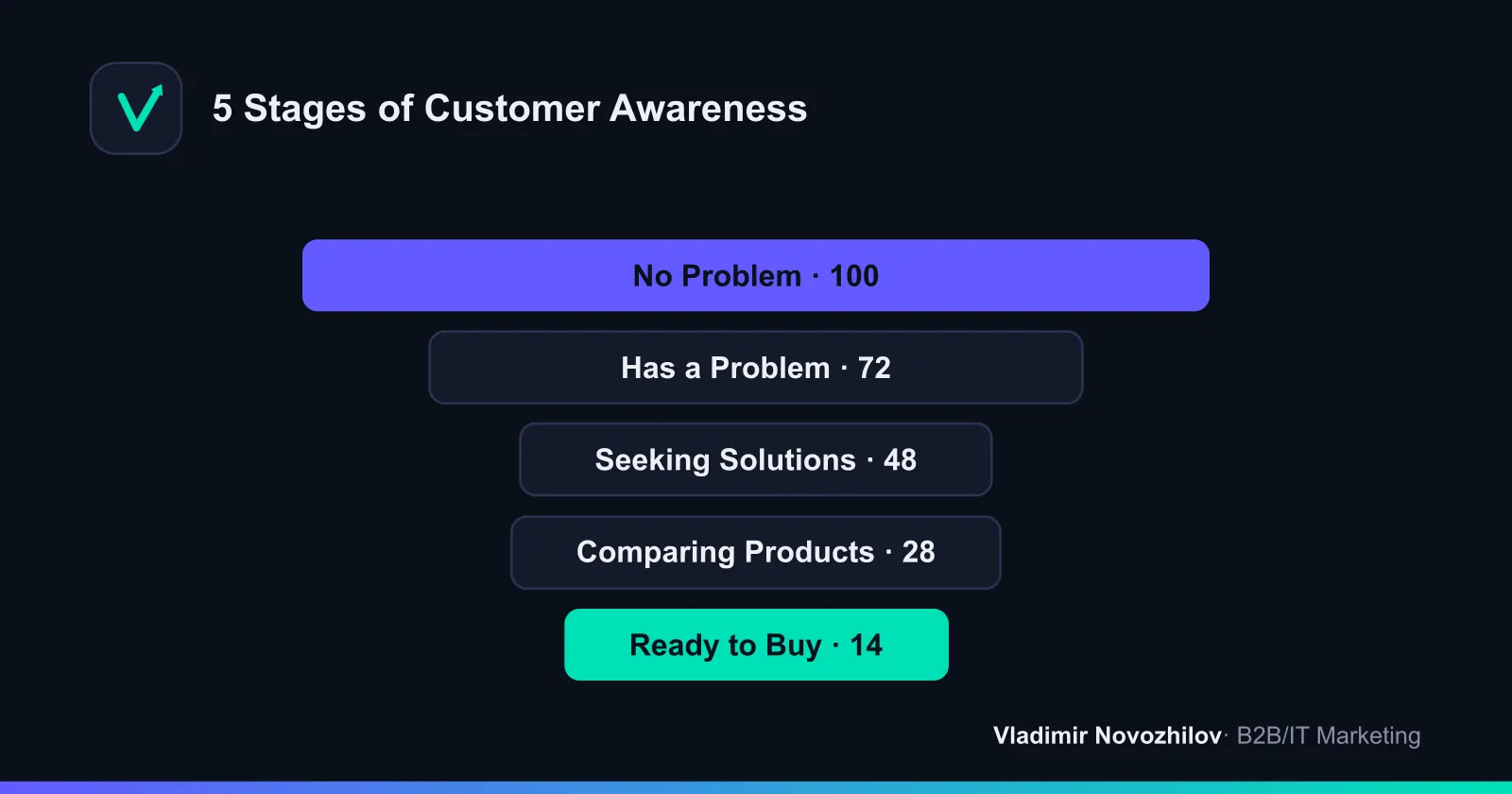
Hunt’s awareness ladder divides the audience by how aware they are of their problem and how ready they are to buy: from “no problem” to “ready to buy.” Each rung calls for its own content and offer: cold audiences need nurturing, hot ones need a direct offer.
JTBD (Jobs To Be Done)
JTBD segments not people but the “jobs” the customer hires a product to do. The formula: “when [situation], I want to [action], so that [outcome].” This method reveals true motives and complements psychographic traits well.
RFM and ABCDX analysis
RFM analysis divides your current customer base by three parameters: Recency (time since last purchase), Frequency, and Monetary value. This lets you find loyal, dormant, and churning customers. ABCDX analysis ranks segments by profitability and ease of implementation — from ideal “A” segments to unpromising “X” ones.
The LTV evaluation method
LTV (customer lifetime value) shows how much profit a segment generates over its entire lifetime. Simple formula: LTV = average order value × number of purchases per year × customer lifespan. Segments with high LTV get budget priority.
Comparison table of segmentation methods
| Method | What it divides | Data required | When to use |
|---|---|---|---|
| Kotler | The market by 4 groups of traits | Analytics, surveys | Building a basic structure from scratch |
| 5W method | The audience by 5 questions | Hypotheses, surveys | Fast start, small business |
| Hunt’s ladder | By purchase readiness | Behavior, queries | Planning content and ads |
| JTBD | By “jobs” and motives | In-depth interviews | Product and messaging |
| RFM analysis | The current base by purchases | CRM | Retention, reactivation |
| LTV | Segments by profitability | CRM, financial data | Budget allocation |
B2B market segmentation: features and parameters
B2B market segmentation is built around the company and its buying committee, not a single person. Key parameters:
- Firmographics: industry, company size, revenue, headcount, region.
- Deal roles: decision-maker, user, economic buyer, influencer/expert.
- Maturity and needs: whether the company has its own team, tech stack, budget cycle.
There are fewer B2B decisions, but each is more expensive and made collectively, so target audience segments must be described both at the company level and by role within it. RFM and LTV in B2B are calculated based on invoices and contracts.
Target audience segmentation in B2C: how the approach differs
In B2C, the foundation is the demographic, geographic, behavioral, and psychographic traits of an individual buyer. The sales cycle is shorter, and decisions are more often emotional and individual. This is where the 5W method, Hunt’s ladder, and RFM analysis based on order history work especially well. B2B and B2C overlap on one point: in both cases, a segment must be measurable, reachable through advertising, and large enough to matter.
How to conduct target audience segmentation: a step-by-step checklist
- Collect data. CRM, web analytics, surveys, interviews, ad platforms.
- Choose segmentation criteria suited to your task — from demographic to psychographic traits.
- Apply a method (5W for a quick start, RFM for an existing base, JTBD for uncovering motives).
- Identify 3–7 segments and describe each one.
- Evaluate the segments by size, reach, and profitability (ABCDX, LTV).
- Craft an offer and channel for each priority segment.
- Run a test and compare conversion rates across segments.
- Revisit the segmentation every 6–12 months.
How to build a target audience segment persona (with an example)
A target audience persona is a detailed description of a typical representative of a segment: who they are, what drives them, and how and why they buy. Use the template table below.
| Persona field | Example (Excel online courses) |
|---|---|
| Segment name | ”Career-focused specialist” |
| Demographic traits | Male/female, 26–35 years old, analyst |
| Geographic traits | Major cities, remote work |
| Behavioral traits | Searches for courses in the evening, compares 3–4 schools |
| Psychographic traits | Values career growth, afraid of falling behind colleagues |
| JTBD | ”When I’m swamped with reports, I want to master formulas so I can keep up and qualify for a promotion” |
| Hunt’s stage | Comparing products |
| Offer | A 4-week workshop with practice on real work tasks |
This template should be filled out for each priority segment — it immediately suggests the right message and channel.
Tools and data sources for customer segmentation
- CRM — deal history, RFM, LTV, B2B roles.
- Web analytics — traffic sources, behavior, on-site action-based segments.
- Surveys and quizzes — quick data on motives and objections.
- In-depth interviews — material for JTBD and psychographics.
- Ad platforms — ready-made audience slices for targeting.
This toolkit is enough to describe customer segments and test hypotheses without expensive research.
Common mistakes in audience segmentation
- Segments that are too small. Dozens of groups too tiny to reach with advertising.
- “Eyeballed” segments. Dividing an audience without CRM or web analytics data.
- Relying only on demographic traits. Age and gender don’t explain purchase motives.
- Segmentation for its own sake. Groups exist, but there are no distinct offers for them.
- A one-time exercise. Segmentation isn’t updated and becomes outdated.
- Ignoring profitability. Resources flow to a large but unprofitable segment.
Segmentation examples across different business niches
Dental clinic (B2C, services). Using Hunt’s ladder, the clinic separated “acute pain — need urgent care” from “planning an implant.” The first group got fast appointments and a phone number in the ad; the second got a nurturing article and an installment plan. Cost per lead for the urgent segment dropped noticeably.
IT integrator (B2B). B2B market segmentation by industry and company size produced separate offers for retail and manufacturing, and separate ones for enterprise and SMB clients. This shortened the sales cycle thanks to relevant case studies presented at first contact.
Online cosmetics store (B2C). RFM analysis identified “dormant” buyers and VIP customers. Dormant customers received a reactivation email with a discount; VIPs got early access to new arrivals. Repeat purchases grew without increasing ad spend.
How often to revisit segmentation
The baseline rhythm is every 6–12 months, plus whenever you launch a product, enter a new market, or see a sharp shift in demand. Update behavioral segments in your CRM (RFM) more often — monthly or quarterly — since purchase recency and frequency change dynamically. Regular review keeps your target audience segments relevant and your marketing precise.
FAQ
- How is target audience segmentation different from defining the target audience?
- Defining the target audience answers the question "who are our customers overall," while target audience segmentation divides that mass into groups with shared traits and needs. You first outline the boundaries of the market, then identify segments within it so you can address each with its own offer and lower acquisition costs.
- Which segmentation method should a small business choose?
- For a start, Sherrington's 5W method works well: five questions (what, who, why, when, where) produce workable segments in a couple of hours with no budget. Once you've accumulated purchase data, add RFM analysis based on your CRM. This combination covers 80% of small business needs without complex analytics.
- How many target audience segments is optimal to identify?
- In practice, 3–7 priority segments are enough. Fewer than three and segmentation loses its purpose; more than seven and resources and creative get spread too thin. Start with 3–5 large groups, each of which you can describe with a distinct message and evaluate for size and profitability.
- How often should audience segmentation be updated?
- As a baseline, revisit segmentation every 6–12 months, as well as when launching a new product, entering a new market, or seeing sharp demand shifts. Behavioral segments in your CRM (RFM) should be updated more often — monthly or quarterly — since purchase recency and frequency change quickly.
- How does B2B segmentation differ from B2C?
- B2B market segmentation relies on company-level parameters (industry, size, revenue, region) and on roles within the buying committee — decision-maker, user, budget holder. In B2C, the foundation is the demographic, geographic, behavioral, and psychographic traits of an individual person. B2B deals are fewer but each is more expensive and decided collectively.
- What tools can be used to collect data without large costs?
- A starter kit: web analytics (segments by source and behavior), a CRM for RFM and deal history, on-site surveys and quizzes, JTBD-style customer interviews, and ad platform data. This is enough to describe target audience segments and test hypotheses without paid research.