Working Content Strategy: Step-by-Step Guide and Examples


TL;DR
A content strategy links business goals, audience needs and channels over a 6–12 month horizon. Unlike a content plan (a publication calendar) or content marketing (the discipline), strategy answers "why", "for whom" and "about what". Below are 8 consecutive steps with tables, examples and a ready checklist to assemble a working system.
Long‑term content strategy connects business goals, audience needs and chosen channels. Essentially it answers three questions: why, for whom, and about what. Everything else—formats, topics, schedule—is a consequence. This article explains how a strategy is structured, how it differs from a content plan and content marketing, and most importantly how to build a working system step by step—with examples, tables and a ready checklist.
I’ve been in B2B, IT and services for over 15 years and repeatedly see the same pattern: companies “start a blog” or “move to Telegram” without a strategy—and six months later everything collapses because they don’t understand where it’s heading. Strategy removes chaos and turns content into a manageable asset.
Why the business needs a content strategy and how it works
Precisely speaking, a content strategy (content strategy) is a system of decisions on what content, for which audience, in which channels and with what goals a company will create over a 6–12 month horizon. It’s not a list of posts; it’s the framework inside which all tactical decisions are made.
Why the business needs a documented content strategy:
- Clear objectives. Content stops being “for presence” and starts working toward KPIs: traffic, leads, lower acquisition cost.
- Rational spending. Budget doesn’t leak into formats and channels that don’t deliver results.
- Predictability. You get a manageable system that can be scaled and handed over to a team.
- Cumulative effect. SEO articles, case studies and knowledge bases work for months and years, reducing dependence on paid ads.
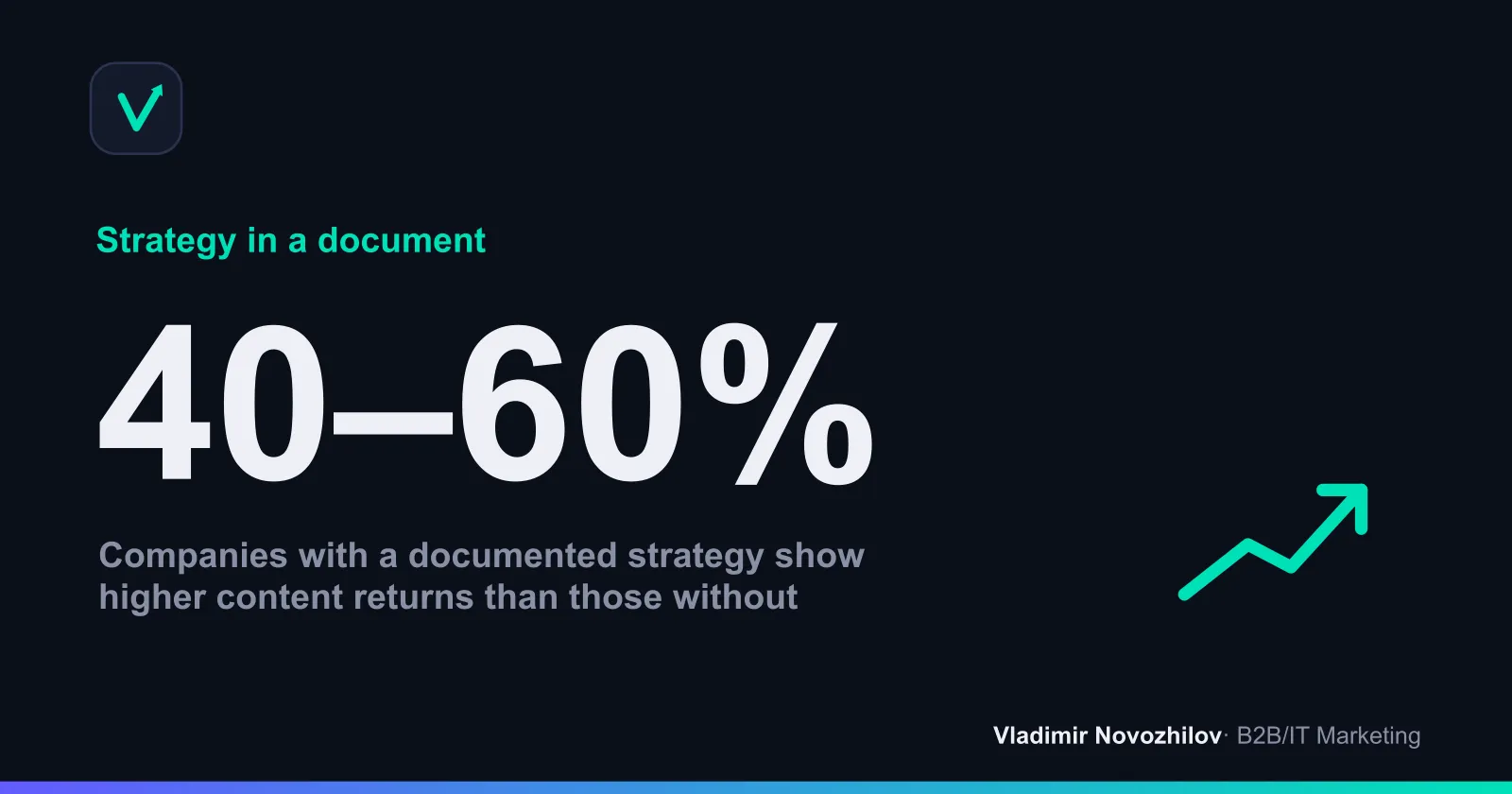
Industry surveys show companies with a documented strategy consistently get more return from content than those acting at random.
How to distinguish strategy, plan and content marketing
These terms are often mixed, though they are different levels.
- Content marketing — the discipline and process: attracting and retaining an audience with useful content instead of direct advertising.
- Content strategy — the document and decision system within content marketing: goals, audience, pillars, channels, metrics.
- Content plan — the tactical calendar: specific publications with dates, formats and owners.
To settle the argument, here’s a compact table.
| Критерий | Контент-маркетинг | Контент-стратегия | Контент-план |
|---|---|---|---|
| Уровень | Дисциплина, подход | Стратегический документ | Тактический инструмент |
| Ключевой вопрос | Как привлекать клиентов контентом | Зачем, для кого и о чём | Что и когда публиковать |
| Горизонт | Постоянно | 6–12 месяцев | 1 месяц / квартал |
| Содержание | Все активности с контентом | Цели, ЦА, пиллары, каналы, KPI | Темы, форматы, даты, авторы |
| Кто владеет | Маркетинг целиком | Стратег / руководитель | Редактор / контент-менеджер |
| Пример | «Мы растём через блог и вебинары» | «Блог для SEO + LinkedIn для экспертности, цель — 40 лидов/мес» | «12 марта — статья про CAC, автор Иванов» |
It’s also important to separate SEO and content marketing: SEO makes content discoverable in search (semantics, optimization), while content marketing ensures the found material solves the reader’s problem and leads to business outcomes. In a strong strategy they work together.
Types of content strategy in practice
There’s no single classification, but it’s practical to look at the goal and funnel “depth.” Below is a working typology.
By goal:
- SEO‑oriented. Focus on organic search traffic and AI search. Core—articles and knowledge base tailored to audience queries.
- Reputation‑expert. Increase trust and recognition: case studies, expert columns, speaking engagements.
- Lead‑generation. Content aimed at collecting applications: lead magnets, webinars, comparisons, calculators.
- Community approach. Retention and engagement; more common in social networks and messengers.
By funnel “depth” (simplified model used by agencies):
- “Direct to cart” — short path and selling content for products with quick decisions.
- “First understand” — complex product needing educational content.
- “Fall in love with the brand” — image strategy for competitive markets.
- “Keep them close” — content for retention and repeat sales.
Most companies combine 2–3 types. A typical B2B case is a combo of an SEO blog (traffic) and expert posts on social networks (trust and leads).
Content types: informational to UGC
To keep a strategy balanced, distinguish content types and map them to the funnel.
- Informational — educates and answers questions: guides, how‑tos, analyses. Top and middle funnel.
- Selling — shows the product in action: demos, comparisons, case studies with numbers. Bottom funnel.
- Image/brand — shapes brand perception: values, culture, expert manifestos.
- Entertaining — boosts reach and engagement, eases brand dryness.
- UGC (user‑generated content) — reviews, client mentions; social proof.
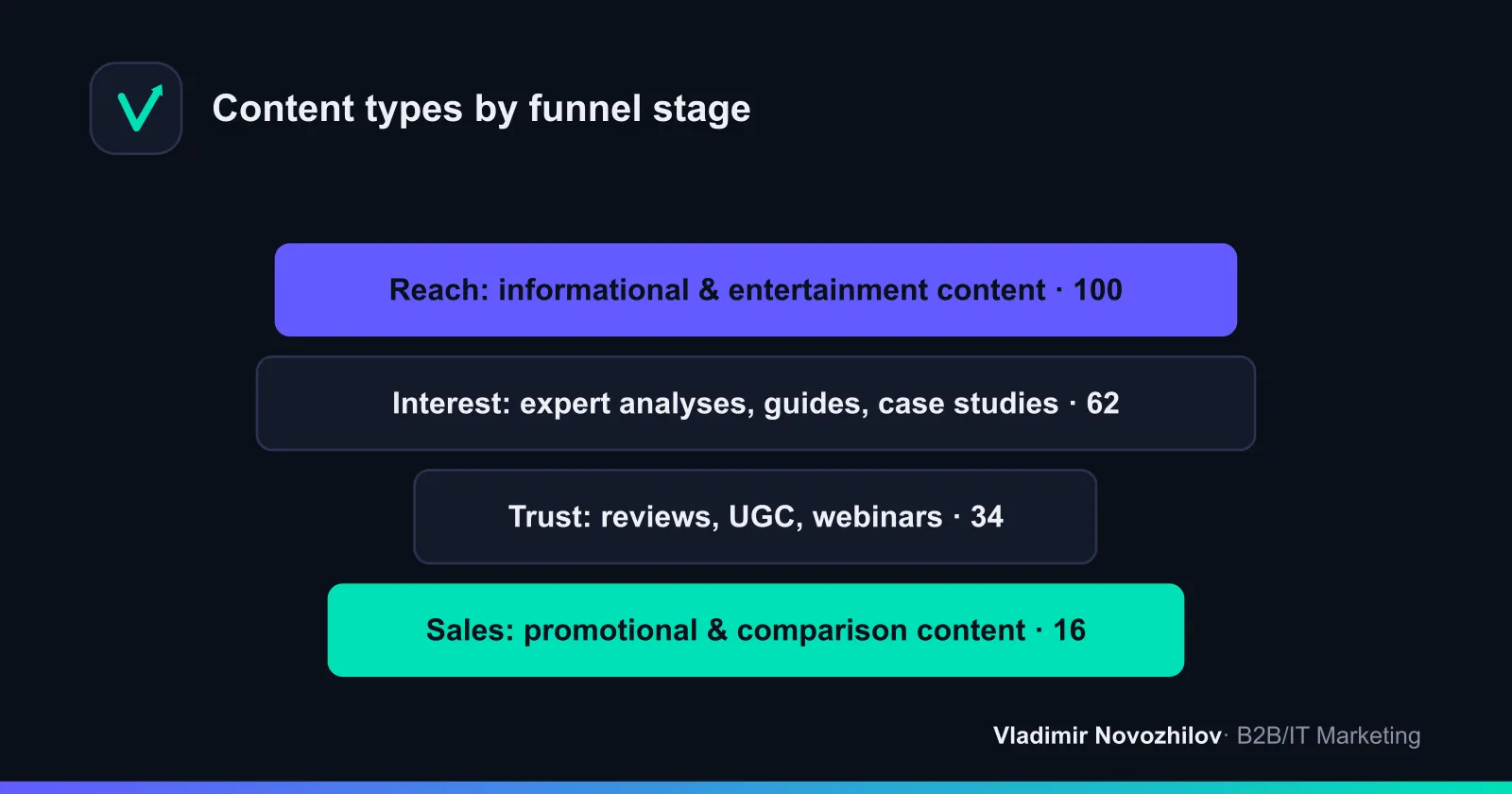
The golden balance rule—don’t overdo selling. In most niches a working mix is roughly 60% value, 20% engagement/brand, 20% sales.
Formats: text, video, audio, graphics, interactive
One content idea can be packaged in different formats—the choice depends on channel and audience habits.
| Формат | Примеры | Когда работает лучше всего |
|---|---|---|
| Текстовый | Статьи, лонгриды, посты, рассылки | SEO, база знаний, экспертность |
| Видео | Обзоры, вебинары, короткие ролики, кружочки | Демонстрация, охваты, доверие |
| Аудио | Подкасты, аудиосообщения | Лояльная аудитория, «фоновое» потребление |
| Графический | Инфографика, карточки, схемы | Сложные данные, соцсети |
| Интерактив | Опросы, викторины, калькуляторы, тесты | Вовлечение, сбор данных о ЦА |
In B2B, longreads and case studies work steadily for SEO, cards and breakdowns for social media, webinars for leads. In services—short before/after videos and client testimonials.
What a content strategy document includes
Before the steps, fix the document structure. A good content strategy template includes mandatory blocks:
- Business goals and content goals + KPIs.
- Target audience personas and their pains.
- Core message and tone of voice.
- Content pillars — 3–5 major themes.
- Distribution channels and their roles.
- Formats and content types.
- Resources: team and content budget.
- Metrics and evaluation regulations.
- Editorial policy and publication rules.
This document is the single source of truth for the team. Next—how to assemble it.
Step by step: how to assemble a content strategy
Below is a practical 8‑step algorithm. These are the main stages: from goals to analytics. Each step is self‑contained—move through them in order.
Step 1. Set goals and KPIs
Start with business goals, not “we need a blog.” Link content to economics: more applications, lower CAC, faster deals, higher LTV. Then convert that into measurable KPIs.
SMART examples:
- Increase organic blog traffic from 5,000 to 15,000 visits per month in 9 months.
- Generate 40 qualified content leads per month by year‑end.
- Reduce the share of paid traffic in leads from 80% to 50%.
Assign a metric and a target value to each goal. Otherwise you can’t evaluate the strategy.
Step 2. Audience analysis
Next—the target audience. Describe 2–3 key segments: who makes decisions, their pains and objections, the language they use, and where they consume content.
Sources: client and sales interviews, search queries, comments, support chats, analytics. For each segment collect a mini‑persona:
- role and context (e.g., head of department in a mid‑market company);
- tasks and pains;
- purchase triggers and barriers;
- preferred channels and formats.
Also fix tone of voice—how the brand speaks to the audience: expert and dry, friendly and simple, bold and informal. A unified tone makes content recognizable.
Step 3. Competitor analysis
Study what competitors and niche leaders publish and how. The goal is not to copy but to find gaps you can fill better.
What to look at:
- topics and formats that give them traffic and engagement;
- active channels;
- frequency and quality of publications;
- queries where they rank in top (semantics);
- what they don’t cover—your growth opportunities.
A simple table “competitor — strong topics — weak spots — our opportunity” saves weeks.
Step 4. Choose distribution channels
Content without distribution doesn’t work. Channels fall into three groups:
- Owned — blog, website, email, knowledge base. Full control.
- Guest/partner — social networks, messengers, external platforms, media, guest posts.
- Paid — seeding, ads to amplify top materials.
Don’t pick “everything at once.” Choose 2–3 platforms where your audience actually lives. Assign each social channel a role: one for expertise and leads, another for reach and awareness. Adapt the same material to the platform instead of duplicating it.
Step 5. Budget and team formation
Assess resources honestly—otherwise the strategy stays on paper. Determine who produces content (in‑house, freelance, hybrid) and calculate the budget.
A simple formula and example calculation:
Monthly budget = (content volume × unit cost) + distribution + tools.
| Статья расходов | Пример (в месяц) |
|---|---|
| 4 SEO-статьи × 8 000 ₽ | 32 000 ₽ |
| 12 постов в соцсети × 2 000 ₽ | 24 000 ₽ |
| Дизайн и графика | 15 000 ₽ |
| Продвижение/посевы | 20 000 ₽ |
| Инструменты (аналитика, сервисы) | 9 000 ₽ |
| Итого | 100 000 ₽ |
Then compare budget with the goal: if the plan is 40 leads per month and the budget is 100 000 ₽, the target CAC for content is 2 500 ₽. Compare with CAC from other channels and LTV—you’ll see whether the model pays off.
Step 6. Create the content plan and rubricator
This is where strategy turns tactical. First gather content pillars—3–5 major themes around which all content is built. For each pillar sketch clusters of subtopics (a semantic core helps for SEO).
Next build a rubricator and a monthly/quarterly content plan. Minimal plan structure:
| Дата | Тема | Тип контента | Формат | Канал | Цель | Ответственный |
|---|---|---|---|---|---|---|
| 03.03 | Как считать CAC | Информационный | Статья | Блог | SEO-трафик | Редактор |
| 07.03 | Кейс: рост лидов ×2 | Продающий | Карточки | Соцсеть | Лиды | SMM |
| 14.03 | Отзыв клиента | UGC | Видео | Соцсеть | Доверие | SMM |
Also fix the editorial policy: presentation rules, stop‑topics, quality requirements, deadlines. This is your media plan in practice.
Step 7. Create, optimize and promote content
Production follows the plan but with two mandatory layers:
- SEO optimization. Each text targets relevant queries: headings, structure, completeness of answer. Consider both classic search and AI output.
- Distribution. One asset = multiple touchpoints: article → newsletter → series of posts → short video. This extracts maximum value from each content piece.
Before launch it’s useful to audit existing content: what to update, remove or repurpose. Often improving old assets delivers quick growth.
Step 8. Evaluate results and performance metrics
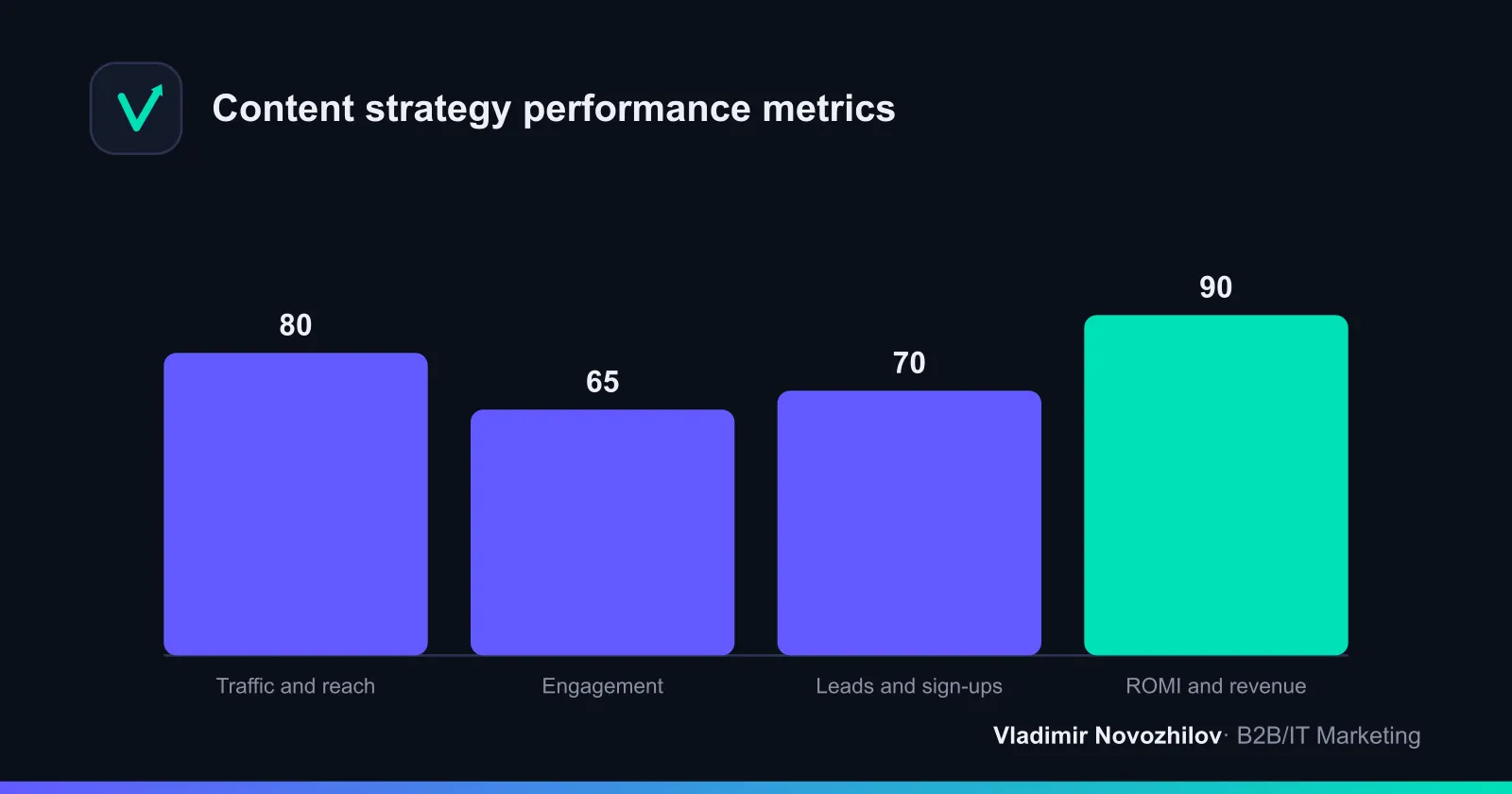
The final stage is analytics. Break metrics down by funnel levels so you don’t celebrate empty views.
- Top: reach, traffic, impressions, new users.
- Middle: engagement, read‑through, subscriptions, time on page.
- Bottom: leads, applications, sales, ROMI, content contribution to revenue.
Link content to economics: calculate CAC for organic and compare with LTV. Monthly reports and a quarterly review of topics and channels.
AI search and GEO: how to adapt the strategy
A common gap in many plans is optimization for AI search and generative answers (GEO). Neural models and AI outputs are increasingly the first brand touchpoint.
To appear in AI answers:
- give a clear definition of the term in the first lines of the relevant section;
- structure the material: headings, lists, tables;
- answer specific questions with direct formulations (FAQ blocks);
- provide numbers, criteria and examples—models cite factual content more often;
- cover the topic fully, not superficially.
GEO essentially reinforces an old rule: produce the most useful and structured material for a query.
Examples of working strategies
Three short benchmarks for different niches (generalized models, not endorsements).
Example 1. B2B, IT service. Goal—50 leads per month from content within a year. Types: SEO + expert. Channels: blog (query‑driven articles like “how to calculate metrics,” “solution comparisons”) and a professional social network (cases, breakdowns). Pillars: metrics, automation, client cases. Success metric—share of organic leads and their CAC. Typical result—organic traffic grows 2–3x in 6–9 months.
Example 2. Services (agency, consulting). Goal—trust and incoming inquiries. Type: reputation‑expert. Channels: blog + founder’s Telegram channel. Formats: case breakdowns with numbers, short videos, checklists. Core message—“we do measurable and transparent work.” This content shortens the sales cycle: the client arrives warmed up.
Example 3. E‑commerce. Goal—traffic and repeat purchases. Types: SEO + community. Channels: blog with product selection guides, social networks with UGC and compilations, email for retention. The mix leans toward value and inspiration; selling content is dosed. Metrics—traffic, cart conversion, LTV.
Overall conclusion: strategy starts with goals and audience; channels and formats derive from them.
Common mistakes when developing a strategy
Common pitfalls I regularly see:
- Starting with formats, not goals. “Let’s shoot reels” without answering “why” wastes money.
- Vague audience. “Our customer is everyone” means content resonates with no one.
- Ignoring distribution. Creating and not promoting is half the work wasted.
- Spreading across too many channels. Two excellent channels beat six mediocre ones.
- No metrics. Without KPIs you can’t tell if the strategy works.
- No tone or editorial policy. Content becomes inconsistent and loses recognizability.
- One‑off approach. Strategy is written and forgotten; review it quarterly.
- Bias toward sales. Constant offers burn the audience.
Checklist and strategy template
Below is a checklist you can transfer to a table or document and use as a content strategy template. Run through the items—if you have answers for everything, the document is ready.
Strategic block:
- Business goals and content goals formulated.
- Measurable KPIs set by funnel levels.
- 2–3 audience segments and their pains described.
- Core message and tone of voice defined.
- Competitor analysis conducted and growth opportunities identified.
Tactical block:
- 3–5 content pillars selected.
- Content types and formats mapped to the funnel.
- 2–3 distribution channels and their roles chosen.
- Content budget calculated and team assembled.
- Rubricator and quarterly content plan compiled.
- Editorial policy documented.
Operational block:
- Analytics and reporting set up.
- Evaluation cadence defined (month/quarter).
- Plan for auditing and updating content included.
- SEO and AI search optimization considered.
This checklist covers the mandatory parts of a strategy. Keep it handy during development and reviews.
In short
Content strategy is not a set of posts but a system that links business goals, audience and channels. It differs from a content plan (calendar) and content marketing (the discipline) by answering “why, for whom, and about what.” To build it, follow 8 steps: goals and KPIs, audience, competitors, channels, budget and team, content plan, production with optimization and distribution, analytics. Add AI search adaptation, watch funnel metrics and review the strategy quarterly—then content becomes a predictable asset, not an expense line.
FAQ
- В чём практическая разница между контент‑стратегией и контент‑планом?
- Стратегия задаёт цели, аудиторию, темы‑пиллары, каналы и метрики на 6–12 месяцев. План — это тактический календарь конкретных публикаций с датами, форматами и ответственными. План меняется чаще, стратегия — рамка для всех решений.
- Сколько времени занимает разработка и запуск стратегии?
- Базовая версия — 2–4 недели: интервью, анализ аудитории и конкурентов, выбор каналов, пиллары, бюджет, метрики. Ещё 2–4 недели на подготовку первых материалов, отладку дистрибуции и отчётности. Полная инерция по SEO — 3–6 месяцев.
- Когда ожидать результаты и какие метрики смотреть?
- Быстрые сигналы — охваты и вовлечённость (первые недели), подписки и трафик (1–2 месяца). Бизнес‑метрики — лиды, заявки, CAC, вклад в выручку — обычно с 2–3 месяцев, устойчивый рост органики — с 3–6 месяцев. Сверяйте метрики по уровням воронки.
- Сколько каналов запускать на старте и как избежать распыления?
- Достаточно 2–3 площадок, где точно есть ваша ЦА. Закрепите за каждым роль (например, блог — SEO‑трафик, соцсеть — доверие и лиды) и адаптируйте материалы под формат канала. Шесть слабых каналов уступят двум сильным.
- Как связать контент с экономикой и доказать окупаемость?
- Задайте цели и KPI до запуска, считайте стоимость лида и CAC по каналам, сравнивайте с LTV. Отмечайте вклад контента в сделки по атрибуции, проводите ревизию тем и каналов ежеквартально. Учитывайте когорты и повторные касания.