Fast Path to MVP and Utilities with Vibe Coding

TL;DR
The approach helps quickly assemble working prototypes and utilities based on LLMs without deep engineering. It shortens time to MVP, reduces cost, and speeds hypothesis validation in B2B and IT. Safe use requires tests, reviews and compliance with Russia's Federal Law 152: code review, SAST/DAST, secret storage, access logging and audits.
Short: the essence of the approach and key terms
Let’s look at how it works, how it differs from neighboring methods and how to embed it into everyday practice. The approach lets you assemble working parts of an application through a dialog with an LLM: you formulate the expected result, the model generates code, you test, refine the prompt and repeat the cycle until you have an MVP or a utility.
Essentially — you explain, the AI writes, the team speeds up hypothesis validation. The method sits between no‑code and classical development: it starts faster than AI‑assisted and is more flexible than visual builders. Typical tasks: quickly validate an idea, build a prototype, automate routine work and reduce time to MVP.
Key terms:
- LLM: large language models (Claude, GPT‑4/4o, Gemini, Qwen, Llama) capable of generating code and text.
- Prompt engineering: the technique of task framing and context management for a model.
- Context window: the number of tokens the model “sees” and takes into account in the dialogue.
- Hallucination: confidently but incorrectly generated code or facts from the model.
- RAG (Retrieval‑Augmented Generation): mixing in relevant materials/specs to improve accuracy.
Where the term came from: Andrey Karpathy and milestones 2025–2026
The term “vibe coding” was popularized by Andrey Karpathy (Андрей Карпатый), describing “programming by sensing the desired result”: first fix the goal, then iteratively refine code together with the model. In 2025–2026 the approach became established: mature IDE assistants, browser “prompt → app” platforms and practices for testing/reviewing AI code emerged. By 2026 it’s a practical method for MVPs and back‑office tools, not just a buzzword.
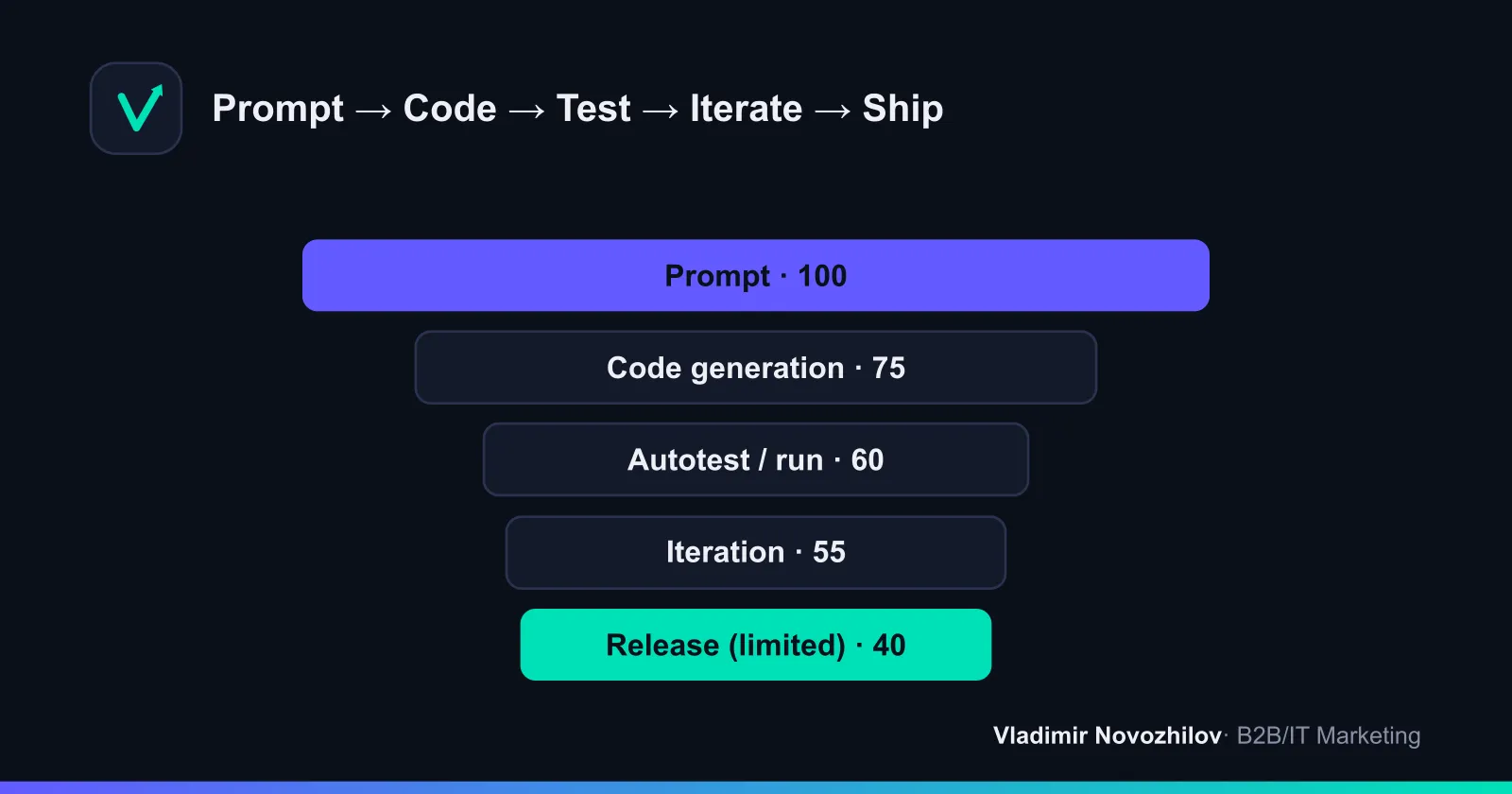
How it works: step‑by‑step cycle (prompt → code → test → iterate)
Briefly on the process: you describe the target result, the model generates an artifact (code/script/config), you verify, add context and repeat until acceptance criteria are met.
Cycle steps:
- Context. Formulate goal, constraints, examples of input/output. Attach DB/UI diagrams and legacy code snippets. Use RAG if necessary.
- Prompt. Give a clear instruction, describe file structure/stack and acceptance criteria.
- Generation. The model produces code/tests/README. In an IDE assistant — commits in batches; in a browser service — a ready app template.
- Run and test. Local run, basic unit tests, fixes. Catch hallucinations and dependency version mismatches early.
- Iterate. Shrink the diff, refine requirements, add edge cases.
- Packaging. Docker, minimal CI, dev/prod configs, run scripts.
Example with a real prompt and result (code + explanation)
Task: build a feedback form (backend API + email notification) in Python FastAPI within one hour.
Example prompt for an LLM/IDE assistant:
You are a senior backend engineer. Generate a minimal service in FastAPI:
- POST /feedback accepts JSON {name, email, message} and validates fields.
- Writes the record to SQLite (table feedbacks) and logs.
- Sends an email (use SMTP with env variables SMTP_HOST, SMTP_USER, SMTP_PASS; for dev — mock).
- Add simple unit‑tests (pytest) and a Dockerfile.
- Versions: Python 3.11, FastAPI 0.111+, SQLModel. Explain how to run locally and in Docker.
Simplified result (fragment main.py):
from fastapi import FastAPI, HTTPException
from pydantic import BaseModel, EmailStr
from sqlmodel import SQLModel, Field, Session, create_engine
import os, smtplib

app = FastAPI()
engine = create_engine("sqlite:///./app.db")

class Feedback(SQLModel, table=True):
    id: int | None = Field(default=None, primary_key=True)
    name: str
    email: str
    message: str

class FeedbackIn(BaseModel):
    name: str
    email: EmailStr
    message: str

@app.on_event("startup")
def on_startup():
    SQLModel.metadata.create_all(engine)

@app.post("/feedback")
def create_feedback(item: FeedbackIn):
    with Session(engine) as s:
        fb = Feedback(**item.dict())
        s.add(fb)
        s.commit()
    try:
        host, user, pwd = os.getenv("SMTP_HOST"), os.getenv("SMTP_USER"), os.getenv("SMTP_PASS")
        if host and user and pwd:
            with smtplib.SMTP(host, 587) as server:
                server.starttls(); server.login(user, pwd)
                server.sendmail(user, item.email, f"Subject:Thanks\n\n{item.message}")
    except Exception:
        pass  # in dev don't fail on email errors
    return {"status":"ok"}
Local run: uvicorn main:app --reload. Tests and Dockerfile are generated by the AI similarly. Then, via iterations, add validation, rate‑limit and CORS.
How it differs from no‑code, low‑code and AI‑assisted development
Key differences from neighboring approaches:
| Approach | What it is | Strengths | Limitations | Who it fits |
|---|---|---|---|---|
| Vibe coding | Code generation from prompts with fast iterations | Fast start, stack flexibility, source control | Risk of hallucinations, requires test discipline | Business for MVPs, internal utilities |
| No‑code | Visual builders without code | Instant assembly of forms/tables, integrations | Blocked on complex logic, vendor‑lock | Ops teams, simple processes |
| Low‑code | Semi‑visual building with extension code | Balance of flexibility and speed | Needs developers | Corporate BPM/integrations |
| AI‑assisted | AI helps write code in IDE | Higher code quality than pure generation | Slower start than vibe coding | Development teams |
| Classical | Full engineering cycle | Predictability, scalability | Expensive and slow to start | Critical systems, high‑load |
Conclusion: for “quick validate and throw away/iterate” — vibe coding fits; for “years ahead with SLO/SLA” — classical/AI‑assisted development is preferable.
Where the method works best: scenarios and limits (MVPs, prototypes, one‑off scripts)
Suitable for:
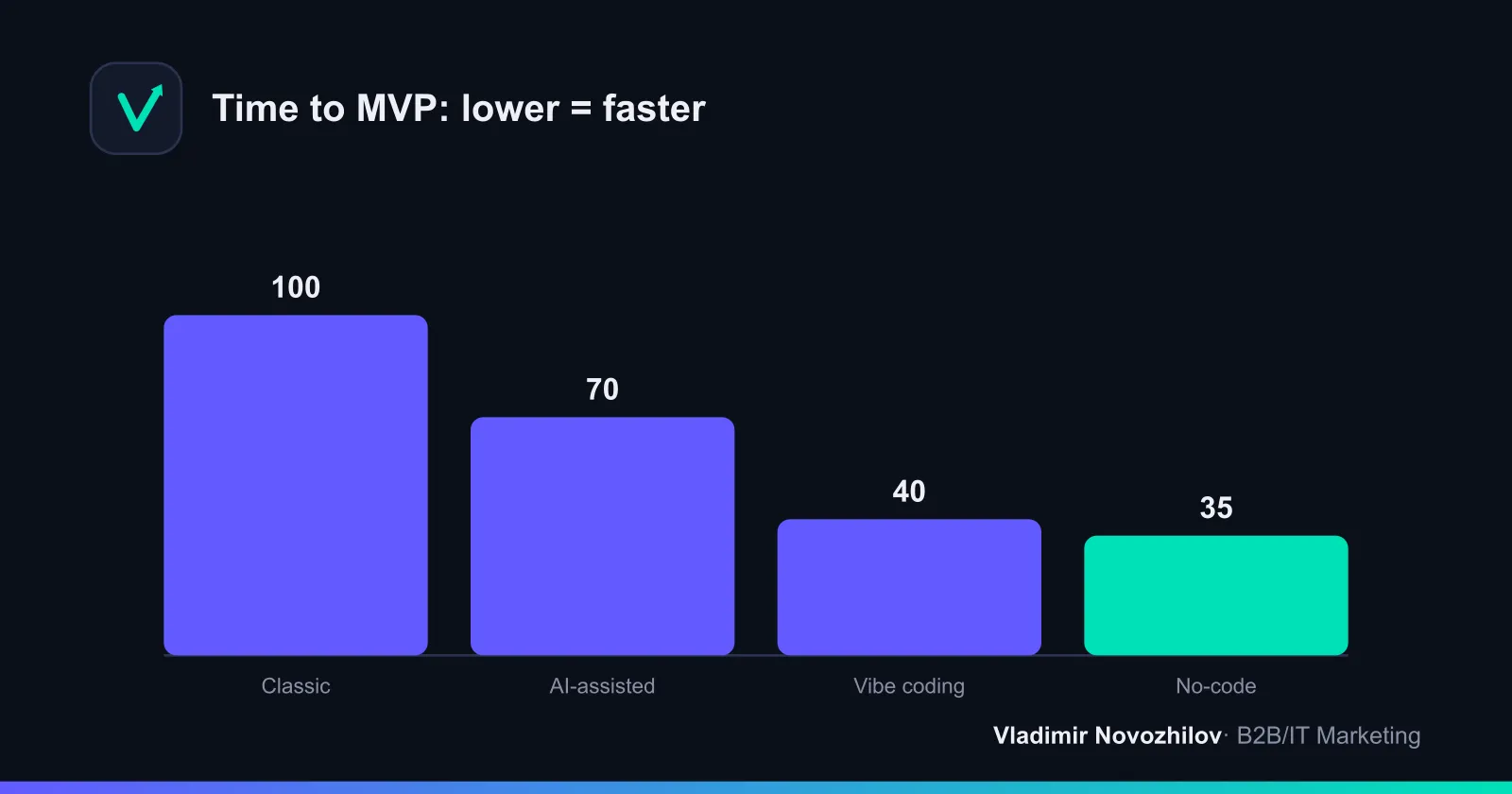
- MVP/PoC to validate a sales channel or a feature hypothesis (time to MVP can shrink 2–3x).
- Internal utilities: parsers, converters, reports, migrations, Telegram bots.
- One‑off scripts and integrations between services.
- Campaign landing pages, calculators, feedback forms.
Limitations:
- Regulated domains (finance, healthcare) and personal data — require deliberate protection and audit.
- High‑load systems, real‑time critical paths, complex distributed transactions.
- Long‑term maintenance without engineers — risk of “magical” code and technical debt.
Risks and security: vulnerabilities, hallucinations, tests and production requirements
Risks here concern code quality, access and compliance.
Technical risks:
- Hallucination and incorrect dependencies. Mitigate: small prompts, example tests, pin versions.
- Narrow context window → lost requirements. Mitigate: concise specs, RAG inclusion of specs.
- Vulnerabilities from “copy‑paste”. Mitigate: SAST/linters, security audit, dependency audit.
- Secret leaks. Mitigate: secrets only in env/secret‑store, ban sending keys in prompts.
Checklist of risks and data protection measures for Russia (FZ‑152, storage, external APIs):
- Classify data: personal data/ trade secret/ public. Personal data under FZ‑152 — only with consents and on agreed platforms.
- Store personal data in Russia or jurisdictions permitted by corporate policy. Document data flows.
- Forbid exporting personal data/secrets to public LLMs. Use local/on‑prem models when working with personal data.
- Check export control of software and cryptography requirements when distributing binaries/encryption.
- Log accesses, enable version and role control. Run periodic security audits.
Production requirements: see the “production readiness” checklist below.
Business impact: ROI, cases and cost savings assessment
This is about reducing “time to value.” Typical effects: −40–70% time to MVP, −30–50% development cost by reducing FTE on boilerplate tasks.
Template to estimate ROI and FTE savings:
- Formula: ROI = (Cost savings − Additional implementation costs) / Additional implementation costs × 100%.
- Cost savings = (Hours classic approach − Hours vibe coding) × blended‑rate of the team + reduced tooling licenses.
- Additional costs = engineer review + tests + security + CI/CD rollout.
Sample calculation (hypothesis):
| Metric | Classical | Vibe coding | Savings |
|---|---|---|---|
| Time to MVP (hours) | 240 | 100 | 140 |
| Blended‑rate (₽/hour) | 4000 | 4000 | — |
| Direct costs (₽) | 960 000 | 400 000 | 560 000 |
| Review/security (₽) | 0 | 120 000 | −120 000 |
| Total savings (₽) | — | — | 440 000 |
| ROI of implementation (%) | — | — | (440 000 / 120 000) × 100% ≈ 367% |
Cases (synthetic but realistic):
- B2B analytics service: parser + log transformer. Result: MVP in 2 weeks instead of 5, −55% sprint budget, pilot conversion 18% → 27%.
- IT outsourcing: internal “brief‑bot” for presales. Result: time to prepare spec reduced from 8 to 3 hours (−62%), win‑rate +6 pp.
- CRM↔BI integration: one‑off ETL scripts and dashboard. Result: ready in 4 days instead of 12, −50% FTE for analysts.
These examples show where the method yields quick returns without critical risk.
Tools in 2026: comparative table (LLMs, IDE assistants, browser platforms)
Below — an overview of tools by class. Availability in Russia as of 2026 may change.
| Class | Tool (example) | Price | Context window | Availability in Russia | Key features |
|---|---|---|---|---|---|
| LLM | Claude (Sonnet), GPT‑4/4o | from $20–30/mo | up to 128k–200k | Usually requires a VPN | Strong reasoning, good instruction following |
| LLM | Gemini | from $20/mo | up to 1M | Often requires a VPN | Large contexts, multimodality |
| LLM | Qwen | from $10–20/mo | 32k–128k | Limited | Price/quality balance, on‑prem options |
| LLM (local) | Llama (via local runtime) | free | 8k–128k | Available | Offline, data control, lower quality/speed |
| IDE assistant | Cursor | $20–40/mo | inherits LLM | Limited | Project generation, auto commits, refactor |
| IDE assistant | GitHub Copilot | $10–19/mo | inherits LLM | Limited | Inline suggestions, chats, test generation |
| IDE assistant | Claude Code | $20–30/mo | up to 200k | Often requires a VPN | Dialog with codebase, batch changes |
| Browser platform | Lovable | from $0 | — | Often requires a VPN | ”Prompt → full‑stack” in minutes |
| Browser platform | Replit | from $0 | — | Often requires a VPN | Hosting + browser IDE |
| Browser platform | Bolt | from $0 | — | Often requires a VPN | Rapid prototypes, UI generation |
Recommendations for choosing tools in Russia (availability, integrations, VPN/localization)
- For personal data and closed projects — local LLMs (Llama) or on‑prem Qwen; store code/data within company contours.
- For rapid MVP without personal data — combine a public LLM (with anonymization) + local run.
- Consider payments: some services require foreign payments. Look for invoiced plans or local alternatives.
- Establish VPN policy and ban sending secrets. For IDE assistants — disable excessive telemetry.
How to start: checklist and ready prompt templates for common tasks
Startup checklist:
- Describe goal, constraints and assumptions (what/why/acceptance).
- Prepare sample input/output and a mini API/DB spec.
- Choose stack and tools (LLM + IDE assistant/browser platform).
- Set up local environment and repo, add basic tests.
- Plan 3–5 vibe coding iterations with control demos.
Ready prompt templates (copy into an LLM/IDE):
- Campaign landing
You are a senior full‑stack. Create a single‑page landing for [product X]:
- Stack: HTML/CSS/Tailwind + Vanilla JS. Responsive.
- Sections: header, benefits, social proof, CTA with form.
- Add lead collection to /api/lead (mock) and basic SEO meta tags.
- Explain how to run locally. Generate README.- Price list parser
You are a data engineer. Write a Python script that downloads XLSX/CSV from a list of URLs, consolidates price lists into a single CSV and validates fields. Add logging, error handling, unit‑tests (pytest) and make tasks.- Feedback form with email (add to landing)
You are a backend dev. Implement POST /feedback with validation (name/email/message), write to SQLite and send email (via env SMTP_...). Protect from spam: rate‑limit and a honeypot field.- Scheduled data cleanup
You are a devops. Create a script to clean temporary files/tables on a schedule with cron/Task Scheduler, logging and a dry‑run mode. Cover critical functions with tests.- Internal knowledge assistant
You are an ML engineer. Prepare a RAG pipeline: index PDFs/Confluence into a vector store, simple search UI and answers with citations. Explain how to run locally.Method to move results to production: tests, reviews, CI/CD, responsibility
“Production readiness” checklist:
- Unit‑tests (70%+ for critical logic), smoke tests, e2e for key scenarios.
- Code review by at least one engineer; style/linters; ban on hardcoded secrets.
- Security audit: SAST/DAST, dependency audit, update policy.
- CI/CD: auto build, test run, containerization (Docker), deploy to staging, manual approval for prod.
- Observability: logging, tracing, alerts; SLO/SLA; rollback plan.
- Docs: README, architecture notes, release checklist, escalation plan.
- Data and legal: FZ‑152 requirements, DPIA if needed, contracts with vendors.
Even if the code is generated by AI, production responsibility remains with the team. It’s discipline, not magic.
Frequently asked questions (FAQ)
Do I need to know how to program to use vibe coding?
Basic skills speed up work and improve review quality. For prototypes, clear task framing and the ability to run code are sufficient.
How does vibe coding differ from no‑code and AI‑assisted development?
No‑code offers faster startup but less flexibility; AI‑assisted yields more predictable code but starts slower. Vibe coding is the middle ground: fast and sufficiently flexible.
Can the method be applied safely in Russia given the legislation?
Yes, with caveats: do not send personal data or secrets to external LLMs, use local models and undergo security audits.
Which tools to choose for the first run?
LLM: Claude, GPT‑4/4o, Gemini, Qwen, Llama. IDE assistants: Cursor, GitHub Copilot, Claude Code. Platforms: Lovable, Replit, Bolt.
How to verify AI code security before production?
Cover with tests, perform code review, run SAST/DAST and logging; verify secret storage and data flows against FZ‑152.
Summary: when to apply the method in a company and an adoption plan
Use vibe coding for fast MVPs, internal tools and one‑off integrations. Avoid critical contours and personal data without local models and security audit. Adoption plan:
- Pick 1–2 low‑risk tasks with a clear “time to MVP” metric.
- Assemble a minimal stack: LLM + IDE assistant, configure environments.
- Run 3–5 iterations, record metrics (hours, quality, bugs, FTE).
- Do a review, add tests, set up CI/CD.
- Fix prompt, security and update standards.
In short: vibe coding is a pragmatic accelerator for development. It wins on speed and cost when combined with engineering discipline and Russia‑specific security requirements.
FAQ
- Do I need to know how to program to work with this approach?
- Basic skills help a lot: you set tasks faster, understand model outputs and perform better reviews. For prototypes, clear task framing and the ability to run code locally are often sufficient.
- How does this method differ from no‑code and AI‑assisted development?
- No‑code starts instantly but is less flexible. AI‑assisted produces more predictable quality but starts slower. Vibe coding sits in the middle: fast, stack‑flexible and with control over source code.
- Can the method be used in Russia while meeting legal requirements?
- Yes, with discipline: do not send personal data or secrets to external LLMs, use local/on‑prem models, document data flows and undergo security audits in line with corporate policies and FZ‑152.
- Which tools should I start with for the first run?
- LLM: Claude, GPT‑4/4o, Gemini, Qwen, Llama. IDE assistants: Cursor, GitHub Copilot, Claude Code. Browser platforms: Lovable, Replit, Bolt — suitable for rapid prototypes.
- How to ensure AI‑generated code is secure before production?
- Cover core logic with tests, perform code review, run SAST/DAST and dependency audits. Verify secret storage and data flows comply with FZ‑152 and internal requirements.